SMC (Smart Money Concepts) and ICT (Inner Circle Trader) are closely related methodologies that both trade institutional order flow but differ in origin and scope. ICT was created by Michael Huddleston and adds time-based analysis such as kill zones and Power of Three, market maker models and defined entry models. SMC is the broader, community-developed framework built on them.
SMC (Smart Money Concepts) and ICT (Inner Circle Trader) are closely related trading methodologies that both focus on institutional order flow, but they differ in origin, scope, and application. ICT was created by Michael Huddleston and emphasizes time-based analysis (kill zones, power of three), specific market maker models, and a defined set of entry models. SMC is the broader community-developed framework that incorporates ICT concepts alongside additional techniques from other traders. In practice, most SMC traders use ICT-originated concepts — the main difference is that SMC is more open-source and adaptable while ICT follows a more rigid, defined system.
Last verified: April 15, 2026 · Side-by-side comparison of SMC and ICT concepts, origins, and applications.
The trading education space is saturated with acronyms, and two of the most common are SMC (Smart Money Concepts) and ICT (Inner Circle Trader). While they share foundational principles, there are meaningful differences in terminology, application, and philosophy.
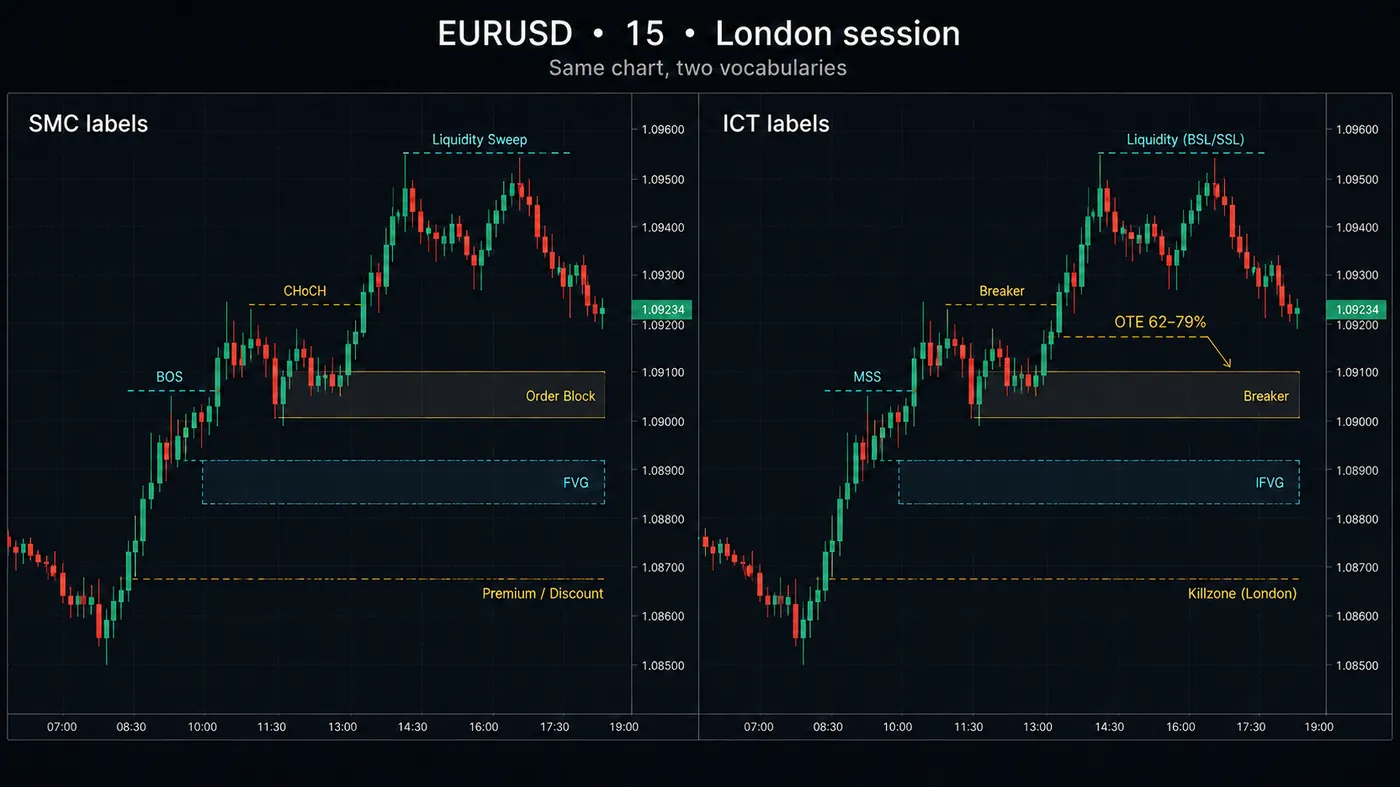
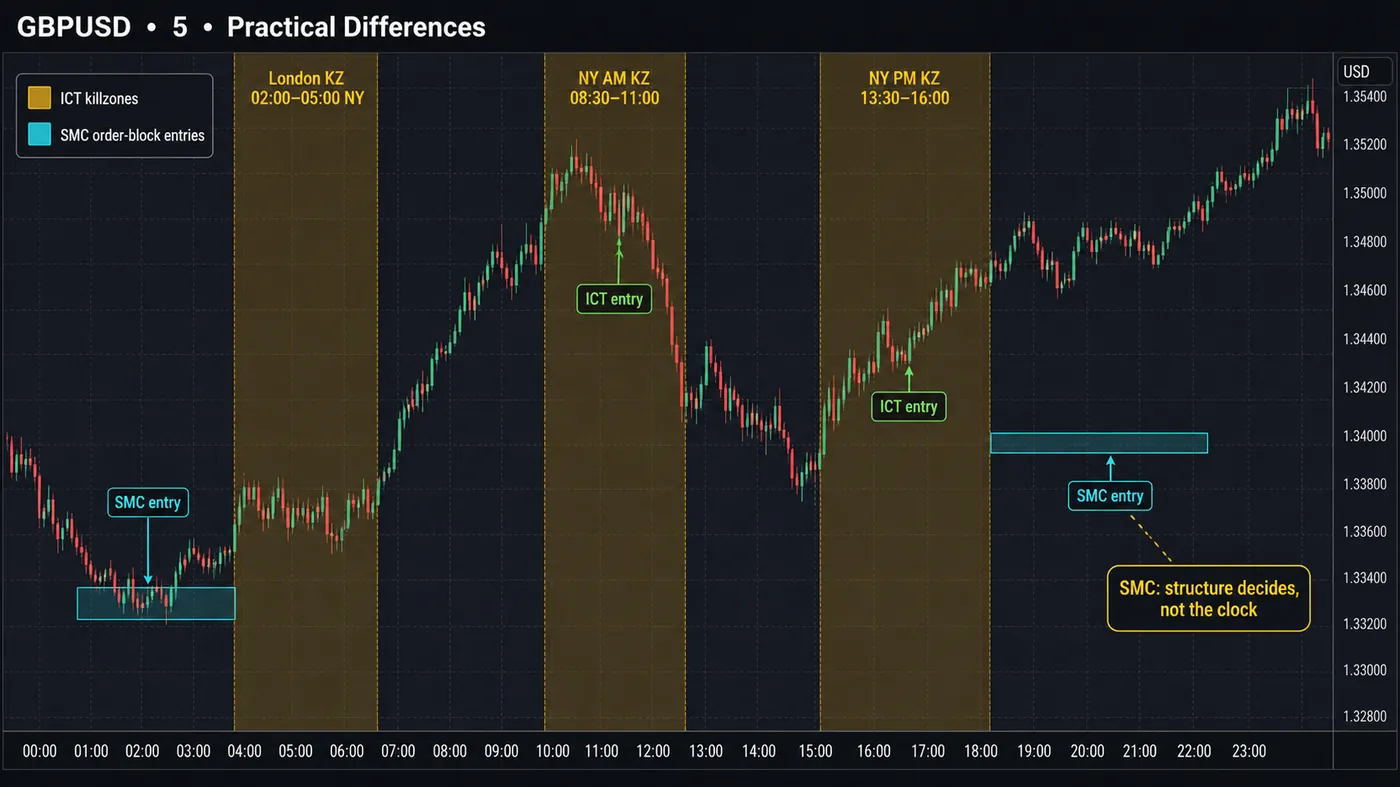
Now the comparison itself — the same London session labelled twice, once in each language.
Indicators that prove themselves in public.
One engine, four precision tools — the Gold (XAU) Scalper, the institutional Gravity Zone, the Zeno momentum Oscillator, and Zeno Stocks for equities.
Where did ICT and SMC come from?
ICT refers specifically to the methodology taught by Michael J. Huddleston, who popularized many institutional trading concepts through his YouTube content and mentorship programs. SMC is a broader umbrella term that encompasses ICT concepts along with adaptations, simplifications, and additions from the wider trading community. Think of ICT as the original framework and SMC as the evolved, community-driven version.
How does ICT terminology differ from SMC?
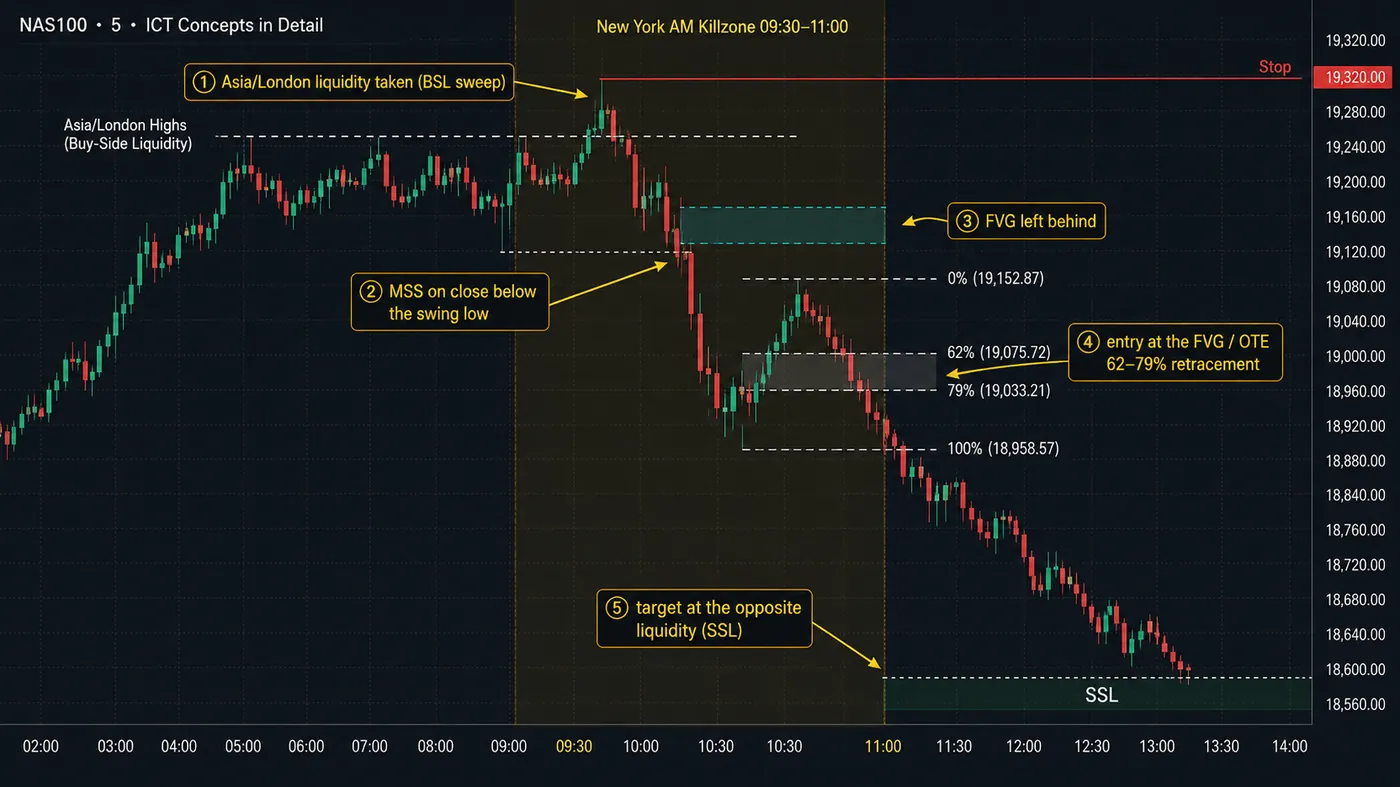
ICT uses specific terms: Optimal Trade Entry (OTE) for the Fibonacci zone between 62-79% retracement, Judas Swing for fake moves at session opens, Killzones for optimal trading windows, and Silver Bullet for specific time-based setups. SMC typically uses simpler equivalents: order blocks, FVGs, liquidity sweeps, and market structure breaks. The concepts are often identical — the labels differ.
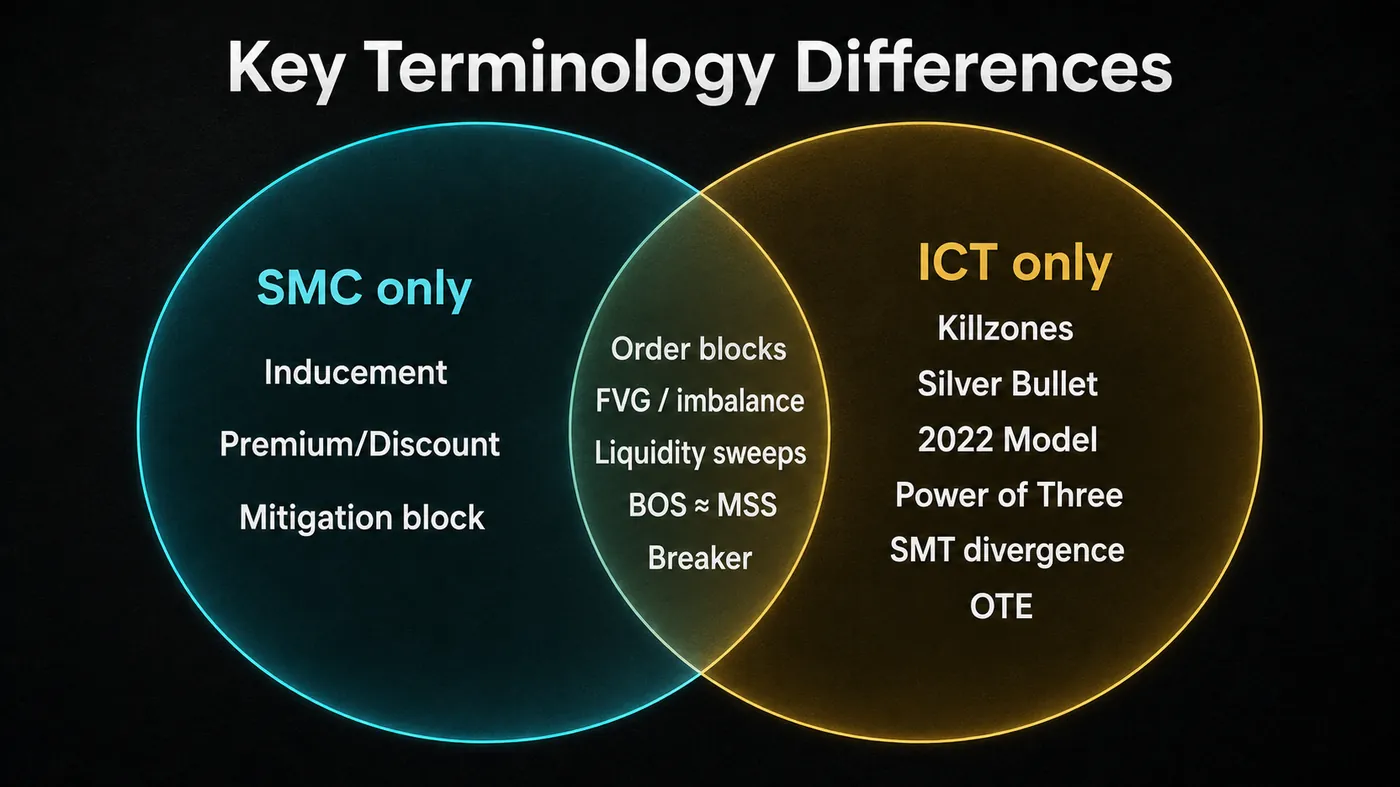
SMC vs ICT terms at a glance
| Concept | SMC label | ICT label |
|---|---|---|
| Structure break | BOS and CHoCH | Market structure shift (MSS) |
| Retracement entry zone | Premium and discount of the range | Optimal Trade Entry, 62–79% Fibonacci |
| Price imbalance | Fair value gap (FVG) | FVG, plus inverse FVG (IFVG) |
| Institutional candle zone | Order block | Order block and breaker block |
| Fake move before the real one | Liquidity sweep and inducement | Judas Swing |
| Timing | Not required; any session | Killzones, Silver Bullet, macros |
| Daily cycle model | Not used | Power of Three |
◆Order blocks, fair value gaps, liquidity sweeps and structure breaks are the shared core; the time-based tools are ICT's own.
How do SMC and ICT differ when you trade them?
Time-based analysis: ICT places heavy emphasis on specific trading times (killzones) and day-of-week patterns. SMC focuses more on structural price action regardless of time. Complexity: ICT is deliberately comprehensive and can take months to learn fully. SMC extracts the highest-value concepts and simplifies them. Backtestability: SMC concepts are generally easier to code and backtest because they rely on objective price structure rather than time-based discretionary elements.

Automate your trades. Let Quantum Algo trade for you.
Every signal executed on your own account — on your account, with the plan you define.
Which Should You Learn?
If you want a complete, detailed framework and are willing to invest significant study time, start with ICT's original content. If you want a streamlined, practical approach that focuses on the highest-edge setups, SMC is more accessible. Many successful traders combine both — using ICT's killzone timing with SMC's structural analysis. Quantum Algo is built on objective, backtestable SMC principles, making it compatible with both approaches.
What are OTE, killzones and Power of Three in ICT?
The Inner Circle Trader (ICT) methodology was developed by Michael J. Huddleston and popularized through a vast library of YouTube content. ICT introduces specific terminology that overlaps with but is not identical to broader SMC concepts. Optimal Trade Entry (OTE) refers to the sweet spot within a retracement — typically the 62–79% Fibonacci zone — where ICT traders look for entries. Killzones are specific time windows (London open, New York open, London close) where ICT identifies the highest-probability setups. The Power of Three (accumulation, manipulation, distribution) describes the three-phase move that occurs within each killzone session.
ICT also emphasizes time-based analysis more heavily than general SMC. Concepts like the True Day Open (midnight EST), the macro time windows (specific minutes within the hour where reversals are more likely), and the silver bullet setup (a specific time-of-day pattern) are unique to ICT and not found in broader SMC frameworks. These time-based elements add precision but also complexity, and they require extensive backtesting on specific session times to validate their effectiveness for your particular market and style.
Is ICT more rule-based than SMC?
The most practical difference between SMC and ICT is the level of prescriptiveness. ICT provides extremely specific rules for almost every aspect of trading: which exact times to trade, which exact Fibonacci levels to use, which exact candle patterns to look for. This prescriptiveness is helpful for beginners who need structure but can become limiting for experienced traders who want to adapt to changing market conditions. SMC, by contrast, provides a broader framework with principles that the trader customizes to their own style, timeframe, and market.
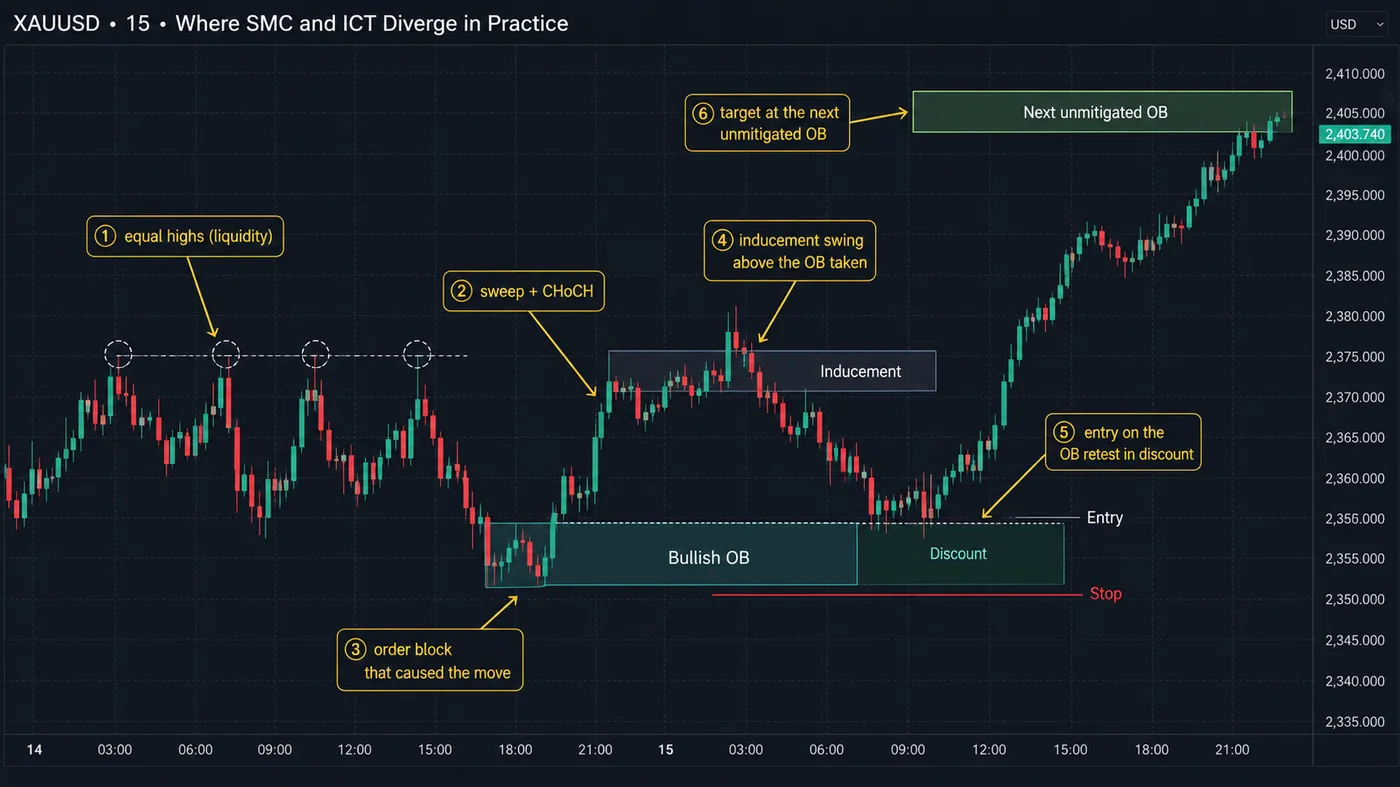
Another divergence is in indicator usage. Pure ICT practitioners tend to use naked charts with no indicators, relying entirely on price action, time, and structural analysis. The broader SMC community is more open to using tools like volume indicators, WaveTrend oscillators, and automated order block detection systems that enhance the core analysis without replacing it. Neither approach is objectively superior — it depends on whether you prefer pure manual analysis or tool-assisted decision-making.
When choosing between ICT and SMC, consider your learning style. If you thrive with rigid rules and step-by-step processes, ICT's prescriptive approach gives you a clear playbook. If you prefer understanding principles and adapting them flexibly, the broader SMC framework gives you more creative freedom. Many successful traders study both approaches and take what works from each, creating a hybrid methodology that suits their personality and market conditions.
How do you test SMC or ICT with a 100-trade challenge?
Whether you choose SMC, ICT, or a hybrid, the ultimate validation is empirical. Commit to a 100-trade challenge where you execute your chosen methodology consistently, without deviation, for 100 consecutive trades. Record every trade in a detailed journal with entry reason, setup type, R:R, and outcome. After 100 trades, calculate your win rate, profit factor, maximum drawdown, and average R:R. These numbers tell you definitively whether your methodology has a statistical edge or whether adjustments are needed.
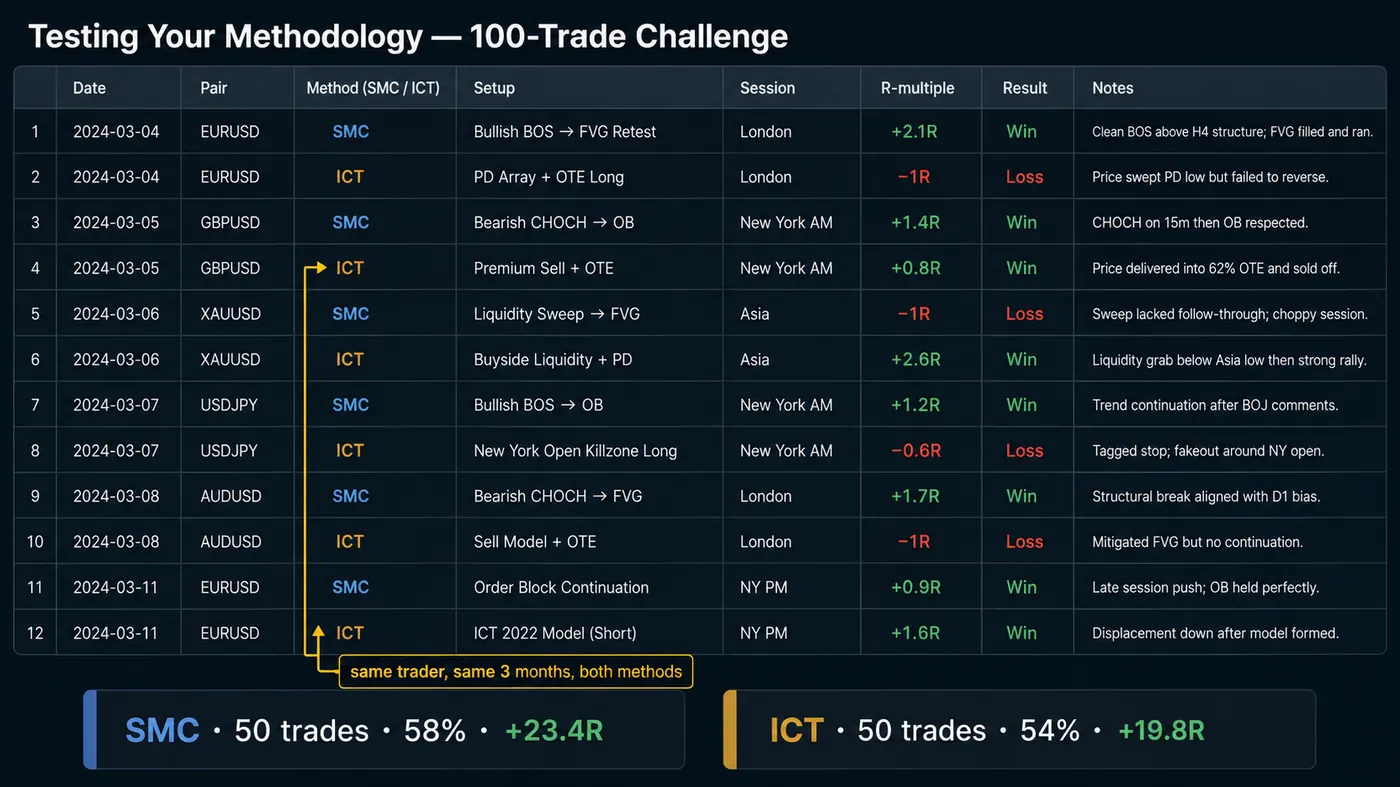
The 100-trade sample is large enough to be statistically meaningful while being achievable within 2–4 months for most active traders. During the challenge, resist the urge to modify your rules — the purpose is to test the methodology as designed, not to optimize mid-test. After the 100 trades, use the data to make evidence-based adjustments: if your win rate is below expectation, examine which setup types underperformed and consider eliminating them. If your R:R is below target, examine whether you are cutting winners too early or targets are set too aggressively. Data-driven refinement based on your own trading results is infinitely more valuable than theoretical discussions about which methodology is "better."
How do the SMC and ICT communities differ?
Both SMC and ICT have large, active online communities — but the cultures are markedly different. The ICT community tends to be more prescriptive and mentor-focused, with many traders following ICT's specific teachings closely. This creates a supportive environment for beginners but can also lead to groupthink where alternative interpretations are discouraged. The broader SMC community is more diverse and decentralized, with multiple educators and approaches coexisting. This diversity means more creative approaches but also more conflicting information that beginners must navigate.
Regardless of which community you engage with, maintain intellectual independence. No educator is right 100% of the time. No methodology works perfectly in all conditions. The community should be a source of ideas, inspiration, and accountability — not a source of trade signals or unquestioned authority. The traders who develop genuine independence of thought, using community input as raw material for their own analysis rather than as instructions to follow blindly, are the ones who achieve long-term success regardless of which specific methodology they use.
Key Takeaways
Understanding SMC and ICT methodology comparison provides a meaningful addition to your trading toolkit, but the real value emerges only when you integrate these concepts with a structured methodology like Smart Money Concepts. No single indicator, pattern, or analytical concept produces consistent profitability in isolation. The concepts covered in this guide become powerful when they serve as one layer in a multi-confirmation system that includes higher-timeframe directional bias, institutional zone identification, and disciplined risk management.
The most important practical step is to backtest before you trade live. Take the concepts from this guide and apply them to historical price data using TradingView's bar replay feature. Walk through at least 50 setups, recording the entry, stop, target, and outcome for each. This backtesting exercise accomplishes two things: it builds your pattern recognition for the specific setup types discussed in this article, and it gives you empirical data on the setup's actual performance — win rate, average R:R, and maximum drawdown — that you can use to make informed decisions about incorporating it into your live trading plan.
Quantum Algo’s free indicators mark order blocks, fair value gaps and liquidity on any chart; Zeno adds confirmed Buy/Sell signals with the stop, TP1 and TP2 drawn — $112.86 $79/mo, cancel anytime. Public calls are timestamped on TradingView, nothing deleted.
Your Next Steps
Now that you have a solid understanding of choosing and committing to a trading methodology, the next step is implementation. This week, dedicate 30 minutes per day to chart markup practice focused specifically on the concepts covered in this guide. Use the daily and 4-hour charts of your primary trading assets. Mark every relevant setup you can find, then track how price interacts with those levels over the next few sessions. This deliberate practice builds the visual pattern recognition that eventually becomes automatic during live trading.
After two weeks of chart markup practice, begin incorporating these setups into your demo trading or your live trading with minimal position sizes. Start with your single highest-conviction setup type and trade only that setup for 30 consecutive trades. After 30 trades, review your journal data: which setups produced the best R:R? Which sessions were most productive? Which assets showed the cleanest patterns? Use this data to refine your approach, eliminate underperforming variants, and concentrate on the specific combinations that your data shows work best for your trading style and market.
Finally, remember that mastery is a journey measured in months and years, not days and weeks. The traders who achieve lasting success are the ones who commit to continuous improvement through consistent practice, honest self-assessment, and evidence-based refinement. Every session of chart markup, every journaled trade, and every weekly review compounds your skill and brings you closer to the level of unconscious competence where profitable trading becomes second nature. Stay patient, stay disciplined, and trust the process.
Whether you choose SMC, ICT, or a hybrid methodology, the single most important decision is to choose and commit. The methodology-hopping trader who switches systems every few weeks never develops the deep competence needed for consistent profitability. The committed trader who masters a single approach — even an imperfect one — develops the pattern recognition, execution discipline, and psychological resilience that produce lasting results. Choose the approach that resonates with your analytical style, commit to it for at least six months, and let the data from your 100-trade challenge guide any future adjustments.
The debate between SMC and ICT is ultimately less important than the decision to commit to deliberate, structured practice with whichever methodology you choose. Both approaches provide genuine edge when applied with discipline and patience. Both fail when applied haphazardly or abandoned prematurely. The methodology is the vehicle; your commitment to mastery is the fuel. Choose the vehicle that feels right, fill it with consistent effort, and trust that the destination — consistent profitability — is achievable for any trader willing to invest the time and discipline required to reach it.
The trading methodology landscape will continue to evolve, but the core institutional principles that both SMC and ICT describe — market structure, order flow, liquidity dynamics, and multi-timeframe alignment — are permanent features of how financial markets operate. Master these principles regardless of which label you apply to them, and you will have a foundation that serves you across any market condition, any asset class, and any evolution of the trading education landscape in the years ahead.