Breaker Block Trading: The Complete Guide to Failed Order Blocks and the Trapped Traders Behind Them
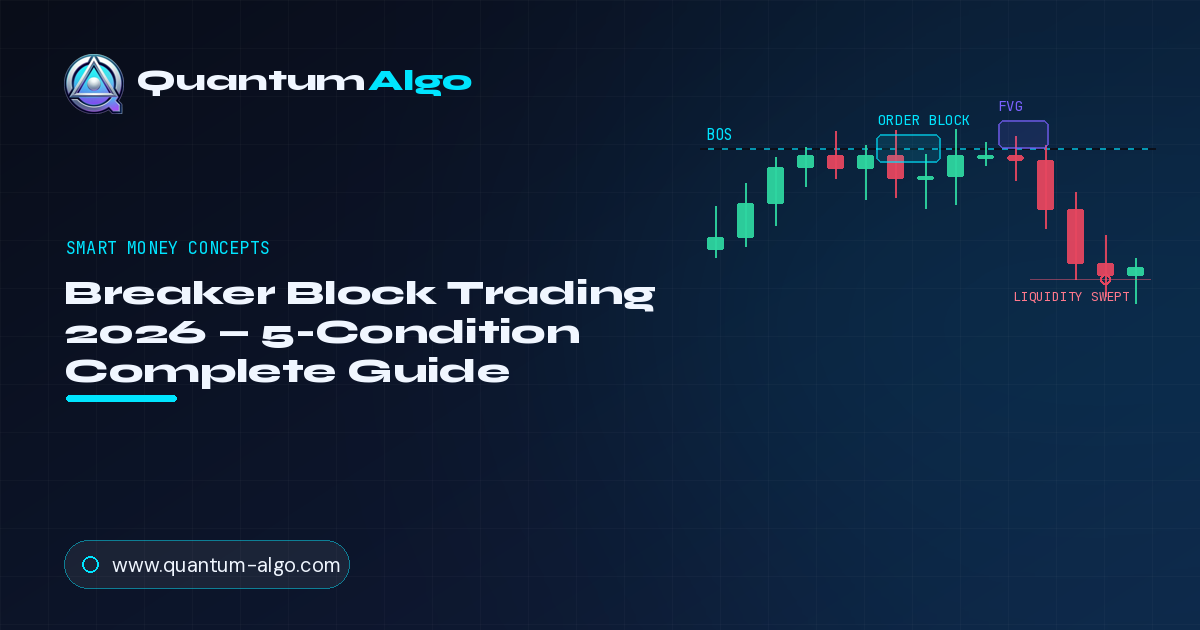
A breaker block is a failed order block: a demand zone that price broke through instead of respecting, which then flips to supply on the retest (or a broken supply zone that flips to demand). It works because the break trapped the traders who bought the original block — their stops and their exits become the sellers when price returns. Identify it with five conditions (a valid original block, a liquidity sweep before the break, displacement through the block, a retest, and higher-timeframe alignment), enter on the retest with the stop beyond the breaker's extreme, and target the liquidity the break was aimed at.
| Signal type | SMC concept (failed order block) |
| Directional bias | Follows the structure break |
| Best context | After a liquidity sweep and break of structure through the original block |
| Confirmation | Retest of the breaker with displacement away from it |
| Invalidation | Full candle close back through the breaker zone |
1. What Is a Breaker Block? The Failed-OB Setup
A breaker block is a failed order block that flips its directional role and becomes resistance instead of support (or support instead of resistance). It is one of the most powerful reversal setups in Smart Money Concepts (SMC) and ICT methodology — and arguably the single highest-probability entry pattern in retail trading.
The mechanic is elegant. An order block forms when institutions accumulate positions before a strong impulse move. When price returns to that order block later and breaks through it with displacement, the order block has "failed" — it no longer holds as support or resistance. But the price level itself does not disappear. It transforms into a breaker block: the failed bullish OB becomes bearish resistance, and the failed bearish OB becomes bullish support.
The reason breaker blocks produce such powerful reactions is psychological and mechanical. Retail traders who entered at the original order block are now trapped in losing positions. When price returns to that broken level for a retest, those trapped traders desperately exit at breakeven, creating selling pressure at what was previously a buying zone.
Combined with institutions who recognize the new structural significance and stack fresh orders at the level, you get a confluence of trapped retail flow and new institutional positioning at the exact same price.
Breaker blocks were popularized by The Inner Circle Trader (ICT) and have become a foundational concept in modern SMC trading. They appear on every timeframe and every liquid market — forex, crypto, indices, futures. The pattern is universal because the underlying mechanic (trapped retail traders + new institutional positioning) repeats across markets and timeframes. Master this single concept and you have one of the most reliable reversal setups in trading.
For context, see our Order Block Trading Guide and Smart Money Concepts Guide.
2. Order Block vs Breaker Block — The Critical Difference
The single most common confusion in SMC trading is between order blocks and breaker blocks. They look similar on a chart but represent completely different setups with opposite trade directions. Understanding the difference is the foundation of trading either correctly.
Order Block (OB): A fresh institutional accumulation zone. Price was last at this level when institutions filled their orders, then displaced away strongly. When price returns for the first time, institutions defend the level (filling remaining orders or adding to positions), creating support or resistance in the same direction as the original move.
Breaker Block (BB): A failed order block where price returned, broke through, and is now retesting from the opposite side. The breaker block flips role — supporting price moves in the opposite direction from the original order block.
The directional flip:
Bullish OB (last bearish candle before bullish displacement that broke structure up) — supports long trades on retest.
Breaker Block from failed Bullish OB — price broke through the bullish OB to the downside.
The level now acts as bearish resistance — supports short trades on retest from below.
Bearish OB (last bullish candle before bearish displacement that broke structure down) — supports short trades on retest.
Breaker Block from failed Bearish OB — price broke through the bearish OB to the upside. The level now acts as bullish support — supports long trades on retest from above.
Why this distinction matters: If you mistake a breaker block for an order block, you will trade in the wrong direction. You see what looks like a bullish OB at $1.0800, enter long expecting support — but the level is actually a breaker block (formerly bearish OB that broke up, now bullish support viewed from the new context). The trade still works because the bias matches.
But the opposite mistake — viewing a broken bullish OB as a "fresh" bullish OB and entering long when the level is now bearish resistance — produces immediate losses.
The lifecycle: Every breaker block was once an order block. The OB formed, was tested or held, then eventually failed. The failure is what creates the breaker block. This means breaker blocks are second-generation structures — they require an existing order block history to form. Fresh charts without prior OB structure will not produce breakers until OBs form and subsequently fail.
3. Bullish vs Bearish Breaker Blocks — Visual Breakdown
Breaker blocks come in two types: bullish breakers (formed from failed bearish order blocks, providing long entries) and bearish breakers (formed from failed bullish order blocks, providing short entries). Understanding the exact formation of each is essential.
Bullish Breaker (long entries): Forms from a failed bearish order block. The sequence: (1) Price rallies. (2) Forms a bearish OB at the top — the last bullish candle before a bearish displacement that breaks structure down. (3) Price drops, then reverses and rallies back up. (4) Rally breaks through the bearish OB with displacement to the upside, invalidating the OB. (5) The price level of the failed bearish OB now becomes bullish support.
When price retraces back to test this level from above, it becomes a long entry zone.
Bearish Breaker (short entries): The mirror image. Forms from a failed bullish order block. The sequence: (1) Price falls. (2) Forms a bullish OB at the bottom. (3) Price rallies, then reverses and falls back down. (4) The decline breaks through the bullish OB to the downside with displacement. (5) The price level of the failed bullish OB now becomes bearish resistance.
When price rallies back to test this level from below, it becomes a short entry zone.
Visually, breaker blocks look like "rotation zones" — areas where price visited multiple times, broke through, and now respects from the opposite direction. The pattern often forms during transition periods between trends, marking the structural turning point where the market shifted from one regime to another. This is why breaker blocks frequently appear at major swing highs and lows on higher timeframes.

Automate your trades. Let Quantum Algo trade for you.
Every signal executed on your own account — 24/7, hands-off.
4. How to Identify a Valid Breaker Block (5 Conditions)
Not every broken level qualifies as a breaker block. To produce reliable reversal setups, the formation must satisfy five strict conditions. This filter is what separates institutional-grade breaker blocks from random support-resistance flips that fail in live markets.
Condition 1 — There was a valid order block at the level previously. The breaker block must be derived from an actual, identifiable order block — the last opposing candle before a displacement that broke structure. If no OB existed at the level, you are looking at a generic S/R flip, not a breaker block. The original OB must have met the standard 4-condition validity test (last opposing candle, engulfing displacement, BOS confirmed, lower-timeframe FVG).
Condition 2 — Price broke through the order block with displacement. A weak, slow drift through the OB does not create a breaker. The break must come with strong impulsive candles — large bodies, minimal wicks, ideally leaving a Fair Value Gap on the lower timeframe. Displacement signals institutional intent to invalidate the previous structure. Without it, the OB might just be temporarily exhausted rather than truly failed.
Condition 3 — A new market structure break (BOS) confirmed the failure. After breaking through the OB, price must continue and break a recent swing high or swing low in the new direction. This is the critical filter that separates a temporary break (where price wicks through the OB and immediately reverses) from a confirmed failure (where the OB is decisively rejected by new structural action).
No new BOS = the OB might still be valid; you do not yet have a breaker.
Condition 4 — Price retraces back to the OB zone for retest. This is the breaker block's activation moment. Without a retest, you have a failed OB but no actionable breaker setup. The retest typically happens within 5-30 candles after the break — fresh breakers (retested within 5-15 candles) are highest quality. Older breakers (50+ candles between break and retest) lose strength as new institutional positioning fades.
Condition 5 — The retest produces a rejection candle. The breaker is only confirmed as a trade setup when price reaches the level and produces visible rejection — an engulfing candle, pinbar, internal BOS on a lower timeframe, or aggressive wick into the zone followed by closing back in the new direction. Entering before rejection means anticipating; entering after rejection means reacting to confirmed institutional defense of the level.
The drawing rule: Once all five conditions are met, mark the breaker block zone as a rectangle covering the body of the original OB candle (open to close) — same drawing as you would have used for the OB itself. The breaker uses the identical price zone; only the direction of the trade changes.
Some traders extend the rectangle to include the wicks for a more conservative zone, but the body provides the cleanest entry trigger.
5. Why Breaker Blocks Work — The Trapped Trader Mechanic
Breaker blocks produce some of the highest win rates in retail trading not because of magic patterns but because of a clear mechanical reason rooted in market microstructure. Understanding the mechanic helps you recognize when a breaker setup is genuinely high-probability versus when it is just a level that broke.
The trapped retail flow: When the original order block formed, retail traders identified it (via indicators, manual analysis, or following SMC educators) and placed positions at the level expecting it to hold. These retail traders entered long at a bullish OB or short at a bearish OB — anticipating the level to act as support or resistance.
When price subsequently broke through the OB with displacement, those retail traders moved from "winning" to "losing." Their stops were below the OB low (for longs) or above the OB high (for shorts). The displacement break triggered many of those stops, but a significant portion of retail traders held on hoping for recovery, refusing to take the loss.
The retest creates the perfect storm: When price returns to the broken level, the trapped retail traders see their losses approaching break-even and rush to exit at zero loss. A trader who entered long at $1.0800 (bullish OB) saw price fall to $1.0750. Now when price returns to $1.0800, that trader's market psychology screams "get out at break-even before it falls again." Their exit creates selling pressure at exactly the level they originally bought.
The new institutional positioning: Simultaneously, institutions who recognized the OB failure now see the level as a key structural turning point. They are not buying at this level anymore (the bullish OB failed) — they are selling. They place fresh limit orders at the broken level, anticipating the retest. When price arrives, these new institutional orders combine with the trapped retail exit flow to produce overwhelming pressure in the new direction.
The math of the setup: Add the trapped retail exit pressure (probably 30-40% of original retail volume at the OB still holding) plus the new institutional positioning (which is typically larger in size than the original OB-defending positions, because institutions are more confident in the failed direction). The combined flow at the breaker retest is often 2-3x the original OB-defending flow.
Why breakers outperform fresh OBs: Fresh order blocks only have institutional flow defending them. Breaker blocks have institutional flow PLUS trapped retail exit flow at the same level. This doubled flow creates the stronger reactions that make breaker blocks one of the highest-edge setups in SMC trading. Backtested data across major pairs shows breaker blocks producing 65-75% win rates versus 55-65% for fresh OBs, when properly identified using the 5-condition filter.
6. How Do You Trade a Breaker Block? Four Proven Strategies
Strategy 1: The Fresh Breaker Retest (Beginner)
The cleanest entry. Identify a recently failed OB (within last 5-15 candles on 1H or 4H). Wait for price to return to the broken zone for the first time. Look for a lower-timeframe rejection candle (engulfing or pinbar on the 15M). Enter on the close of the rejection candle. Stop-loss 10-20 pips beyond the breaker boundary. Target the previous swing high or low in the new direction.
Expected win rate: 65-75% when the 5-condition filter is properly applied. The combination of fresh institutional positioning and trapped retail flow produces high-probability reactions on the first retest.
Strategy 2: The Breaker + FVG Confluence (Intermediate)
Identify a breaker block on the 1H chart. Drop to the 15M and look for a Fair Value Gap that overlaps with the breaker zone (formed during the displacement break that invalidated the original OB). When price returns to the overlap zone, you have BOTH the breaker mechanic AND the unfilled FVG creating compressed reaction pressure.
This setup produces tighter entries (because the FVG narrows the breaker zone) with wider targets (because the institutional defense is stronger). Expected R:R: 3:1 to 5:1. See our FVG Guide for confluence mechanics.
Strategy 3: The Mitigation Block Variant (Intermediate)
A mitigation block is a special breaker block variant where the failed OB never gets fully "mitigated" (tested) before failing. The sequence: OB forms → price moves slightly away → returns and wicks into the OB without closing inside → reverses back in the original direction. The wick-only test failed to mitigate institutional orders.
When price returns to this mitigation block, it produces even stronger reactions than standard breakers because the original OB orders are still partially active in addition to the trapped flow.
Trade mitigation blocks identical to standard breakers but expect higher win rates (70-80%) and tighter, more aggressive reactions. Watch for mitigation blocks on the 4H and Daily timeframes — they are most reliable on higher timeframes where institutional defense is strongest.
Strategy 4: The Multi-Timeframe Nested Breaker (Advanced)
Identify a daily or 4H breaker block. Drop to the 15M and find a smaller breaker block nested inside the higher-timeframe breaker zone (often forming during the lower-timeframe retest of the HTF breaker). The LTF breaker gives you precision entry while the HTF breaker provides the directional bias and wide target.
Expected R:R: 4:1 to 8:1. The tight LTF stop combined with the wide HTF move potential produces the best risk-to-reward ratios in SMC trading. This is the strategy used by professional discretionary traders for major positions.
7. Common Breaker Block Trading Mistakes
Mistake 1: Confusing breaker blocks with fresh order blocks. The most common error. A trader sees a candle that looks like an OB at a recent low, marks it as a bullish OB, and enters long expecting support — but the level is actually a bearish breaker block (formerly bullish OB that failed). Always verify whether the level was previously broken before deciding direction.
Mistake 2: Trading breakers without BOS confirmation. Just because price wicked through an OB does not mean the OB has failed. A wick into the OB without closing inside, followed by a return in the original direction, is mitigation — not failure. Without a new BOS confirming the failure, the OB might still be valid.
Mistake 3: Trading old, stale breakers. Breakers retested 50+ candles after the break have lost most of their institutional defense. The trapped retail traders have either exited (taking the loss) or had their stops triggered. The fresh institutional positioning has been absorbed by other flow. Stale breakers produce weak reactions or fail entirely. Focus on breakers retested within 5-30 candles.
Mistake 4: Stops inside the breaker zone. Placing stops just beyond the breaker body without accounting for the wick range gets you wiped out by normal volatility. Use the wick extreme as your stop boundary, not the body. Add 0.5 ATR buffer beyond the wick for breathing room.
Mistake 5: Ignoring higher timeframe bias. A bullish breaker on the 15M chart against a strongly bearish 4H trend is fighting institutional flow. Higher timeframe trend bias overrides lower timeframe setups. Always check the next 2 timeframes up before taking a breaker trade.
Mistake 6: Not waiting for rejection confirmation. Entering at the edge of the breaker zone before any rejection candle forms means anticipating the reversal. This catches you in 30-40% of cases where price wicks through the breaker and continues. Waiting for the rejection candle close (engulfing, pinbar, internal BOS) catches you only after institutional defense is confirmed.
8. Test Your Knowledge
Seven questions on breaker block trading.
9. Automate Breaker Block Detection
Manually tracking every order block to detect when one fails and becomes a breaker takes hours per chart across multiple pairs and timeframes. This is exactly what algorithmic detection does better than manual analysis.
Frequently Asked Questions
A breaker block is the price level of a failed order block — the level that previously acted as support or resistance flips role and now operates in the opposite direction. Bullish breakers form from failed bearish OBs (now act as support); bearish breakers form from failed bullish OBs (now act as resistance).
An order block is a fresh institutional accumulation zone — when retested, it supports trades in the same direction as the original move. A breaker block is a failed OB that flips direction — when retested, it supports trades in the opposite direction. The price level is the same; the trade direction is opposite.
Check 5 conditions: (1) there was a valid order block at the level, (2) price broke through with displacement, (3) a new Break of Structure confirmed the failure, (4) price retraced back for retest, (5) a rejection candle forms at the level. All five must align for a confirmed breaker setup.
Two mechanics combine: trapped retail traders who entered at the original order block now rush to exit at break-even when price returns to the broken level, AND institutions place fresh orders at the level in the new direction. The combined flow creates strong reactions, producing 65-75% win rates on properly identified breakers.
A mitigation block is a breaker block variant where the original OB never gets fully tested before failing — price wicks into the zone without closing inside, then reverses back. The unmitigated institutional orders combined with trapped retail flow create even stronger reactions than standard breakers, producing 70-80% win rates.
4H and Daily produce the strongest, most reliable breakers because institutional positioning is heaviest on higher timeframes. Drop to 15M or 5M for entry confirmation. Avoid breakers below 15M as they often represent noise rather than institutional structure shifts.
Fresh breakers (retested within 5-15 candles after the OB failure) are highest quality. Breakers tested 30-50 candles after the break weaken significantly. Beyond 50 candles, most institutional positioning and trapped retail flow has been absorbed — the level loses its breaker characteristics and reverts to generic S/R.
Yes. Breaker blocks work on every liquid market — forex, crypto, indices, gold, futures. The underlying mechanic (trapped retail flow plus new institutional positioning) is universal across markets with significant institutional participation. The 5-condition validation framework applies identically across asset classes.
References & Related Guides
More in this topic
- Order Blocks with Volume — Free Order Block Indicator for TradingView (Volume-Graded Zones, Mitigation, Breakers)
- BOS & CHoCH: Complete Market Structure Guide 2026
- Displacement Trading 2026 — SMC Institutional Conviction Guide
- Fair Value Gaps (FVG): Complete Trading Guide 2026
- ICT Silver Bullet Strategy: The Complete Guide (2026)
- ICT Trading Strategy: Complete Interactive Guide 2026
- Is ICT and SMC the Same? Differences Explained (2026)
- Liquidity Sweep Trading: Stop Hunts Explained (2026 Guide)
- Liquidity Trading Guide 2026 — Raids & Kill Zones
- Order Blocks Trading: Complete 2026 Guide
- Order Flow Trading 2026 — Read the Footprint of Institutions
- Smart Money Concepts (SMC): Ultimate Trading Guide 2026
- What Is a Market Structure Shift (MSS) in Trading? 2026
Core reading
For a focused comparison, read the BPR and breaker structure before applying the setup.
For a focused comparison, read the ICT Unicorn breaker component before applying the setup.