Optimal Trade Entry
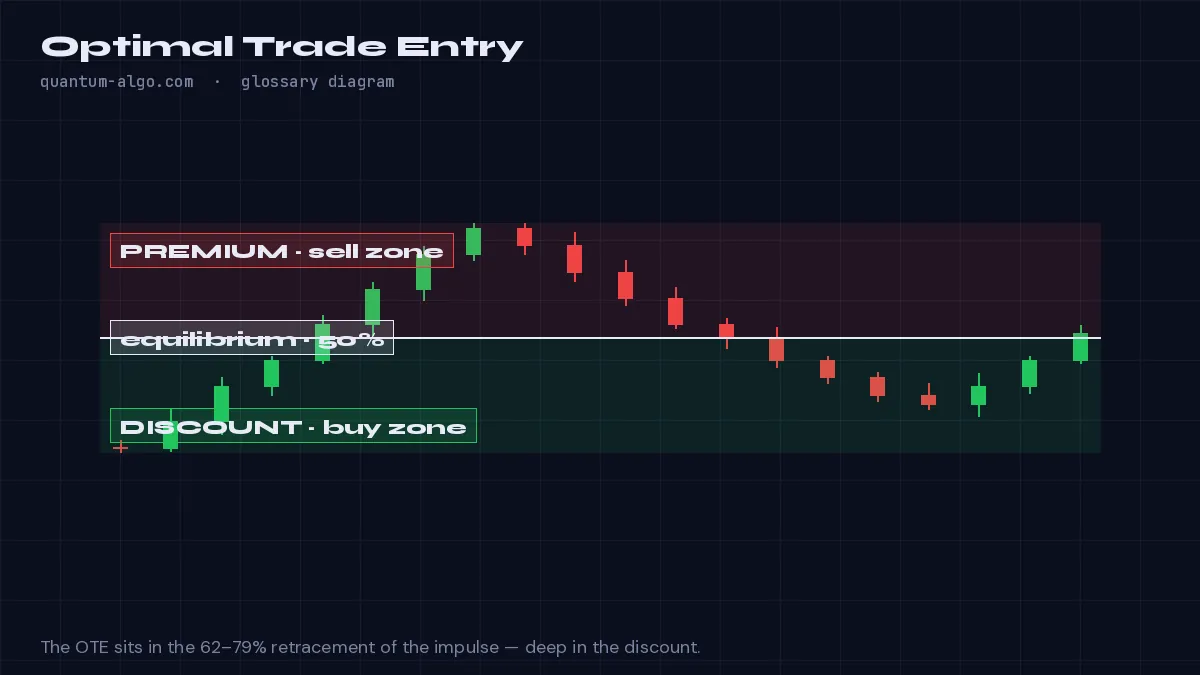
Optimal trade entry is the Fibonacci retracement zone between 62% and 79% of an impulsive move. ICT methodology treats it as the best entry area inside an order block or fair value gap, with 70.5% as the sweet spot. Traders draw the Fibonacci over the impulse, enter inside the zone after a lower-timeframe CHoCH, and stop beyond the 79% level.
◆Full guide: Optimal Trade Entry: The OTE Zone, Sweet Spot and Silver Bullet
What it means
The Optimal Trade Entry (OTE) is an ICT-specific concept defining the Fibonacci retracement zone between 62% and 79% of an impulsive move as the highest-probability entry zone within a valid order block or Fair Value Gap. The 70.5% level (sometimes called the 'sweet spot') is the most-watched single line within the OTE zone.
The logic combines two probability factors. First, the 61.8%–78.6% Fibonacci range is statistically where most trend retracements stall before continuation. Second, this zone within a valid OB or FVG carries the institutional confluence that gives the entry edge. The intersection — Fibonacci-retracement + SMC point of interest — is the OTE.
Standard OTE execution: identify an impulsive leg with displacement, draw Fibonacci from the swing low to the swing high (for bullish trades), wait for price to retrace into the 62%–79% zone, and confirm with a CHoCH on a lower timeframe before entering. Stop-loss goes beyond the 79% level (or beyond the swept liquidity that started the move). Take-profit at 1:2 or higher R:R.
OTE is not a magic number. The probability advantage is modest (3–5 percentage points over random retracement entries), but it is real and consistent across markets. The concept's main practical value is providing a precise framework for entry timing rather than vague 'wait for pullback' instructions.
How to identify it on a chart
- Draw Fibonacci from the swing low to the swing high of the impulse (for longs).
- The 62–79% retracement band is the OTE.
- Enter inside it, ideally where it overlaps an order block or FVG, stop below the swing low.
Worked example
An impulse from 1,800 to 1,900 gives an OTE of 1,821–1,838. Price returns to 1,830 where a 1-hour order block sits; the long targets the high with a stop at 1,795.
See it on the chart, read it in depth
Frequently asked questions
Is OTE the same as the Fibonacci 'golden pocket'?
Roughly. The golden pocket is typically defined as 61.8%–65% (a tighter zone), while OTE is 62%–79% (broader). Many traders use the terms interchangeably and focus on the 70.5% level as the central anchor of both.
Should OTE be used alone or with confluence?
OTE alone is mediocre. OTE within a valid order block or FVG is high-probability. The Fibonacci is the timing tool; the OB/FVG is the structural anchor. Without the SMC confluence, OTE is just a Fibonacci retracement and behaves like every other generic Fib trade.
Does OTE work on lower timeframes?
Less reliably. Lower timeframes are noisier and the difference between entering at 62% versus 79% is often a few pips. OTE works best on 1H and above where the retracement zone is wide enough to give meaningful precision.
Related terms
See Optimal Trade Entry on your TradingView chart
Zeno reads Smart Money structure across timeframes and prints the entry, stop and targets — with a public record of every posted trade. The free indicators draw the concepts this page defines.