Judas Swing
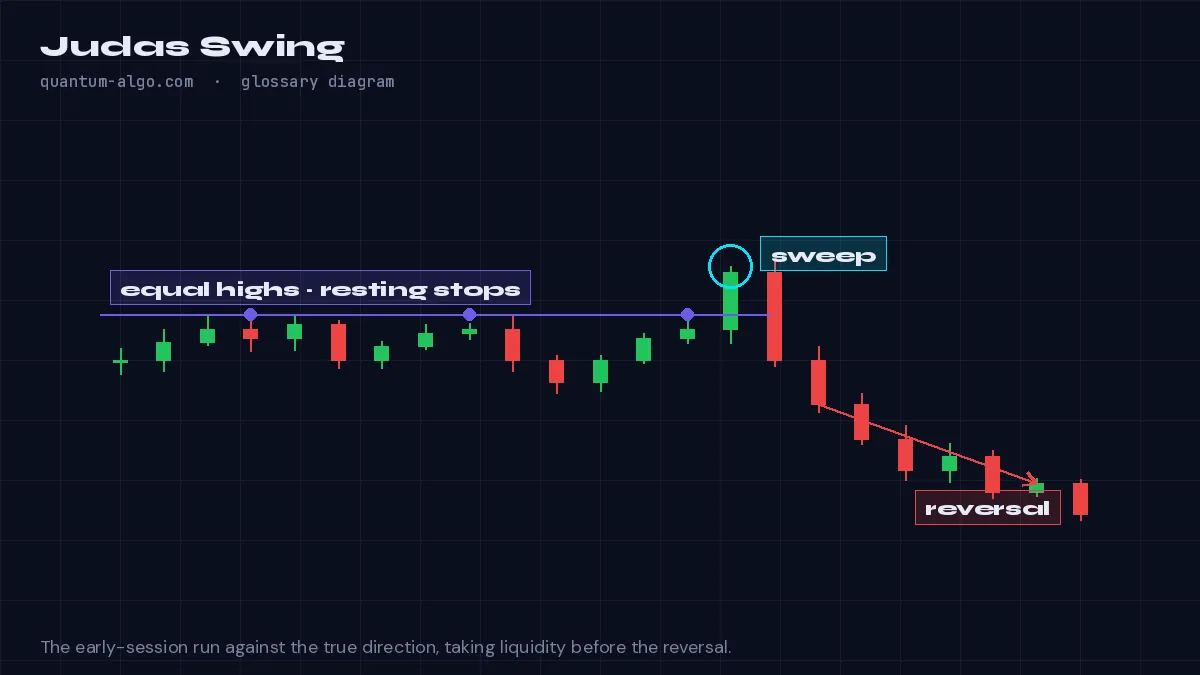
A Judas swing is a deliberate fake move at the start of a trading session, typically London Open. It sweeps the Asian range before reversing in the real direction. Traders avoid the first move of the session and wait 60–120 minutes for the swing to complete. They then enter on the lower-timeframe CHoCH in the true institutional direction.
◆Full guide: ICT Trading Strategy: The Complete Inner Circle Trader Guide
What it means
The Judas Swing is an ICT term for the fake move that often occurs at the start of the London or New York session, designed to harvest retail liquidity before the real institutional trend begins. The name reflects its character: the move 'betrays' traders who enter the initial direction, then reverses to deliver the actual move in the opposite direction.
The classic Judas Swing pattern: the Asian session prints a tight range with clear highs and lows. London opens, and within the first 1–3 hours, price aggressively breaks one side of the Asian range — sweeping the liquidity above (or below) — before reversing sharply and trending the opposite direction for the rest of London and New York hours.
Judas Swings are a specific case of the broader inducement concept, applied at session-open timing. They are most reliable on EURUSD, GBPUSD, and gold during London Open, and on Nasdaq, S&P, and DXY during New York Open. The pattern is less reliable on Bitcoin and crypto majors because crypto runs 24/7 without the same session-anchored institutional behavior.
Practical defense: do not enter the first move of the London or New York session unless you have explicit higher-timeframe confluence. Wait for the swing to complete (typically 60–120 minutes after session open), watch for the reversal CHoCH on the lower timeframe, and enter on the actual institutional direction.
How to identify it on a chart
- At the London or New York open, price moves decisively in one direction.
- It runs a prior high or low — the Asian range or the previous day's extreme.
- The move reverses with displacement; the true session direction is the opposite of the Judas move.
Worked example
At 08:00 UTC, GBPUSD rallies 25 pips through the Asian high, then a bearish displacement candle closes back inside the range. The rally was the Judas swing; the session trends down from there.
See it on the chart, read it in depth
Frequently asked questions
How do I identify a Judas Swing in real time?
Watch for the first aggressive break of the Asian-session range (high or low) within the first 90 minutes of London Open. If that break stalls and produces a CHoCH on a lower timeframe within 1–3 hours, it was likely a Judas Swing and the real direction is the opposite.
Does the Judas Swing happen every day?
No, it occurs roughly 60–70% of trading days for EURUSD/GBPUSD. Some days London opens with a clean directional move that simply continues. The Judas pattern is a probability, not a certainty.
Can I trade the Judas Swing itself?
Aggressively yes — but it requires real-time experience. Most discretionary traders prefer to wait for the swing to complete and trade the reversal, which is higher probability and lower stress than fading the initial move.
Related terms
See Judas Swing on your TradingView chart
Zeno reads Smart Money structure across timeframes and prints the entry, stop and targets — with a public record of every posted trade. The free indicators draw the concepts this page defines.