Break of Structure & CHoCH: The Complete Guide to Market Structure Shifts
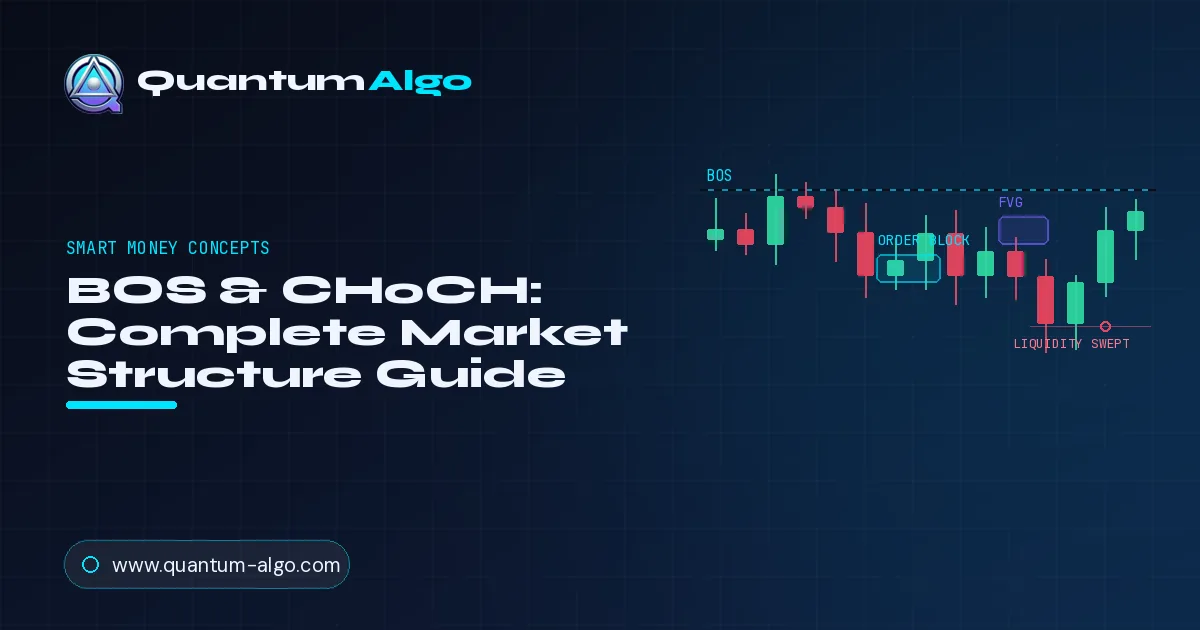
A Break of Structure (BOS) is price breaking a swing high in an uptrend or a swing low in a downtrend, confirming continuation. A Change of Character (CHoCH) is the first break against the trend, below the last higher low or above the last lower high, signaling possible reversal. CHoCH is the alert; a new-direction BOS is the confirmation.
What Is a Break of Structure (BOS)?
Break of Structure (BOS) and Change of Character (CHoCH) are the two most important market structure signals in Smart Money Concepts. BOS occurs when price breaks a swing high in an uptrend or swing low in a downtrend, confirming trend continuation. CHoCH occurs when price breaks structure in the opposite direction — a swing low break in an uptrend or swing high break in a downtrend — signaling a potential trend reversal.
BOS is used to identify continuation trade setups, while CHoCH signals the beginning of a new trend direction and the most aggressive entry opportunities.
Last verified: April 15, 2026
A Break of Structure is the most fundamental signal in all of price action trading. It occurs when price breaks the most recent swing high (in an uptrend) or the most recent swing low (in a downtrend), confirming that the prevailing trend is continuing. Put simply: BOS = trend continuation.
In an uptrend, price creates a pattern of higher highs (HH) and higher lows (HL). Each time price breaks above the previous swing high and closes beyond it, that is a bullish BOS. It tells you that buyers remain in control and have pushed price to a new structural high. The trend is intact. In a downtrend, the mirror applies: price creates lower lows (LL) and lower highs (LH).
Each time price closes below the previous swing low, that is a bearish BOS — sellers remain dominant.
BOS is the backbone of every Smart Money Concepts strategy. Before you look for order blocks, fair value gaps, or liquidity sweeps, you first need to know which direction the market is moving. BOS tells you that direction. Without it, every other tool is a coin flip.
What Is a Change of Character (CHoCH)?
If BOS is the market saying "everything is fine," CHoCH is the market whispering "something just changed." A Change of Character occurs when price breaks a key structural level against the prevailing trend. It is the earliest warning signal that a trend reversal may be beginning.
In an uptrend, CHoCH happens when price breaks below the most recent higher low. This is the first crack in bullish structure — the first time sellers have pushed through a level that was supposed to hold. In a downtrend, CHoCH occurs when price breaks above the most recent lower high — the first sign that buyers are gaining control.
CHoCH does not guarantee a reversal. It is a probability shift. Before CHoCH, the trend had a >50% chance of continuing. After CHoCH, the probability flips — the old trend now has a higher chance of reversing. Smart money traders use CHoCH as a trigger to start looking for reversal setups rather than trend-continuation plays.
How do you tell a BOS from a CHoCH?
These two concepts are the most confused in all of SMC trading. Memorize this table and you will never mix them up again:
| Criteria | BOS (Break of Structure) | CHoCH (Change of Character) |
|---|---|---|
| Direction | WITH the trend | AGAINST the trend |
| Signal | Trend continuation | Potential trend reversal |
| In uptrend | New higher high breaks prev. HH | Price breaks below the last HL |
| In downtrend | New lower low breaks prev. LL | Price breaks above the last LH |
| Confidence level | High — confirms existing bias | Medium — early warning, needs confirmation |
| Trade action | Continue trading in trend direction | Start looking for reversal entries |
| Best confluence | Order blocks + FVGs in trend direction | Liquidity sweep + OB/FVG at CHoCH level |
The simplest way to remember: BOS says "keep going." CHoCH says "something changed." Most traders over-complicate this. If price breaks a swing point in the direction of the current trend, that is BOS. If it breaks a swing point against the current trend, that is CHoCH. Everything else is nuance.
What are the 4 types of structural shifts?
Not all BOS and CHoCH events are equal. Understanding the four structural categories helps you prioritize which signals matter most.
Bullish BOS
Price breaks above the previous swing high in an uptrend. This is the most common structural event — it simply confirms that the bullish trend is continuing. Each bullish BOS is a green light to look for long entries on pullbacks to order blocks and fair value gaps.
Bearish BOS
Price breaks below the previous swing low in a downtrend. Confirms sellers remain in control. Each bearish BOS signals continuation of the downtrend — look for short entries at order blocks and FVGs above the current price, during pullbacks.
Bullish CHoCH
Price breaks above the most recent lower high during a downtrend. This is the first signal that sellers may be losing control. The downtrend is no longer confirmed. Watch for a subsequent bullish BOS to confirm the reversal before entering aggressive long positions.
Bearish CHoCH
Price breaks below the most recent higher low during an uptrend. This is the first crack in bullish structure. The uptrend is no longer confirmed. The highest-probability play after a bearish CHoCH is to wait for a liquidity sweep + bearish order block for short entries.
How is internal structure different from external structure?
External structure refers to the major swing highs and lows that define the overall trend — the "macro" structural points visible on higher timeframes. When external structure breaks, it signals a significant shift in market direction that can persist for days or weeks.
Internal structure refers to the minor swing points that form within pullbacks and consolidations — the "micro" movements inside a larger trend leg. Internal BOS happens frequently and is useful for timing entries, but it does not override external structure.
The relationship is hierarchical: external structure always takes priority. An internal bullish BOS inside an externally bearish trend is a pullback, not a reversal. Only trade internal structure when it aligns with external structure — this single principle eliminates most of your losing trades.
How do you validate a BOS or CHoCH?
Not every swing-point break is a valid structural shift. Use these four rules to filter false signals:
Rule 1: Did a candle body close beyond the swing point?
A valid BOS or CHoCH requires a candle body close beyond the swing point — not just a wick. Wick-only breaks are almost always liquidity sweeps, not structural breaks. When price wicks through a level but closes back inside, it signals that the level was raided for liquidity but is still being defended. Wait for a body close before labeling any move as BOS or CHoCH.
Rule 2: Did displacement follow the break?
After the break, there should be strong momentum candles moving away from the broken level. If price breaks a swing high but then immediately stalls or reverses, the "BOS" lacks conviction. True institutional structural breaks are followed by displacement — large-bodied candles with small wicks indicating urgency. No displacement = low-confidence break.
Rule 3: Does the higher timeframe agree with the break?
A BOS on the 5-minute chart means nothing if the 4-hour structure says the opposite. Higher timeframes always override lower timeframes. Before validating any BOS or CHoCH, check one timeframe higher. If your signal aligns with the HTF structure, it is high probability. If it contradicts HTF structure, it is a counter-trend trap waiting to happen.
Rule 4: Was liquidity swept before the break?
The best structural breaks occur after liquidity has been swept. If price sweeps sell-side liquidity (takes out stops below a low), then produces a bullish CHoCH — that is an exceptionally high-probability reversal signal. The sweep provides institutions the liquidity they need; the CHoCH confirms they are deploying it in the new direction. BOS/CHoCH without a preceding liquidity event is lower probability.
Interactive: Structure Shift Simulator
Test your understanding of BOS vs CHoCH with these market scenarios. Read each scenario and identify the correct structural event.
◆ Scenario 1 of 4
How do you trade BOS and CHoCH across timeframes?
The most profitable BOS/CHoCH trading strategy uses three timeframes working together. Each timeframe serves a specific purpose in the workflow.
Step 1: Establish Higher-Timeframe Bias (Daily / 4H)
Open the Daily or 4H chart and map the market structure. Is price making higher highs and higher lows (bullish)? Or lower highs and lower lows (bearish)? This determines your only allowed trade direction. If Daily structure is bullish, you only look for longs. Period. Mark the most recent BOS levels — these are your structural "lines in the sand." Also identify any CHoCH that might signal a pending reversal.
If a Daily CHoCH has occurred, reduce position sizes and tighten stops until a new BOS confirms the new direction.
Which 6 market structure mistakes should you avoid?
Mistake #1: Confusing Wick Breaks with BOS
A wick piercing through a swing point is not a BOS — it is usually a liquidity sweep. If the candle body does not close beyond the level, the structure is still intact. Fix: Only count body closes as valid structural breaks.
Mistake #2: Trading LTF Structure Against HTF Direction
A 5-minute bullish BOS inside a daily downtrend is a pullback, not a trend change. Fix: Always check one timeframe higher. If your LTF signal contradicts HTF structure, it is a trap.
Mistake #3: Labeling Every Move as BOS or CHoCH
Not every swing point break qualifies. Minor fluctuations in price — especially on very low timeframes — create "noise" structure that has no institutional significance. Fix: Use clearly defined swing points. If you need to squint to see the structure, it is not valid structure.
Mistake #4: Entering Immediately After CHoCH
CHoCH is an alert, not an entry signal. Entering the moment you see CHoCH means entering during the momentum of the reversal move — often at the worst possible price. Fix: After CHoCH, wait for a pullback to an order block or FVG before entering. The CHoCH tells you direction; the pullback gives you a price.
Mistake #5: Ignoring the Liquidity Context
A BOS that occurs without any preceding liquidity sweep is lower probability than one that follows a sweep. Fix: Check whether liquidity was swept before the structural break. Sweep + BOS/CHoCH = high confidence. BOS/CHoCH alone = moderate confidence.
Mistake #6: Not Distinguishing Internal from External Structure
Trading every internal BOS as if it were an external structural shift leads to overtrading and inconsistency. Fix: Clearly separate your external and internal structural levels. Use external for bias, internal for entry timing. Never trade internal structure against external direction.
Automating BOS/CHoCH Detection on TradingView
Manually mapping market structure across multiple assets and timeframes is one of the most time-consuming parts of SMC trading. Quantum Algo automates the entire process on TradingView.
Real-time detection — identifies BOS and CHoCH as they form, distinguishing between body closes and wick-only breaks. Multi-timeframe panel — displays structural status across Daily, 4H, 1H, and 15M simultaneously. Internal vs External — separates major swing points from minor pullback structure. Non-repainting — all detections are confirmed on candle close and never change retroactively. Alerts — receive notifications when a CHoCH forms on your watchlist, so you never miss a potential reversal setup.
Test Your Knowledge
BOS & CHoCH Mastery Quiz
Frequently Asked Questions
A Break of Structure happens when price breaks the most recent swing point in the direction of the current trend. In an uptrend, it means making a new higher high. In a downtrend, it means making a new lower low. It confirms the trend is continuing.
BOS breaks a swing point WITH the trend (continuation). CHoCH breaks a swing point AGAINST the trend (potential reversal). BOS says "keep going." CHoCH says "something changed." Both require a candle body close beyond the level to be valid.
No. A valid BOS requires a candle body close beyond the swing point. Wicks through levels are typically liquidity sweeps — the market raiding stop-losses before continuing. Only body closes qualify as structural breaks.
Use multi-timeframe analysis. Daily and 4H for directional bias, 1H for zone refinement, 15M and 5M for entry-level structure shifts. Higher timeframes always override lower timeframes. A daily BOS is more significant than a 5M BOS.
Yes. Market structure analysis works on all liquid markets. BTC and ETH perpetual futures on exchanges like Bybit show clean BOS and CHoCH patterns, especially on 4H and Daily charts.
CHoCH is an alert, not an entry. After CHoCH, wait for price to pull back to an order block or fair value gap in the new direction. Enter there with a stop beyond the structure. The CHoCH gives you direction; the pullback gives you price.
External BOS breaks a major swing point that defines the overall trend. Internal BOS breaks a minor swing point within a pullback. External structure determines your bias; internal structure helps time entries. Never trade internal structure against external direction.
Yes. Quantum Algo identifies BOS and CHoCH in real time on TradingView with body-close confirmation, multi-timeframe display, and non-repainting signals. It distinguishes internal from external structure and alerts you when CHoCH forms.
Continue Your Learning Path
References & Related Guides
More in this topic
- Smart Money Concepts Engine — Free SMC Indicator for TradingView (Structure, Order Blocks, FVG, Liquidity, Confluence Score)
- Optimal Trade Entry (OTE): Complete Guide
- Breaker Block Trading — 5-Condition Complete Guide
- Displacement Trading — SMC Institutional Conviction Guide
- Fair Value Gaps (FVG): Complete Trading Guide
- ICT Silver Bullet Strategy: The Complete Guide
- ICT Trading Strategy: Complete Interactive Guide
- Is ICT and SMC the Same? Differences Explained
- Liquidity Sweep Trading: Stop Hunts Explained
- Liquidity Trading Guide — Raids & Kill Zones
- Order Blocks Trading: Complete Guide
- Order Flow Trading — Read the Footprint of Institutions
- Smart Money Concepts (SMC): Ultimate Trading Guide
- What Is a Market Structure Shift (MSS) in Trading?
- BOS vs MSS: Break of Structure vs Structure Shift
Core reading
- Best TradingView Indicators — Complete Guide
- Risk Management in Trading — Complete Guide
- Candlestick Patterns Guide — Engulfing, Pinbar & More
- All Premium Guides
- Quantum Algo on TradingView
- Public Track Record