Liquidity Sweep Trading: Trade the Stop Hunt Like Institutions
| Signal type | SMC concept (stop hunt) |
| Directional bias | Reversal after the sweep |
| Best context | Equal highs/lows or obvious swing points holding resting stops |
| Confirmation | Sharp reclaim of the swept level with displacement |
| Invalidation | Acceptance beyond the swept level (true breakout) |
1. What Is a Liquidity Sweep?
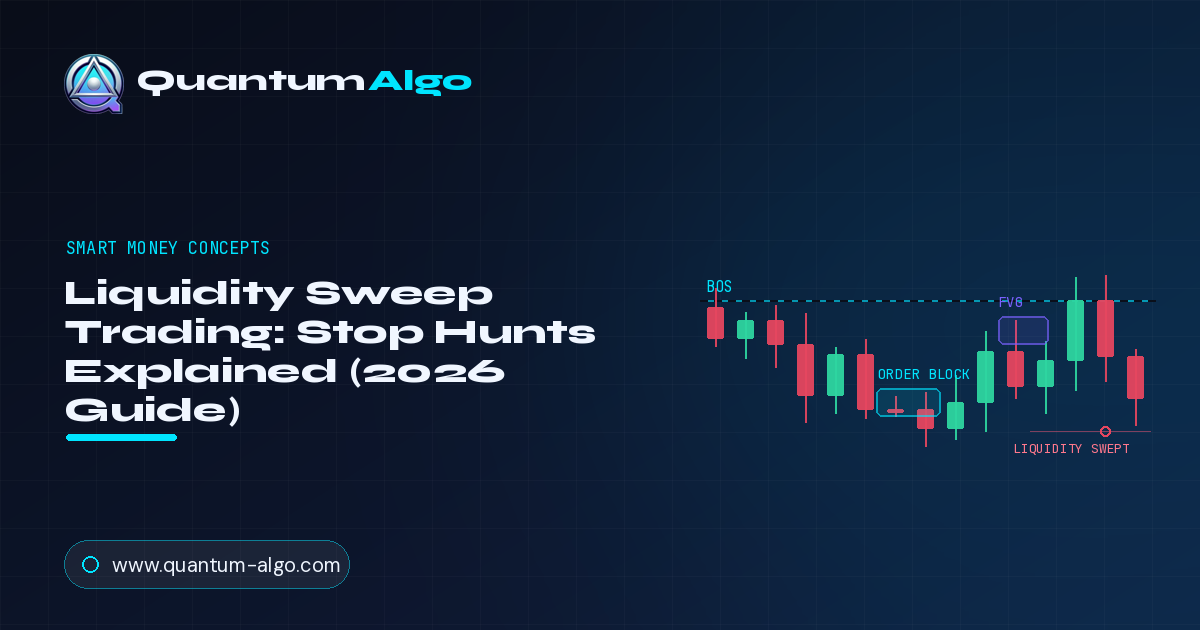
A liquidity sweep (also called a "stop hunt," "stop run," or "liquidity grab") is a price movement that pushes briefly beyond a key high or low to trigger clustered stop-loss orders, then immediately reverses in the opposite direction. It is one of the most reliable institutional patterns in Smart Money Concepts trading — and one of the most consistently misunderstood concepts in retail trading.
2. Why Institutions Engineer Liquidity Sweeps
To understand why liquidity sweeps work as trading setups, you need to understand what institutions are doing mechanically. The pattern is not random — it is the visible footprint of a specific institutional behavior with clear economic logic.
The institutional problem: A hedge fund wants to short EUR/USD with a $200 million position. They cannot place a single market sell order — doing so would crash the price 50+ pips before they could fill even half the position. They need to sell INTO buying pressure to avoid moving the market against themselves. They need someone willing to buy from them in size.
Where the buyers are: Above recent resistance, retail traders have placed two types of orders that institutions can target. First, buy-stop orders from breakout traders entering long positions on a break above resistance. Second, stop-loss orders from existing short traders whose risk management triggers if price moves above resistance against them. Both types execute as market buys when triggered.
The visible result: A long upper wick that pushes above resistance, immediately followed by candles that close back below the resistance level. The retail traders who entered breakout longs are trapped immediately at a loss. The retail traders who had stops above resistance got wiped out. The institutions have a fully filled short position at favorable prices — and now drive price down for their target.
The retail confusion: Most retail traders interpret liquidity sweeps as "fake-outs" — believing the breakout failed due to weakness. This misses the point. The breakout did not fail; it served its purpose perfectly. Institutions got the liquidity they needed; retail traders got stopped or trapped; the market reversed exactly as designed. Understanding this distinction transforms how you trade these patterns.
3. Anatomy of a Liquidity Sweep — The 4-Phase Pattern
Every valid liquidity sweep follows the same four-phase structure. Memorize this anatomy and you can spot the pattern in real time across any market or timeframe.

Automate your trades. Let Quantum Algo trade for you.
Every signal executed on your own account — 24/7, hands-off.
4. How to Identify a Valid Liquidity Sweep
Five validation criteria separate genuine institutional sweeps from random wicks. Every criterion must be met before you have a valid trade setup.
Criterion 1: A clear liquidity pool must exist. The sweep must target obvious liquidity — equal highs, equal lows, or a recent swing high/low that retail traders would all see and place orders around. Random price levels do not produce reliable sweeps because there is no concentrated stop cluster to harvest. The cleaner the equal-highs/equal-lows formation before the sweep, the more reliable the sweep itself.
Criterion 2: The wick must be aggressive and isolated. A valid sweep wick is significantly longer than the average wick length in the surrounding candles. If recent wicks have been 5-10 pips, a sweep wick should be 15-30+ pips. The aggressive single-candle wick distinguishes engineered sweeps from gradual breakout attempts that genuinely fail. Multiple consecutive candles slowly grinding above resistance is a weak breakout, not a sweep.
Criterion 3: Price must reclaim within 1-3 candles. The reclaim defines the sweep. Price must close back inside the original range within 1 to 3 candles after the sweep wick. Longer reclaim periods (5+ candles before returning below the level) often indicate that the breakout was real and the eventual reversal is a separate setup, not part of the sweep mechanic.
Criterion 4: Volume should spike on the sweep candle. The sweep should occur on noticeably elevated volume — typically 1.5x to 3x the average volume of preceding candles. This volume spike is the visible footprint of institutional order execution combined with retail stop triggering. Sweeps on flat volume are usually low-quality or fake patterns.
Criterion 5: The sweep should align with higher timeframe structure. A bearish sweep (long upper wick reversal) is most reliable when the higher timeframe trend is bearish or transitioning. A bullish sweep is most reliable in bullish or transitioning HTF context. Sweeps that fight the dominant trend on the higher timeframe have lower probability — they may produce a short-term reversal but often resume in the original direction quickly.
The "perfect sweep" checklist: Equal highs/lows visible. Aggressive isolated wick beyond the level. Reclaim within 1-3 candles. Volume spike on sweep candle. HTF alignment. When all five align, you have an institutional-grade setup. Skip setups where 2+ criteria are missing — the edge degrades rapidly without full alignment.
5. The Entry Framework — Timing the Reversal
Knowing a sweep occurred is only half the trade. The other half is timing your entry to capture the reversal without getting caught by additional volatility. Here is the complete entry framework.
Entry Option 1 — The Reclaim Entry (most common): Enter on the close of the candle that first reclaims back inside the original range. For a bearish sweep, this is the first candle that closes below the broken resistance after the sweep wick. For a bullish sweep, the first candle closing above the broken support. The reclaim close confirms institutions have completed their fills and the reversal is active.
Entry Option 2 — The Pullback Entry (best R:R): After the reclaim, wait for price to pull back briefly toward the broken level (without reaching it). Enter on the small pullback. This catches a better entry price but you miss reversals that move aggressively without pulling back (about 30-40% of valid sweeps continue without offering retest entries).
Entry Option 3 — The Lower Timeframe Confirmation (most selective): After the higher timeframe sweep, drop to a lower timeframe (e.g., from 1H to 5M) and wait for an internal break of structure (BOS) on the lower timeframe in the reversal direction. Enter on the LTF BOS confirmation. Best for traders who want maximum confirmation and willing to give up some R:R for higher win rate.
Stop-Loss Placement: Standard rule — place stop just beyond the sweep wick's extreme (the highest point of the wick for bearish sweeps, lowest point for bullish sweeps). This protects against secondary sweep attempts which sometimes occur on the same level. Add 0.3-0.5 ATR buffer beyond the wick to avoid stop-outs from normal volatility.
Target Setting: The most reliable target is the opposite end of the recent consolidation range. If the sweep occurred at the top of a range, target the range low. If at the bottom, target the range high. This single rule produces 3:1 to 5:1 R:R on most properly-identified sweeps. For more aggressive targets, project the range height beyond the breakout point in the direction of the reversal — the "range expansion" target.
The R:R math: A typical sweep setup has a tight stop (just beyond the wick) and a wide target (opposite end of range). This produces favorable R:R automatically. Setups with R:R below 2.5:1 should generally be skipped — either the sweep was inadequately validated or the range is too narrow to justify the trade.
6. How Do You Trade a Liquidity Sweep? Four Proven Strategies
Strategy 1: Equal Highs/Lows Sweep (Beginner)
The foundational strategy. Identify obvious equal highs or equal lows on the 1H or 4H chart. Wait for price to sweep beyond the level with an aggressive wick. Confirm reclaim within 1-3 candles. Enter on reclaim close. Stop just beyond the sweep wick + 0.5 ATR. Target the opposite end of the recent range.
Expected metrics: Win rate 65-75% with R:R typically 2.5:1 to 4:1. This is the highest-edge starting strategy for traders new to SMC reversal trading.
Strategy 2: Sweep + Order Block Confluence (Intermediate)
Identify a liquidity sweep where the sweep wick reaches into an existing order block on a higher timeframe. The OB provides additional institutional confirmation — the sweep is harvesting liquidity while filling unfilled orders at the OB. The dual confirmation produces win rates above 80%. Entry, stop, and target identical to Strategy 1.
See our Order Block Guide for OB identification mechanics. The Sweep + OB confluence is one of the highest-edge setups in all of SMC trading.
Strategy 3: Session Kill Zone Sweep (Intermediate)
Liquidity sweeps are particularly reliable during specific market sessions. The London Open (3-5 AM EST), New York Open (8:30-10 AM EST), and the Asian/London transition often produce engineered sweeps as institutions establish daily positioning. Watch for sweeps during these kill zones — they have higher win rates than sweeps during quiet sessions because institutional participation is heaviest.
Setup conditions: identify the daily high/low established during the prior session. As the new session opens, watch for sweeps of that level followed by reversal. See our ICT Trading Strategy Guide for kill zone framework details.
Strategy 4: Multi-Timeframe Sweep Reversal (Advanced)
Identify a Daily or Weekly sweep at a major structural level. Drop to the 1H or 4H chart for entry timing — wait for a lower-timeframe BOS confirming the reversal has begun. Enter on the LTF BOS. The HTF sweep provides the directional bias and wide target; the LTF BOS provides the precise entry with tight stop.
Expected R:R: 5:1 to 10:1. The tight LTF entry combined with the wide HTF reversal target produces the best R:R profile in SMC trading. This is the strategy used by professional discretionary traders for major positions.
7. Common Liquidity Sweep Mistakes
Mistake 1: Confusing real breakouts with sweeps. The most common error. Price breaks above resistance and the trader assumes "fake-out incoming" — enters short anticipating reversal. But genuine breakouts happen too — and trying to short every breakout produces consistent losses. The reclaim is the filter: if price stays above the broken level, it was real; if price reclaims within 1-3 candles, it was a sweep. Never anticipate; always wait for the reclaim.
Mistake 2: Trading sweeps at meaningless levels. A "sweep" of a random price level that no retail traders were watching has no institutional logic. Real sweeps target visible liquidity — equal highs, equal lows, recent swing extremes that thousands of retail traders identified. Without a clear liquidity pool to harvest, the wick is just noise, not a sweep.
Mistake 3: Stops too tight. Placing your stop just beyond the broken level (without accounting for the sweep wick extreme) gets you stopped on secondary sweep attempts. Some sweeps come in pairs — initial sweep, brief reversal, second sweep slightly higher, then real reversal. Stops just beyond the broken level catch you in the second sweep. Stops beyond the full sweep wick extreme survive these secondary moves.
Mistake 4: Ignoring volume context. Sweeps on flat volume have much lower win rates than sweeps with clear volume expansion. The volume spike is the visible footprint of institutional execution. Without it, the wick may be retail-driven noise rather than institutional engineering. Always verify the volume signature before entering.
Mistake 5: Fighting higher timeframe trend. A bullish sweep (long lower wick reversal) against a strongly bearish 4H trend often produces a brief reversal then resumes the original direction. Sweeps aligned with HTF trend are far more reliable. Always check HTF context before taking sweep trades.
Mistake 6: Holding too long after the reversal. Liquidity sweep reversals are typically range-bound moves. They produce strong reversal action to the opposite end of the recent range, then often consolidate or reverse again. Traders who try to hold beyond the natural target (opposite end of range) frequently give back significant profits. Stick with the standard target; scale out partial positions for runners only on multi-timeframe setups.
8. Test Your Knowledge
Seven questions on liquidity sweep trading.
9. Detect Sweeps Automatically
Monitoring multiple pairs for liquidity sweeps requires checking equal highs, equal lows, and reclaim sequences in real time across every chart. Algorithmic detection handles this systematically and alerts you only when valid sweeps complete.
Frequently Asked Questions
A liquidity sweep is a price movement that pushes briefly beyond a key high or low to trigger clustered stop-loss orders, then immediately reverses. Also called a stop hunt or stop run, it represents institutions engineering moves to access the liquidity stops provide — needed to fill large positions in size.
The reclaim is the critical filter. If price wicks beyond a level and stays above (or below) it for more than 3 candles, the breakout was real. If price reclaims back inside the original range within 1-3 candles, it was a sweep. Never trade in advance — wait for the reclaim to confirm which scenario occurred.
Liquidity sweeps reflect a universal mechanic — institutions need large opposing flow to fill big positions. Stop clusters above highs and below lows are the densest liquidity pools available. By engineering moves into these clusters, institutions trigger stops and obtain the flow needed. The visible pattern is the footprint of this execution behavior.
Target obvious liquidity — equal highs and equal lows visible on the chart, recent swing extremes, key psychological round numbers, and major previous structural levels. Random price levels do not produce reliable sweeps because there is no concentrated stop cluster to harvest.
Functionally the same — both involve a wick beyond a level followed by reversal. The distinction is interpretation. "Fakeout" implies the breakout failed due to weakness. "Liquidity sweep" recognizes the move was engineered to harvest liquidity. The trading approach is identical; the SMC framing helps you understand WHY the pattern repeats so reliably.
1H and 4H produce the most reliable sweeps for retail traders because institutional participation is significant and stops cluster meaningfully at these levels. 15M sweeps work but require fast execution. Sub-15M timeframes often show too much noise to differentiate sweeps from random wicks. Daily and Weekly sweeps are the highest-quality setups but appear less frequently.
Yes. Liquidity sweeps work on every liquid market — forex, crypto, indices, gold, futures. The mechanic depends on institutional execution needs and retail stop placement, both of which exist universally. Crypto produces particularly clean sweeps because crypto traders frequently use technical stop placement that creates clear, harvestable clusters.
Properly validated sweeps (passing all 5 criteria) produce win rates of 65-75% on standalone setups. When combined with order block or FVG confluence at the sweep level, win rates climb to 80%+ as documented across multiple SMC backtest studies. R:R typically falls between 2.5:1 and 5:1 depending on range size and entry technique.
References & Related Guides
More in this topic
- Institutional Key Levels — Free Support and Resistance Indicator for TradingView (Pivot-Clustered Levels, Power Scoring, Rejection Signals)
- Liquidity Sweeps — Free Liquidity Sweep Indicator for TradingView (Buy-Side and Sell-Side Liquidity, Stop Hunts)
- Smart Money Concepts Engine — Free SMC Indicator for TradingView (Structure, Order Blocks, FVG, Liquidity, Confluence Score)
- Bookmap Review (2026): The Order-Book Heatmap, and What It Actually Shows a Smart Money Trader
- Unusual Whales Review (2026): Options Flow, Dark Pools and Congress Trades — What the Data Can and Can't Tell You
- Order Types Explained: Market vs Limit vs Stop vs Bracket Orders (and Which to Use When)
- What Is Institutional Trading? How Big Orders Move Markets (and Leave Footprints)
- Liquidation in Trading 2026 — Magnets & Purges
- Inducement Trading 2026 — Trap Liquidity Explained
- Optimal Trade Entry (OTE): Complete Guide 2026
- Funding Rate Trading: Complete Guide 2026
- BOS & CHoCH: Complete Market Structure Guide 2026
- Breaker Block Trading 2026 — 5-Condition Complete Guide
- Displacement Trading 2026 — SMC Institutional Conviction Guide
- Fair Value Gaps (FVG): Complete Trading Guide 2026
- ICT Silver Bullet Strategy: The Complete Guide (2026)
- ICT Trading Strategy: Complete Interactive Guide 2026
- Is ICT and SMC the Same? Differences Explained (2026)
- Liquidity Trading Guide 2026 — Raids & Kill Zones
- Order Blocks Trading: Complete 2026 Guide
- Order Flow Trading 2026 — Read the Footprint of Institutions
- Smart Money Concepts (SMC): Ultimate Trading Guide 2026
- What Is a Market Structure Shift (MSS) in Trading? 2026
- QFL Strategy Guide 2026
Core reading
For a focused comparison, read the BPR liquidity-sweep retest before applying the setup.