ICT Methodology
ICT methodology is the institutional trading framework by Michael Huddleston (Inner Circle Trader). It introduced order blocks, fair value gaps, breaker blocks, killzones, optimal trade entry and liquidity sweeps to retail Smart Money trading. It is session-based, focusing on London Open (2:00–5:00 AM EST), New York Open (8:30–11:00 AM EST) and London Close, with precise rule-based entries.
◆Full guide: ICT Trading Strategy: The Complete Inner Circle Trader Guide
What it means
ICT (Inner Circle Trader) is the trading methodology developed and taught by Michael Huddleston, a former Forex trader and educator. ICT introduced the modern terminology used throughout Smart Money Concepts: order blocks, Fair Value Gaps, breaker blocks, killzones, optimal trade entry (OTE), liquidity sweeps, and the broader institutional-flow framework. Most current SMC content traces its core vocabulary to ICT material.
ICT methodology is heavily session-based. It places strong emphasis on London Open (2:00–5:00 AM EST), New York Open (8:30–11:00 AM EST), and London Close (10:00 AM–12:00 PM EST) as the windows where institutional activity is concentrated. Trading outside these killzones produces materially lower win rates in ICT-style execution.
The relationship between ICT and SMC is one of overlapping origin. SMC as a broader category includes ICT concepts plus elements of Wyckoff theory and traditional supply-and-demand analysis. All ICT is SMC, but not all SMC is strictly ICT. The vocabulary differences (order block in ICT vs. demand zone in classical) reflect different analytical lineages reading the same underlying institutional mechanics.
ICT execution emphasizes precision: exact CE entries on FVGs, exact swing-point breaks for BOS/CHoCH, exact session-time windows for trade activity. This precision is both ICT's strength (clarity of rules) and its trap (over-fitting to specific candle patterns can produce too many missed trades). Most successful ICT-derived SMC traders blend ICT precision with broader contextual judgment.
How to identify it on a chart
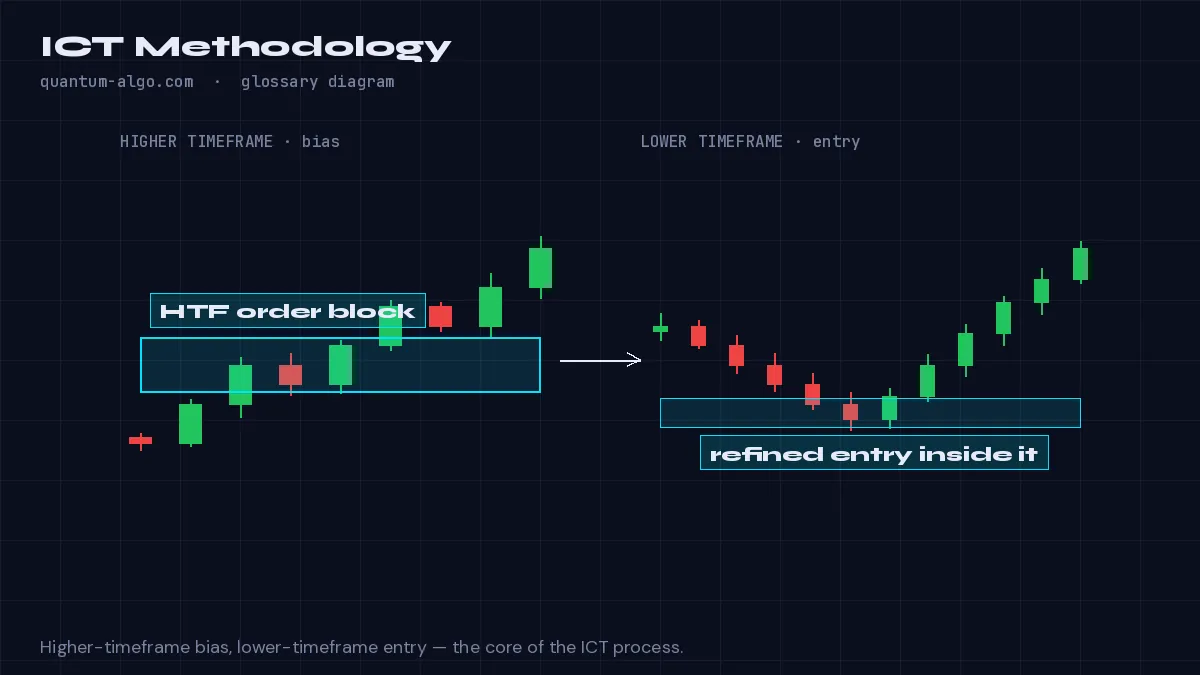
- Establish the daily and 4-hour bias from structure and liquidity.
- Wait for the killzone and a liquidity sweep against the bias.
- Enter on the displacement-created FVG or order block on the 1–15 minute chart.
Worked example
Daily bias is bullish. In the London killzone price sweeps the Asian low, displaces higher and leaves a 5-minute FVG; the entry is the return to that gap with the stop below the sweep low.
See it on the chart, read it in depth
Frequently asked questions
Is ICT the same as SMC?
ICT is the original school that introduced most modern SMC vocabulary. SMC is the broader methodology that includes ICT plus Wyckoff and supply/demand. Most current 'SMC' content is essentially ICT with adjacent concepts blended in.
Do I need to follow ICT killzones strictly?
Killzones are statistically significant — institutional activity does concentrate in those windows. But trading exclusively in killzones means missing setups that occur outside them. Many successful SMC traders use killzones as a confluence factor rather than a strict gate.
Where can I learn ICT methodology systematically?
Michael Huddleston's free YouTube content is the primary source. For applied, structured learning, our Academy lessons on order blocks, FVGs, liquidity, and session-based trading cover the practical execution components of ICT methodology.
Related terms
See ICT Methodology on your TradingView chart
Zeno reads Smart Money structure across timeframes and prints the entry, stop and targets — with a public record of every posted trade. The free indicators draw the concepts this page defines.