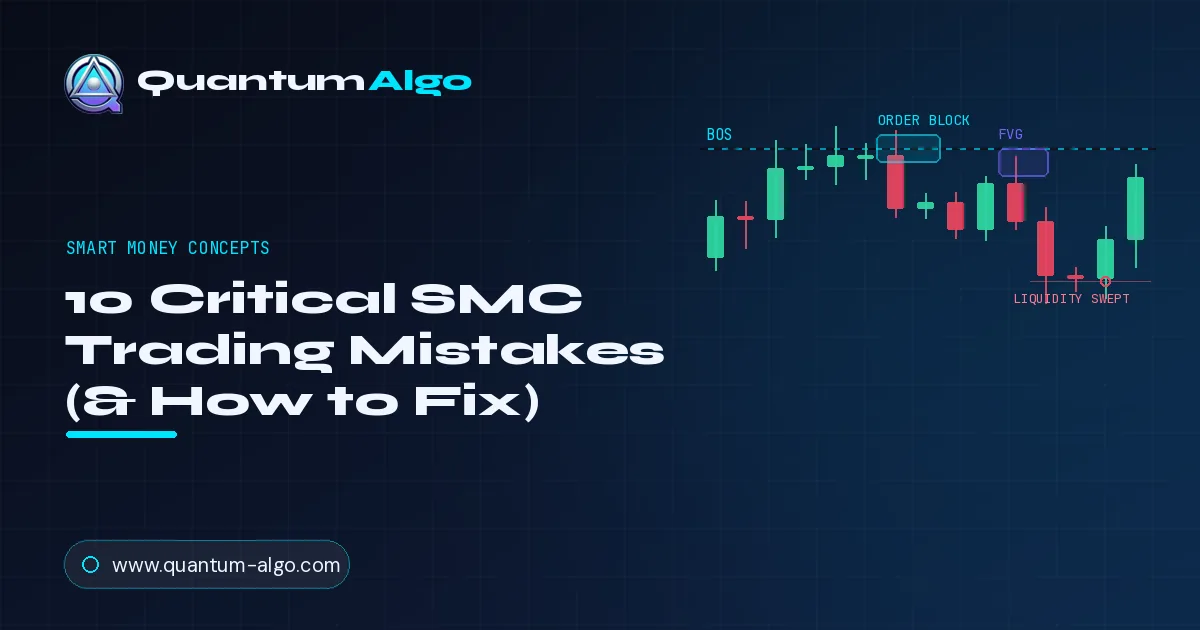
The 10 most common Smart Money Concepts trading mistakes are: trading against the higher-timeframe trend, entering before confirmation (anticipating rather than reacting), ignoring risk management, using too many timeframes simultaneously, trading every order block without grading quality, not waiting for BOS/CHoCH confirmation, overtrading during low-volume sessions, moving stop losses to avoid being stopped out, risking more after losses (revenge trading), and neglecting to journal and review trades. Most SMC traders lose money not because the methodology doesn't work, but because they skip the confirmation step and enter prematurely.
Last verified: April 15, 2026
Smart Money Concepts gives you a powerful framework — but the framework only works if you avoid the pitfalls that trap most traders. After analyzing thousands of trades from our community, here are the 10 most common mistakes and how to fix each one.
The ten most common SMC trading mistakes are trading against the higher-timeframe trend, entering at every order block, stops placed too tight, ignoring nearby liquidity, over-leveraging, analysis paralysis, ignoring session context, not journaling, chasing missed entries, and switching strategies after losses. Fixes: set HTF bias first, trade only order blocks that created a BOS, and risk 1–2% per trade maximum.
1. Why is trading against the higher timeframe so costly?
The most destructive mistake. A perfect 5-minute bullish OB means nothing if the 4-hour chart is in a clear downtrend. Fix: Always establish HTF bias first. If you can't clearly identify the HTF direction, sit on your hands.
2. Should you enter at every order block?
Not all order blocks are equal. Many traders enter at every OB they spot, leading to excessive trades and death by a thousand cuts. Fix: Only trade OBs that (a) created a BOS, (b) haven't been previously tested, and (c) have FVG confluence.
3. Placing Stops Too Tight
Putting your stop loss at the edge of an order block rather than beyond the structural invalidation point. Price regularly wicks into OBs before reversing — your stop gets hit, then the trade works. Fix: Stops go beyond the OB wick, always. Accept the wider stop and reduce position size accordingly.
4. Ignoring Liquidity Before Entering
Entering a trade without checking whether there's nearby liquidity that price might sweep first. Fix: Before every entry, identify the nearest BSL and SSL. If unswept liquidity sits between your entry and target, there's a high chance price will deviate to grab it first.
5. Why is over-leveraging so dangerous?
Using 20x-50x leverage because "the setup looks perfect." Even the best SMC setups have a 30-40% failure rate. Fix: Risk 1-2% per trade maximum. This is the only rule that's truly non-negotiable.
6. Analysis Paralysis
Drawing 47 order blocks across 6 timeframes and being unable to take any trade. Fix: Use exactly 3 timeframes. Mark no more than 2-3 key levels per timeframe. If the setup isn't obvious in 30 seconds, move to the next asset.
7. Which sessions suit SMC setups best?
Taking setups during low-volatility periods (e.g., late Asian session for forex). SMC works best when institutional players are active. Fix: Focus on London and New York sessions for forex/gold. For crypto, watch the US market open and weekly close windows.
8. Not Tracking Performance
Trading without a journal means you can't identify what's working and what isn't. Fix: Log every trade with: timeframe, setup type, R-result, and screenshot. Review weekly.
9. Chasing Missed Entries
Price moved past your planned entry, so you market buy at a worse price. This ruins your risk-to-reward and turns a 2R potential into a 0.8R trade. Fix: Use limit orders. If price moves past your zone, the setup is missed — there will always be another one.
10. Switching Strategies After a Losing Streak
Three losses in a row, so you abandon SMC for the next shiny indicator. Every strategy has drawdowns. Fix: Commit to 100 trades with strict rules before evaluating. A strategy's edge only reveals itself over a statistically significant sample.
What is the root cause of most SMC mistakes?
Looking across all ten mistakes, a single root cause connects most of them: insufficient patience. Trading against the higher timeframe happens because you are impatient with waiting for pullbacks. Entering at every order block happens because you are impatient with filtering for quality. Placing stops too tight happens because you are impatient with giving trades room to breathe. Over-leveraging happens because you are impatient with account growth. Chasing missed entries happens because you are impatient with waiting for the next setup.
The antidote to impatience is a deep, internalized understanding that the market will provide more opportunities. Missing one setup does not matter because another one will form tomorrow, or next week. Taking a loss on a properly managed trade does not matter because the next fifty trades will make up for it and more. This abundance mindset — the conviction that opportunities are unlimited while capital is finite — is the psychological foundation that eliminates most SMC trading mistakes.
What belongs on an SMC error-prevention checklist?
Professional pilots use checklists before every flight, not because they do not know how to fly, but because the consequences of forgetting a step are severe. Traders benefit from the same approach. Create a pre-trade checklist that you review before placing every order. A practical SMC checklist includes: Is the higher-timeframe bias aligned with my trade direction? Is the order block I am trading unmitigated (first touch)? Does the R:R meet my minimum threshold? Is my position size within my 1% risk limit? Am I within my daily trade limit? Am I in a calm, neutral emotional state?
If any item on the checklist fails, the trade does not get placed. This is not optional — it is the rule. The power of the checklist is that it takes the decision-making burden off your in-the-moment emotional state and places it on a systematized process that you designed during calm, rational analysis. When you are tempted to take a marginal trade, the checklist gives you an objective reason to say no. Over hundreds of trades, this systematic gatekeeping prevents the subset of impulsive, low-quality entries that disproportionately drag down your performance.
How do you fix one trading mistake at a time?
Rather than trying to eliminate all mistakes at once (which is overwhelming and unsustainable), create a system that targets your single biggest current mistake. Review your last 20 trades and identify which of the 10 mistakes cost you the most money. Focus exclusively on that mistake for the next 30 days. Create a specific rule to prevent it, write it on a card next to your screen, and check it before every trade. After 30 days, review your performance — if the mistake has been reduced, maintain the rule and move on to your second-biggest mistake.
This sequential approach is more effective than trying to fix everything simultaneously because it concentrates your limited willpower on a single behavioral change. Willpower is a finite resource — if you spread it across 10 simultaneous changes, none of them stick. By focusing on one change at a time and giving each change 30 days to become automatic, you build permanent behavioral improvements that compound over the year. Twelve sequential month-long fixes will transform your trading more completely than a January resolution to "trade perfectly" that collapses by February.
How does following your process compound over time?
Every time you follow your rules correctly — even when the individual trade loses money — you are building the neural pathways of disciplined execution. Over time, rule-following becomes automatic rather than effortful. The seasoned trader does not have to fight the urge to move their stop loss; the thought simply does not occur to them because disciplined execution has become their default mode. Reaching this state of unconscious competence takes approximately 12–24 months of consistent, deliberate practice.
The compound effect of this behavioral improvement is extraordinary. A trader who eliminates just one major mistake per quarter improves their performance by roughly 5–15% per quarter — not through better entries or a fancier indicator, but through fewer unnecessary losses. Over a year, the cumulative improvement from eliminating four major mistakes can easily double your net profitability. The path to consistent profits runs through mistake elimination, not strategy optimization. Fix the leaks, and the profits that were always available from your methodology will flow through naturally.
Key Takeaways
Understanding avoiding common SMC mistakes provides a meaningful addition to your trading toolkit, but the real value emerges only when you integrate these concepts with a structured methodology like Smart Money Concepts. No single indicator, pattern, or analytical concept produces consistent profitability in isolation. The concepts covered in this guide become powerful when they serve as one layer in a multi-confirmation system that includes higher-timeframe directional bias, institutional zone identification, and disciplined risk management.
The most important practical step is to backtest before you trade live. Take the concepts from this guide and apply them to historical price data using TradingView's bar replay feature. Walk through at least 50 setups, recording the entry, stop, target, and outcome for each. This backtesting exercise accomplishes two things: it builds your pattern recognition for the specific setup types discussed in this article, and it gives you empirical data on the setup's actual performance — win rate, average R:R, and maximum drawdown — that you can use to make informed decisions about incorporating it into your live trading plan.
Your Next Steps
Now that you have a solid understanding of building systematic error prevention into your trading process, the next step is implementation. This week, dedicate 30 minutes per day to chart markup practice focused specifically on the concepts covered in this guide. Use the daily and 4-hour charts of your primary trading assets. Mark every relevant setup you can find, then track how price interacts with those levels over the next few sessions. This deliberate practice builds the visual pattern recognition that eventually becomes automatic during live trading.
After two weeks of chart markup practice, begin incorporating these setups into your demo trading or your live trading with minimal position sizes. Start with your single highest-conviction setup type and trade only that setup for 30 consecutive trades. After 30 trades, review your journal data: which setups produced the best R:R? Which sessions were most productive? Which assets showed the cleanest patterns? Use this data to refine your approach, eliminate underperforming variants, and concentrate on the specific combinations that your data shows work best for your trading style and market.
Finally, remember that mastery is a journey measured in months and years, not days and weeks. The traders who achieve lasting success are the ones who commit to continuous improvement through consistent practice, honest self-assessment, and evidence-based refinement. Every session of chart markup, every journaled trade, and every weekly review compounds your skill and brings you closer to the level of unconscious competence where profitable trading becomes second nature. Stay patient, stay disciplined, and trust the process.
Every trader makes mistakes — the difference between profitable traders and losing traders is not the absence of mistakes but the speed of recognition and correction. The profitable trader notices they are deviating from their plan, corrects the behavior, and moves forward. The losing trader either does not notice the deviation or lacks the discipline to correct it. By systematically working through the ten mistakes identified in this guide and building specific prevention mechanisms for each one, you are accelerating the recognition-and-correction cycle that ultimately determines your long-term trading success.
Which three SMC mistakes cost the most?
Every error in this list is common, but three account for the majority of blown SMC accounts. Each has the same root: taking a concept that describes where and using it to decide whether.
Mistake 1 — Trading a zone with no bias
An order block in a downtrend is not a buy signal. Structure decides direction; the zone only refines the price.
Mistake 2 — Entering on touch, with no reaction
Arrival at a level is a location, not evidence anyone is defending it.
Mistake 3 — Taking the inducement instead of the real zone
The obvious level in front of the real one exists to collect your stop.
How do you fix each SMC mistake?
Each mistake maps to a specific, checkable correction. Print this and run through it before every entry.
| Mistake | Why it happens | The correction |
|---|---|---|
| Trading zones without bias | Zones are easy to see; structure takes work | Establish direction from BOS/CHoCH before looking for any zone |
| Entering on first touch | Fear of missing the move | Require a reaction — rejection candle or lower-timeframe shift |
| Taking the inducement | The bait is deliberately the most obvious level | Find the real higher-timeframe zone first, treat what's in front as bait |
| Marking every candle as an order block | Pattern-matching without the displacement test | Require decisive displacement away from the zone |
| Ignoring higher timeframes | Lower timeframes give more setups | Bias from HTF, entries on LTF — never the reverse |
| Trading in premium when bullish | Buying feels safest when price is rising | Check the range position — buy discount, sell premium |
| Stops just beyond the obvious level | Tight stops feel efficient | Place stops beyond the zone and the sweep, not inside the harvest pocket |
| Redrawing zones to fit the trade | Loss aversion after entry | Mark zones before entry and never move them afterwards |
| No risk framework | Focus on entries, not survival | Fixed percentage risk, sized from stop distance every time |
| Overtrading low-quality setups | Boredom and the urge to be in the market | Demand multiple confluences; fewer, better trades |
Bias before zones
Read structure first, every time. If you cannot state the trend in one sentence, you are not ready to look for an entry.
Reaction before entry
Arrival at a level is not defence of it. Require visible evidence that someone is transacting there before committing.
Real zone, not the bait
The most obvious level is usually the trap. Work backwards from the higher-timeframe zone to identify what is bait.
Risk before reward
Size from stop distance with fixed percentage risk. Survive the losing streak and the edge has time to work.
Remove the guesswork from the map
Quantum Algo marks structure, order blocks, fair value gaps and liquidity automatically, and scores the confluence — so you can see instantly whether a zone has support or is a trap.
See the indicator → Full SMC guide