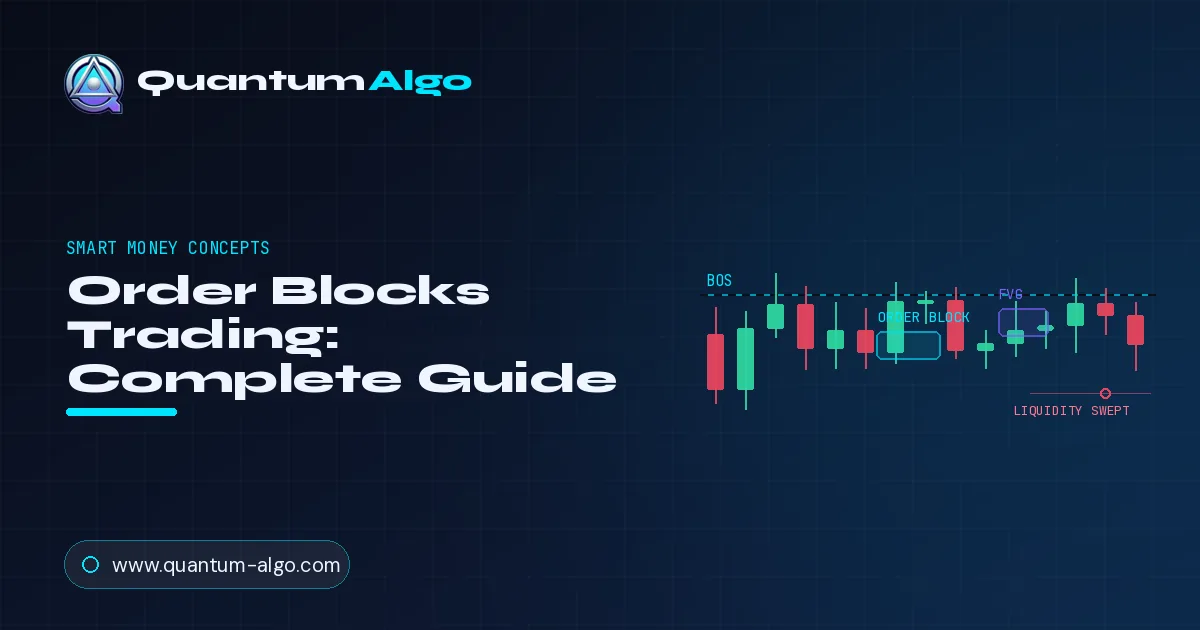
An order block is the last down-close before a strong move up, or the last up-close before a move down, where an institution filled a large order. Price returns because the institution defends it: buy the retest of a bullish block, sell a bearish one, stop beyond, target the next liquidity. Grade it on displacement, prior sweep, imbalance, freshness and higher-timeframe context.
What Is an Order Block?
This complete order blocks trading guide covers the full methodology for identifying, grading, and trading institutional order blocks. An order block is the last opposing candle before a Break of Structure — the exact zone where institutional traders placed the orders that caused the structural break.
This guide covers order block identification rules, the A/B/C grading system (based on structural origin, mitigation status, and confluence factors), entry techniques (limit orders vs market orders at the zone), stop loss placement (below the order block wick), and take profit strategies (next liquidity target or opposing order block).
The last down-candle before the impulsive move up — institutions absorbed sell-side there. The zone is drawn from that candle’s range and becomes demand on the retest.
Last verified: April 15, 2026
An order block is the last opposing candle before a significant impulsive move that creates a Break of Structure (BOS). It marks the exact price zone where institutional traders — banks, hedge funds, pension funds, and algorithmic market makers — placed massive buy or sell orders before driving price in one direction.
Think of it this way: when a hedge fund needs to buy $200 million worth of Bitcoin, they cannot execute that as a single market order. The available liquidity at any price level is a fraction of that size. Instead, their execution algorithms break the order into hundreds of smaller chunks, accumulating gradually over a period of time. The final candle of that accumulation — just before price launches — is the order block.
When price returns to this level days, hours, or even weeks later, the institution often has remaining unfilled orders at the same price. These resting orders create buying or selling pressure that causes a visible reaction on the chart — giving you a high-probability entry zone.
This is not theoretical. It is the mechanical result of how large orders interact with finite market liquidity. Understanding this process gives you a structural edge over traders who rely on lagging indicators or arbitrary support/resistance levels.
Fig 1. Anatomy of a bullish order block: the last bearish candle before displacement + BOS, creating a high-probability retest zone.
◆ Key TakeawayAn order block is NOT just any candle before a move. It must precede a displacement that breaks market structure. No BOS = no valid order block. This single filter eliminates 80% of false signals.
Why do order blocks exist?
Understanding why order blocks form is more important than memorizing how to draw them. Order blocks are a structural consequence of how large institutional orders interact with limited market liquidity.
Why can't institutions fill a large order at one price?
When a hedge fund needs to buy $100 million of EUR/USD or 2,000 BTC, they face a fundamental constraint: there isn't enough liquidity at any single price level to fill the entire order. If they placed a $100M market buy, they would push price up dramatically against themselves — a phenomenon called slippage. Their average fill price would be far worse than the current market price.
How do institutions split large orders with algorithms?
To solve this, institutions use execution algorithms (TWAP, VWAP, iceberg orders) that break the order into hundreds of smaller chunks. These chunks are executed gradually — every few seconds, minutes, or even hours — across multiple price levels. On a candlestick chart, this gradual accumulation looks like a period of consolidation or a series of small-bodied candles. The price zone where this accumulation occurred is the order block.
Why does price react at order blocks?
Not all of the institutional order gets filled during the initial accumulation phase. Some portion remains as resting limit orders or algorithmic triggers at specific price levels. When price returns to the order block zone days or weeks later, these remaining orders activate — creating buying or selling pressure that causes the visible reaction on the chart. This is not mystical.
It is the mechanical result of partially filled large orders resting in the market's order book.
Fig 2. The institutional order lifecycle: Accumulate → Displace → Reload. Your entry is at Step 3.
What are the types of order blocks?
Order blocks come in several forms. Understanding each type — and when they flip — is essential for reading institutional intent correctly.
✓
Bullish Order Block
The last bearish (red) candle before a strong bullish displacement that breaks structure upward. It represents institutional buying disguised as selling. Institutions need sellers at these levels — so the candle looks bearish while they quietly accumulate. When price returns, their remaining buy orders create support.
✗
Bearish Order Block
The last bullish (green) candle before a strong bearish displacement that breaks structure downward. It represents institutional selling disguised as buying. The candle looks bullish while institutions distribute positions. On retest, their remaining sell orders create resistance that pushes price back down.
◆
Breaker Block
When an order block fails — price breaks through it entirely — it becomes a breaker. A failed bullish OB flips to resistance; a failed bearish OB flips to support. Breakers represent zones where trapped institutional positions are being unwound, creating reliable reactions in the opposite direction.
◆
Mitigation Block
A mitigation block forms when institutions use a returning move to close or reduce a losing position at breakeven or minimal loss. Unlike a regular OB where they add, at a mitigation block they exit. The zone still produces a reaction, but the mechanism is different — it's position management rather than new accumulation.
Fig 3. Bullish OB (last red candle before up-move) vs Bearish OB (last green candle before down-move).
◆ Key TakeawayThe deception is intentional. A bullish OB looks bearish; a bearish OB looks bullish. Institutions need retail traders on the wrong side to fill their orders. When you understand this, you stop getting trapped.
How do you grade an order block on five points?
Not all order blocks are created equal. A systematic grading framework helps you filter the 20% of OBs that produce 80% of your profits. Score each order block from 0-5 using these criteria:
Left: A+ OB — caused a BOS, has displacement, unmitigated, aligned with HTF. Right: weak OB — no displacement, already tapped twice, counter-trend.
+1 Break of Structure (BOS)
The order block must have caused a clear Break of Structure. This is the single most important filter. If the impulsive move following the OB candle did not break the previous swing high (for bullish) or swing low (for bearish), it is not a valid order block. No BOS = no OB. This criterion alone eliminates roughly 60% of false order blocks.
+1 Displacement Strength
Strong, aggressive candles should move away from the OB zone. Look for candles with large bodies and small wicks — these indicate conviction. The displacement candle should be 2-4x larger than the average candle in that market context. Weak, grinding moves with long wicks suggest the OB was formed by retail activity rather than institutional orders. Strong displacement = institutional urgency.
+1 Unmitigated (First Touch)
The OB has never been retested. First-touch order blocks have the highest probability because all of the institutional orders at that level are still unfilled. Each subsequent test (mitigation) consumes a portion of the resting orders, reducing the zone's effectiveness. An OB tested three times has dramatically less institutional interest remaining than a fresh, unmitigated one.
+1 FVG Overlap (Confluence)
When an order block overlaps with a Fair Value Gap, you have both institutional entry AND price imbalance confirming the same zone. This is the highest-probability configuration in SMC trading. The FVG indicates that price moved so aggressively away from the OB that it left a gap — confirming strong institutional commitment. An OB without an FVG can still work, but the confluence of both significantly increases your edge.
+1 Higher-Timeframe Alignment
The OB must align with the higher-timeframe directional bias. A bullish 15-minute order block inside a 4-hour downtrend is a counter-trend setup with low probability, regardless of how perfect the OB looks in isolation. Conversely, a Grade B order block that perfectly aligns with daily bullish structure will outperform a Grade A OB that fights the trend. HTF alignment is the context that makes or breaks every other criterion.
Fig 4. The OB quality scale. Most profitable traders only take Grade A (4) and A+ (5) setups.
◆ Key TakeawayDiscipline means refusing to trade low-grade OBs. You might take only 3-5 trades per week instead of 15-20, but the win rate on Grade A+ setups is dramatically higher — producing better returns with less stress and screen time.
3 Entry Models for Order Block Trading
Once you have identified a high-grade order block, you need a precise entry method. Each model offers a different balance of simplicity, win rate, and frequency. Click each tab to explore.
① Limit Order
② Confirmation
③ FVG Refinement
Model 1: Limit Order Entry
Place a limit order at the OB boundary (the open of the OB candle for a bullish setup, or the close for a bearish setup). Stop-loss goes beyond the OB wick with 1-2 pips buffer. This is the simplest model — set and forget. It works best on higher timeframes (4H, Daily) where OBs are more reliable.
Drawback: price may wick through the OB without a clear reaction, triggering your limit and then stopping you out. Win rate is lower (~45-55%), but the R:R is excellent (often 1:3+) because your entries are at the extreme of the zone.
Fig 5. Three entry models compared. Model 3 (FVG Refinement) combines OB + FVG confluence for maximum probability.
Why does the stop go beyond the order block wick?
Regardless of which entry model you use, always place your stop-loss beyond the order block wick — never inside the body. If the wick gets swept, the institutional thesis is invalidated. For a bullish OB, your stop goes below the lowest wick of the OB candle, plus a 1-2 pip buffer for spread. For a bearish OB, the stop goes above the highest wick. This gives you a precisely defined risk before you enter.
Where should you take profit on an order block trade?
Set your primary take-profit at the next significant liquidity level in the direction of your trade. This is typically the nearest unswept swing high (for longs) or swing low (for shorts). A secondary target can be the next HTF order block in the opposing direction. This naturally produces 1:2 to 1:4 risk-to-reward ratios when combined with tight OB-based stop placement.
Interactive: Grade This Order Block
Practice the 5-point grading system in real time. Check each criterion that applies to the hypothetical order block below. The simulator calculates the grade and tells you whether to trade it.
◆ OB Quality Grading Simulator
The move after the OB candle broke market structure (BOS confirmed)
+1
Strong displacement — large-bodied candles with small wicks moved away
+1
The OB zone is unmitigated — price has never retested it before
+1
A Fair Value Gap (FVG) overlaps with the order block zone
+1
The OB aligns with the higher-timeframe directional bias
+1
Check the criteria above → Score: 0/5 — Grade F (Do not trade)
How do you trade order blocks across multiple timeframes?
The most powerful order block setups occur when multiple timeframes align. A lower-timeframe OB nested inside a higher-timeframe OB creates a zone of concentrated institutional interest that produces the highest-probability trades.
Which three timeframes should an order block trader use?
Higher Timeframe (Daily / 4H): Determines your directional bias. If the daily structure is bullish (higher highs, higher lows), you only look for bullish setups. Mark the most significant unmitigated order blocks at this level — these are your "zones of interest" where you will look for entries on lower timeframes.
Mid Timeframe (1H): Refines the zone. When price approaches your HTF order block, switch to the 1H chart to identify the specific OB candle within the larger zone. This narrows your area of interest from a 50-pip HTF zone to a 15-20 pip precise level.
Lower Timeframe (15M / 5M): Provides your entry trigger. Wait for a Change of Character (CHoCH) on the LTF within the HTF order block zone. Once you see the CHoCH, look for a new LTF order block or FVG that formed during the reversal. This is your precision entry. Stop-loss goes beyond the LTF structure, and your target is the HTF liquidity level.
Timeframe
Purpose
What to Mark
Action
Daily / 4H
Directional bias
Structure + key OBs
Determine long/short bias
1H
Zone refinement
Specific OB candle
Narrow the entry zone
15M / 5M
Entry trigger
CHoCH + LTF OB/FVG
Execute the trade
What is a nested order block setup?
The best setup in all of order block trading is the nested OB: a 15-minute bullish OB that sits inside an unmitigated 4-hour bullish OB, with the daily structure bullish. Three timeframes, one directional thesis, maximum confluence. When you find this setup, your typical win rate approaches 65-70% with R:R ratios of 1:3 or better. These setups appear 2-4 times per week on major pairs and crypto assets.
◆ Key TakeawayNever trade a lower-timeframe OB that contradicts the higher-timeframe structure. The most common mistake is finding a "perfect" 5M bullish OB inside a 4H bearish trend. The HTF always wins in the end.
7 Deadly Order Block Mistakes (And How to Avoid Them)
Mistake #1: Trading OBs Without BOS Confirmation
The single most common error. Traders see a strong candle followed by a move and label it an "order block" — but the move never broke structure. Without a BOS, you have a random reaction, not an institutional entry zone. Fix: Make BOS your non-negotiable first filter. If you cannot point to the specific swing high or low that was broken, the OB is invalid.
Mistake #2: Trading Already-Mitigated OBs
Each time price returns to an order block and reacts, a portion of the resting institutional orders gets filled. By the second or third retest, most of the institutional interest is consumed. Fix: Prioritize first-touch OBs exclusively. If an OB has already been tested, downgrade it by at least one grade level in your quality assessment.
Mistake #3: Ignoring Higher-Timeframe Context
A picture-perfect 15M bullish OB inside a daily bearish trend is a trap, not an opportunity. HTF institutional flow will eventually overwhelm LTF setups that fight it. Fix: Always establish your daily/4H bias before looking at any lower-timeframe OBs. Only trade OBs that align with HTF direction.
Mistake #4: Using OBs as the Only Signal
Order blocks are powerful, but they are one piece of the puzzle. The best setups combine OBs with fair value gaps, liquidity sweeps, and market structure analysis. Fix: Use the 5-point grading system. An OB scoring 5/5 has confluence from multiple SMC concepts, dramatically increasing probability.
Mistake #5: Drawing OB Zones Too Wide
Some traders mark the entire consolidation before a move as the "order block." This creates zones so wide that your stop-loss distance destroys your risk-to-reward. Fix: The order block is specifically the last opposing candle before the displacement. Draw the zone from the high to the low of that single candle (or at most 2-3 candles in the immediate consolidation).
Mistake #6: Entering Before Liquidity Is Swept
If you enter at an OB before the market has swept nearby liquidity, you are likely to get stopped out when the sweep happens. Fix: Wait for the liquidity sweep to complete before entering at the OB. The sequence is: liquidity sweep → CHoCH → OB entry.
Mistake #7: No Position Sizing Discipline
Even a Grade A+ order block can fail. If you risk 10% of your account on a single OB trade, one loss can devastate your equity. Fix: Risk 1-2% maximum per trade, regardless of how confident the setup looks. Use a position size calculator to determine your lot size based on your stop-loss distance and account balance.
How do order blocks differ from supply and demand zones?
Many traders conflate order blocks with traditional supply and demand zones. While they share surface similarities, the identification methodology and precision are fundamentally different.
Criteria
Order Blocks (SMC)
Supply & Demand (Traditional)
Identification
Last opposing candle before BOS
Any swing high/low with strong reaction
Requires BOS?
Yes — non-negotiable
No — any visible reaction qualifies
Precision
Single candle (tight zone)
Often 3-10 candles (wide zone)
Stop-Loss
Tight (beyond OB wick)
Wide (beyond S&D zone)
R:R Typical
1:3 to 1:5
1:1.5 to 1:2.5
Filtering
5-point grading system
Subjective "strong" vs "weak"
Institutional basis
Based on order flow mechanics
Based on visual price reactions
The critical difference is precision. Order blocks produce tighter zones, which means tighter stop-losses, which means better risk-to-reward ratios. When you can consistently achieve 1:3+ R:R, you only need a 30-35% win rate to be profitable. That margin of error is the structural advantage OB trading provides over traditional S&D analysis.
Automating OB Detection on TradingView
Manually identifying, grading, and tracking order blocks across multiple assets and timeframes is time-consuming and error-prone. This is where specialized tools become essential — not as a replacement for understanding, but as an amplifier of your analysis speed.
Quantum Algo automates the entire order block workflow on TradingView:
Real-time OB detection — identifies bullish and bearish order blocks as they form, using the BOS-confirmed methodology described in this guide. Multi-factor grading — filters out low-quality OBs by analyzing displacement strength, mitigation status, and FVG overlap. Only high-grade zones are displayed. Multi-timeframe panel — shows OB confluence across timeframes in a single dashboard, eliminating the need to switch charts constantly. Non-repainting signals — every detection is confirmed on candle close.
Signals never change retroactively. Alert system — receive TradingView alerts when price approaches an unmitigated high-grade OB, so you never miss a setup even when away from charts.
Test Your Knowledge
Order Block Mastery Quiz
When an order block fails and price breaks through it, the level often inverts — see the full breaker block trading guide for how to trade that flip.
Frequently Asked Questions
What is an order block in simple terms?+
An order block is a specific candle on a chart where large institutional traders placed massive buy or sell orders before a significant price move. It is the last opposing candle before price breaks structure. When price returns to that level, remaining institutional orders often cause a reaction — creating a trading opportunity.
How do I know if an order block is still valid?+
An order block remains valid as long as it is unmitigated — meaning price has not returned to and reacted at the zone. Once price retests the OB and reacts (mitigation), a portion of the institutional orders has been filled, reducing its effectiveness. First-touch OBs have the highest probability.
Do order blocks work for crypto trading?+
Yes. Order blocks work across all liquid markets — crypto, forex, stocks, indices, and commodities. In crypto, OBs tend to be wider due to higher volatility. BTC and ETH perpetual futures on exchanges like Bybit show clean order block patterns, especially on 4H and Daily timeframes. The same institutional mechanics apply regardless of asset class.
What is the best timeframe for order block trading?+
Use multi-timeframe analysis: Daily/4H for directional bias and identifying key OBs, 1H for zone refinement, and 15M/5M for entry triggers. Higher timeframes produce more reliable OBs. A 15M OB nested inside a 4H OB is the highest-probability configuration.
What is the difference between ICT and SMC order blocks?+
ICT (Inner Circle Trader) refers to Michael Huddleston's specific methodology. SMC (Smart Money Concepts) is the broader umbrella that includes ICT concepts. The order block definition is essentially the same in both — the last opposing candle before displacement. ICT may add additional context like specific kill zone timing and PD arrays.
Can I automate order block detection?+
Yes. Quantum Algo automatically detects, grades, and displays order blocks on TradingView in real time. It uses the BOS-confirmed methodology described in this guide and filters out low-quality setups. This eliminates manual chart markup and ensures you never miss a high-grade OB forming on your watchlist.
How many order block trades should I take per week?+
Quality over quantity. If you strictly follow the 5-point grading system, you will typically find 3-5 Grade A or A+ setups per week across major assets. Many profitable OB traders take only 2-3 trades per week. Overtrading low-grade OBs is the fastest path to a losing account.
What risk per trade is appropriate for OB trading?+
Risk 1-2% of your account per trade maximum. Even Grade A+ order blocks can fail — no setup has a 100% win rate. With 1% risk and a 1:3 R:R target, you only need a 30% win rate to break even. Most traders using the grading system achieve 50-65% win rates on filtered setups, which produces substantial returns with controlled drawdowns.
What makes a high-quality order block?+
A high-quality order block creates a Break of Structure, has strong displacement away from it, is unmitigated with no previous tests, overlaps with a Fair Value Gap, and aligns with the higher-timeframe bias.
Where do I place my stop loss when trading an order block?+
Always place your stop loss beyond the order block wick, never inside the body. If the wick gets swept, the thesis is invalidated and you want to be out of the trade.
How do you find order blocks on TradingView?+
Manually, look for the last opposing candle before a strong impulsive move that created a Break of Structure. Quantum Algo automates this by detecting, grading, and displaying order blocks in real time on any TradingView chart.
ILY writes trading education for Quantum Algo — breaking down smart money concepts, market structure, and price action into clear, practical lessons. Every guide is reviewed by Quant, the founder, and every trade idea Quantum Algo publishes is timestamped so anyone can verify it.