Silver Bullet
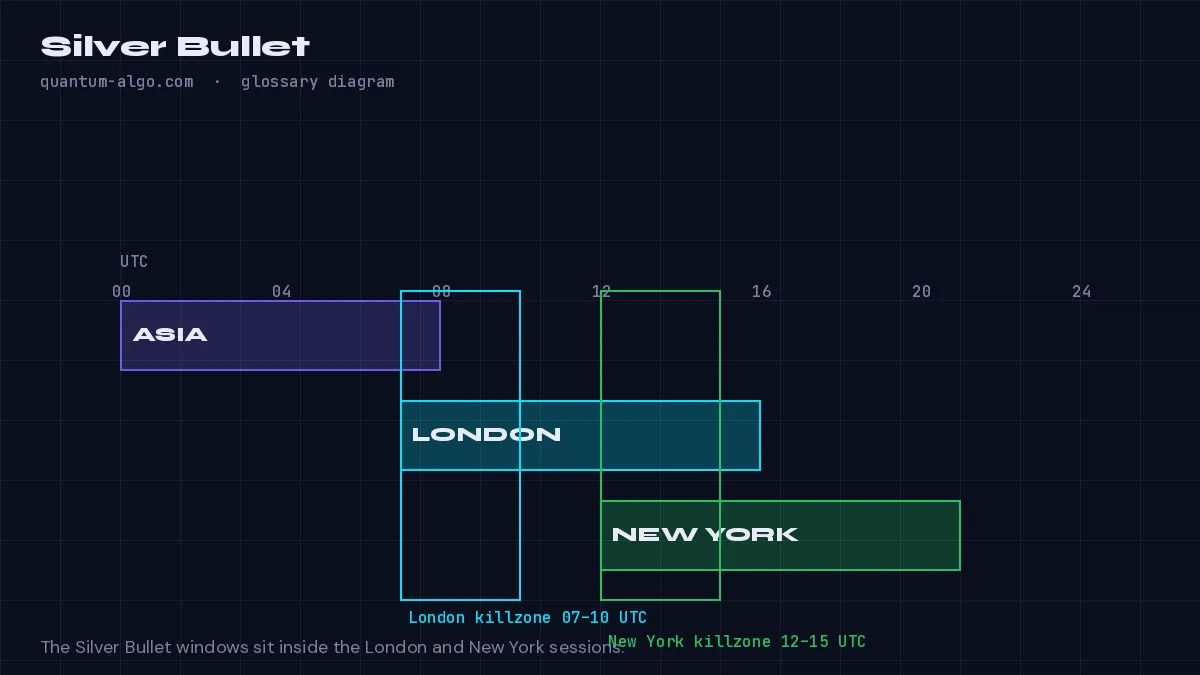
The Silver Bullet is an ICT time-based setup: a fair value gap that forms inside one of three one-hour windows (03:00–04:00, 10:00–11:00, 14:00–15:00 New York time) after a liquidity sweep, traded toward the next liquidity pool.
What it means
The Silver Bullet narrows the whole ICT method to a clock. In each of three specific hours — the London Silver Bullet at 03:00–04:00 ET, the AM session at 10:00–11:00 and the PM session at 14:00–15:00 — the trader waits for a liquidity sweep, then a displacement that leaves a fair value gap, and enters on the return to that gap. Targets are the nearest opposing liquidity: a session high or low, equal highs, a previous day's extreme.
The window matters because those hours coincide with the highest algorithmic participation in each session, and the fair value gap formed there is far more likely to be respected. Outside the window, the same pattern is a normal FVG trade with normal odds.
The OTE + Silver Bullet indicator marks the windows, detects the sweep and the gap, and grades the setup; the full guide walks through the rules, the risk model and the failure cases.
How to identify it on a chart
- Mark the three Silver Bullet windows in New York time on your chart.
- Inside a window, wait for a sweep of a recent high or low.
- Enter on the first fair value gap left by the displacement away from the sweep; stop beyond the sweep, target the next liquidity pool.
Worked example
At 10:12 ET, NQ sweeps the pre-market high and drops 40 points, leaving a 1-minute FVG. Price returns to the gap at 10:20; the short targets the overnight low, reached at 10:48 — a textbook AM Silver Bullet.
See it on the chart, read it in depth
Frequently asked questions
What are the Silver Bullet times?
03:00–04:00, 10:00–11:00 and 14:00–15:00 New York time. Convert to your local zone or use an indicator that draws them.
Which markets does the Silver Bullet work on?
Index futures, forex majors and gold are the classic markets; on crypto the AM and PM windows carry over, though weekends dilute the effect.
What is the risk-to-reward of a Silver Bullet?
Typically 2:1 or better — the stop sits just beyond the sweep and the target is the next liquidity pool; the guide shows how to size for it.
Does the Silver Bullet require an FVG?
Yes — the entry is the fair value gap; without one, the setup is not a Silver Bullet.
Related terms
See Silver Bullet on your TradingView chart
Zeno reads Smart Money structure across timeframes and prints the entry, stop and targets — with a public record of every posted trade. The free indicators draw the concepts this page defines.