Who Is ICT (Michael J. Huddleston)? The Trader Behind Killzones, FVGs and the 2022 Model
ICT is Michael J. Huddleston, an American trader who has published free market-structure lessons on YouTube as The Inner Circle Trader since 2010. He introduced killzones, Power of Three, Optimal Trade Entry, the Silver Bullet and the 2022 Model; liquidity, imbalance, accumulation and distribution come from Wyckoff, Market Profile and order flow. He has no verified track record.
I get asked "is ICT legit?" almost weekly, usually by someone who has just watched forty hours of him and is not sure whether they learned trading or joined something. This is the answer I give: who he is, what is verifiable, which concepts are genuinely his framing and which are older than he is, and the one thing to do before you trade any of it. Quantum Algo’s engine runs on the structural half of his catalogue — the half you can measure.
Indicators that prove themselves in public.
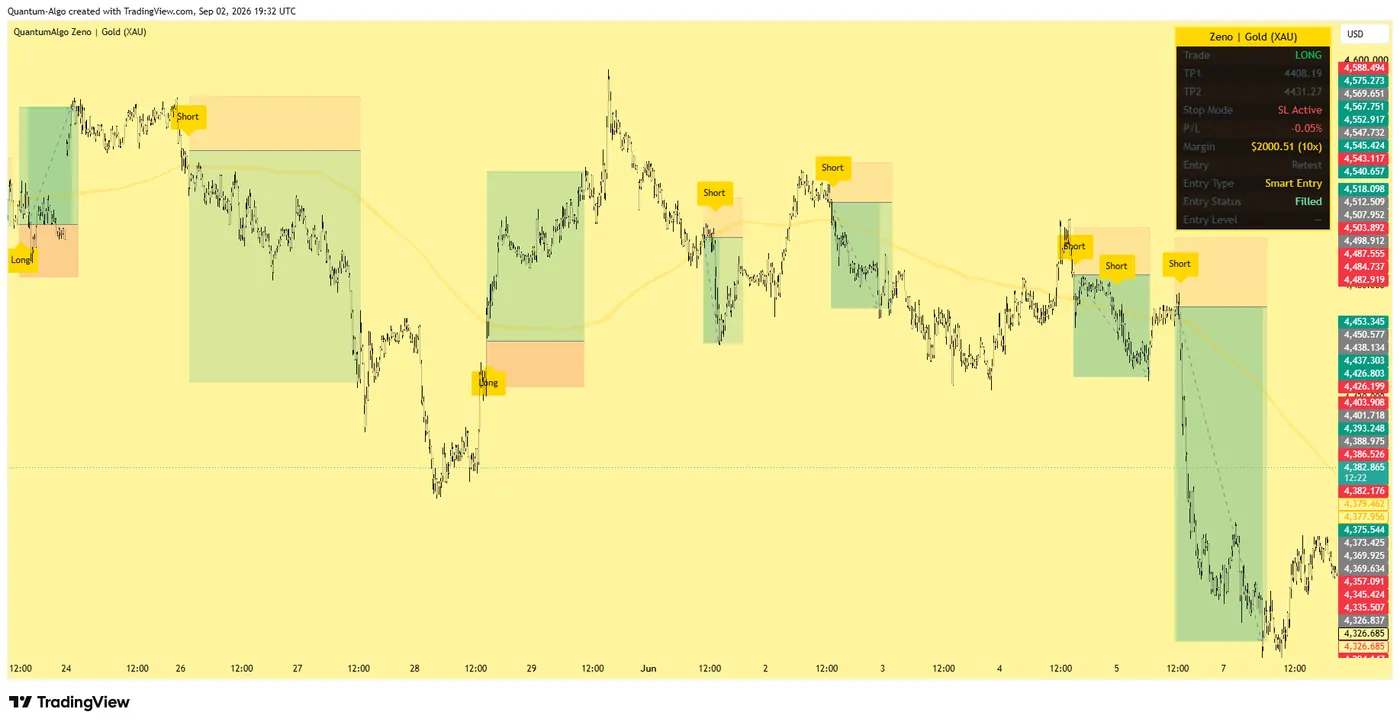
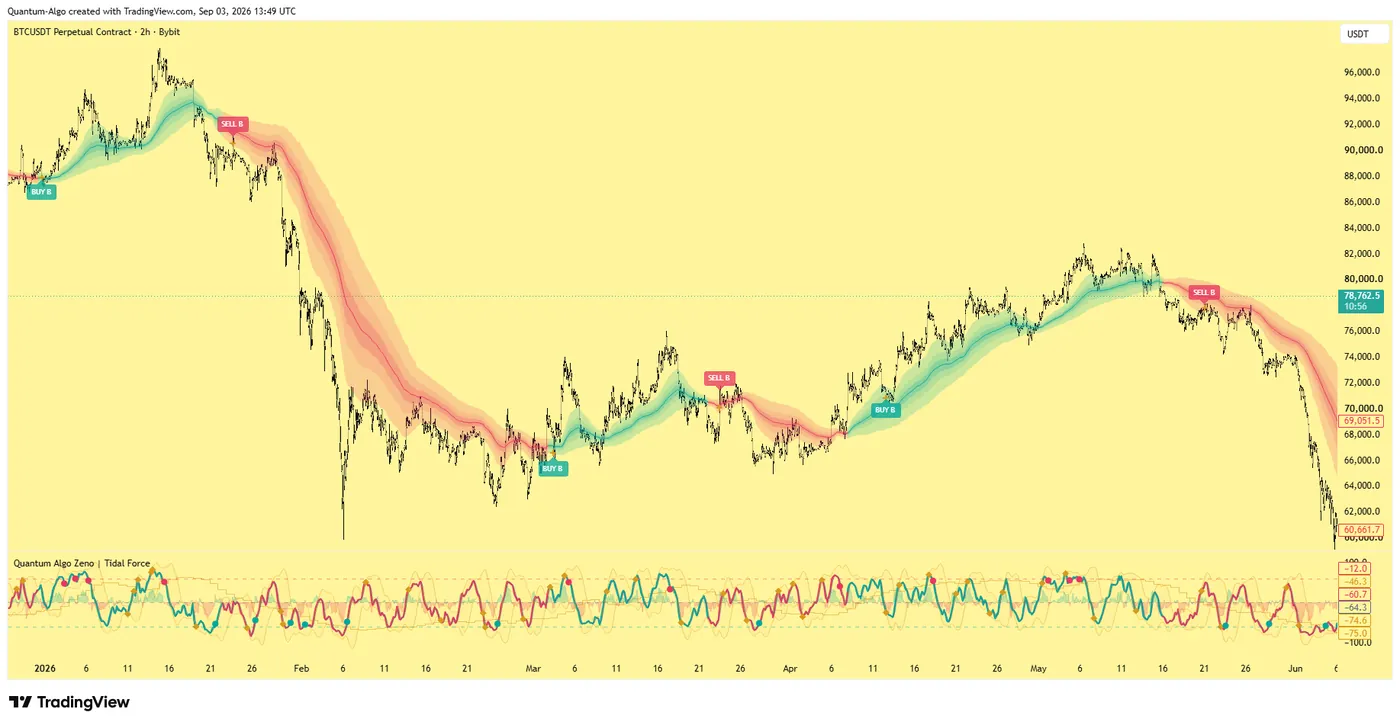
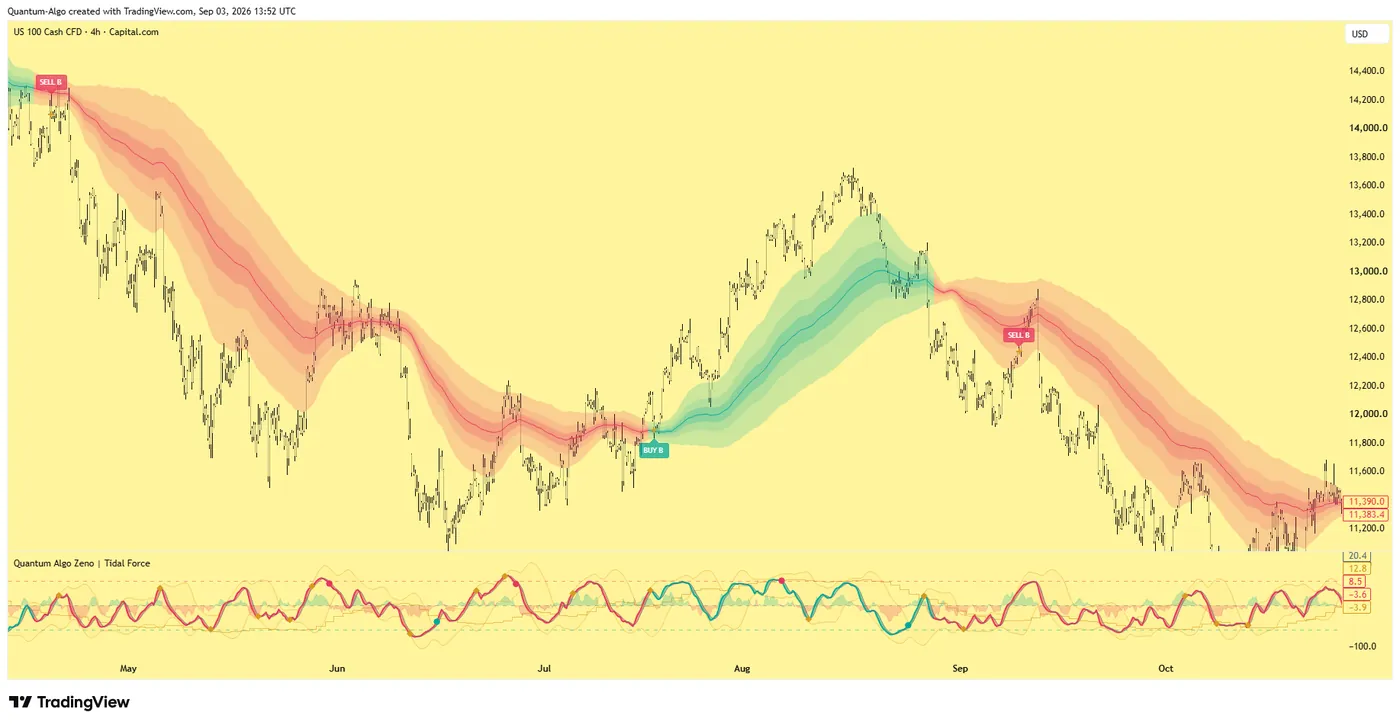
One engine, four precision tools — the Gold (XAU) Scalper, the institutional Gravity Zone, the Zeno momentum Oscillator, and Zeno Stocks for equities.
Who is ICT?
ICT is the online name of Michael J. Huddleston, an American trader and educator who has been publishing free market-structure lessons on YouTube since 2010 under the handle "The Inner Circle Trader". He is the person behind the vocabulary that now fills half of trading Twitter — killzones, fair value gaps, the Silver Bullet, the 2022 Model, Power of Three — and the reason a whole generation of retail traders draws boxes on candles instead of moving averages.
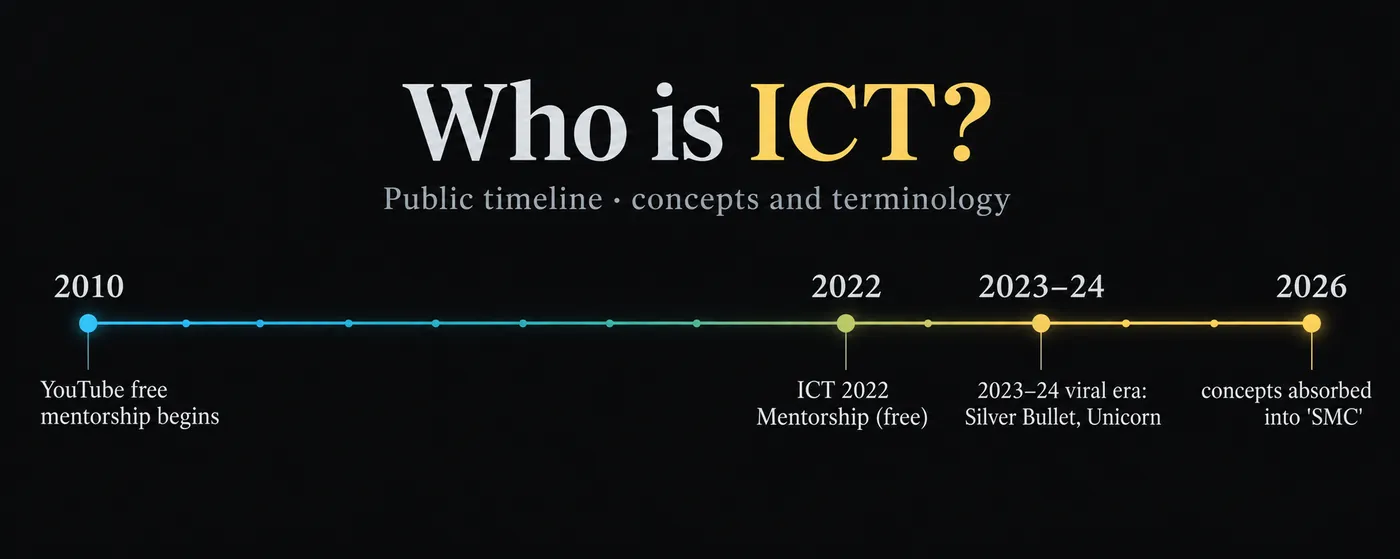
If you have searched for him you have probably found two things: thousands of hours of long, unedited videos, and an argument about whether any of it works. This page is the short answer to who he is, what he actually introduced, what he borrowed from older schools, and how to separate the method from the mythology.
What is actually known about Michael Huddleston?
Huddleston has been careful about what he shares publicly. What is verifiable: he is based in the United States, he has been active online under the ICT name since roughly 2010, he taught paid mentorship programmes earlier in his career and then moved to publishing the material free, and his YouTube channel and X account are the primary sources of his teaching. He has said in his own videos that he began trading in the 1990s and describes his method as reverse-engineering how large institutions execute.
What is not verifiable: audited returns. Huddleston has never published a broker-verified track record, and he says openly that he does not intend to. That is the single fact worth holding onto when you read anything about him — from admirers or critics. Everything below is about the method, which you can test yourself, rather than the man, whom you cannot.
What did ICT actually introduce?
Strip away the branding and there are roughly six things in the ICT catalogue that are genuinely his framing, in the sense that the specific rules and names came from him:
- Killzones — fixed time windows (London 2:00–5:00 New York time, New York AM 8:30–11:00, New York PM 1:30–4:00) inside which he says the highest-probability moves occur.
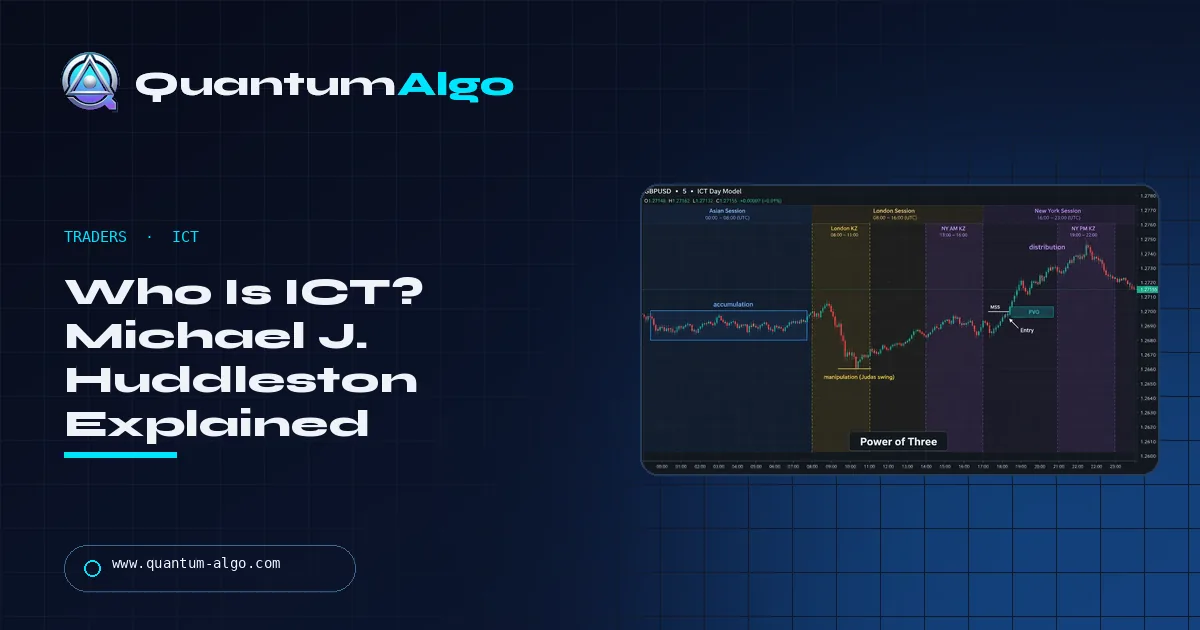
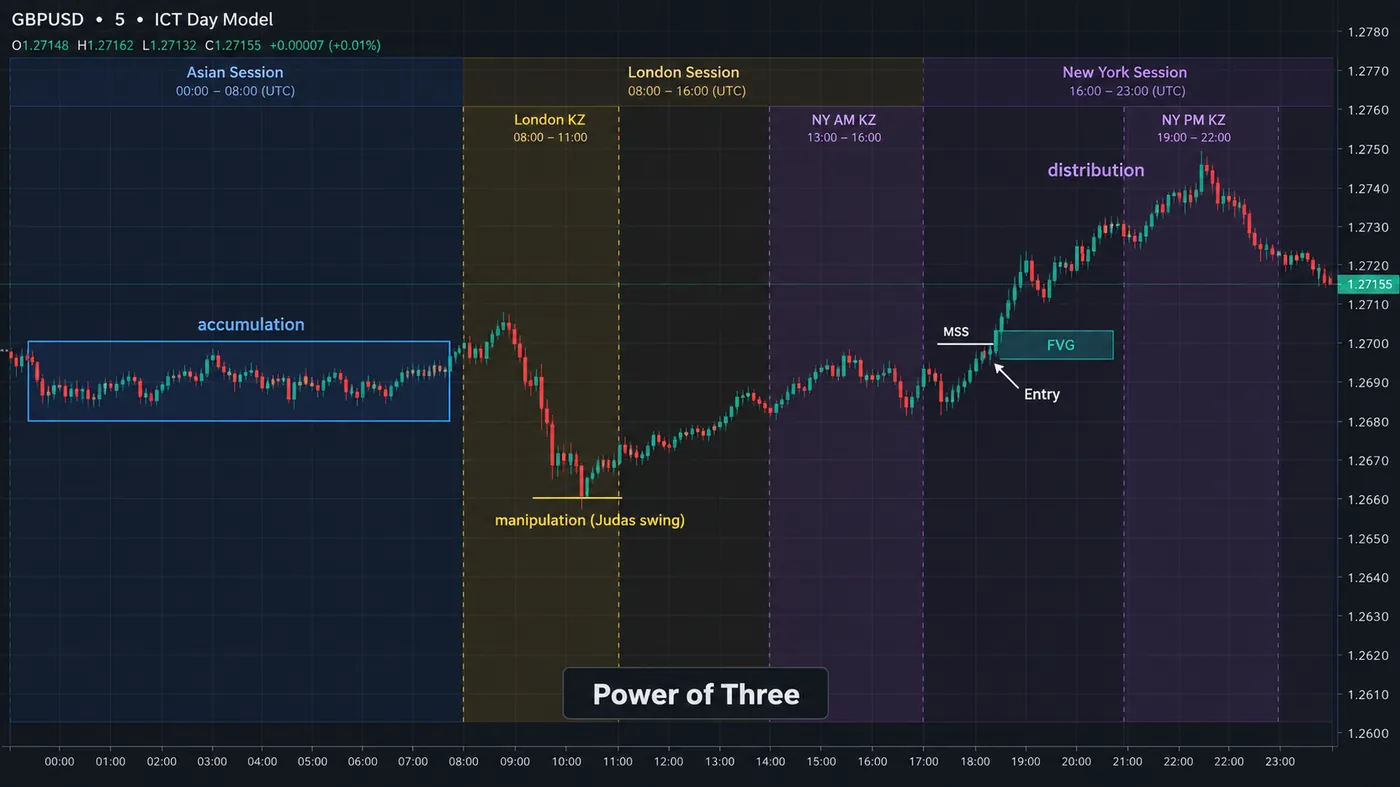
- Power of Three (AMD) — the idea that a session or a day is engineered in three phases: accumulation, manipulation (the "Judas swing" against the eventual direction), then distribution.
- Optimal Trade Entry (OTE) — a retracement entry between the 62% and 79% Fibonacci levels of the impulse leg.
- The Silver Bullet — a one-hour window (10:00–11:00 New York) where a fair value gap forming after a liquidity sweep is traded for a fixed target.
- The 2022 Model — a full-day sequence: higher-timeframe draw on liquidity, lower-timeframe sweep, market structure shift, entry on the fair value gap, target at the opposite liquidity.
- SMT divergence — reading correlated pairs (EUR/USD vs GBP/USD, ES vs NQ) for a failure to make a matching high or low as confirmation.
The chart in the middle of this guide shows the day model in one picture: an Asian range boxed as accumulation, a London sweep below it labelled manipulation, then the New York expansion as distribution, with the market structure shift and fair value gap marking the entry.
What did ICT borrow from older schools?
This is the part that gets people angry on both sides, so I will keep it factual.
Richard Wyckoff wrote about accumulation, markup, distribution and markdown in the 1930s; the Power of Three is a session-sized version of that cycle. J. Peter Steidlmayer's Market Profile, published by the CBOT in the 1980s, is where "value area", "imbalance" and the idea that price seeks liquidity at inefficient levels come from — fair value gaps are the three-candle expression of an imbalance. Order-flow traders were talking about stops resting above equal highs as "liquidity" for decades before the phrase "buy-side liquidity" appeared on YouTube.
None of that makes the ICT framing worthless. Naming things precisely and attaching times and rules to them is real work, and it is why his version spread when the originals did not. It just means the honest answer to "did ICT invent this?" is: he invented the packaging and the schedule, not the market behaviour.
ICT framing vs older roots at a glance
| Concept | What it describes | Origin |
|---|---|---|
| Killzones | Fixed London and New York time windows | ICT's framing |
| Power of Three (AMD) | Accumulation, manipulation, distribution in one session | ICT's framing of Wyckoff's cycle |
| Optimal Trade Entry | Entry at the 62–79% retracement | ICT's framing |
| Silver Bullet | FVG after a sweep, 10:00–11:00 New York | ICT's framing |
| Fair value gap | Three-candle imbalance | Older: Market Profile imbalance |
| Liquidity (BSL/SSL) | Stops resting above highs and below lows | Older: order-flow trading |
| Accumulation and distribution | Range phases before markup or markdown | Older: Wyckoff, 1930s |
◆The names, schedule and entry rules are ICT's; the market behaviour is older.
ICT versus SMC — is there a difference?
Smart Money Concepts is what happened when ICT's students, and their students, started teaching the material with their own names for it. Most of the vocabulary maps one-to-one: market structure shift became break of structure and change of character, breaker blocks became order blocks, the killzone schedule mostly got dropped. Our SMC vs ICT guide walks through the mapping on a single chart.
The practical difference is time. ICT is session-obsessed; SMC as it is usually taught trades structure whenever it appears. If you learned from an "SMC" account and never heard a killzone mentioned, you learned the structure half of ICT without the clock.
Does the ICT method work?
Here is the honest position after watching subscribers test it for years.
The structural ideas — liquidity above equal highs gets taken, displacement leaves imbalances that get revisited, entries at the origin of a move beat entries in the middle — are real and measurable. Quantum Algo's public track record is built on exactly these mechanics, executed by an engine rather than by eye, and it is published trade by trade on TradingView so anyone can count it.
What does not survive testing is the discretionary layer. "Wait for the killzone, then wait for the sweep, then wait for the shift, then decide if the FVG is clean enough" produces four or five judgement calls per trade, and two traders following the same video will mark different charts. That is why ICT's own students report wildly different results and why the method has a reputation for being unfalsifiable: any losing trade can be explained afterwards as a rule that was not quite met.
If you want to trade it, the fix is mechanical: write the rules down so precisely that a script could execute them, backtest that script, and only then trade it. Our free algorithmic trading course covers how.
Why does the ICT name draw so much criticism?
Three reasons, and they are separate.
The first is the absence of a verified record, covered above. The second is the length and style of the teaching — hundred-hour playlists, digressions, and a persona that promises institutional secrets — which reads as marketing to people outside the community. The third is the ecosystem around him: hundreds of accounts selling "ICT mentorship", funded-account challenges marketed on his clips, and indicator scripts using his terms, none of which he controls but all of which carry his name.
My own view is that the second and third are reasons to be careful with the community and the first is a reason to test everything, but neither is a reason to ignore the structural ideas, which are older than him and hold up.
How can you learn ICT concepts without the mythology?
- Start with the shared core — liquidity, market structure, order blocks, fair value gaps — which is the same whether you call it ICT or SMC. Our free 80-lesson Academy covers all four.
- Add time only after structure: run the same setups with and without the killzone filter and measure the difference on your own charts.
- Pick one model and one market. The 2022 Model on NAS100 during the New York AM session is the most-tested combination for a reason.
- Log every trade with the setup name, the session and the R-multiple; after fifty trades you will know whether the clock is helping you or just making you wait.
- Use a tool that marks the structure for you, so the only discretion left is whether to take the trade. That is the job Quantum Algo's free indicators do, and the reason Zeno exists.
ICT is Michael J. Huddleston: a real, long-running educator with no verified track record, whose original contributions are the schedule and the named models, and whose structural ideas are older than he is and hold up under testing. Learn the shared core first, add time second, write the rules precisely, and measure — the method rewards mechanics and punishes mythology.
◆ Interactive check
Is it ICT’s, or older than him?
Questions people ask about ICT
He says so and has taught publicly since 2010, but he has never published a broker-verified track record. Judge the method by testing it, not by the person.
The YouTube material, including the 2022 Mentorship playlist, is free. Anything sold as "ICT mentorship" by a third party is not from him.
The 2022 Model, because it is a complete sequence from higher-timeframe bias to exit, and because NAS100 in the New York AM killzone gives you a repeatable environment to practise it.
London 2:00–5:00 am New York time; New York AM 8:30–11:00 am; New York PM 1:30–4:00 pm. The Silver Bullet window is 10:00–11:00 am New York.
He popularised the names and the entry rules. The underlying ideas — institutional footprints and price imbalance — come from Wyckoff, Market Profile and order-flow analysis that predate him by decades.
Inner Circle Trader — Michael J. Huddleston’s online name and the name of his teaching method. In trading conversation "ICT" refers to both the person and the concepts.
SMC grew out of ICT’s students teaching the material under their own names. Most of the vocabulary maps one-to-one; the main practical difference is that ICT is strict about session timing and most SMC teaching is not.
With the shared core — liquidity, market structure, order blocks and fair value gaps — because it is the same whether you learn it as ICT or SMC. Add killzones after you can mark structure without them.
No. Huddleston does not publish indicators. Scripts using his terms are third-party, and their quality varies from useful to repainting.
Zeno reads the structural side — liquidity sweeps, order blocks, imbalances, structure shifts — and prints signals on confirmed closes with the stop and targets drawn. It does not use killzones as a filter; the public track record shows the results without the clock.
References & Related Guides
Read next
- ICT Trading Strategy: Complete Guide
- SMC vs ICT: Key Differences
- ICT 2022 Model
- Optimal Trade Entry (OTE)
- Wyckoff Method
- Smart Money Concepts Guide
- Liquidity Sweep Trading
Authoritative sources
- The Inner Circle Trader — official YouTube channel
- ICT 2022 Mentorship playlist (free)
- Richard D. Wyckoff — The Wyckoff Method (archive)
- CME Group: Market Profile (Steidlmayer) education
- CFTC: advisories on trading educators and unverified performance claims