Displacement Trading: The Footprint of Institutional Conviction
| Signal type | SMC concept (impulse move) |
| Directional bias | Direction of displacement |
| Best context | Fresh break of structure leaving FVGs behind |
| Confirmation | Retracement into the displacement FVG that holds |
| Invalidation | Full fill of the displacement leg's origin |
1. What Is Displacement in Trading?
Displacement is a strong, impulsive price move that breaks decisively in one direction with significant momentum, creating an unmistakable visual gap between the prior consolidation and the new directional flow. In Smart Money Concepts (SMC) and ICT methodology, displacement is the visible footprint of institutional commitment — the precise moment when large players stop accumulating quietly and begin moving aggressively to drive price in their intended direction.
Displacement is not just any strong candle. It is a specific pattern with measurable characteristics: large body relative to recent candles, minimal upper and lower wicks indicating one-sided pressure, and a movement that decisively breaks structure or invalidates a prior consolidation pattern. When displacement occurs, it confirms that institutions have committed capital to the new direction and are no longer interested in accumulating or distributing at previous prices.
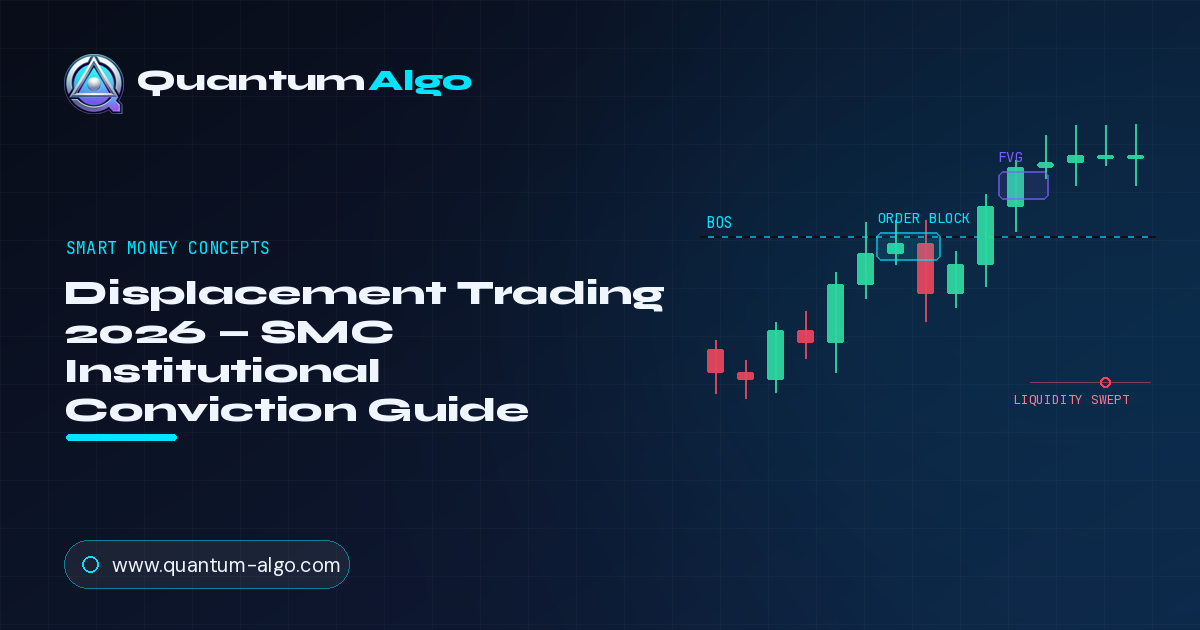
The concept of displacement is foundational to every SMC trading framework. Order blocks are not valid without displacement — the candle preceding a strong displacement is what creates the OB. Fair Value Gaps are formed by the displacement move itself — the gap between candles in the displacement leg is the FVG. Break of Structure (BOS) is confirmed by displacement breaking through a swing high or low. Without displacement, none of these SMC concepts work — they are all built on top of the displacement footprint.
Recognizing displacement in real time separates beginning SMC traders from professionals. Beginners draw order blocks and FVGs at any candle that "looks like" the pattern, ignoring whether the surrounding context actually showed displacement. Professionals require displacement confirmation before marking any institutional zone. This single discipline — requiring displacement validation for every SMC setup — is the difference between consistent profitability and consistent losses in institutional trading. For broader context, see our Smart Money Concepts Guide and ICT Trading Strategy Guide.
2. Anatomy of a Displacement Candle
Every valid displacement has measurable characteristics. The pattern is not subjective — it follows a specific structural template that you can verify visually or programmatically.
Component 1: Large body relative to recent candles. The displacement candle's body (open to close) must be significantly larger than the average body of preceding candles — ideally 1.5x to 3x or larger. The body size directly measures the magnitude of directional pressure during that period. A candle with a body equal to or smaller than recent candles cannot qualify as displacement regardless of how directional it appears, because there was insufficient one-sided pressure to break the existing equilibrium.
Component 2: Minimal wicks on both sides. Long upper or lower wicks indicate price rejection — the move tested higher (or lower) levels but failed to hold them. Displacement requires the opposite: conviction throughout the candle. The wicks should be small relative to the body, typically less than 20% of the body length on each side. Long wicks on a "displacement" candle disqualify it because they reveal failed attempts in one direction, not committed flow.
Component 3: Multiple consecutive impulsive candles preferred. The strongest displacement is not a single candle but a sequence of 2-4 consecutive impulsive candles in the same direction. Single-candle displacements can occur (especially on news), but multi-candle displacements demonstrate sustained institutional commitment rather than momentary volatility. Look for 3-candle displacement sequences as the gold standard.
Component 4: A visible Fair Value Gap. True displacement leaves a price imbalance — the candles move so fast that there is an unfilled gap between the wicks of consecutive candles. Specifically, the lower wick of candle 3 does not overlap the upper wick of candle 1 (in a bullish displacement). This unfilled price range is the FVG. Without a visible FVG on the lower timeframe, the displacement was probably not strong enough to qualify as institutional.
Component 5: A break of recent structure. The displacement must decisively break either a swing high (bullish displacement) or swing low (bearish displacement) from the prior consolidation. A strong directional candle that fails to break structure is just strong directional volatility, not displacement. The structural break confirms the move has institutional consequences for the market's directional bias.
3. How to Identify Valid Displacement (5 Criteria)
The five-criterion validation framework eliminates ambiguity in displacement identification. Every criterion must be met before you can confidently mark a move as institutional displacement.
Criterion 1: Body size 1.5x+ the average of preceding 10 candles. Calculate the average body size of the previous 10 candles, then verify the displacement candle's body is at least 1.5x that average — preferably 2x or 3x larger. This quantifies the relative impulse. A 30-pip candle in a market where recent candles averaged 8 pips is clear displacement; the same 30-pip candle in a market where recent candles averaged 25 pips is not displacement, just normal momentum.
Criterion 2: Wick-to-body ratio under 0.2 on both sides. Measure the upper wick and lower wick separately, dividing each by the body length. Both ratios should be below 0.2 (the wicks should be less than 20% of the body length). A candle with a 50-pip body and a 5-pip top wick passes (10% ratio). A candle with a 50-pip body and a 30-pip top wick fails (60% ratio) — too much rejection occurred.
Criterion 3: Decisive break of recent swing high or low. The displacement must push price beyond the most recent meaningful swing extreme. A 50-pip green candle that ends 5 pips below the prior swing high is not a confirmed displacement — it failed to break structure. A 30-pip green candle that pushes 15 pips beyond the prior swing high IS displacement — structure broke.
Criterion 4: Fair Value Gap visible on the lower timeframe. Drop down to the next lower timeframe (e.g., from 1H to 15M). The displacement leg should show a 3-candle FVG pattern — candle 1's upper wick does not overlap candle 3's lower wick (or the reverse for bearish displacement). If no FVG appears on the lower timeframe, the move probably was not impulsive enough to qualify as institutional displacement.
Criterion 5: Volume confirms institutional participation. The displacement candles should occur on volume significantly above the recent average — typically 1.5x to 3x. Volume context distinguishes institutional displacement from algorithmic noise or thin-market spikes. Displacement candles on flat volume often indicate manipulation or low-liquidity moves that fail to sustain.
The combined filter: Apply all 5 criteria sequentially. If a candle passes all 5, you have institutional-grade displacement that validates surrounding SMC structures (order blocks, FVGs, BOS confirmations). Skip setups where 2+ criteria are missing — the displacement is questionable and downstream SMC concepts cannot be reliably marked.

Automate your trades. Let Quantum Algo trade for you.
Every signal executed on your own account — 24/7, hands-off.
4. Why Displacement Matters — The Institutional Signal
Displacement is not just a chart pattern — it is the structural mechanism that signals institutional commitment. Understanding why displacement carries meaning helps you recognize when it is genuine versus when retail momentum is mimicking it.
The accumulation phase reality: Institutions accumulating large positions cannot move price aggressively in their intended direction until their accumulation is complete. Doing so would warn other market participants and ruin their average entry. The accumulation phase is characterized by sideways consolidation with small candles and balanced wicks — institutions buying or selling quietly within the range.
The displacement transition: Once accumulation is complete, the institution no longer benefits from price staying at the accumulation level. They release the artificial "lid" that was keeping price in the consolidation range and aggressively position to drive price toward their target. The result is the displacement candle — the moment of transition from accumulation to mark-up (for longs) or distribution to mark-down (for shorts).
Why the body size signals commitment: A small-bodied candle indicates balanced flow — buyers and sellers roughly matched throughout the period. A large body with small wicks indicates dominant flow — one side overwhelming the other. The relative body size directly measures how committed the dominant side was during that period. Larger bodies = stronger commitment = more institutional involvement.
Why minimal wicks matter: Wicks represent failed attempts in the opposite direction. A 50-pip bullish candle with a 30-pip top wick means buyers initially pushed 80 pips up, then sellers pushed price back down 30 pips. That is not committed flow — that is a battle. A 50-pip bullish candle with a 5-pip top wick means buyers pushed up and never gave back significant ground — true committed institutional buying.
Why the structure break matters: Institutions only need to displace when they are changing the market's directional bias. A move that fails to break structure was not actually changing the market — it was just causing volatility within the existing structure. A move that decisively breaks a swing extreme has changed the dominant directional flow and forces other market participants to adjust their positioning accordingly.
The order flow interpretation: Each displacement candle represents thousands of small executions concentrated in one direction. Footprint chart analysis (see our Order Flow Guide) reveals that displacement candles show heavy imbalance — buy volume far exceeding sell volume (or vice versa). The chart pattern is the macro-level signature of micro-level order flow imbalance.
The trader's takeaway: Without displacement, the market has not actually committed to a direction. Order blocks, FVGs, and BOS confirmations all derive their predictive power from the displacement that preceded them. Marking SMC zones without displacement validation produces fake signals and consistent losses. The discipline of requiring displacement for every SMC setup is what separates 65% win-rate traders from 50% win-rate traders.
5. Displacement Confluences — OB, FVG, BOS
Displacement gains its full power when combined with surrounding SMC structures. Here is how displacement interacts with the three core SMC concepts to create high-probability setups.
Displacement + Order Block: The candle immediately before a displacement is what creates the order block. The order block is the last opposing candle (last bearish before a bullish displacement, or last bullish before a bearish displacement). Without the displacement, the candle is just a normal candle in a consolidation — no OB exists. When price returns to the order block later for a retest, the displacement that originally formed it confirms institutional positioning at that level. See our Order Block Trading Guide for full mechanics.
Displacement + Fair Value Gap: Displacement creates FVGs as a byproduct of impulsive movement. The faster price moves in one direction, the more likely an unfilled gap exists between the wicks of consecutive candles. A 3-candle FVG inside a displacement leg is the strongest pattern — both the displacement (proving institutional commitment) and the FVG (proving urgent imbalance) at the same location. When price returns to fill the FVG, it must navigate the institutional zone created by the displacement. See our FVG Guide for complete framework.
Displacement + Break of Structure (BOS): BOS is only valid when caused by displacement. A swing high broken by a small-bodied candle with long wicks is a "weak BOS" that often fails to sustain the new direction. A swing high broken by a displacement candle with large body and minimal wicks is a "strong BOS" that confirms a genuine trend shift. Always verify displacement when assessing BOS quality — weak BOS produces continuation fakeouts, strong BOS produces sustained trend changes.
The triple confluence setup: When displacement, OB, and FVG all align at a specific price zone, you have the gold standard SMC setup. The order block marks the institutional positioning zone, the FVG marks the urgency imbalance, and the displacement confirms institutional commitment. Win rates on triple-confluence setups are documented at 75-85% across major pairs and timeframes — the highest in retail trading.
How to trade the confluence: Wait for price to return to the OB + FVG zone on the timeframe where the displacement originally formed. Look for rejection (engulfing, pinbar, internal BOS on the next lower timeframe). Enter on rejection close. Stop just beyond the OB/FVG combined zone. Target the next opposing structural level or the origin of the displacement leg. Expected R:R: 3:1 to 6:1.
6. How Do You Trade Displacement? Four Proven Strategies
Strategy 1: Trade With the Displacement (Beginner)
The simplest strategy. When displacement occurs in a clear direction, enter on the close of the displacement candle or the next candle. Stop just below the OB created by the displacement (or just above for shorts). Target the next opposing structural level. This is momentum trading — you enter as institutions commit, riding their move to the target.
Setup requirements: Displacement must pass all 5 criteria. Higher timeframe trend must align. Avoid trading displacement against major HTF trend reversals. Expected R:R: 2:1 to 4:1. Expected win rate: 60-70%.
Strategy 2: Displacement-Created Order Block Retest (Intermediate)
After displacement, mark the OB it created (last opposing candle before the displacement). Wait for price to retrace to the OB. Enter on rejection candle inside the OB. Stop just beyond the OB extreme. Target the origin of the displacement leg (typically the displacement's high or low) or the next opposing structural level.
Why this works: The retest of a displacement-confirmed OB combines mean reversion (price returning to the OB) with institutional positioning (proven by the displacement). High win rate due to dual confirmation. Expected R:R: 3:1 to 5:1.
Strategy 3: Displacement Triple Confluence (Advanced)
Wait for setups where displacement, OB, and FVG all align at the same zone. Mark the combined zone. Wait for price to return for a retest. Enter on rejection within the combined zone. Tight stop just beyond the zone. Target the next opposing major structural level.
Why this is the best: Triple confluence produces the highest win rates in SMC trading. The combination of institutional positioning (OB) + urgency imbalance (FVG) + committed flow (displacement) creates compressed reaction zones with explosive responses. Expected R:R: 4:1 to 8:1. Expected win rate: 75-85%.
Strategy 4: Multi-Timeframe Displacement Stack (Expert)
Identify displacement on a higher timeframe (Daily or 4H). Drop to the LTF (1H or 15M) and find a smaller displacement in the same direction nested within the HTF displacement zone. Enter on the LTF displacement. The HTF displacement provides the directional bias and wide target; the LTF displacement provides precise entry timing with tight stop.
Expected R:R: 5:1 to 10:1. The tightness of the LTF entry combined with the wide HTF target produces exceptional risk-to-reward ratios. This is the strategy used by professional discretionary traders for major positions.
7. Common Displacement Trading Mistakes
Mistake 1: Marking SMC zones without verifying displacement. The most common error in retail SMC trading. A trader sees a candle that "looks like" an OB or FVG and marks it without checking whether displacement actually occurred. Without displacement, the candle is not an institutional zone — it is just a candle. Always validate displacement first; mark zones only when displacement is confirmed.
Mistake 2: Mistaking volatility for displacement. News events, low-liquidity periods, and end-of-session moves can produce large directional candles that look like displacement but lack institutional structural significance. These "fake displacements" often reverse quickly and produce losing trades. Always check whether the candle aligns with the 5 displacement criteria — particularly volume context and structural significance.
Mistake 3: Trading displacement against HTF trend. A bullish displacement on the 5M chart against a strongly bearish 4H trend often produces a short-term move that reverses violently. Higher timeframe institutional flow overrides lower timeframe displacement. Always check the next 2 timeframes up before trading any displacement.
Mistake 4: Entering too late after displacement. Traders see displacement complete, then wait too long for "confirmation" — entering 3-4 candles after the displacement. By then, the easy edge has been captured. Best entries are at the close of the displacement itself or the immediate next candle. Delayed entries miss the optimal risk-to-reward window.
Mistake 5: Tight stops on momentum displacement trades. Trying to use a 5-pip stop on a displacement that moved 80 pips often gets stopped by normal volatility. Adjust stop placement to the structural level created by the displacement (just beyond the OB or origin of displacement), not arbitrary tight stops based on entry price.
Mistake 6: Ignoring volume confirmation. Displacement candles on flat volume often fail to sustain. The volume signature is part of the validation framework — without it, displacement loses its institutional confirmation. Always verify volume expansion on displacement candles before treating them as institutional commitment.
8. Test Your Knowledge
Seven questions on displacement trading.
9. Detect Displacement Automatically
Validating every candle against the 5-criterion displacement framework manually takes minutes per chart across multiple pairs and timeframes. Algorithmic detection handles validation in milliseconds and only highlights candles that pass all criteria.
Frequently Asked Questions
Displacement is a strong impulsive price move with a large body and minimal wicks that decisively breaks structure or invalidates prior consolidation. It is the visible footprint of institutional commitment — the foundation of every SMC concept including order blocks, FVGs, and Break of Structure.
Apply 5 criteria: (1) body size 1.5x+ the average of preceding 10 candles, (2) wick-to-body ratio under 0.2 on both sides, (3) decisive break of recent swing high or low, (4) visible FVG on the lower timeframe, (5) volume 1.5x+ recent average. All five must be present.
Every SMC concept depends on displacement. Order blocks need displacement to be valid. FVGs are created by displacement. BOS is confirmed by displacement. Marking SMC zones without displacement validation produces fake signals and consistent losses. Always verify displacement before marking any institutional zone.
A breakout is any move beyond a previous high or low. Displacement is a specific type of breakout with large body, minimal wicks, structural significance, and volume confirmation. All displacements are breakouts, but most breakouts are not displacements. The quantitative validation framework distinguishes institutional displacement from retail breakouts.
When displacement, order block, and Fair Value Gap all align at the same price zone, you have the triple confluence — the gold standard SMC setup. Win rates on these setups are documented at 75-85% across major pairs and timeframes, the highest in retail trading.
Higher timeframes (4H, Daily) produce the strongest, most reliable displacements because institutional positioning is heaviest on higher timeframes. Drop to 15M or 5M for entry timing using the lower-timeframe displacement nested within the HTF displacement zone.
For trade-with-displacement strategies: just beyond the order block created by the displacement, with 0.5 ATR buffer. For OB retest strategies: just beyond the OB extreme. Avoid arbitrary tight stops based on entry price — use structural stops based on the displacement's footprint.
Yes. Displacement works on every liquid market — forex, crypto, indices, gold, futures. The mechanic depends on institutional execution behavior, which is universal across markets with significant institutional participation. The 5-criterion validation framework applies identically across asset classes.
References & Related Guides
More in this topic
- What Is Institutional Trading? How Big Orders Move Markets (and Leave Footprints)
- BOS & CHoCH: Complete Market Structure Guide 2026
- Breaker Block Trading 2026 — 5-Condition Complete Guide
- Fair Value Gaps (FVG): Complete Trading Guide 2026
- ICT Silver Bullet Strategy: The Complete Guide (2026)
- ICT Trading Strategy: Complete Interactive Guide 2026
- Is ICT and SMC the Same? Differences Explained (2026)
- Liquidity Sweep Trading: Stop Hunts Explained (2026 Guide)
- Liquidity Trading Guide 2026 — Raids & Kill Zones
- Order Blocks Trading: Complete 2026 Guide
- Order Flow Trading 2026 — Read the Footprint of Institutions
- Smart Money Concepts (SMC): Ultimate Trading Guide 2026
- What Is a Market Structure Shift (MSS) in Trading? 2026
Core reading
For a focused comparison, read the BPR displacement context before applying the setup.