Distribution
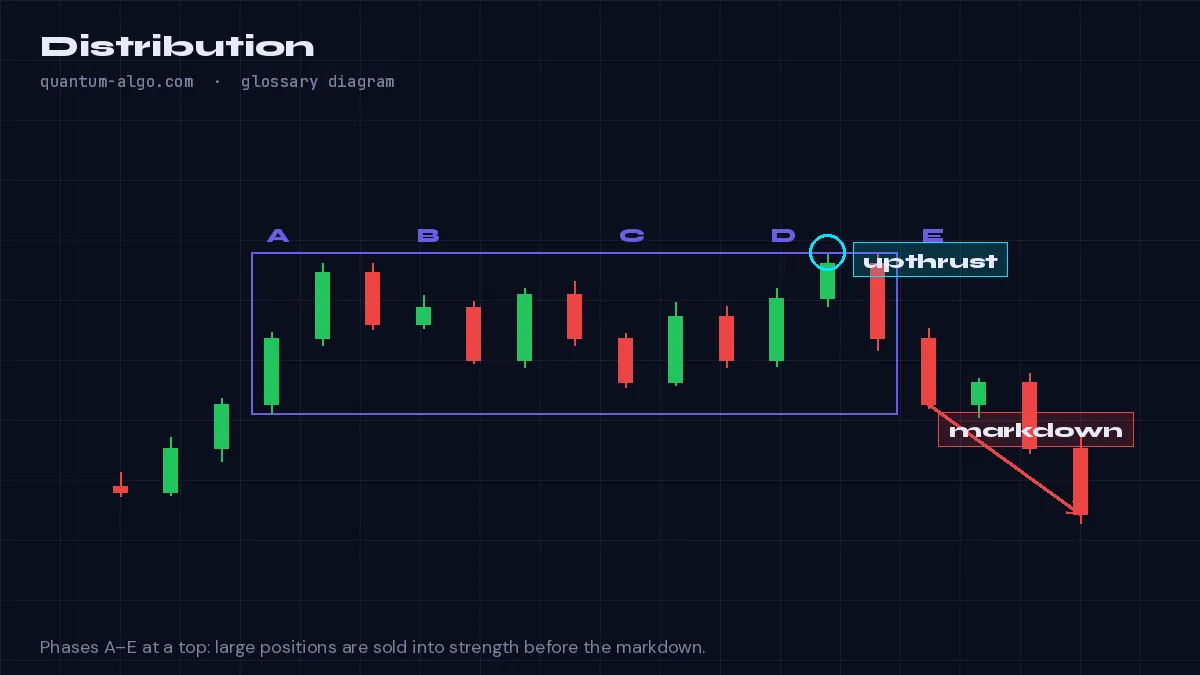
Distribution is the Wyckoff phase where institutions offload long positions to retail traders during apparent consolidation at highs, before a markdown begins. Traders watch for an upthrust, a false break above the range that is sold immediately, followed by a bearish displacement through range support; that sequence signals exiting longs and preparing shorts.
◆Full guide: Wyckoff Method: The Complete Institutional Market Methodology Guide
What it means
Distribution is the Wyckoff phase where institutional traders quietly exit long positions while retail traders, drawn in by the prior markup, continue to buy. The chart appearance: an extended trading range near the highs of a prior uptrend, with decreasing buying volume and increasing volume on selling within the range. Retail traders see 'consolidation near highs'; institutions are distributing.
Distribution mirrors accumulation in structure but inverts in direction. The corresponding Wyckoff events are: Preliminary Supply, Buying Climax, Automatic Reaction, Secondary Test, and Upthrust (the inverse of the Spring — a deliberate sweep above range resistance to trigger long-stops and breakout-buy orders before markdown begins). The Upthrust is the institutional 'last chance' to offload remaining inventory before pulling support.
The Upthrust + Sign of Weakness sequence is the actionable distribution event. Price breaks above the range high, sweeps buy-side liquidity, then prints a strong bearish displacement candle that breaks range support. This is the textbook distribution-to-markdown transition and corresponds exactly to the modern SMC pattern of equal-highs sweep + bearish CHoCH.
Recognizing distribution in real time is one of the most valuable skills in trading. Most retail traders buy at distribution (because price is at highs and the recent trend was up) and lose. Traders who recognize distribution can scale out of long positions, prepare short setups, and avoid the markdown phase that follows.
How to identify it on a chart
- A prior uptrend stalls into a buying climax on heavy volume.
- Price ranges; rallies come on decreasing volume while dips find heavier selling.
- An upthrust — a false break above the range — is sold immediately, then structure breaks down.
Worked example
After a parabolic run, ETH ranges for two weeks. A wick above the range high is sold instantly and the candle closes back inside — the upthrust; the following break below the range low with volume starts the markdown.
See it on the chart, read it in depth
Frequently asked questions
How is distribution different from a healthy pullback?
Distribution lasts longer (weeks to months on daily) and shows characteristic volume signatures (decreasing buying, increasing selling within the range). Healthy pullbacks are shorter and shallower, without extended ranging at highs. The Upthrust event distinguishes distribution from continuation pullbacks.
What is an Upthrust?
The Wyckoff term for a deliberate sweep above range resistance that fails. Price breaks the range high, triggers buy-stops and breakout-buy orders, then reverses sharply downward. The Upthrust is the inverse of the Spring — both are deliberate liquidity events, but Spring marks accumulation completion while Upthrust marks distribution completion.
Should I short during distribution?
Yes, after confirmation. The textbook short entry is after the Upthrust + Sign of Weakness sequence: the Upthrust sweeps BSL, the Sign of Weakness (bearish displacement candle) breaks range support, and you enter on a pullback to the order block or FVG that produced the Sign of Weakness.
Related terms
See Distribution on your TradingView chart
Zeno reads Smart Money structure across timeframes and prints the entry, stop and targets — with a public record of every posted trade. The free indicators draw the concepts this page defines.