The Best Crypto Indicator: Reading the Liquidation Game on Bitcoin & Altcoins
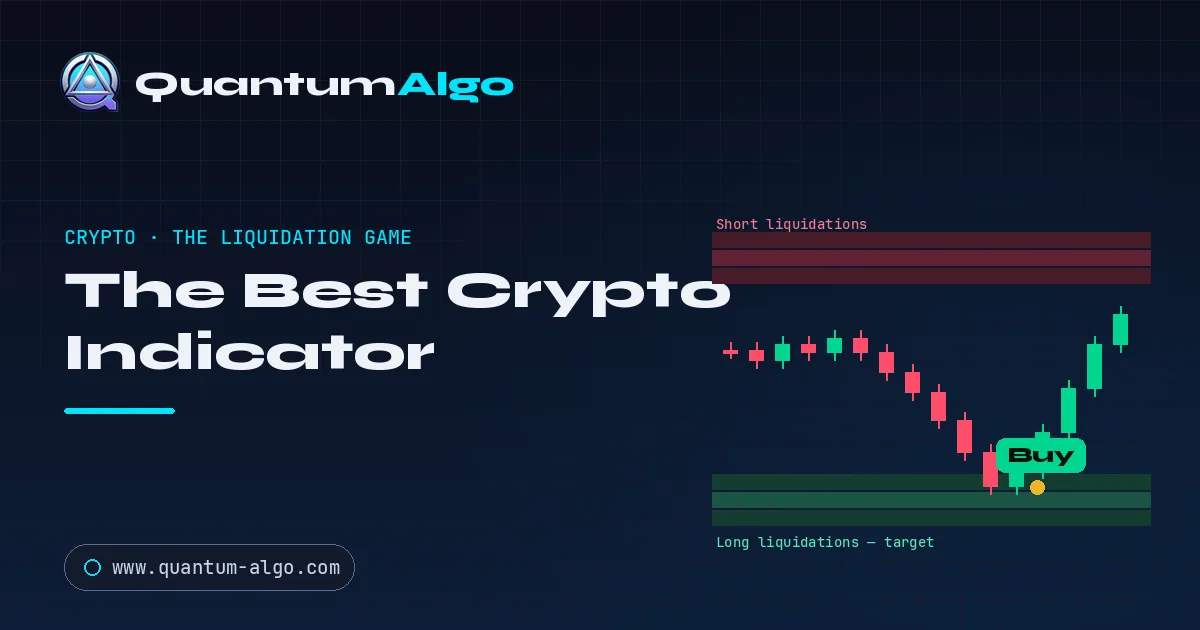
The best crypto indicator reads liquidation liquidity, not momentum. Because exchanges offer 50x, 100x and even 125x leverage, liquidation clusters sit above and below price, and market makers push price into them to harvest forced fills before reversing. No RSI can see that map; a Smart Money Concepts structure engine maps the sweeps, order blocks and funding-driven reversals into close-confirmed entries.
Crypto is the only market where the crowd's stop-losses are the trading opportunity. Because every major exchange offers 50×, 100×, even 125× leverage, the order book is stacked with liquidation levels — prices at which leveraged positions get force-closed. Market-makers can see those clusters, and they push price straight into them to harvest the forced fills before reversing. No RSI reading, no moving-average cross, and no on-chain dashboard can see that map. The best crypto indicator is the one that reads the liquidation game directly — and that is what Quantum Algo is built to do.
Indicators that prove themselves in public.
One engine, four precision tools — the Gold (XAU) Scalper, the institutional Gravity Zone, the Zeno momentum Oscillator, and Zeno Stocks for equities.
This guide is not a list of oscillators. It explains why crypto behaves unlike any other asset, walks through the mechanics of a liquidation hunt candle by candle, and shows how a Smart Money Concepts engine turns funding, leverage and liquidity into non-repainting entries with a verified public record. It's written for people who have watched a "perfect" long get wicked out to the exact dollar and want to understand who did it and why.
| The core problem | Leverage creates liquidation clusters; market-makers hunt them, and lagging tools can't see them |
| What it is | A Smart Money Concepts structure engine that maps liquidation liquidity, not momentum |
| Best for | BTC, ETH and liquid altcoins on TradingView — spot or perps, 24/7, any timeframe |
| Reads | Liquidation sweeps, order blocks, FVGs, funding-driven reversals, MTF structure |
| Signals | Non-repainting, close-confirmed Buy / Sell with exact entry, stop, two targets |
| Proof | Public, timestamped record — 75% win rate over 160 closed signals |
Why is crypto structurally unlike every other market?
Three features make crypto its own animal, and every one of them breaks the classic indicators.
It never closes. There is no opening bell to reset momentum, no session to anchor a moving average. Trends run through weekends and holidays, and the thinnest liquidity — Sunday nights, holiday mornings — is precisely when the largest engineered moves happen, because it costs less to push price when the book is empty.
It is a leverage market first. Spot volume is a fraction of perpetual-futures volume. That means the dominant order flow is leveraged, and leveraged positions have a hard floor and ceiling: the liquidation price. Millions of longs opened at similar levels create a shelf of sell-stops beneath price; shorts create buy-stops above. Those shelves are the liquidity that moves the market.
Funding steers it. When perpetual funding turns sharply positive, the crowd is heavily long and paying to hold — a setup for a long squeeze down into their liquidations. Negative funding is the mirror. Funding is a real-time crowd-positioning gauge that no equity or forex trader even has.
An RSI knows none of this. It reads the same "overbought" whether the book is stacked with liquidations or empty. To trade crypto well you need a tool that reads the map underneath the price, not a smoothed version of the price itself.
How does a crypto liquidation hunt unfold?
Here is the move that costs retail traders the most money, drawn out step by step.
Price consolidates and a shelf of long liquidations builds a few percent below — every leverage trader who bought the dip has a stop or a liquidation there. The move looks bullish, so more longs pile in. Then, often in thin hours, price is pushed down hard through that shelf. Each liquidation that triggers becomes a forced market sell, which drives price lower, which triggers the next liquidation — a cascade. For a few seconds the chart looks like the end of the world. Then, with the forced sellers flushed out and the desks filled long at the bottom, price snaps back violently. The traders who got liquidated watch "their" move happen without them.
Read the chart above as a story: the green bands below are stacked long-liquidation levels, the target. Price cascades into the densest band, the liquidity sweep completes, and the reversal fires. Quantum Algo marks that lower band as a high-probability demand zone before the sweep and only confirms the entry on the reversal candle — so instead of being the liquidity, you are positioned with the desks that engineered it.
Why can't oscillators and on-chain metrics see liquidations?
Each popular crypto tool fails the liquidation test in its own way. RSI and MACD are momentum — during a cascade they scream "oversold" at the exact moment price is manufacturing the reversal, so they either shake you out or lure you short into the bottom. Moving averages lag by definition and get sliced repeatedly in crypto's whippy ranges. On-chain metrics — MVRV, SOPR, exchange net-flows — describe slow, aggregate holder behavior on a daily cadence; they are genuinely useful for macro context but tell you nothing about where the next four-hour candle is headed. None of them can see resting orders or liquidation shelves, because none of them takes order flow as an input. That single blind spot is why a structure engine outperforms the entire standard toolkit on crypto.
| Oscillators / MAs / on-chain | Quantum Algo (SMC) | |
|---|---|---|
| Primary input | Past price or slow chain data | Live order flow & liquidity |
| Liquidation shelves | Invisible | Mapped as demand / supply zones |
| Funding & crowd bias | Not considered | Context for squeeze setups |
| Behaviour in a cascade | Flashes oversold — traps you | Waits for the sweep, then confirms |
| Weekend / thin liquidity | Same lagging read | Reads the engineered move |
| Output | A line to interpret | Entry, stop, two targets |
How Quantum Algo maps liquidation liquidity
Quantum Algo is one engine with four tools, and on crypto they combine to read the leverage game. The Structure engine maps graded order blocks and unmitigated Fair Value Gaps — the zones where the sweep is most likely to reverse — and grades them so you weight the cleanest. The Gravity Zone is the crypto trader's edge: it highlights the liquidity price is magnetically drawn toward, which in a leverage market is exactly the liquidation shelf. The Oscillator is used only as an exhaustion filter on the reversal candle, never as a standalone trigger. The multi-timeframe panel keeps your scalp aligned with the daily bias so you're buying sweeps in an uptrend, not catching a knife in a downtrend. The output is one non-repainting signal with a defined trade plan — the reading is institutional, the decision is simple.
How does liquidation trading differ on Bitcoin and altcoins?
The liquidation mechanic is universal, but its intensity scales with leverage and thinness. On Bitcoin and Ethereum, sweeps are cleaner and zones more reliable because liquidity is deep. On large-cap alts, the same patterns work but moves are sharper — the thinner book means cascades overshoot further, so zones need a touch more room. On low-cap alts, be selective: liquidity is so thin that structure can be manufactured almost at will, and a good indicator's best signal is often "no clean setup here." Quantum Algo's zone grading is what makes this practical — it tells you when a BTC-grade setup exists on an altcoin and when you're looking at noise. A recurring beginner mistake is applying a clean-BTC mindset to a low-cap; the tool's grade is there to stop you.
The public record
Anyone can screenshot a liquidation-bottom long after the fact. Quantum Algo's answer is that its public Zeno calls are posted on TradingView with a timestamp before the outcome, and stays on the record permanently — wins, losses and breakevens, never edited. Across that public ledger: a 75% win rate over 160 closed signals, 2.3:1 planned risk-to-reward. The curve below shows what fixed 1% sizing does with an edge like that — and why, in a leverage market, sizing matters even more than the signal.
Note the drawdowns. In crypto they cluster, because engineered moves come in clusters, and a run of stopped sweeps is normal. The edge is in the large sample, not any single trade — which is exactly why fixed-fractional risk is non-negotiable here. Blow-ups in crypto are almost never a bad signal; they're oversized leverage meeting a normal losing streak.
What does a 24/7 crypto trading workflow look like?
Set the daily bias on the multi-timeframe panel and trade only with it. Mark the shelves — the obvious highs and lows where liquidations stack, and the graded zones beneath them. Respect the calendar: expect the nastiest sweeps in thin hours and around funding resets, and size down if you must be in then. Wait for the sweep and the close-confirmed signal inside the zone — never pre-empt the cascade. Execute with a stop the hunt can't reach, beyond the liquidation shelf rather than on it, and let the two targets do the work. Journal funding and session alongside each trade; over a few dozen you'll see your own edge sharpen around specific conditions.
How do you backtest crypto strategies honestly?
Because Quantum Algo doesn't repaint, you can scroll back through any pair and see every sweep and signal exactly as it printed. Two crypto-specific cautions when you test: first, use real perpetual data with wicks intact — clean spot closes hide the exact liquidation sweeps that make or break the method. Second, log the maximum drawdown and the worst losing streak, not just the win rate, because leverage turns an ordinary streak into an account-ender if you're oversized. Record fifty sweeps with fixed risk, and if your numbers track the public ledger, the edge is real in your hands. The best crypto indicator isn't the one with the prettiest backtest — it's the one whose logic you can watch work, candle by candle, in the one market built entirely on other people's stops.

Automate your trades. Let Quantum Algo trade for you.
Every signal executed on your own account — 24/7, hands-off.
Frequently Asked Questions
The best crypto indicator is one that reads liquidation liquidity and order flow rather than momentum. Quantum Algo is a Smart Money Concepts engine that maps the liquidation shelves market-makers hunt, confirms with structure, and fires non-repainting Buy/Sell signals with exact entry, stop and two targets — backed by a 75% win rate over 160 closed signals.
Because in a leverage market your stop under an obvious low sits in a liquidation cluster, and market-makers push price into those clusters to harvest forced fills before reversing. The fix is to read where the crowd's stops sit and place yours beyond the shelf — which is exactly what a liquidation-aware indicator shows you.
Not as standalone triggers. During a liquidation cascade they flash 'oversold' at the precise moment the reversal is being manufactured, so they trap you. They can serve as a minor exhaustion filter, but they can't see the liquidation shelves that actually drive crypto reversals.
On-chain metrics like MVRV and exchange flows are useful for slow macro context but describe aggregate holder behavior on a daily cadence. They don't tell you where the next intraday move goes. Order-flow structure does, so the two complement each other rather than compete.
Yes — sharply positive funding means the crowd is heavily long and paying to hold, a classic setup for a squeeze down into their liquidations; negative funding is the mirror. Quantum Algo uses that crowd-positioning context to weight squeeze setups, though structure remains the trigger.
Yes, but with grading. The liquidation mechanic is universal, so the same signals apply, but thin-book altcoins overshoot further and low-caps can have manufactured structure. Quantum Algo grades each zone so you know when an altcoin setup is BTC-grade and when it's noise to skip.
No. Every signal is confirmed on candle close and never changes retroactively — essential when you're backtesting sweeps, because a repainting tool would redraw the exact wicks that define the setup. You can scroll back and verify every past signal.
Yes, and weekends are often where the cleanest engineered moves happen because liquidity is thin. The method is the same; just expect sharper sweeps and size accordingly. Many traders reduce size in the thinnest hours rather than avoid them.
The indicator doesn't dictate leverage, but crypto punishes oversizing brutally. Because losing streaks cluster, the safe approach is fixed-fractional risk — a small, constant percent of the account per trade — with leverage only as a tool to hit that risk, never to amplify it.
Yes. Signals route to the QuantumBot webhook for hands-free execution with exchange-side stop-loss, take-profit and breakeven protection — useful in a 24/7 market where you can't watch every session. Manual traders get the same signals as push notifications.
43 of the 160 closed Zeno signals are public TradingView ideas, each timestamped before the result was known and never edited; the other 117 are premium signals recorded when they closed. You can open the public calls yourself rather than trusting a curated screenshot.
Matrix is $19/month for core signals, Atlas $39/month for the full SMC toolkit with filtering and backtesting, and Zeno $79/month for professionals with exact trade plans and the premium suite. Annual billing saves 25%, and every plan includes the public track record.
References & Related Guides
More in this topic
- Day Trading Crypto: A Market With No Sessions, a Clock That Still Matters, and the Trades That Fit It
- How Many Trading Days Are in a Year? (Calendar, by Market, Calculator)
- ADX Indicator: Complete Trading Guide
- AlphaTrend Indicator: Complete Trading Guide
- ATR (Average True Range): Complete Trading Guide
- Awesome Oscillator: Complete Indicator Guide
- What Are the Best Volume Indicators?
- Bollinger Bands — Complete Trading Indicator Guide
- CCI Indicator: Complete Guide
- Chandelier Exit: Complete Trading Guide
- Donchian Channels: Complete Indicator Guide
- Fibonacci Bollinger Bands: Complete Trading Guide
- Fibonacci Retracement — Complete Trading Guide
- Hull Moving Average (HMA): Complete Trading Guide
- Gaussian Channel Indicator Guide
- Best Buy/Sell Indicator Guide
Core reading
- BOS & CHoCH: Complete Market Structure Guide
- Order Blocks Trading: Complete Guide
- Best TradingView Indicators — Complete Guide
- Risk Management in Trading — Complete Guide
- Candlestick Patterns Guide — Engulfing, Pinbar & More
- All Premium Guides
- Quantum Algo on TradingView
- Public Track Record
Authoritative sources
For the next decision, continue with the TOTAL chart before a crypto indicator and keep the execution rule separate from the context.
For the next decision, continue with a crypto breadth participation check and keep the execution rule separate from the context.
For the next decision, continue with a crypto trading bot comparison and keep the execution rule separate from the context.