Copy Trading vs Automated Trading: What’s the Difference?
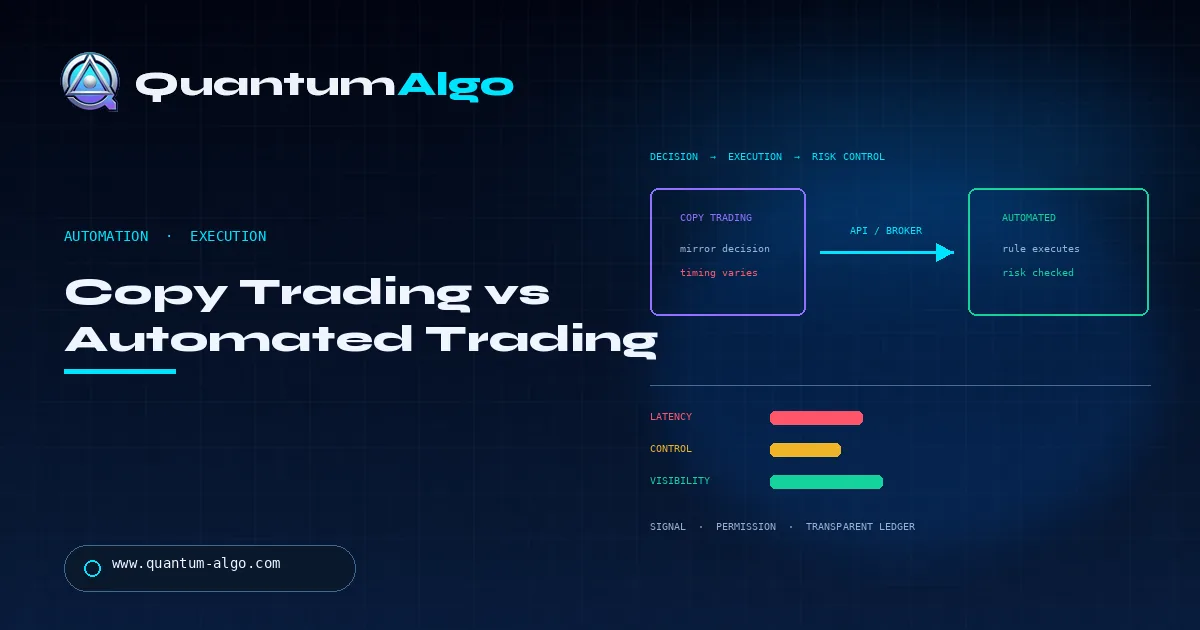
Copy trading mirrors another trader’s decisions, while automated trading executes a defined set of rules or signals. The useful comparison is not which sounds more passive; it is who controls the rules, what permissions the connection has, how fills are checked, and whether the result can be audited.
A copied trade can look automated because the order appears in your account without a manual click. The distinction matters when the market moves, a stop is missed, or you need to explain what happened. In copy trading, your account mirrors another decision stream. In automated trading, software applies explicit signals and risk rules to an execution connection. Quantum Algo’s QuantumBot is the latter funnel: a $199/mo automated execution service for the signals the user chooses to connect, with Zeno as the signal layer and free public indicators marking order blocks and fair value gaps.
Indicators that prove themselves in public.
One engine, four precision tools — the Gold (XAU) Scalper, the institutional Gravity Zone, the Zeno momentum Oscillator, and Zeno Stocks for equities.
Use the guide as a decision filter, not as a collection of labels. The market, the session and the invalidation still decide whether an idea deserves risk.
What is the difference between copy trading and automated trading?
Copy trading mirrors trades from a source account, strategy provider or signal stream. Automated trading follows programmed conditions, alerts or explicit signal rules. The two can overlap, but they create different questions about source dependence, timing, customization and failure handling.
If a copied source changes size or exits early, your account may follow the new decision. In an automated system, the rule should define what happens when an alert arrives, an order partially fills or the connection is unavailable. “Hands off” describes the user experience; it does not describe the control system.
| Dimension | Copy trading | Automated trading |
|---|---|---|
| Who decides the trade | Another person or provider | A written rule set or signal you chose |
| Sizing and stops | Mirrored, often with proportional scaling you do not control | Defined per rule; can be capped per trade and per day |
| Latency | Provider fill first, yours after — slippage on fast moves | Order sent on the trigger; slippage depends on your venue |
| Permissions needed | Account access or a copy link with trade rights | API key with trade-only permission; withdrawals disabled |
| Auditability | Provider statistics; your fills may differ | Every order logged against the rule that fired it |
| Failure mode | Provider changes behaviour or stops | Rule stops fitting the market; connection/venue outages |
Is copy trading safe for your account and custody?
Safety depends on permissions, broker or exchange architecture, leverage, position limits and the provider’s operating record. Never assume that an API connection has the same permissions everywhere. Withdrawal access, transfer permissions and account ownership should be checked before a strategy is connected.
A useful preflight question is: can the connection trade without withdrawing funds, and can I revoke it? A second is: can I see the source decision, the order sent to my account and the fill I received? If the answer is no, the convenience is hiding the risk boundary.
How does automated execution differ from copying a trade?
Copying is sensitive to the source event and the follower’s delay, allocation method and available liquidity. Automated execution can apply a fixed risk rule, stop distance, duplicate-signal check and expiry before sending an order. Neither model removes slippage, downtime or a bad signal.
Worked example: a hypothetical EURUSD signal enters at 1.2500, stops at 1.2450 and targets 1.2600. That is 50 pips of risk for 100 pips of planned reward, or 2R. A copier may receive a later price and silently change the R multiple; an explicit automated rule can reject the order when the maximum allowed deviation is exceeded.

Automate your trades. Let Quantum Algo trade for you.
Every signal executed on your own account — on your account, with the plan you define.
How do you choose between copy trading and automated trading?
Write the decision as a control checklist. Identify the signal source, the rule owner, the account permissions, the sizing method, the stop and target logic, the failure response and the record you can review. Then run the smallest practical test with no assumption that past performance will transfer.
I prefer a connection that makes the order path reconstructable: signal time, intended entry, actual fill, stop, target, risk and outcome. If a provider cannot explain that chain, a high win rate is not enough. The system should make it easy to say no before it makes it easy to place an order.
What risks do copy trading and automated trading share?
Both can suffer from slippage, latency, outages, data errors, correlated exposure, leverage and a strategy that stops working. Both can also create false confidence because the order appears without the emotional friction of a manual click. The absence of a click is not the absence of risk.
Set a maximum account risk, a daily loss boundary and a kill switch before connection. Decide what happens if the source sends a duplicate, the stop is rejected or the feed goes stale. These are not edge cases; they are part of the product you are using.
Which model gives you more control?
Automated trading usually gives more control when its inputs and rules are visible: the user can define size, allowed symbols, timing and rejection conditions. Copy trading can still be controlled if permissions, allocation and provider changes are transparent, but the source remains an external decision-maker.
The right model depends on what you value. If you want to follow a person’s discretionary decisions, copying may be the intended product. If you want a repeatable signal-to-order process, explicit automation is easier to test. In both cases, keep a ledger instead of trusting a dashboard summary.
Does QuantumBot copy trades or automate signals?
QuantumBot is Quantum Algo’s automated execution service, not a claim that the service marks every Smart Money Concepts structure or guarantees an outcome. It executes supported signals through the user’s connected account. Zeno provides confirmed Buy/Sell signals with SL/TP and built-in risk management; the free public indicators mark order blocks and fair value gaps.
Before connecting anything, verify the supported account, permissions, sizing, stop behaviour and disconnect process. Quantum Algo publishes a ledger showing 75% across 160 closed signals—120 wins and 40 losses—as evidence to inspect, not a promise that automation will produce the same result in a personal account.
| Layer | What it measures | Job in the plan |
|---|---|---|
| Copy trading | Mirrored decision | External control |
| Automated trading | Explicit rules | Repeatable execution |
| API permission | Allowed actions | Custody boundary |
| Ledger | Timestamped record | Auditability |
What should an execution audit show?
An audit should show the source signal or rule, timestamp, intended price, actual fill, quantity, stop, target, fees, slippage and final outcome. Without that chain, it is difficult to know whether the strategy or the connection caused the result.
The record should be exportable and understandable without a marketing dashboard. Transparency is an operating feature, not a decoration.
Why do permissions matter more than convenience?
A connection can be technically easy and still have a wide risk boundary. Check whether it can withdraw, transfer, trade derivatives, change leverage or create orders larger than intended. Start with the smallest permission set.
Revoke access when the service is not in use and decide who can stop execution. A disconnected account is easier to reason about than an account connected by default.
How should you test a copied or automated strategy?
Start with a controlled sample, compare intended and actual fills and record every exception. Do not evaluate only the winning trades. Include stale alerts, rejected orders, partial fills and manual interventions.
A small test answers operational questions before a larger balance makes those questions expensive.
What is a good kill switch?
A kill switch is a rule or action that stops new orders after a daily loss, data failure, repeated rejection or unexpected position. It should be easy to find and tested before it is needed.
The best automation is not the one that never fails; it is the one whose failure mode is bounded and visible.
Can automation remove emotion?
It can remove some click-level hesitation, but users still change permissions, disable stops or override a loss after the fact. Emotional risk moves from entry selection to system configuration and intervention.
A written operating checklist keeps the user from making a large decision in the middle of a fast market.
How does QuantumBot fit?
QuantumBot is positioned as an automated execution service for supported signals, while Zeno is the Buy/Sell signal product with SL/TP and built-in risk management. The free public indicators mark SMC structures rather than acting as an automated execution service.
Review the connection and signal rules before subscribing. Keep the ledger and the risk boundary visible.
What is the practical rule?
Choose the model whose decisions and failure modes you can explain. If you cannot reconstruct why the order was sent and how it was sized, the system is not ready for more trust.
Convenience is useful only after control and evidence are in place.
How does latency change the comparison?
A copied order may arrive after the source has moved, especially in fast gold, crypto or index markets. The follower’s stop distance and reward can change even when the source trade remains profitable. Automation can apply a maximum deviation rule, but no software removes market movement between signal and fill.
Measure intended and actual prices in the log. If the average slip makes a 2R plan materially smaller, the connection is part of the strategy result and should be reviewed as such.
What should a user ask a provider?
Ask what creates the signal, who owns the rule, what account permissions are needed, how size is calculated, what happens on a rejected stop and how the connection is revoked. Ask for examples of failed execution, not only winners.
Clear answers reduce ambiguity before money is connected. Evasive answers are themselves a risk signal, regardless of whether the provider has a polished interface.
Why does transparency matter in automation?
Automation can make a bad result feel anonymous: the order simply appeared. A timestamped ledger restores accountability by showing the signal, fill, risk and outcome. It helps distinguish a bad market decision from a connection or configuration failure.
Quantum Algo’s public ledger follows this evidence-first idea. It is useful because a reader can inspect the record rather than accept a claim that a bot is profitable by definition.
Why is strategy ownership important?
A copied provider can change instruments, risk or trade frequency without matching your objectives. An automated rule can also change when its owner updates code or alert logic. Ask how changes are announced, versioned and recorded. A system that changes silently is difficult to evaluate.
Keep the version of the rules beside the order log. If results change after a version change, you can investigate instead of blending two different systems into one performance number.
How should users think about manual overrides?
A manual override can be sensible during an outage or unusual market event, but it changes the sample. Record why the override happened, what risk remained and whether the order was still part of the tested plan. Otherwise the strategy appears automated while the most important decisions were discretionary.
I prefer a clear emergency mode: stop new orders, close or manage existing exposure according to a documented rule, then review. “I will decide in the moment” is not an operating control.
What makes an automation service worth comparing?
Compare the signal definition, connection permissions, execution path, error handling, visible record and pricing. The cheapest service is not necessarily the lowest-risk service, and a polished interface is not evidence of reliable fills.
QuantumBot’s role is execution for supported signals; Zeno’s role is Buy/Sell signals with SL/TP and built-in risk management. The free public indicators mark structures. Keeping those roles distinct makes the comparison more useful.
What should happen after a rejected order?
A rejected order should create a visible exception, not a silent retry with larger size. Check the reason, the remaining exposure and whether the original risk geometry still exists. If the price has moved beyond the allowed deviation, the safe action may be no trade.
Every retry needs an idempotency or duplicate check. Without one, a connection problem can turn a single intended position into multiple positions. This is a small implementation detail with a large effect on account risk.
How do you compare performance fairly?
Compare the same symbol, session, risk model, costs and slippage assumptions. A copied source result and an automated follower result are not directly comparable when the fills differ or the follower uses a different allocation. Keep gross and net figures separate.
The performance table should include missed, rejected and manually changed trades. Excluding exceptions makes the system look smoother while hiding exactly the operating behaviour a buyer needs to evaluate.
What should buyers remember before connecting an account?
The connection is part of the strategy. Read the permissions, test the order path, define the stop condition and keep a record that lets you reconstruct the result. Only then does convenience become a useful feature instead of an unpriced risk. A clear record should survive a losing trade and a rejected order. Review every exception before increasing trust.
That is the standard I would use before increasing trust or position size.
What is the simplest comparison buyers can make?
Ask who owns the decision, who can change the size, who can stop the order and what record remains after the trade. Those four questions expose the real difference between copying a decision and executing an explicit signal plan.
If the answers are vague, the service is not ready for a larger balance. Convenience should reduce clicks, not reduce your ability to audit risk.
Compare control, custody, execution and auditability before comparing convenience. Copy trading mirrors an external decision stream; automated trading applies explicit rules or signals. Neither removes slippage, connection risk or the need for a hard loss boundary.
◆ Interactive check
Can you compare execution models by control instead of hype?
Questions traders ask about trading automation
Copy trading mirrors trades or decisions from a source account, provider or signal stream into a follower account. The follower’s result can differ because of timing, size, liquidity and execution.
Automated trading uses software to apply defined rules, alerts or signals to order execution. The rules should specify sizing, stops, targets, duplicate handling and what happens when the connection fails.
Neither is universally better. Copy trading may suit someone who wants to mirror a decision-maker, while automation can offer more control over explicit execution and risk rules. Compare permissions and auditability.
Safety depends on the provider, account permissions, leverage, custody structure and your ability to stop or revoke access. Never assume past performance removes operational or market risk.
Yes. A copied position can lose money through a bad signal, market movement, delay, slippage or sizing error. Your fill can differ from the source account’s fill.
No. A bot can execute rules consistently, but it cannot guarantee positive expectancy, stable market conditions or a particular return. Connection and data failures are additional risks.
A signal is an instruction or alert about a possible trade. A bot is an execution system that can apply rules and send orders; it still needs a defined signal, risk boundary and supported connection.
QuantumBot is Quantum Algo’s automated execution service for supported signals and account connections. It is not presented as copying a person’s discretionary account, and it does not replace user verification of permissions and risk.
No. The free public Quantum Algo indicators mark order blocks and fair value gaps. Zeno provides confirmed Buy/Sell signals with SL/TP and built-in risk management.
Quantum Algo publishes a public ledger showing a 75% win rate over 160 closed signals, with 120 wins and 40 losses. That is evidence to verify, not a personal-account guarantee.
References & Related Guides
Read next
- What Is a Trading Bot? Types, How They Work, Why Most Fail, and the Design That Survives
- Best Trading Bots Guide
- Algorithmic Trading Beginners Guide
- Non-Repainting Indicators
- QuantumBot
Authoritative sources
- FCA InvestSmart: copy trading risks
- FINRA: relationship-investment scam warnings
- TradingView: alerts documentation