How Many Trading Days Are in a Year? (2026 Calendar, by Market, Calculator)
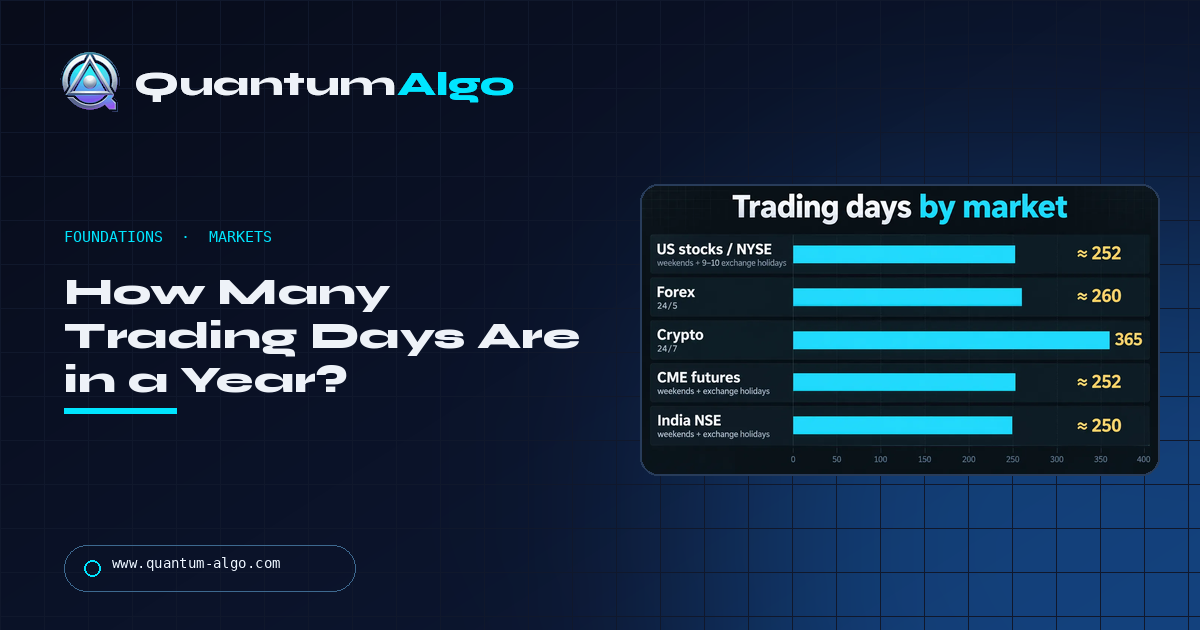
There are 252 trading days in a typical US stock-market year — 365 days minus 104 weekend days minus the nine or ten exchange holidays. 2026 has exactly 252. Forex trades about 260 days (24/5), crypto all 365, India's NSE about 250 and London about 253. Use 252 when you annualise US stock or futures returns, and √252 for volatility.
Everyone building a backtest or an annualised return hits this question, and the answer depends on the market. This page is the count by market, the full 2026 US holiday calendar with every closure and half-day, the month-by-month numbers, and a calculator that returns trading days and the √N factor for any date range — plus the three places where using the wrong number silently breaks the maths.
Indicators that prove themselves in public.
One engine, four precision tools — the Gold (XAU) Scalper, the institutional Gravity Zone, the Zeno momentum Oscillator, and Zeno Stocks for equities.
How many trading days are there in a year?
There are 252 trading days in a typical US stock-market year. That is 365 calendar days minus 104 weekend days minus the nine or ten weekdays the NYSE and Nasdaq close for holidays. In 2026 the count is exactly 252; in a leap year with a holiday landing on a weekend it can be 251 or 253. Forex runs about 260 days because it trades around the clock from Sunday evening to Friday evening and only truly stops for the weekend. Crypto never closes: 365 days, or 366 in a leap year.
I get asked this most often by people building a backtest or an annualised return, and the number they need depends entirely on which market they trade. The rest of this page is the breakdown by market, the 2026 calendar with every holiday marked, and the two or three places where the number quietly changes a calculation.
Why 252 and not 260?
A year has 52 weeks and one or two extra days, so there are 260 or 261 weekdays. US exchanges then close for New Year's Day, Martin Luther King Jr. Day, Presidents' Day, Good Friday, Memorial Day, Juneteenth, Independence Day, Labor Day, Thanksgiving and Christmas. Some years a holiday falls on a Saturday and is observed on Friday, or falls on a Sunday and is observed on Monday, which is why the count drifts by a day.
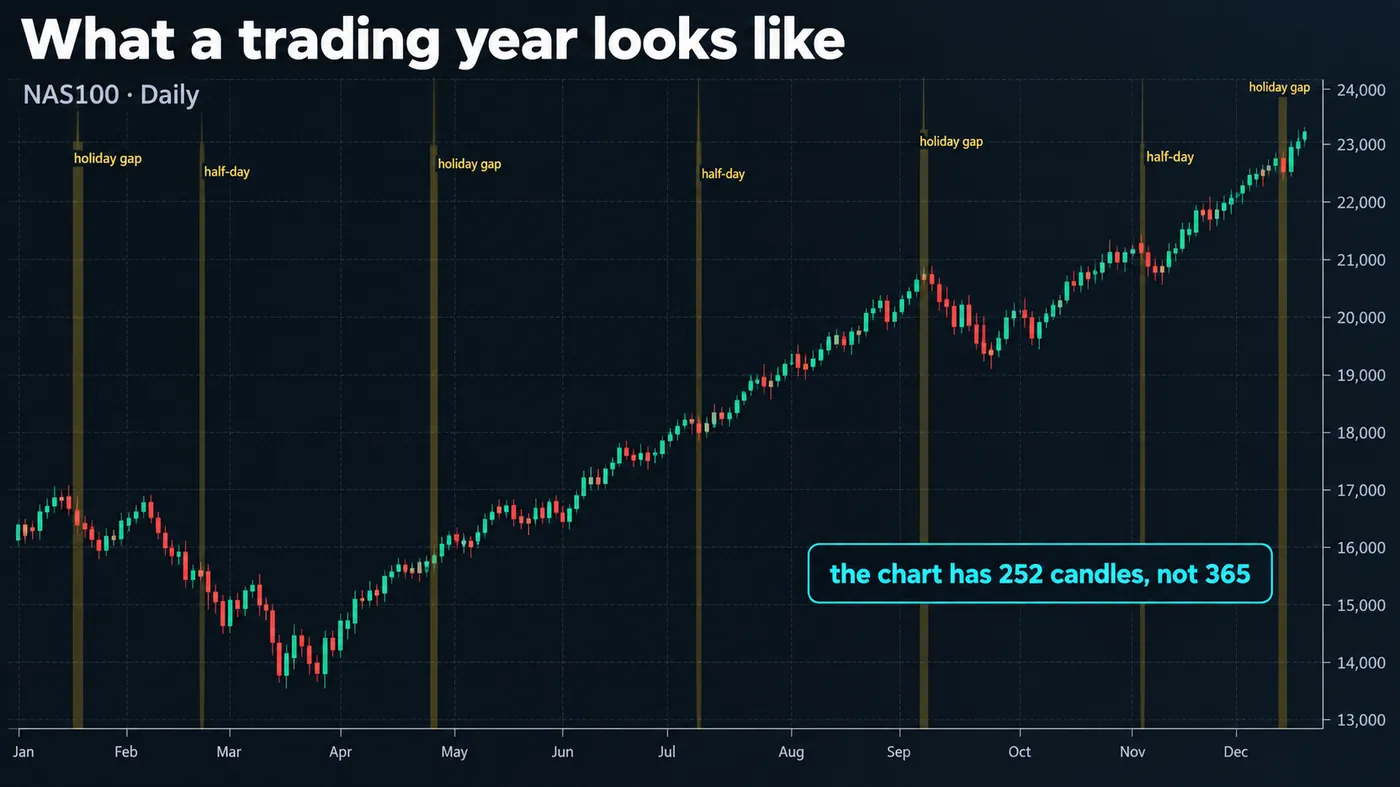
There are also three early closes — the day after Thanksgiving, Christmas Eve when it lands on a weekday, and the day before Independence Day in some years — where the cash session ends at 1:00 pm Eastern. They count as trading days, but they are half-days for volume, which matters if your strategy is session-based.
Trading days by market
| Market | Days per year | Why |
|---|---|---|
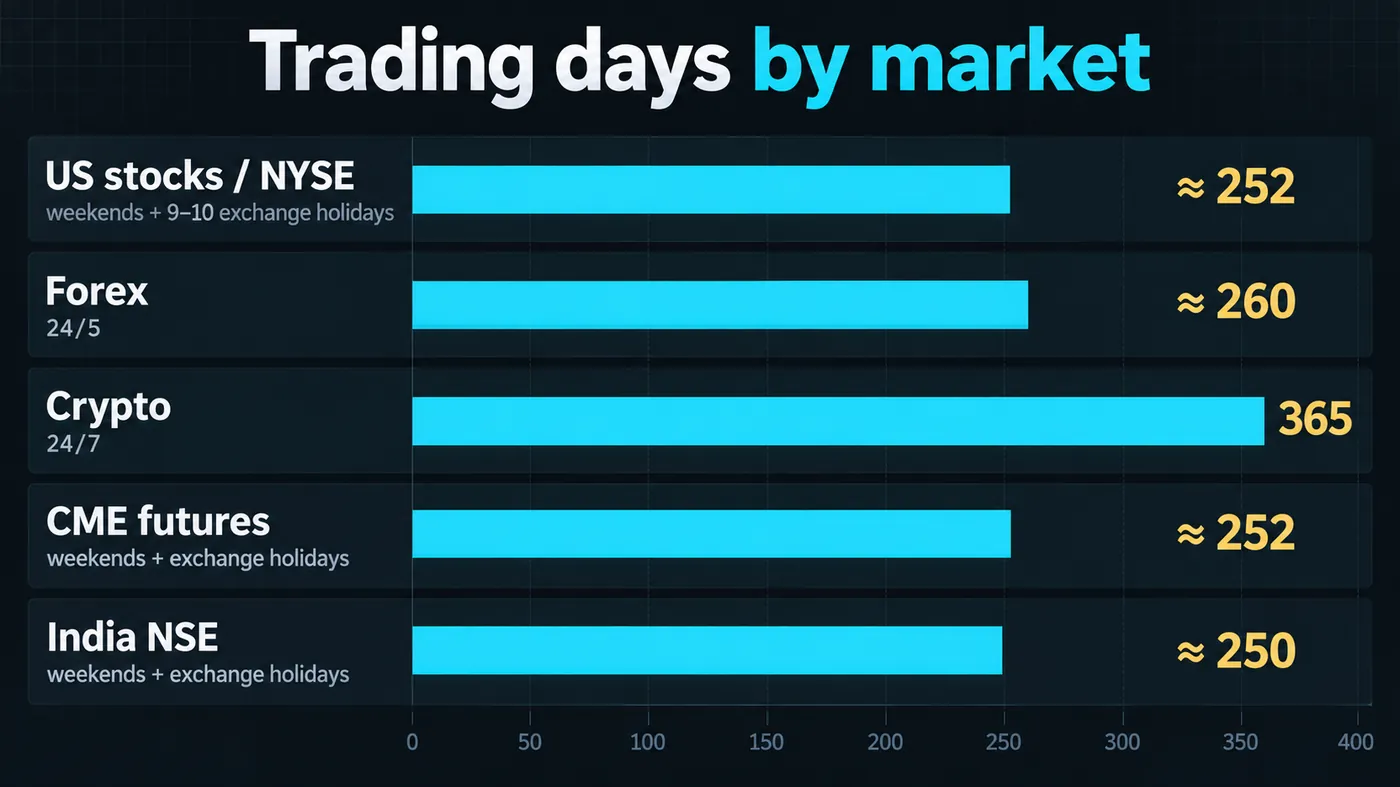
| US stocks (NYSE, Nasdaq) | ≈ 252 | weekends + 9–10 exchange holidays, 3 half-days |
| CME futures (ES, NQ, GC, CL) | ≈ 252 | mirrors US holidays; Globex trades nearly 23 hours on open days |
| Forex (spot) | ≈ 260 | 24/5, Sunday 5 pm to Friday 5 pm New York; thin on major holidays |
| Crypto (spot and perpetuals) | 365 | 24/7, exchange maintenance windows aside |
| India NSE / BSE | ≈ 250 | weekends + around 15 exchange holidays |
| London LSE | ≈ 253 | weekends + 8 bank holidays |
| Tokyo JPX | ≈ 245 | weekends + 16 or so national holidays including Golden Week |
Two things trip people up. Forex "trades on holidays" but liquidity on Christmas or the Fourth of July is a fraction of normal, so counting them as full days overstates your opportunity set. And crypto's 365 is real, but the weekend sessions behave differently — thinner books, larger wicks — so a strategy tested only on weekdays has been tested on about 70% of the data.

Automate your trades. Let Quantum Algo trade for you.
Every signal executed on your own account — on your account, with the plan you define.
The 2026 US market calendar
The calendar illustration in this guide shows every 2026 US market holiday: New Year's Day (Jan 1), MLK Day (Jan 19), Presidents' Day (Feb 16), Good Friday (Apr 3), Memorial Day (May 25), Juneteenth (Jun 19), Independence Day (Jul 3 observed, since the 4th is a Saturday), Labor Day (Sep 7), Thanksgiving (Nov 26) and Christmas (Dec 25). Ten closures, 104 weekend days, 252 sessions. Early closes fall on November 27 and December 24.
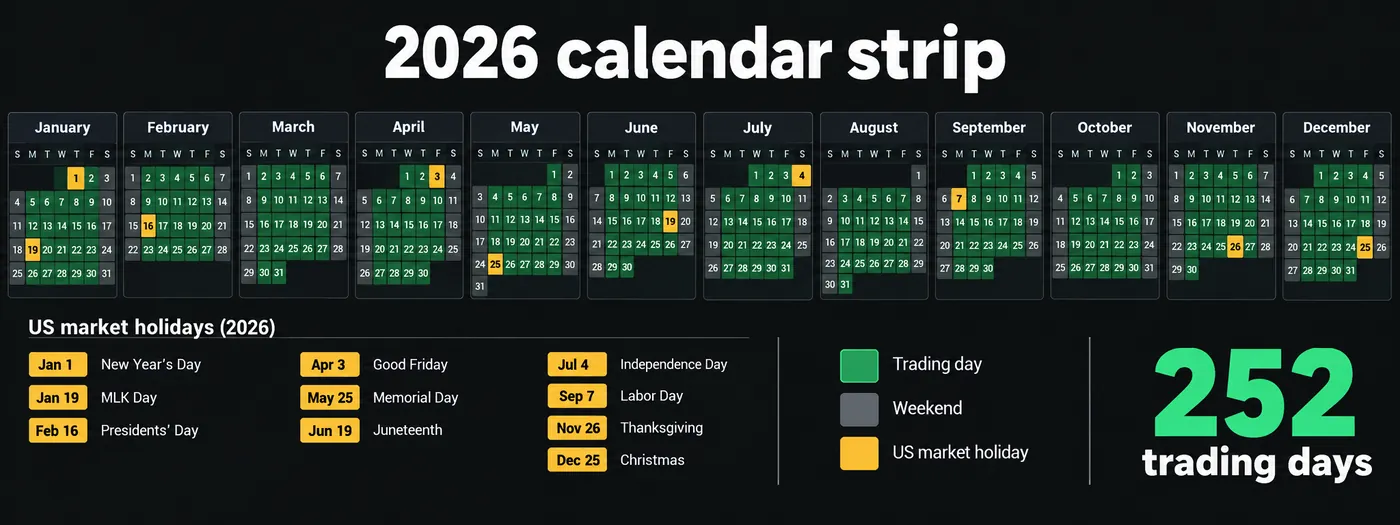
By quarter the split is roughly 61 / 63 / 64 / 64, which is why "63 trading days" is the standard quarter length in annualisation formulas.
Where the number changes your maths
Annualising returns and volatility. The convention is to multiply daily returns by 252 and daily volatility by √252 ≈ 15.87. Use 260 for forex, 365 for crypto — using 252 on a crypto strategy understates annual volatility by about 17%.
Sharpe ratio. Daily Sharpe × √252. Same substitution by market.
Backtest sample size. A one-year daily-bar backtest on stocks is 252 observations, not 365. On a 15-minute chart of the US cash session it is about 26 bars a day, 6,550 a year.
Position sizing and drawdown planning. If you take two trades a day, that is roughly 500 trades a year on stocks and 730 on crypto — the number a Monte Carlo test should use per run.
Options. Time decay is quoted per calendar day, but implied-volatility models use trading days; the mismatch is why theta looks different over a long weekend.
Trading days per month
January 20, February 19, March 22, April 21, May 20, June 22, July 22, August 21, September 21, October 22, November 19, December 22 — that is the 2026 US calendar month by month. November and February are the short months; March, June, July, October and December are the long ones. If you set monthly targets, a flat number per month is off by up to 15% either way.
Using the calculator
Pick a market, set a date range, and the calculator below returns the number of trading days, weekends removed, holidays removed, and the √N factor for annualising. It uses the 2026 US holiday list for stocks and futures, weekday counting for forex, and every day for crypto. For other exchanges, enter the holiday count from the exchange's own calendar and the tool does the rest.
252 is a US stock and futures number: weekends and about ten holidays out of 365. Forex is about 260, crypto is 365, and other exchanges sit between 245 and 253. Use the right count when you annualise returns and volatility, when you size a backtest sample, and when you set a monthly target — the short months are 15% shorter than the long ones.
◆ Interactive check
Do you know your market's calendar?
Questions people ask about trading days
About 252 in the United States. The exact figure moves between 250 and 253 depending on where weekends fall and whether a holiday is observed on a weekday.
Between 19 and 23; the long-run average is 21. Check the month-by-month list above for 2026.
Around 63, with the first quarter usually the shortest at 61 or 62.
Yes, spot and perpetual crypto markets trade every calendar day, though weekend liquidity is materially thinner and many exchanges schedule maintenance windows.
Because forex has no exchange holidays — it stops only for the weekend. Liquidity on major holidays is still low, so many traders treat it as 250 effective days.
250 for US stocks — one fewer than usual because of the national day of mourning for President Carter on January 9 and the way the holidays fell. 2026 returns to 252.
Yes. The cash session opens normally and closes at 1 pm Eastern, so it counts as a session; volume is roughly half a normal day.
US cash equities: 252 days × 6.5 hours ≈ 1,638 hours. CME Globex futures: roughly 252 × 23 ≈ 5,800 hours. Forex: about 120 hours a week × 52 ≈ 6,240 hours.
Because the count depends on where weekends fall and whether a holiday is observed on a weekday. 2027 will have a different number from 2026.
The public ledger counts posted trades, not days; for annualised figures on gold and crypto signals we use 260 and 365 respectively, matching each market's calendar.
References & Related Guides
Read next
- What Is After-Hours Trading? Extended Hours, Earnings Gaps and Why the Spread Is the Catch
- What Is Trading?
- Backtesting Trading Strategies
- Monte Carlo Simulation for Trading
- What Is Paper Trading?
- Trading Journal: Complete Guide
Authoritative sources
- NYSE: hours and holiday calendar
- Nasdaq: stock market holiday schedule
- CME Group: trading hours and holiday calendar
- NSE India: trading holidays
- Investopedia: annualising volatility with √252