Day Trading Crypto: A Market With No Sessions, a Clock That Still Matters, and the Trades That Fit It
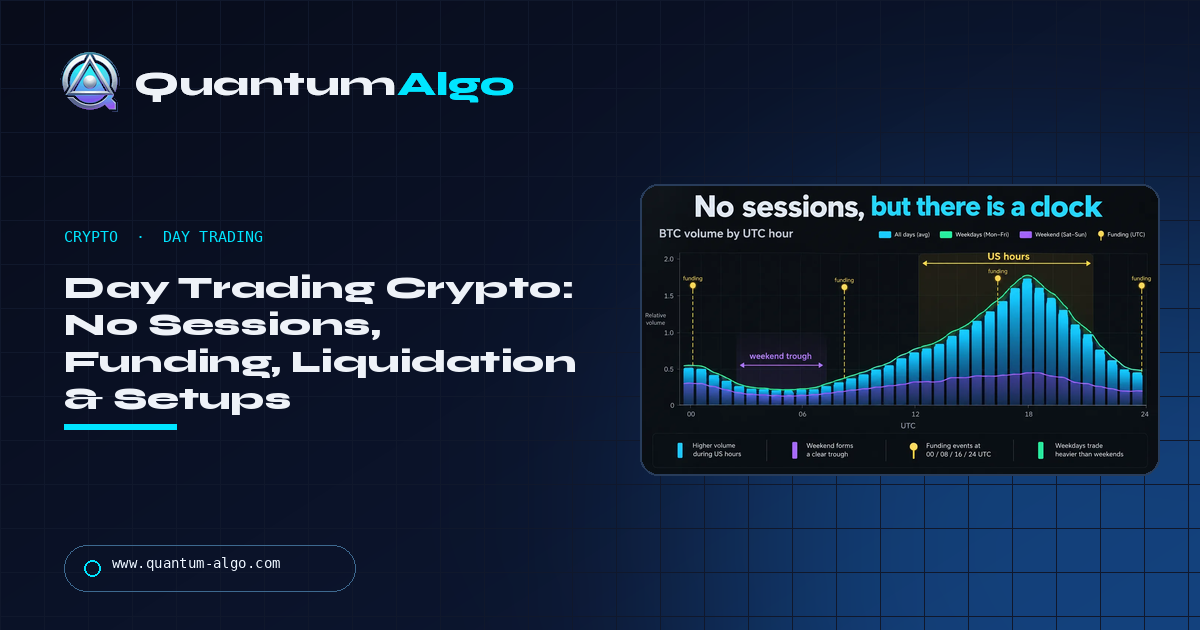
Day trading crypto is opening and closing positions in Bitcoin, Ethereum or other coins within a day, usually on perpetual futures at an exchange where leverage, shorting and 24/7 access make it practical. It differs from stocks and forex in five ways that decide everything: no sessions but a clock (US hours peak, weekends trough, funding every eight hours), leverage as a slider rather than a regulator's cap, the exchange as counterparty, funding paid or received on positions held through the timestamp, and liquidation — not your stop — as the thing that can close the trade if leverage is set before the stop.
The general day-trading method is on our roadmap and applies unchanged; this page is the five things crypto changes and the trades that fit them. The volume clock shows when BTC is actually alive; the liquidation chart shows the one mistake that lets the exchange manage your risk; the ETH trade shows the complete Smart Money sequence with the funding time marked. The sizer below puts the stop distance and the liquidation distance side by side for any inputs.
Indicators that prove themselves in public.
One engine, four precision tools — the Gold (XAU) Scalper, the institutional Gravity Zone, the Zeno momentum Oscillator, and Zeno Stocks for equities.
What is day trading crypto?
Day trading crypto is opening and closing positions in Bitcoin, Ethereum or other coins within a day — usually on perpetual futures at an exchange such as Bybit, Binance, OKX, Bitget or Kraken, where leverage, shorting and 24/7 access make intraday trading practical. It differs from day trading stocks or forex in five ways that decide everything: there are no sessions but there is a clock, leverage is a slider rather than a regulator's cap, the exchange is the counterparty, funding is paid or received every eight hours, and liquidation — not your stop — can be the thing that closes the trade. This guide is about those five differences and the trades that fit them; the general "how to day trade" method is in our roadmap and applies unchanged.
No sessions, but there is a clock
The volume-by-hour illustration in this guide is BTC volume across a typical week by UTC hour. Crypto never closes, but it is not equally alive: volume rises through the European morning, peaks in US hours (13:00–21:00 UTC — the overlap with the stock market open and the futures pit), and troughs at the weekend, when weekend volume can be half a weekday's and spreads on altcoins widen accordingly. The three vertical markers are the funding timestamps — 00:00, 08:00 and 16:00 UTC on most exchanges — when perpetual positions pay or receive funding and price often twitches as positions are closed around them.
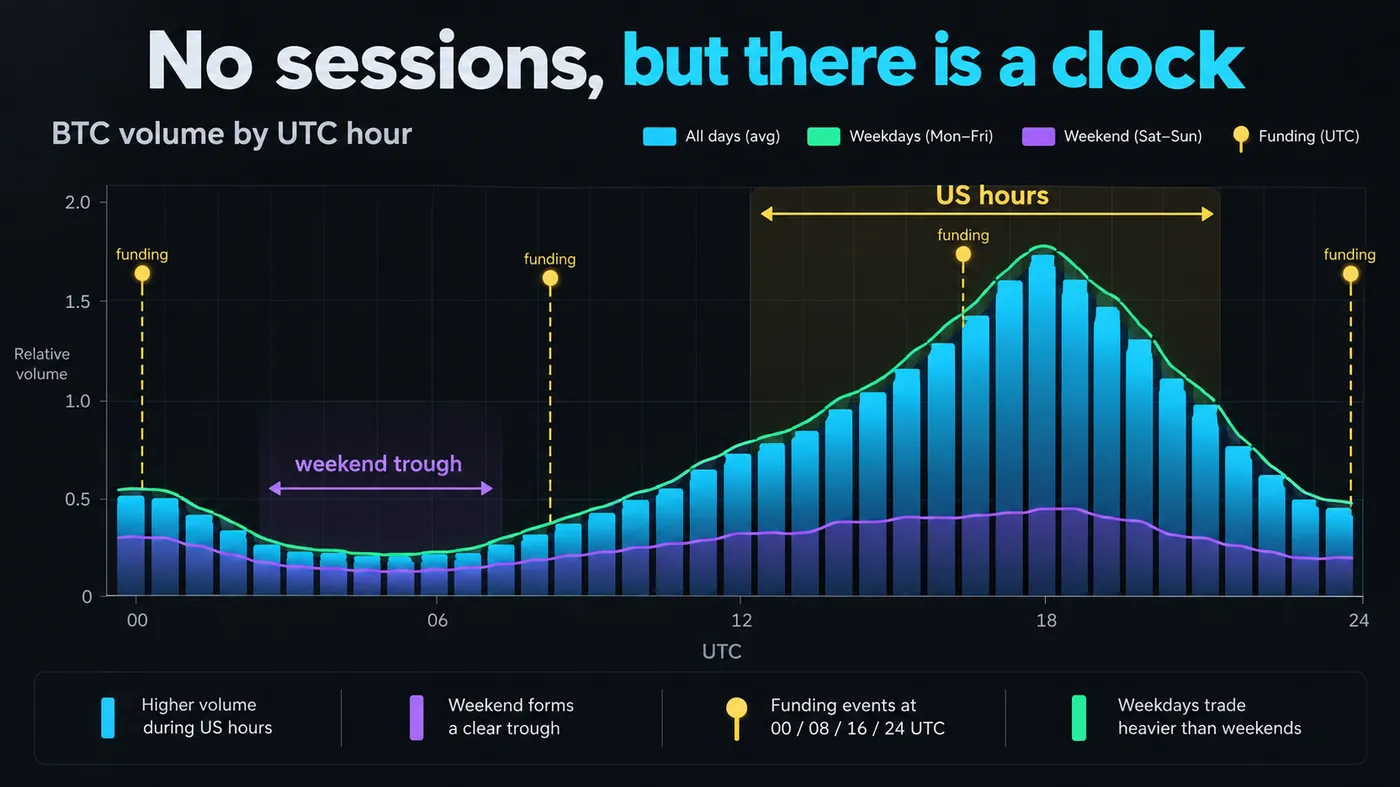
Practical consequences: day trade in the US window, when the structure is cleanest and the fills best; treat weekend setups as provisional; and know where the next funding time falls relative to your intended hold. The CME Bitcoin futures gap — the difference between Friday's CME close and the following Sunday's open — is a level crypto traders watch because it fills often enough to matter.
Perpetuals, funding and mark price
Most crypto day trading is on perpetual futures: contracts with no expiry that track spot through the funding mechanism. When perpetuals trade above spot, longs pay shorts a small rate every eight hours; below spot, shorts pay longs. For a day trader who is flat before the funding time it is irrelevant; for one who holds through it, it is a cost or a credit worth checking — a 0.05% rate on a 10× position is 0.5% of your margin. Our funding rate guide has the mechanics and the contrarian read.
Mark price is the exchange's fair-value estimate, and it — not the last trade — triggers liquidation and, if you set it so, stops. Always set stop triggers on mark price: a single thin-book wick on last price can fire a stop the mark never touched.
Leverage, liquidation and where your stop really is
The liquidation-versus-stop illustration in this guide is the picture every crypto day trader needs before the first trade. A BTC 15-minute long, stop 1.2% below entry — a normal structure stop. At 10× leverage the liquidation price sits about 9% below entry, comfortably beyond the stop. At 25× it sits about 3.5% below — still beyond the 1.2% stop, but at 50× it would be inside it, and on a smaller stop even 25× can be. The callout: if liquidation is closer than your stop, the exchange is your risk manager, and the exchange charges a fee to do the job badly.
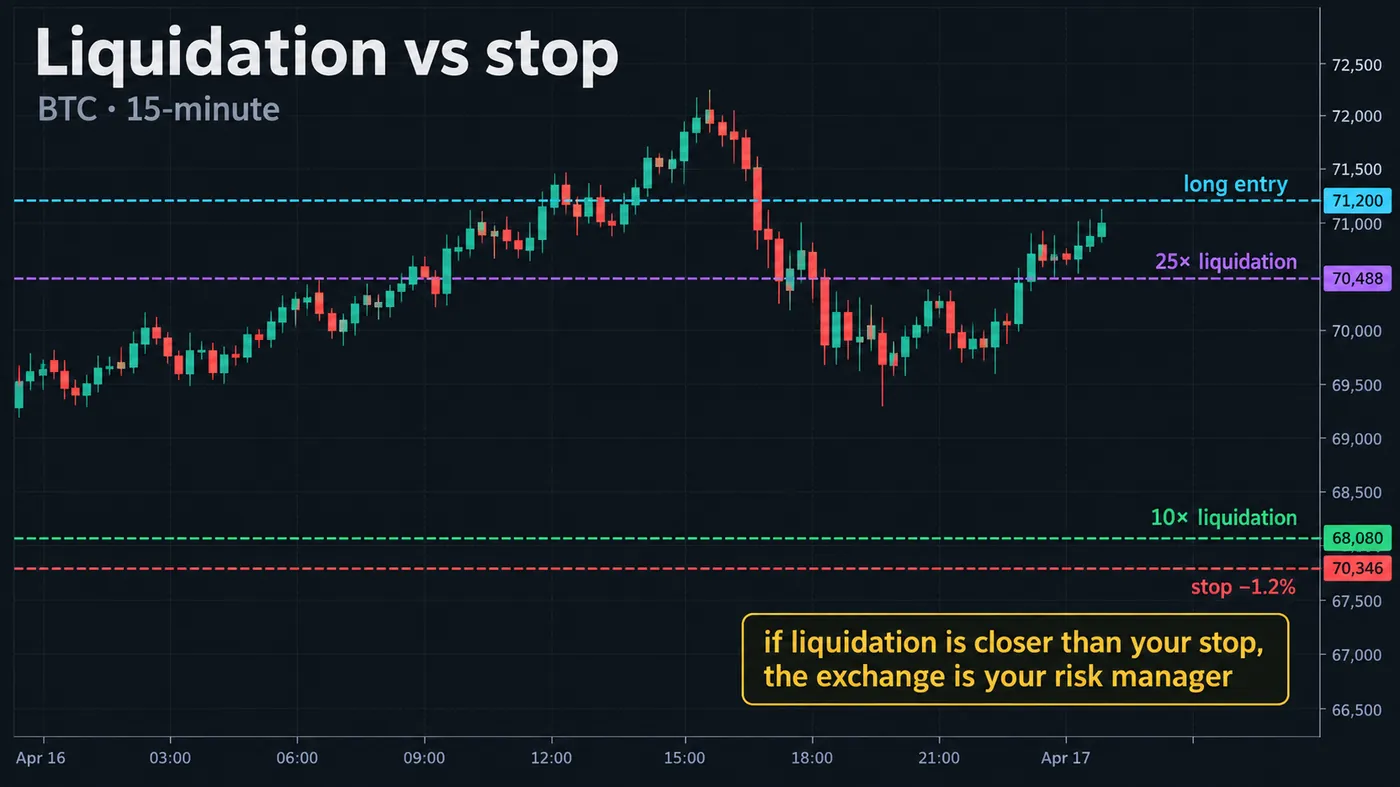
The rule that keeps this simple: choose the stop from the chart, size the position from the risk (1% of the account divided by the stop distance), and only then look at leverage — as the notional the position implies divided by your margin. Leverage is an output. A 1.2% stop at 1% risk is a position worth 83% of the account in notional; at 10× leverage that uses 8% of the account as margin, and liquidation is nowhere near. Our leverage and liquidation guides have the arithmetic in full; the sizer on this page shows the stop and the liquidation distance side by side for any inputs.
The exchange is the counterparty
In stocks and regulated forex the venue is not the risk. In crypto it is: the exchange holds the assets, runs the matching engine, sets the liquidation logic and can halt withdrawals. Day traders reduce that risk mechanically — keep only the trading balance on the exchange, use API keys with withdrawal disabled if a bot executes, withdraw profits on a schedule, and prefer the largest venues with published proof of reserves. Our crypto exchange and platforms guides cover the choice; the point here is that "risk management" in crypto includes the venue.

Automate your trades. Let Quantum Algo trade for you.
Every signal executed on your own account — on your account, with the plan you define.
A crypto day trade, start to finish
The ETH 5-minute chart in this guide is one complete trade, numbered:
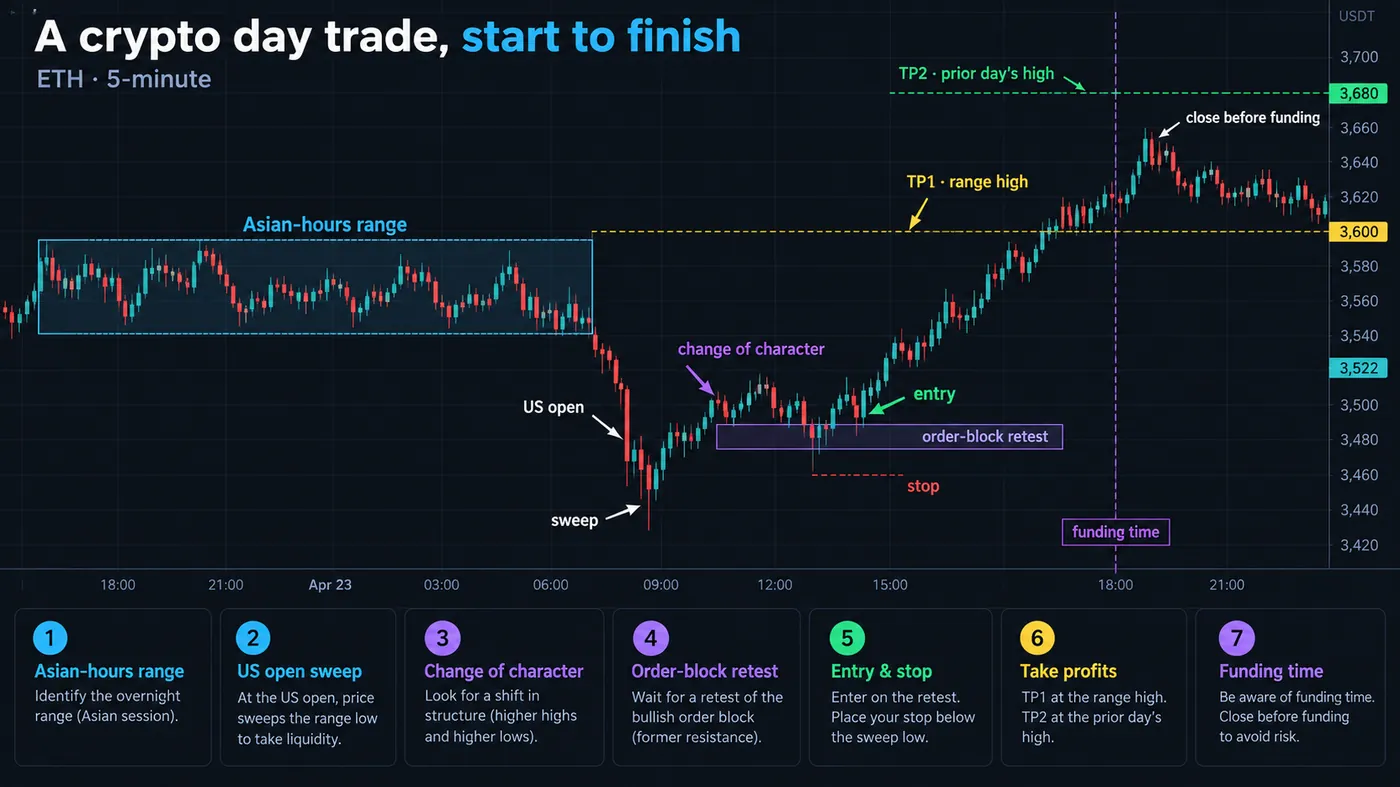
- The Asian-hours range — overnight, ETH built a range; its low is where the resting stops are.
- The US-open sweep — at 13:30 UTC the range low is taken out on a burst of volume; longs are stopped, shorts pile in.
- The change of character — the next candles reclaim the range and break the last lower high: the sweep was the low.
- The order-block retest — price returns to the last down-close before the reclaim; entry there.
- The stop — below the sweep's low, 1.2% away; position sized from it.
- TP1 at the range high, TP2 at the prior day's high — half off at the first, stop to breakeven, the rest to the second.
- The funding time — 16:00 UTC is marked; the trade is closed before it, because the plan does not include paying funding to hold.
That sequence — range, sweep, change of character, retest, targets at liquidity — is the Smart Money setup that Zeno marks on the 2-hour and 15-minute charts, and it is the reason our crypto calls print in the US window.
Day trading crypto strategies that fit the market
- Range sweep and reclaim — the trade above. Works because overnight ranges are built on thin liquidity and tested when volume arrives.
- Funding-time fade — extreme funding (longs paying heavily) into resistance, faded at the funding timestamp as leveraged longs close. Requires the funding read from our funding guide.
- Liquidation cascade continuation — a sharp move that triggers stacked liquidations accelerates; trade the continuation with the liquidation heatmap as the map and a wide stop. Advanced.
- BTC-first, alts-second — altcoins follow Bitcoin intraday with a lag; read the setup on BTC, execute on the alt with the cleaner structure and tighter spread. Our altcoin lesson covers the correlation.
What does not fit: grid bots in a trending day, scalping altcoins with wide spreads at the weekend, and holding a leveraged position through a funding time you did not price.
Spot or perpetuals for day trading
Spot is the coin itself: no leverage, no funding, no liquidation, no shorting; a day trade is buying and selling the asset, with the exchange holding it. Perpetuals are the contract: leverage, funding, liquidation, shorting both ways, and — on the major venues — deeper books and tighter spreads than spot on the same pair. Beginners should day trade spot for the first fifty logged trades, precisely because it removes three of the five ways crypto differs; then perpetuals at 2–5× notional, sized from the stop, with mark-price triggers. Our spot-versus-futures guide has the full comparison.
Fees, and why makers matter
Crypto day trading is priced on notional: taker fees of roughly 0.04–0.06% per side on perpetuals at the major exchanges, maker fees near zero or negative. On a $20,000 position that is $8–12 per side as a taker, $0–4 as a maker. Forty round trips a month at $20,000 is $640–960 in taker fees — a real fraction of a 1% risk budget on a $20,000 account. Enter with limit orders where the structure allows (the order-block retest is a limit-order entry by nature), exit TP1 and TP2 with limits, and keep market orders for stops and for flattening. The sizer on this page shows the fee line next to the risk.
The weekend and the CME gap
Weekend volume is half a weekday's on BTC and less on altcoins; spreads widen, structure is unreliable, and a Sunday-night move can be reversed entirely by Monday's US open. The CME Bitcoin futures contract closes Friday 4 pm CT and reopens Sunday 5 pm CT; the gap between the two is a level that fills often enough that most crypto day traders mark it. Day trade the weekend at half size, or not at all, and note the gap on Monday's chart.
Rules of the trade
- Stop from the chart, size from the risk, leverage as an output — never the other way round.
- Stop triggers on mark price.
- Flat before funding unless the funding is in your favour and small.
- US window for the cleanest structure; weekends at half size or not at all.
- Only the trading balance on the exchange; profits withdrawn on a schedule.
- Fifty logged trades on the testnet or at minimum size before real size — Bybit's and Binance's testnets run the real engine.
How we day trade crypto
Zeno's regime labels on the 2-hour chart give the bias; the 15-minute structure gives the entry, stop and targets. Our public crypto calls on the track record — ACH, SPX-USDT, PYTH, XPL and the rest — were swing-to-intraday setups on exactly that sequence. QuantumBot executes the same signals on Bybit, Binance, OKX, Bitget or Kraken with the stop and take-profits resting on the exchange and a risk engine that caps account heat, which is the honest way to day trade a 24/7 market without watching it 24/7.
Crypto changes five things — the clock, the leverage, the counterparty, the funding and the liquidation — and none of them change the method: stop from the chart, size from the risk, leverage as an output, trigger on mark price, flat before funding, US hours for structure, weekends at half size, only the trading balance on the exchange. The setup is the same sweep-and-retest as everywhere else; the exchange is the extra risk.
◆ Interactive check
Do you know the five differences?
Questions people ask about day trading crypto
You can practise with $100 at correct sizing on a perpetual with small minimums; the returns will be tuition, not income. Sizing at 1% risk on $100 is a $1 stop, which is fine for learning and nothing else.
For the same minority as in every market — those with a documented setup, fixed risk and a record — and crypto adds funding, liquidation and venue risk to the list of ways to lose. The loss rates published by regulated CFD brokers apply to crypto CFDs too.
Whatever the stop and risk imply, which is usually 3–10× notional; choose leverage last, not first, and never let liquidation sit closer than the stop.
No. The rule is FINRA's for US stock margin accounts. Crypto exchanges have no day-trade count; the constraint is your risk rules.
The US window, roughly 13:00–21:00 UTC, when BTC volume peaks and structure is cleanest; the London morning is second. Weekends are thin.
Zeno runs on every major exchange's charts on TradingView; the crypto calls on our public record are the 2-hour and 15-minute setups described here, and QuantumBot executes them on five exchanges with exchange-side stops.
There is no rule-based minimum — no PDT rule — so the limit is sizing: at 1% risk with a 1.2% stop, a $1,000 account trades $830 of notional. Enough to learn; income needs the capital every market needs. Our "is day trading worth it" page has the arithmetic.
In most jurisdictions every closed trade is a taxable event, and perpetual gains are treated as short-term income. Keep the exchange's export from day one; the journal doubles as the tax record.
BTC and ETH for liquidity, structure and the tightest spreads; large altcoins only when they are leading and in the US window. Thin altcoins at the weekend are where accounts go to pay spreads.
One with deep perpetual books, mark-price triggers, low maker fees, a testnet and a track record of honouring withdrawals — Bybit, Binance, OKX, Bitget and Kraken are the five QuantumBot supports for that reason. Our platforms pillar has the criteria.
References & Related Guides
Read next
- Liquidation in Trading
- Funding Rate Trading
- Leverage Trading: Complete Guide
- Spot vs Futures Trading
- Crypto Trading Strategy for Beginners
- Crypto Trading with SMC (Academy)
- What Is a Trading Bot?
- QuantumBot
Authoritative sources
- Bybit: funding rate mechanics
- Binance: mark price and liquidation
- CME Group: Bitcoin futures (the CME gap)
- CFTC: digital asset advisories
- FCA: cryptoasset consumer information