Higher Timeframe Bias (HTF): The Complete Top-Down Guide
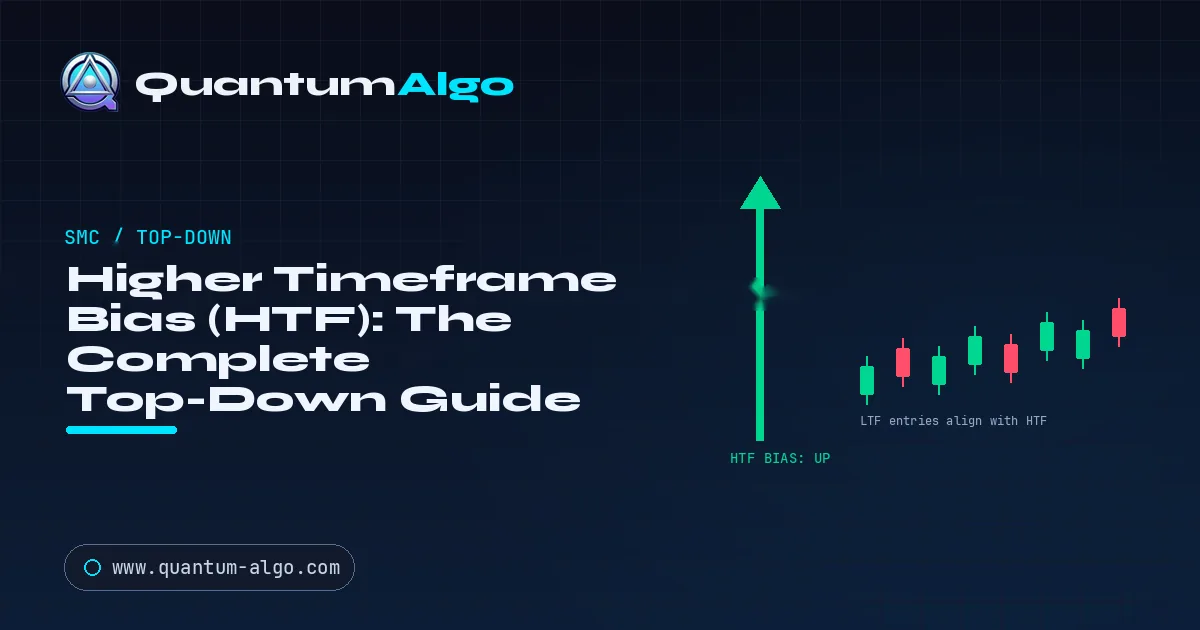
Higher timeframe bias (HTF) is the directional lean, bullish, bearish or neutral, you set from a higher timeframe before you enter. The higher timeframe sets the context, the lower timeframe the entry: a 5-minute entry reads the 1-hour or 4-hour, a 1-hour entry reads the daily. Only take entries that agree with the bias; counter-trend moves are usually pullbacks.
Higher timeframe bias — HTF bias — is the discipline of deciding which direction you are willing to trade before you drop down to your entry timeframe. It answers the single most important question in any trade: with the flow, or against it? Traders who skip this step end up taking beautiful-looking setups in the wrong direction, fighting the dominant order flow and wondering why their win rate is stuck. Establishing a clear HTF bias is one of the highest-leverage habits in structured, top-down trading.
This guide explains what HTF bias is, why the higher timeframe dominates, how to determine your bias from structure and key levels, and how to translate that bias into lower-timeframe entries without over-trading. It is written for traders who want a repeatable, top-down process rather than a pile of disconnected signals.

Automate your trades. Let Quantum Algo trade for you.
Every signal executed on your own account — 24/7, hands-off.
What does higher timeframe bias mean for your entries?
HTF bias is a directional lean — bullish, bearish, or neutral — derived from analysing a higher timeframe than the one you enter on. If you enter on the 5-minute chart, your HTF might be the 1-hour or 4-hour; if you enter on the 1-hour, your HTF might be the daily. The bias is your decision about which way the dominant flow is pointing, and it acts as a filter: you look for longs when your bias is bullish, shorts when it is bearish, and you stand aside or trade cautiously when it is neutral.
The reason this matters so much is that lower timeframes are noisy. On a 5-minute chart, price constantly makes small moves in both directions, and almost any bar can be spun into a setup. The higher timeframe cuts through that noise by showing the larger structure that the small moves are happening inside. Without HTF bias, you are reacting to noise; with it, you are trading noise in the direction of the signal.
How the timeframes stack
The higher timeframe defines the direction; the lower timeframe refines the entry inside that direction.
Why do higher timeframes carry more weight?
Higher timeframes carry more weight because they represent more information and more participants. A daily candle summarises an entire day of buying and selling from every kind of trader, including large institutions that cannot express their positions on a 5-minute chart. The levels, structure, and trends visible on higher timeframes are therefore watched by more capital and tend to hold more reliably than lower-timeframe patterns, which are dominated by short-term noise.
This is why a lower-timeframe move against the higher-timeframe trend is usually a temporary pullback rather than a true reversal — the larger flow reasserts itself. Trading in the direction of the higher timeframe means you are aligned with that dominant flow, so your pullback entries are supported by the bigger picture, your targets are more likely to be reached, and your stops are less likely to be run by the market simply reverting to its larger trend.
Which four inputs set your higher timeframe bias?
Setting your bias is a structured read of the higher timeframe, not a guess. A few clear inputs, taken together, give you a confident directional lean.
The four inputs that set your bias
Read them together — agreement gives a confident lean, conflict means neutral.
Market structure
Higher highs and higher lows mean a bullish structure; lower highs and lower lows mean bearish. A break of that structure is the first clue the bias may be shifting.
Key levels
Where is price relative to major support, resistance, and supply/demand zones on the higher timeframe? Bias leans bullish above support heading toward resistance, and the reverse below.
Premium vs discount
Within a higher-timeframe range, is price in a discount (lower half, favouring longs) or a premium (upper half, favouring shorts)? This refines where a biased entry is attractive.
Liquidity and draw
Where is the obvious liquidity the market is likely drawn toward — resting highs or lows? The higher-timeframe draw on liquidity often points to the near-term directional target.
How do you go from HTF bias to an entry?
Once your bias is set, the workflow is a disciplined drill-down. You start wide to establish context and progressively narrow to a precise entry, never letting the lower timeframe override the direction the higher timeframe has already decided.
The top-down drill-down
Context flows one way — from the higher timeframe down. The lower timeframe only refines timing.
First, set the bias on the higher timeframe. Second, identify the higher-timeframe zone where a biased entry makes sense — a discount area in a bullish bias, an order block, or a level price is drawing toward. Third, drop to the lower timeframe and wait for confirmation there — a shift in lower-timeframe structure, sometimes via a fair value gap, in the direction of your bias, showing the pullback is ending. Fourth, enter with a defined stop and target. The key discipline is that steps two through four all serve the direction decided in step one; the lower timeframe refines when, never which way.
What mistakes undo a higher timeframe bias?
The concept is simple, but a few recurring errors undo it in practice. Avoiding them is most of the battle.
When timeframes conflict
A bullish daily with a bearish intermediate usually means the lower one is a pullback.
Fighting the bias
Taking a clean lower-timeframe setup against your own HTF bias because it looks too good to skip. This is the most common and most costly mistake — the setup is usually a counter-trend trap.
Too many timeframes
Stacking four or five timeframes until they conflict and paralyse you. Two or three — a bias timeframe, optionally a mid, and an entry timeframe — is enough.
Forcing a bias
Insisting on a bullish or bearish read when the higher timeframe is genuinely unclear. Neutral is a valid answer; forcing direction leads to low-quality trades.
Never updating it
Setting a bias and clinging to it after the higher-timeframe structure has clearly broken. Bias is dynamic — a decisive structure break is your cue to reassess.
What are good bias-to-entry timeframe pairings?
Choosing the right bias-to-entry timeframe pairing is what makes the method practical. The table below gives sensible starting pairings by style — adjust to taste, keeping the roughly 4-6× ratio.
| Style | Bias timeframe | Entry timeframe | Typical hold |
|---|---|---|---|
| Scalping | 15-min / 1-hour | 1-min / 5-min | Minutes |
| Day trading | 1-hour / 4-hour | 5-min / 15-min | Hours |
| Swing trading | Daily | 1-hour / 4-hour | Days |
| Position trading | Weekly | Daily | Weeks+ |
The exact charts matter less than the relationship between them. Too small a gap and the bias timeframe adds no real context; too large a gap and its moves are irrelevant to your holding period. The 4-6× ratio keeps the higher timeframe meaningful without being disconnected from your trades.
What should you do when timeframes disagree?
Sometimes the higher timeframe and an intermediate timeframe disagree — the daily is bullish but the 4-hour has turned down. This is normal and does not break the method; it just requires a clear rule for which timeframe wins.
Highest timeframe leads
When timeframes conflict, the higher one generally carries more weight for direction. A bullish daily with a bearish 4-hour usually means the 4-hour is a pullback within the daily uptrend.
Conflict can mean wait
Persistent disagreement across your timeframes is often a signal to stand aside. The cleanest trades come when your bias and entry timeframes align, not when you are forcing a read through conflict.
Use the mid as a trigger
An intermediate timeframe turning back in line with the highest timeframe can be your cue that the pullback is over and it is time to look for entries.
Does HTF bias work for every trading style?
HTF bias scales to any style; only the specific timeframes change. A scalper entering on the 1-minute might take bias from the 15-minute or 1-hour. A day trader entering on the 5- or 15-minute takes bias from the 1-hour or 4-hour. A swing trader entering on the 1-hour or 4-hour takes bias from the daily or weekly. The ratio matters more than the exact charts: your bias timeframe should be roughly four to six times higher than your entry timeframe, high enough to provide real context but not so high that its moves are irrelevant to your holding period.
Whatever your style, the principle is constant — establish direction on the higher timeframe, execute on the lower, and never let the lower timeframe talk you out of the higher timeframe's read. This single habit filters out a large share of losing trades, because most losing trades are, at root, good setups taken in the wrong direction.
• Structure across timeframes — Objective market structure, order blocks and liquidity on every timeframe
• Bias and entry, aligned — The same institutional-grade context for your HTF bias and LTF entries
• Accountable performance — A verified public track record behind every signal
◆ Read higher-timeframe structure objectively
Quantum Algo maps market structure, order blocks, fair value gaps and liquidity across timeframes — so your higher-timeframe bias and lower-timeframe entries are built on the same clear, institutional-grade context, all backed by a verified public track record.
See the indicator → Verify the track recordFrequently Asked Questions
Higher timeframe bias, or HTF bias, is a directional lean — bullish, bearish, or neutral — derived from analysing a timeframe higher than the one you enter on. It acts as a filter: you look for longs when your bias is bullish, shorts when it is bearish, and stand aside when it is neutral. The idea is to decide which direction you are willing to trade before dropping to your entry timeframe, so you trade with the dominant flow rather than against it.
Higher timeframes represent more information and more participants. A daily candle summarises a whole day of activity from every kind of trader, including large institutions that cannot express positions on a 5-minute chart. The levels, structure, and trends on higher timeframes are watched by more capital and hold more reliably, so a lower-timeframe move against the higher-timeframe trend is usually a temporary pullback rather than a true reversal.
Read a few clear inputs together: market structure (higher highs and lows for bullish, lower highs and lows for bearish), price position relative to key higher-timeframe levels and supply/demand zones, whether price is in a discount or premium within a range, and where the obvious liquidity draw sits. When these inputs agree, you have a confident bias; when they conflict, the honest read is neutral, which is a valid and disciplined answer.
Use a bias timeframe roughly four to six times higher than your entry timeframe. Scalpers might take bias from the 15-minute or 1-hour and enter on the 1- or 5-minute; day traders take bias from the 1-hour or 4-hour and enter on the 5- or 15-minute; swing traders take bias from the daily and enter on the 1-hour or 4-hour. The ratio matters more than the exact charts — high enough for real context, not so high its moves are irrelevant to your holding period.
Conflict is normal. As a rule, the higher timeframe carries more weight for direction, so a bullish daily with a bearish 4-hour usually means the 4-hour is a pullback within the daily uptrend. Persistent disagreement across your timeframes is often a signal to stand aside, since the cleanest trades come when your bias and entry timeframes align. An intermediate timeframe turning back in line with the highest one can serve as your entry trigger.
You can, but it is the most common and costly mistake in top-down trading. Taking a clean lower-timeframe setup against your own HTF bias usually means walking into a counter-trend trap — the larger flow tends to reassert itself and run your stop. The whole point of establishing a bias is to filter those trades out. If you find a setup too good to skip against your bias, that is usually the signal to skip it.
Bias is dynamic, not permanent. You update it when the higher-timeframe structure decisively changes — for example, a former uptrend taking out a major higher low, or a downtrend breaking a significant lower high. Minor noise does not change the bias, but a clear structure break is your cue to reassess and potentially flip it. Clinging to an outdated bias after the structure has broken is a frequent way traders keep trading the wrong direction.
Yes. HTF bias is central to Smart Money Concepts and ICT-style top-down analysis, which emphasise establishing directional context on a higher timeframe using structure, liquidity, and premium/discount, then executing precise entries on a lower timeframe. The approach pairs naturally with order blocks, fair value gaps, and liquidity concepts, all of which are read most reliably when aligned with a clear higher-timeframe bias.
Premium and discount describe where price sits within a higher-timeframe range. The upper half is the premium, where the strategy favours selling; the lower half is the discount, where it favours buying. Combined with a directional bias, this refines where a biased entry is attractive — in a bullish bias you prefer to buy in the discount, and in a bearish bias you prefer to sell in the premium, rather than entering at unfavourable prices.
Yes — HTF bias scales to every style, only the specific timeframes change. A scalper entering on the 1-minute might take bias from the 15-minute or 1-hour. The benefit is arguably greatest for scalpers, because the very low timeframes they trade are the noisiest, so having a higher-timeframe direction to filter entries removes a large share of the random, counter-trend setups that lower timeframes constantly generate.
Fighting your own bias — taking a lower-timeframe setup against the direction you already established because it looks too clean to pass up. These counter-trend setups are usually traps, since the higher-timeframe flow reasserts itself. Other common errors are stacking too many timeframes until they conflict and paralyse you, forcing a directional read when the higher timeframe is genuinely neutral, and failing to update the bias after a decisive structure break.
Quantum Algo maps market structure, order blocks, fair value gaps, and liquidity across timeframes, so both your higher-timeframe bias and your lower-timeframe entries are built on the same clear, institutional-grade context. Instead of eyeballing structure and levels, you get objective tools for reading the higher-timeframe direction and then finding entries that agree with it — backed by a verified public track record so the approach is accountable.
References & Related Guides
More in this topic
- Smart Money Concepts (SMC): Ultimate Trading Guide
- ICT Trading Strategy: Complete Interactive Guide
- Is ICT and SMC the Same? Differences Explained
- What Is a Market Structure Shift (MSS) in Trading?
- Liquidity in Trading: Complete Guide — Order Blocks, Raids & Kill Zones
- Order Blocks Trading: Complete Guide (Identify, Grade & Trade OBs)
- Fair Value Gaps (FVG): Complete Trading Guide
- Supply and Demand Trading Guide — Zones, Flips & Strategies
- Trend Trading Strategy: The Complete Guide
- Day Trading Strategies Guide
- Swing Trading Strategies Guide
- Best TradingView Indicators
- What Is the Golden Pocket in Trading? (Fib 0.618)
- Momentum Trading Strategy: Complete Guide | Quantum Algo
- Premium, Discount & Equilibrium in SMC
Core reading
- Smart Money Concepts (SMC): Ultimate Trading Guide
- ICT Trading Strategy: Complete Interactive Guide
- Risk Management in Trading — The Complete Survival Guide
- All Premium Guides
- Public Track Record
- Quantum Algo on TradingView