The Best Indicator Combination: Confluence That Actually Improves Win Rate
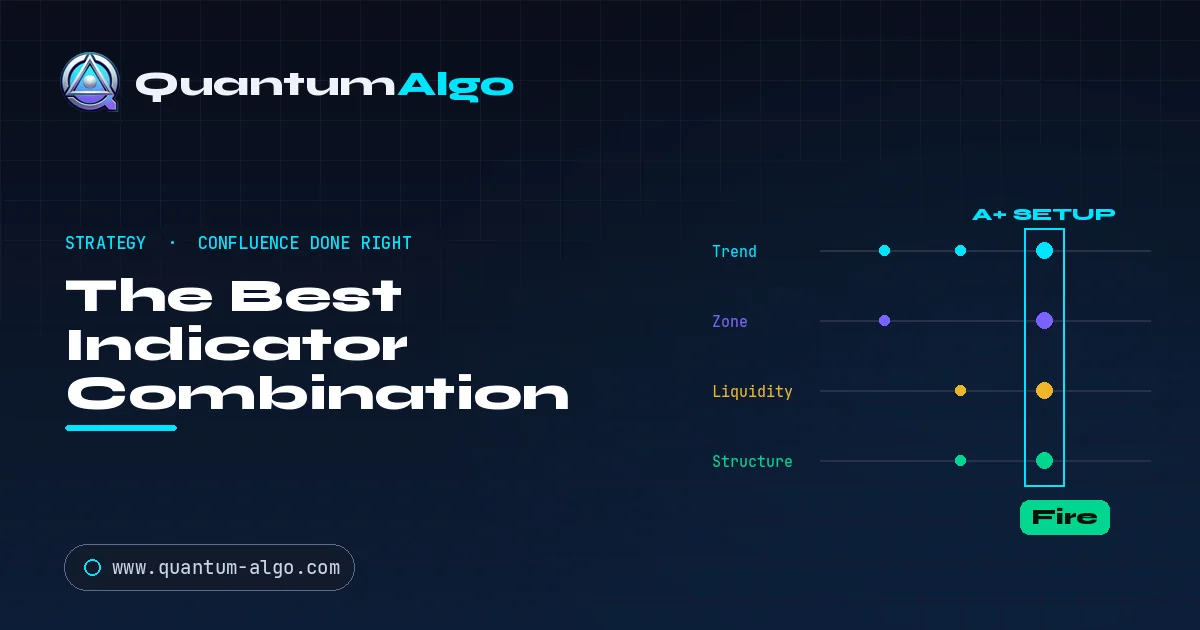
The best indicator combination pairs four independent dimensions, not correlated momentum tools: higher-timeframe trend, institutional zone (order block or FVG), a liquidity sweep and a structure shift (BOS/CHoCH). RSI, MACD and Stochastic are one dimension counted thrice. Quantum Algo runs all four in one engine and signals only when they agree, with a 75% win rate over 160 trades.
Ask most traders for the best indicator combination and you'll get a recipe: RSI plus MACD plus a couple of moving averages plus Bollinger Bands. It feels like confluence — four green lights must be safer than one. It isn't. Those tools are all derivatives of the same input, recent price momentum, so stacking them is like asking four people who read the same newspaper for an independent opinion. Real confluence comes from combining independent confirmations that each measure a genuinely different thing — and once you see that, you realize the best "combination" isn't five scripts on a chart. It's one engine that checks four independent dimensions and only signals when they agree. That engine is Quantum Algo.
A small-cap breakout needs independent participation and range checks; see the US2000 range-expansion framework before stacking another oscillator.
Confluence is more useful when one input is currency context: the JP225 plus USDJPY confirmation framework makes that test explicit.
Indicators that prove themselves in public.
One engine, four precision tools — the Gold (XAU) Scalper, the institutional Gravity Zone, the Zeno momentum Oscillator, and Zeno Stocks for equities.
This guide is about confluence done right: why stacking correlated indicators lowers your win rate, which specific combinations help versus which are redundant, how to score a setup across independent dimensions, and how a single Smart Money Concepts engine bakes real confluence into one non-repainting signal. Unlike the market-specific guides, this one is about the method — it applies to forex, crypto, stocks and indices alike.
| The trap | Most 'combinations' stack correlated momentum tools that all say the same thing |
| The principle | Confluence needs independent confirmations across different dimensions |
| The four dimensions | Higher-timeframe trend · institutional zone · liquidity · structure shift |
| The shortcut | One engine that checks all four — Quantum Algo — and signals only on agreement |
| Signals | Non-repainting, close-confirmed Buy / Sell fired only where confluences align |
| Proof | Public, timestamped record — 75% win rate over 160 closed signals |
Why do correlated indicators lower your win rate?
Indicators are not independent votes. RSI, MACD, Stochastic and a moving-average slope all take recent price as their input and transform it, so when they agree it's because they're measuring the same thing, not because you have four separate pieces of evidence. That produces two failure modes. When they line up, you get false confidence in what is really a single, correlated read. When they conflict — which they constantly do, because each smooths price differently — you get analysis paralysis and miss the trade or take it late.
There's a deeper problem: redundant momentum stacks share one blind spot. None of them can see where the orders are. They'll all flash "buy" as price runs into fresh institutional supply, because none of them knows the zone exists. Adding a fifth momentum tool doesn't patch that hole — it just adds conviction to a blind guess. This is why traders with cluttered charts routinely underperform a beginner reading clean structure. More indicators, more noise, lower win rate.
What are the four independent dimensions of confluence?
A genuinely high-probability setup stacks four confirmations, each measuring a different dimension of the market, in order.
Trend — the higher-timeframe bias. Direction first; the single biggest edge, and independent of any entry trigger. Zone — where price is relative to institutional levels: a graded order block or unmitigated Fair Value Gap in discount or premium, not mid-range. Liquidity — has an obvious high or low been swept, telling you smart money just fueled the move? Structure — has a change of character confirmed intent has shifted? Momentum can add a fifth, light layer as an exhaustion filter, but only as confirmation, never the trigger.
The diagram makes the logic concrete: each lane is one independent dimension, and partial overlaps — where only two or three agree — are decoys that trap traders looking for confluence in the wrong place. The signal fires only in the narrow window where all four align. That is what a real combination looks like, and it's a world away from stacking oscillators.
Which popular indicator combinations actually work?
Here's how the most-searched combinations actually stack up, judged by one question: does each part add independent information, or just repeat what another part already said? Same-dimension pairings score poorly; cross-dimension pairings score well.
| Combination | What it really adds | Verdict |
|---|---|---|
| RSI + MACD | Two momentum reads of the same input | Redundant |
| MA crossover + RSI | Lagging trend + lagging momentum | Weak |
| Bollinger + Stochastic | Volatility envelope + momentum | Mean-reversion only |
| Support/Resistance + RSI | Manual levels + momentum | Subjective |
| Structure + Liquidity + HTF bias | Three independent dimensions | Strong |
| Quantum Algo (all four + filter) | Trend, zone, liquidity, structure in one engine | Best |
Two combinations to specifically avoid: RSI + MACD + Stochastic (all momentum — one dimension, triple-counted) and multiple moving averages (all the same lagging trend read). Both feel like confluence and deliver none. The pairings that help combine different things: trend with structure, structure with liquidity, liquidity with a light momentum filter.
What score makes a confluence setup worth taking?
You don't need to eyeball five charts — you need a checklist that forces independence. Give a setup one point for each dimension it satisfies: with the higher-timeframe trend (1), at a graded institutional zone (1), off a genuine liquidity sweep (1), confirmed by a structure shift (1). A four-out-of-four is an A+ setup and the only kind worth full size. Three is a reduced-size trade at best. Two or fewer isn't a trade — it's a chart you find a reason to like. The discipline of scoring is what turns "confluence" from a vibe into a rule, and it's the difference between a combination that raises your win rate and one that just clutters the screen. Demanding all four naturally reduces your trade count, which is the point: fewer, higher-quality trades beat more, lower-quality ones every time.
The best combination is one engine
The cleanest way to run a four-dimension confluence is not to bolt five scripts onto a chart and referee the overlap — it's to use one engine that computes all of it and only signals when they agree. That is Quantum Algo. The Structure engine supplies the zone, the liquidity sweep and the structure shift; the multi-timeframe panel supplies the trend; the Gravity Zone highlights the liquidity being targeted; the Oscillator adds the exhaustion filter — as confluence, never as the trigger.
The engine fires a Buy or Sell only where trend, zone, liquidity and structure line up, as one non-repainting signal with an exact entry, stop and two targets. It's the four-factor checklist, automated and confirmed on close — the same reason one well-designed engine beats a cluttered chart. The complete Smart Money Concepts guide covers each layer in depth.
The public record
Filtering for four-factor confluence means fewer trades — but better ones. Quantum Algo posts its public Zeno calls on TradingView with a timestamp before the outcome, kept permanently — wins, losses and breakevens, never edited. Across the full record: a 75% win rate over 160 closed signals, 2.3:1 planned risk-to-reward — the payoff of only taking setups where the confirmations agree.
The drawdowns are normal — even a four-factor edge loses trades, and the math works over the large sample, not the next one. What compounds the account is pairing the confluence with fixed-fractional risk management: the combination supplies the edge, your sizing turns it into a curve.
What belongs on a confluence checklist?
Trend — confirm the higher-timeframe direction and trade only with it. Zone — wait for price to reach a graded order block or FVG in discount (longs) or premium (shorts). Liquidity — require a sweep of an obvious high or low into that zone. Structure — require a change of character to confirm intent. When Quantum Algo prints the close-confirmed signal at the intersection of all four, take the exact entry, stop and targets with fixed risk. If a setup is missing one of the four, skip it — that discipline is the entire value of a combination. Run your own study: log fifty four-factor setups and you'll typically find the demand for all four cuts your trade count but lifts your win rate, which is exactly why you build a combination in the first place.

Automate your trades. Let Quantum Algo trade for you.
Every signal executed on your own account — 24/7, hands-off.
Frequently Asked Questions
The best combination is a small set of independent confirmations across different dimensions — higher-timeframe trend, institutional zone, liquidity and structure — not several redundant momentum tools. Quantum Algo bakes this four-factor confluence into one engine and only fires a non-repainting signal where they align, backed by a 75% win rate over 160 closed signals.
No — both measure momentum from the same input, so they're redundant rather than independent, confirm each other for the wrong reasons, and share the same blind spot: neither can see where institutional orders sit. A better combination pairs different dimensions, like structure with liquidity and higher-timeframe trend.
Usually the opposite. Stacking correlated indicators adds noise and analysis paralysis without adding independent information, and often lowers win rate. The goal is fewer, better, independent confirmations — each measuring a genuinely different thing.
Combine across dimensions: higher-timeframe bias (direction), an institutional zone like an order block or FVG (location), a liquidity sweep (fuel), and a structure shift (trigger), with momentum only as a light exhaustion filter. Quantum Algo computes all of these and signals only on agreement.
Give one point for each independent dimension: with the higher-timeframe trend, at a graded zone, off a genuine liquidity sweep, confirmed by a structure shift. Four out of four is an A+ setup worth full size; three is reduced size; two or fewer isn't a trade. Scoring forces independence and turns confluence into a rule.
Because it runs the four-dimension confluence in one engine and only signals when trend, zone, liquidity and structure line up — no eyeballing the overlap of five scripts, no conflicting readings, and it never repaints. You get one clean signal with an exact trade plan instead of a cluttered chart.
Yes, and that's the point. Requiring all four confirmations reduces your trade count but raises the quality and win rate of the trades you take. A good combination is a filter, not a signal generator.
Yes — the four-factor confluence is market-agnostic because institutional order flow behaves similarly everywhere. Quantum Algo applies it across forex, crypto, stocks, indices and gold, with market-specific tools tuned for each.
No. Every signal is confirmed on candle close and never changes retroactively, which is essential for both live trading and honest backtesting. You can scroll back through any market and verify every past signal.
Yes. Rather than learning five indicators, beginners get one engine that checks all four dimensions and outputs a simple Buy or Sell with an exact entry, stop and two targets, plus a free 80-lesson Academy that teaches the underlying Smart Money Concepts from scratch.
Matrix is $19/month for core signals, Atlas $39/month for the full SMC toolkit with filtering and backtesting, and Zeno $79/month for professionals with exact trade plans and the premium suite. Annual billing saves 25%, and every plan includes the public track record.
References & Related Guides
More in this topic
- ADX Indicator: Complete Trading Guide
- AlphaTrend Indicator: Complete Trading Guide
- ATR (Average True Range): Complete Trading Guide
- Awesome Oscillator: Complete Indicator Guide
- What Are the Best Volume Indicators?
- Bollinger Bands — Complete Trading Indicator Guide
- CCI Indicator: Complete Guide
- Chandelier Exit: Complete Trading Guide
- Donchian Channels: Complete Indicator Guide
- Fibonacci Bollinger Bands: Complete Trading Guide
- Fibonacci Retracement — Complete Trading Guide
- Hull Moving Average (HMA): Complete Trading Guide
- Gaussian Channel Indicator Guide
- Best Buy/Sell Indicator Guide
Core reading
- BOS & CHoCH: Complete Market Structure Guide
- Order Blocks Trading: Complete Guide
- Best TradingView Indicators — Complete Guide
- Risk Management in Trading — Complete Guide
- Candlestick Patterns Guide — Engulfing, Pinbar & More
- All Premium Guides
- Quantum Algo on TradingView
- Public Track Record