TradeDay Review: Quick Pay vs Fast Pass, the Drawdown, the Profit Split and Our Verdict
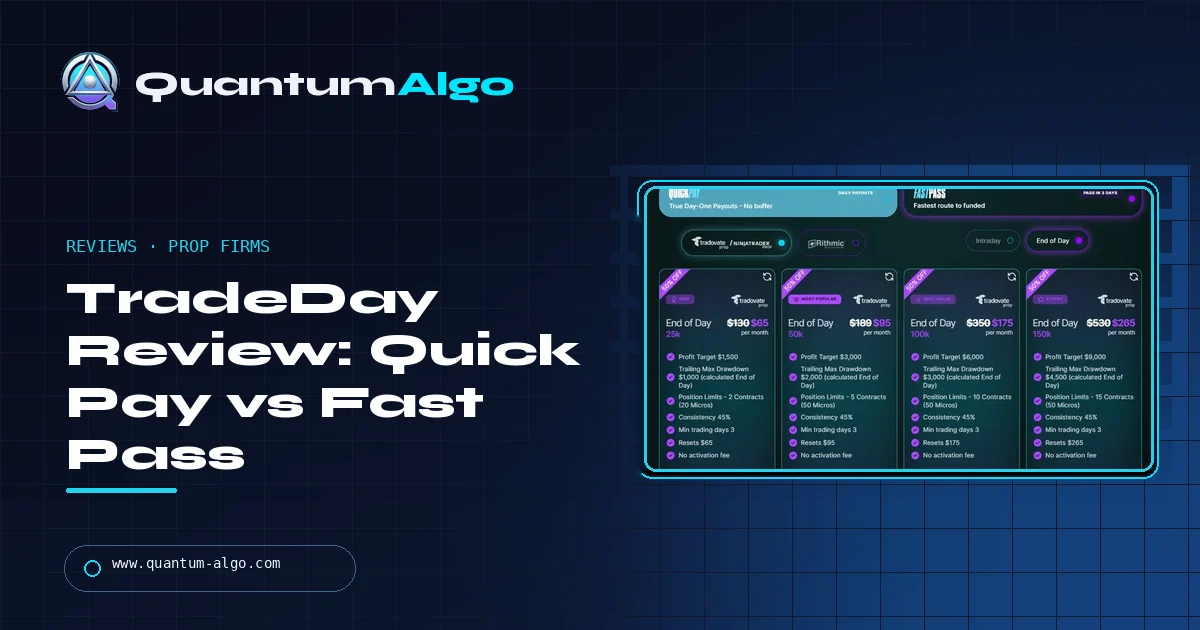
TradeDay is a Chicago futures prop firm, running since 2020, with two programs. Quick Pay pays from day one with no buffer, but keeps 50% of profits until an account is $4,000 up. Fast Pass passes in three days and splits 80/20, but caps each payout. Evaluations list at $100 to $530 a month with no activation fee, and TradeDay discloses a 36% pass rate. Rating: 3.8/5.
TradeDay sells two very different funded accounts under one brand, and the one that suits you depends on how fast you expect to make your first $4,000. I went through the pricing cards, the funded rules and the payout policies in TradeDay's help centre on 11 November 2026. This review sets out what each program costs, how the drawdown works on each, and where the profit split changes.
What is TradeDay?
TradeDay is a futures-only prop firm run by TradeDay LLC from Chicago, Illinois, and it has funded traders since 2020. You pay a monthly fee for an evaluation, trade CME futures on a simulated account until you hit a profit target, then trade a funded account and share the profits. It is the same model as other retail prop firms, so the usual warning applies: the funded stage starts on a simulated account ("Funded Sim"), and only consistent traders move to a live account later.
Two numbers on its own site are worth more than any testimonial. TradeDay says it has paid out more than $10 million since launch, and its footer discloses that the evaluation pass rate was 36% between January and June 2026. Few firms publish that second figure. It tells you the test is passable but not easy, and that the fee is a cost most buyers pay more than once.
If you are new to the product being traded, read how futures contracts, ticks and margin work before buying any evaluation. Every rule below is measured in dollars of futures P&L.
What is the difference between Quick Pay and Fast Pass?
Quick Pay is TradeDay's original program: a five-day minimum evaluation, then payouts from the first day funded with no buffer to build. Fast Pass is newer: pass in as little as three days, then a payout system with winning-day requirements and caps.
| Quick Pay | Fast Pass | |
|---|---|---|
| Minimum evaluation days | 5 | 3 |
| Consistency in the evaluation | No day above 30% of profit | No day above 45% of profit |
| Evaluation drawdown | Intraday or end-of-day (your choice) | End-of-day |
| Funded Sim drawdown | Intraday, whatever you chose before | End-of-day |
| First payout | From day one, no buffer | After 5 winning days ($100 to $250 each) |
| Funded Sim split | 50/50 below $4,000 profit, 80/20 above | 80/20 |
| Largest payout per request | No cap stated | 50% of balance, capped $750 to $2,250 |
| Funded Live split | 50% up to the buffer, 90% above | 90% |
The choice comes down to the profit split. Quick Pay pays from day one, but on a Funded Sim account TradeDay keeps half of every dollar until your account is $4,000 up. Fast Pass makes you wait for five winning days, then splits 80/20 from the first payout. If you expect to withdraw small amounts early, Fast Pass usually pays you more. If you plan to build a cushion past $4,000 before withdrawing, Quick Pay's simpler rules start to make sense.
How much does TradeDay cost?
These are list prices from TradeDay's pricing section on 11 November 2026. On that day the site was running up to 55% off with the code TDNEW, so a 50K Quick Pay showed $59 against a struck-through $131. Promotions run most of the time; treat the list price as the ceiling. There is no activation fee on any plan, and a reset costs the same as one month.
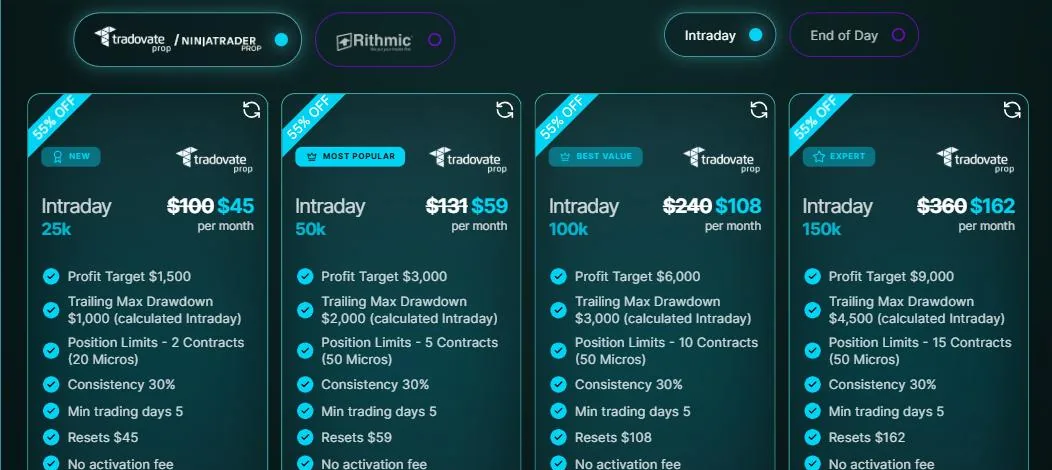
| Plan | Quick Pay intraday | Quick Pay end-of-day | Fast Pass | Target | Max drawdown | Max contracts (minis / micros) |
|---|---|---|---|---|---|---|
| 25K | $100 / mo | $120 / mo | $130 / mo | $1,500 | $1,000 | 2 / 20 |
| 50K | $131 / mo | $175 / mo | $189 / mo | $3,000 | $2,000 | 5 / 50 |
| 100K | $240 / mo | $285 / mo | $350 / mo | $6,000 | $3,000 | 10 / 50 |
| 150K | $360 / mo | $400 / mo | $530 / mo | $9,000 | $4,500 | 15 / 50 |
Because billing is monthly, your real cost is the price times the months you take, plus resets. A 50K Quick Pay passed in the second month with one reset costs $131 + $131 + $131 = $393 at list price. The calculator further down does this for every plan and shows what you would keep from a payout.
Indicators that prove themselves in public.
One engine, four precision tools — the Gold (XAU) Scalper, the institutional Gravity Zone, the Zeno momentum Oscillator, and Zeno Stocks for equities.
How does the TradeDay drawdown work?
TradeDay describes itself as having one main rule: do not hit the trailing maximum drawdown. The limit sits a fixed distance below your highest balance ($1,000 on 25K up to $4,500 on 150K) and follows it up. How it follows depends on the plan:
- Intraday trailing moves up with your highest equity during the session, including open profit. A trade that runs $800 in your favour and then comes back can cost you $800 of room even though you closed flat. This is the stricter version, explained in our Tradeify review and Apex review.
- End-of-day trailing only moves after the session closes at a new high, so intraday swings do not ratchet it up. It is still enforced during the session.
The catch most buyers miss: on Quick Pay, every Funded Sim account uses an intraday drawdown, even if you passed an end-of-day evaluation. TradeDay labels these plans "End of Day (Intraday Funded Drawdown)". Fast Pass keeps the end-of-day drawdown when funded. On Fast Pass, the drawdown also stops trailing at your starting balance once you take the first payout.
Size every trade from the room left to the limit, not from the account size. Our position sizing guide and a hard stop loss matter more here than any entry signal.
What are the TradeDay payout rules?
Both programs have a $250 minimum payout request, and TradeDay says most requests are processed within 24 hours on business days. US bank wires are free; international wires cost $15 and on-chain crypto withdrawals carry network fees.
Quick Pay Funded Sim. No buffer and no minimum days: you can request a payout from any positive balance. The split is calculated on your current profit, not on lifetime withdrawals: 50/50 while profit is below $4,000, 80/20 on the part above $4,000. Example from TradeDay's own policy: taking $3,000 from $6,000 of profit pays $2,100 ($1,600 at 80% plus $500 at 50%). The drawdown keeps trailing from gross profit, so payouts do not reset it.
Fast Pass Funded Sim. You need five profitable days (not necessarily in a row) of at least $100, $150, $200 or $250 depending on size, and no single day above 45% of gross profit. Each request can be up to 50% of the balance, capped at $750 (25K), $1,500 (50K), $1,875 (100K) or $2,250 (150K) for accounts opened from 26 July 2026. You stop trading until the payout arrives, and the next cycle starts at the next session. The split is 80/20.
Funded Live. Consistent traders are moved to a live account. Fast Pass Live starts at a $0 balance with a trailing buffer, smaller contract limits (1 to 4 contracts by size) and a 90/10 split. Quick Pay Live splits 50% up to the required buffer and 90% above it. A trader can hold up to five Funded Live accounts. Compare this with the caps at Alpha Futures and MyFundedFutures.
What does the Fast Pass offer look like?
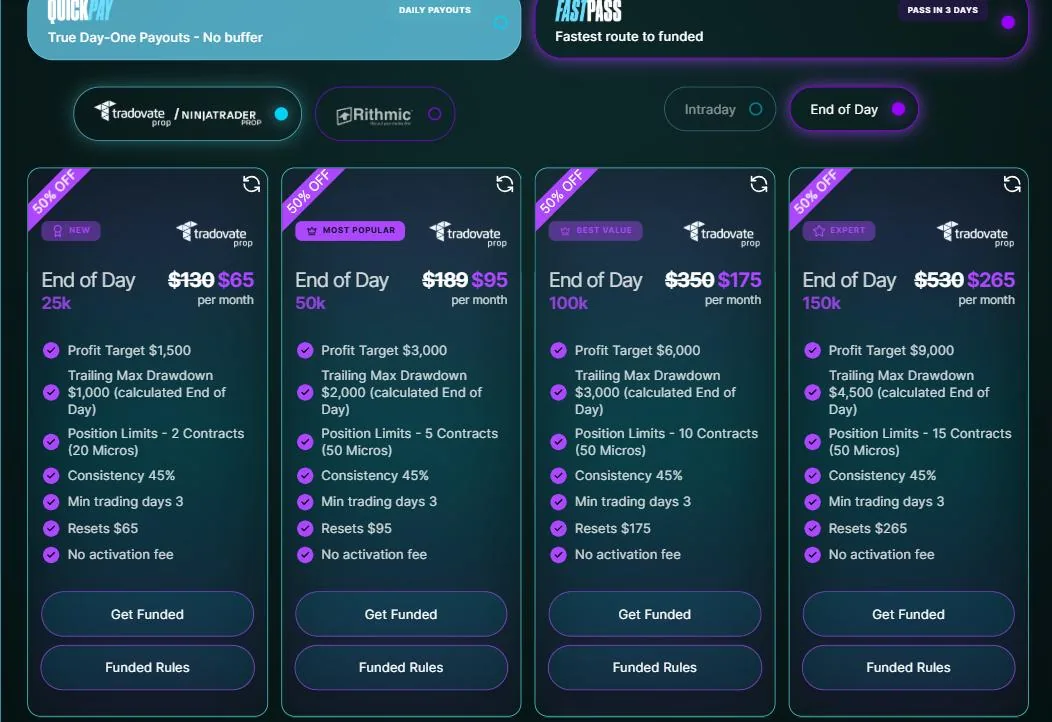
Fast Pass costs more per month than Quick Pay at every size, and in exchange removes two days from the minimum and the intraday drawdown from the funded stage. The evaluation consistency rule is looser (45% instead of 30%), so one strong day is less likely to hold up your pass.
Who should pay the premium? A trader whose strategy has occasional large winners and who wants an end-of-day drawdown on the funded account. Who should not? Anyone who plans to pass slowly: at $189 a month for 50K, three months of Fast Pass cost $567 at list price before any reset, against $393 for Quick Pay.
TradeDay cost and payout calculator
Pick a program and size, say how long you expect to take and how many resets you might use, then enter a profit amount to see what TradeDay's split would leave you on a Funded Sim account.
The payout figure assumes you withdraw the full profit entered on Quick Pay, and the largest allowed single request on Fast Pass. List prices, November 2026; check the current promotion before you buy.
Which platforms does TradeDay support?
TradeDay offers two data routes. On CQG you can use Tradovate (free licence), NinjaTrader (free NT8 licence or your own) and TradingView, which is free to connect but needs your own TradingView plan. On Rithmic you can use R|Trader Pro and ATAS (free licences), plus Quantower, Sierra Chart, Bookmap, MotiveWave, Jigsaw, MultiCharts and others with your own licence.
The platform is chosen when you buy, and the feed decides what you can connect later, so pick before you pay. If you are unsure which route fits, Rithmic vs Tradovate covers the difference, and prop firms that use TradingView lists the alternatives if TradingView charting is what you want.
Which TradeDay rules end the most accounts?
Most failed accounts break the drawdown. The rest usually trip one of these rules, which are in the help centre rather than on the pricing cards:
| Rule | What it says | Where it applies |
|---|---|---|
| Trailing max drawdown | Intraday on Quick Pay funded; end-of-day on Fast Pass funded | Every account |
| Consistency | 30% (Quick Pay) or 45% (Fast Pass) of profit in one day | Evaluations; Fast Pass funded payouts |
| Price limits | No trading within 2% of a price limit | Funded accounts |
| Bots and automation | Third-party bots and automated systems are banned | Every account |
| Hedging and order splitting | No long in one account and short in another; no order splitting | Every account |
| Trade count | More than 200 trades in a day is not allowed | Every account |
TradeDay also keeps the right to withhold profits from trades placed during tier 1 data releases if a funded account is lost with a positive balance. Read the order types you use around news and keep size small on release days. If you plan to automate, our guide to whether trading bots work explains why firms like TradeDay ban them.
Reference data
| Item | Value (checked November 2026) |
|---|---|
| Company | TradeDay LLC, Chicago, Illinois; funding since 2020 |
| Markets | CME group futures (permitted products list) |
| Programs | Quick Pay, Fast Pass; Funded Sim then Funded Live |
| List prices | $100 to $530 a month; no activation fee |
| Evaluation pass rate | 36%, January to June 2026 (TradeDay disclosure) |
| Minimum payout | $250 |
| Quick Pay split | 50/50 below $4,000 profit, 80/20 above |
| Fast Pass split | 80/20; payout cap $750 to $2,250 per request |
| Funded Live split | 90% (Fast Pass); 50% to the buffer, 90% above (Quick Pay) |
| Platforms | Tradovate, NinjaTrader, TradingView (CQG); R|Trader Pro, ATAS, Quantower and others (Rithmic) |
What are the pros and cons of TradeDay?
| Strengths | Weaknesses |
|---|---|
| Running since 2020, publishes a 36% pass rate | Quick Pay splits 50/50 until profit passes $4,000 |
| No activation fee; reset costs one month | Quick Pay funded accounts use an intraday drawdown |
| Day-one payouts with no buffer on Quick Pay | Fast Pass caps each payout at $750 to $2,250 |
| End-of-day drawdown kept on Fast Pass funded accounts | Monthly billing: slow passes cost more |
| Wide platform choice on CQG and Rithmic | Funded Sim accounts are simulated |
How does TradeDay compare with other futures prop firms?
The firms closest to TradeDay also sell monthly futures evaluations with a trailing drawdown. The differences that matter most are the drawdown type on the funded account, the split on your first withdrawals and the cap on each payout. Alpha Futures pays 90% on every plan with an end-of-day drawdown but caps payouts on three of its four plans. Topstep, Take Profit Trader, Lucid Trading and MyFundedFutures each handle those three points differently; the full rulebooks are in our reviews.
Against that field, TradeDay's strengths are the published pass rate, no activation fee and Fast Pass's end-of-day funded drawdown. Its weakness is the 50/50 split on the first $4,000 of Quick Pay profit. If price is what decides, the cheapest prop firms compares cost per funded dollar, and prop firms for US traders covers which firms accept US residents on which platforms.
Who is TradeDay for, and what is our verdict?
TradeDay suits two kinds of trader. On Fast Pass, a trader who can string together five modest winning days and wants an end-of-day drawdown when funded. On Quick Pay, a patient trader who will build a cushion past $4,000 before withdrawing much, and who is comfortable with an intraday drawdown.
It suits a trader who wants to withdraw small amounts early less well. On Quick Pay the first $4,000 of profit is split 50/50, which is a steeper share than most competitors take.
My rating is 3.8 out of 5. The firm is established, transparent about its pass rate, and charges no activation fee, but the Quick Pay split and its intraday funded drawdown hold it back. Pass with a plan built around the drawdown first; a written prop firm strategy and a trading journal will do more for your result than the choice of program.
TradeDay sells Quick Pay (5-day pass, day-one payouts, 50/50 split below $4,000 of profit, intraday funded drawdown) and Fast Pass (3-day pass, 80/20 split, end-of-day funded drawdown, capped payouts). List prices run $100 to $530 a month with no activation fee, and the firm discloses a 36% pass rate. Choose the program by how soon you want to withdraw.
◆ Interactive check
Do you know TradeDay's rules?
Questions traders ask about TradeDay
TradeDay LLC has operated from Chicago since 2020, says it has paid out more than $10 million, and publishes its evaluation pass rate (36% for January to June 2026). Its funded accounts start as simulated accounts, so read the payout policy before you buy.
List prices run from $100 a month (25K Quick Pay intraday) to $530 a month (150K Fast Pass). There is no activation fee, a reset costs one month, and promotions such as the TDNEW code often cut prices by half.
On Quick Pay Funded Sim, 50/50 while account profit is below $4,000 and 80/20 above it. On Fast Pass Funded Sim, 80/20. On Funded Live accounts, 90/10 above any buffer.
Quick Pay has a 5-day minimum, day-one payouts with no buffer and an intraday funded drawdown. Fast Pass has a 3-day minimum, an end-of-day funded drawdown, an 80/20 split and payouts after five winning days, capped per request.
Fast Pass does, in the evaluation and when funded. Quick Pay offers it in the evaluation only; every Quick Pay Funded Sim account uses an intraday trailing drawdown.
TradeDay says most requests are processed within 24 hours on business days. The minimum request is $250.
Yes, on the CQG route. Connecting is free, but you need your own TradingView plan.
There is no blanket news ban, but bracketing data releases is prohibited, and profits from trades in tier 1 data releases can be withheld if a funded account is lost.
Yes for charting: Quantum Algo's Zeno indicators run on TradingView and give signals you act on by hand. TradeDay bans third-party bots and automated systems, so do not connect anything that places orders for you.
References & Related Guides
Read next
- Alpha Futures Review
- Topstep Review
- MyFundedFutures Review
- Take Profit Trader Review
- Lucid Trading Review
- Tradeify Review
- Cheapest Prop Firms
- Prop Firms for US Traders
- Rithmic vs Tradovate
- Futures Trading for Beginners
Primary sources
- TradeDay — pricing, programs and pass-rate disclosure (checked 11 November 2026)
- TradeDay help centre — Quick Pay Funded Sim payout policy
- TradeDay help centre — Fast Pass Funded Sim payout policy
- TradeDay help centre — trading platforms
- TradeDay help centre — prohibited trade practices
- CFTC — Learn and Protect: futures trading risks