My Funded Futures Review: Plans, the Drawdown Rule That Matters, Payouts and Who It Suits

My Funded Futures (MFFU) is a US futures prop firm, founded in 2023, with one-time evaluations from $109 ($25k Rapid) to $477 ($150k Pro), no activation fee, no daily loss limit, a 90/10 split with daily payout eligibility on Rapid, and TradingView execution through Tradovate. The catch: a 50% consistency rule and Rapid's intraday drawdown when funded.
My Funded Futures went from a new name to one of the biggest futures prop firms in two years by paying daily, dropping the activation fee and putting "100% of your first $10k" on the homepage. Whether it is the right firm for you depends on one rule most reviews skim: what happens to the trailing drawdown once you are funded. This review explains the current plans, that rule, the consistency and payout conditions, the platforms, and where MFFU stands against Topstep, Apex, Take Profit Trader and Tradeify, with a plan-fit tool at the end.
Indicators that prove themselves in public.
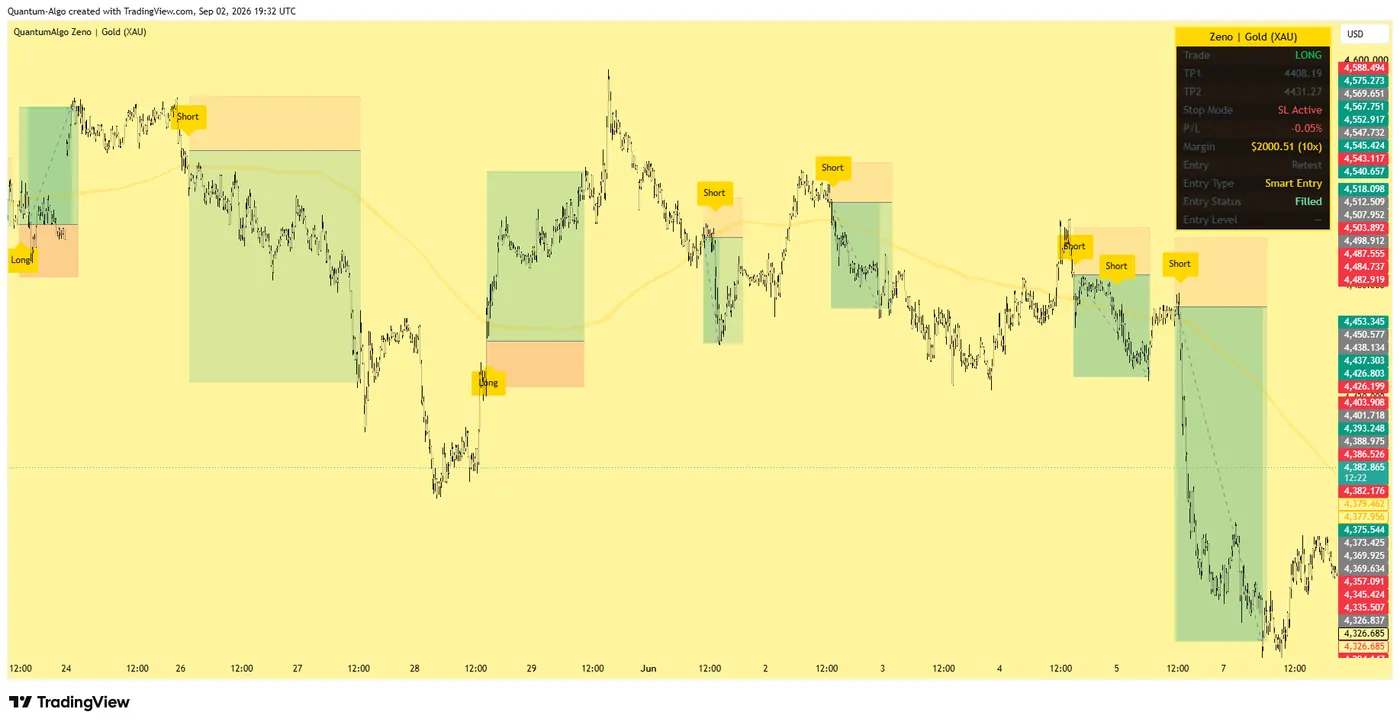
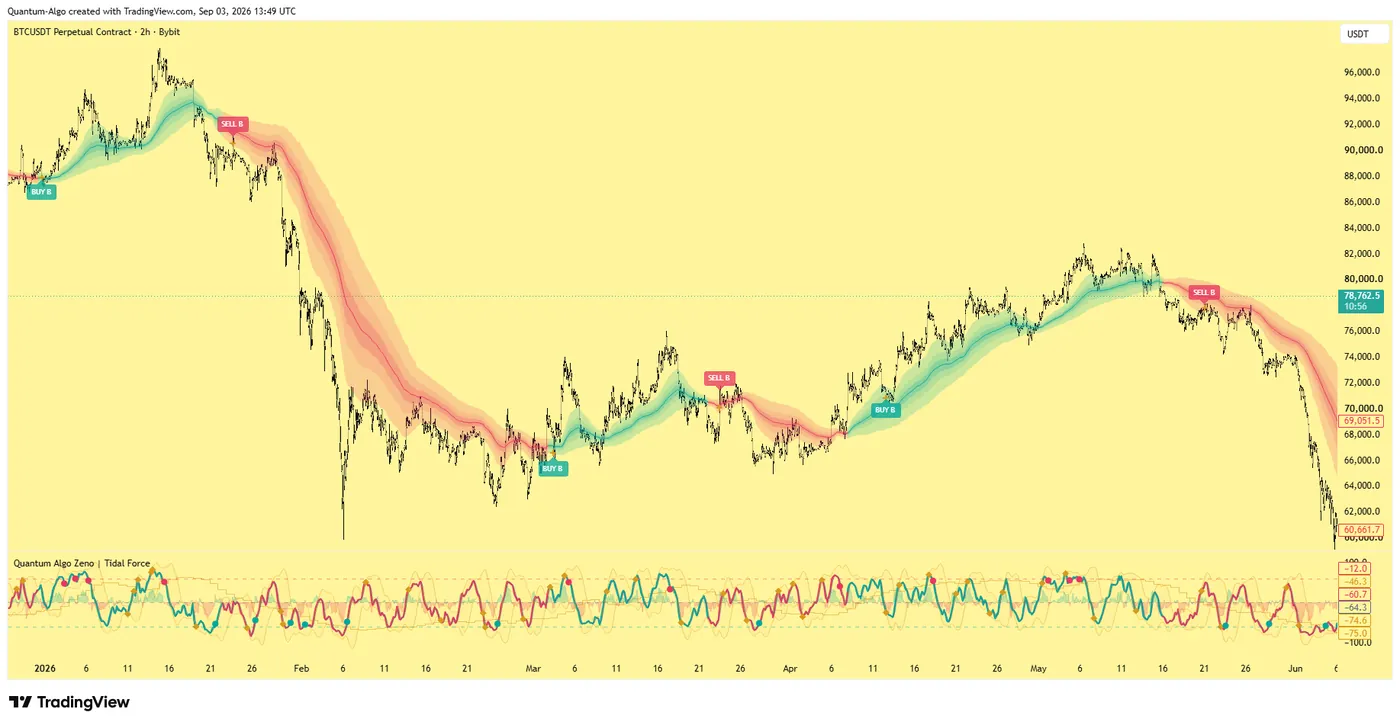
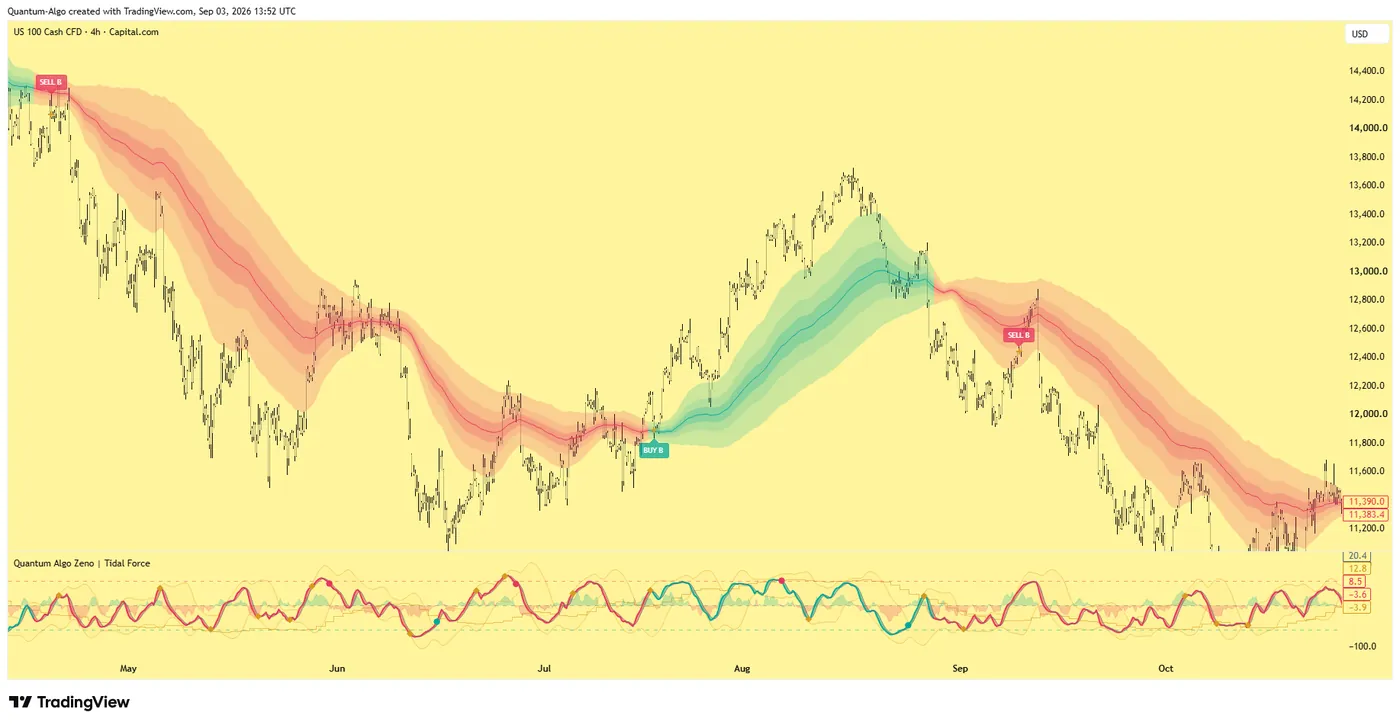
One engine, four precision tools — the Gold (XAU) Scalper, the institutional Gravity Zone, the Zeno momentum Oscillator, and Zeno Stocks for equities.
What is My Funded Futures?
My Funded Futures — MFFU to everyone who trades it — is a US futures prop firm founded in 2023 that grew faster than almost any other in the space by doing three things the incumbents did slowly: paying out daily, dropping the activation fee, and offering a 100%-of-the-first-$10,000 profit split as the headline on its most popular plan. It runs on the standard funded-futures model: you pay for a simulated evaluation account, hit a profit target without breaching a trailing drawdown, and move to a simulated funded account from which real payouts are made, with a path to a live account for consistent traders.
This review is for the trader deciding between MFFU and the other futures firms — Topstep, Apex, Take Profit Trader, Tradeify — and for the MFFU customer trying to keep up with a rule set that has changed more often than most. It covers the current plans and what each costs, the drawdown mechanics that actually decide pass rates, the consistency and payout rules, the platforms, where the firm is strong and where it is not, and a plan-fit tool at the end. Prices and rules were checked in September 2026; MFFU changes them frequently, so treat the rules page as the source of truth and this page as the explanation.
Is My Funded Futures worth it?
Rating: 4.2 / 5. One of the two or three best-value futures prop firms on the market for the trader who wants to be paid quickly and often: daily payout eligibility on Rapid, a 90/10 split, no activation fee, no daily loss limit, a one- or two-day minimum, and a Trustpilot record that is large and mostly positive. Loses points for a rule surface that is genuinely hard to keep track of — four plans, two drawdown regimes, three different consistency thresholds — for the switch from end-of-day to intraday trailing drawdown once you are funded on Rapid, and for the frequency with which the plans themselves are rewritten.
Best for: intraday futures traders with defined stops who want daily payouts and can live with an intraday trailing drawdown once funded; TradingView users, because execution through Tradovate is supported. Not for: anyone who holds overnight through drawdown on Rapid, anyone who trades one big day a week (the consistency rule will hold your payout), and anyone who wants a rule set that stays still.
What account types does MFFU offer?

- Rapid — $25k, $50k, $100k and $150k evaluations, one-time fee, end-of-day trailing drawdown in the evaluation that becomes an intraday (real-time high-water) trail when funded; 90/10 split; payouts requestable daily once the conditions are met; no daily loss limit; 50% consistency rule in the evaluation.
- Rapid EOD — the same idea with the end-of-day drawdown kept in the funded stage, a 30% consistency rule in the evaluation and a four-day minimum; 90/10 split, daily payout eligibility.
- Pro — $50k, $100k and $150k, end-of-day trailing drawdown in both stages, 80/20 split, a 14-calendar-day payout cycle, a profit buffer that stays in the account, and a "One-Day" add-on on the $50k that removes the consistency rule for a higher target.
- Builder — $25k and $50k at a fixed price, end-of-day drawdown, a soft daily-loss pause on the $50k, no consistency rule in the evaluation, 80/20 split, capped at a handful of sim-funded payouts before you are moved to the next stage.
- No activation fee on any current plan, no data fees during the evaluation, and a reset from roughly $84 upward depending on the plan.
- Platforms — Tradovate, NinjaTrader, TradingView (through Tradovate) and Quantower at checkout; data from dxFeed.
- Payouts — most requests auto-approved, manual reviews quoted at six to twelve business hours, paid through Rise (ACH, instant transfer or crypto) with a flat fee per fiat withdrawal.
- Live path — consistent sim-funded traders are moved to a live account after a set number of payouts or profit.
Current plans and prices
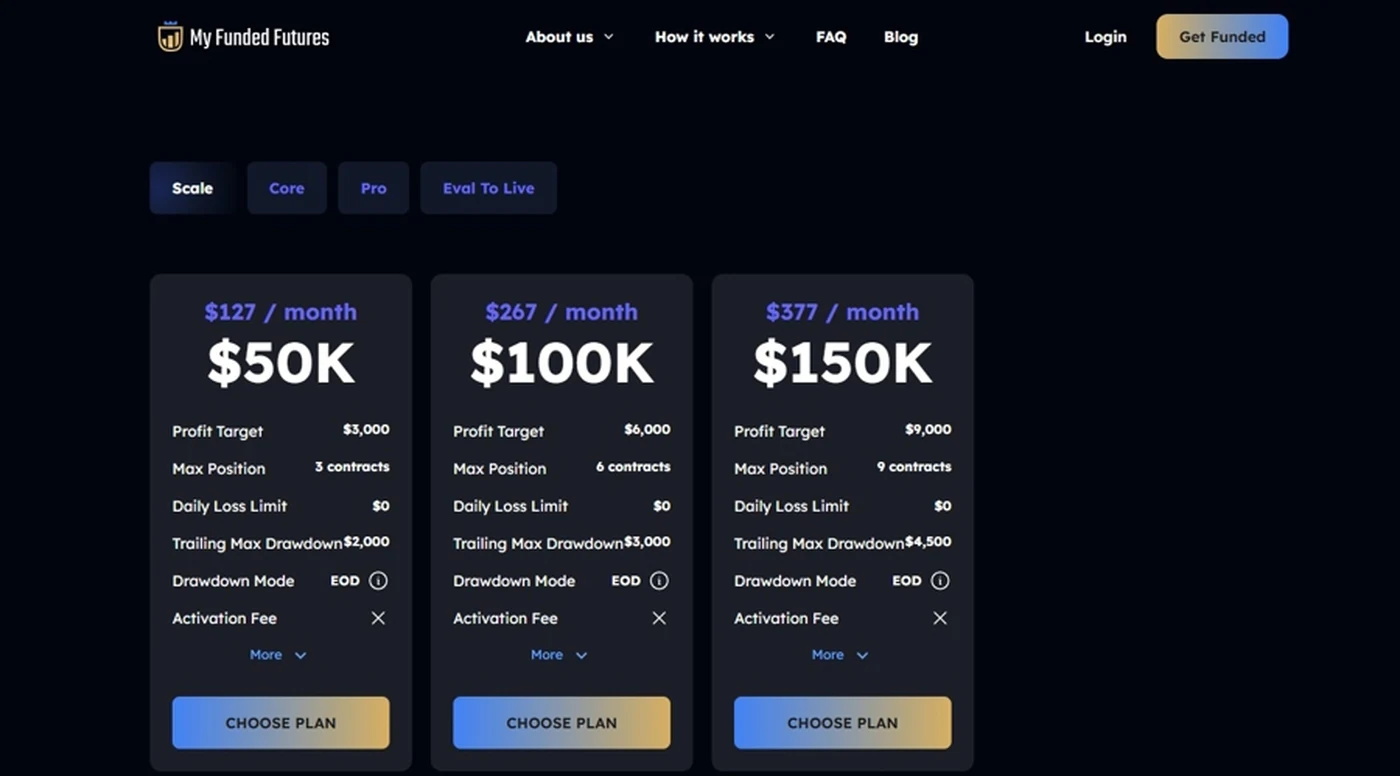
MFFU sold its accounts as monthly subscriptions — Core, Scale and Pro, with Scale at $127 a month for $50k — until it moved to one-time evaluation pricing. The current line-up, checked September 2026:
| Plan | $25k | $50k | $100k | $150k | Target | Drawdown | Split | Payouts |
|---|---|---|---|---|---|---|---|---|
| Rapid | $109 | $157 | $267 | $347 | $1.5k / $3k / $6k / $9k | EOD in eval → intraday trail when funded | 90/10 | Daily eligibility, 24h after first trade |
| Rapid EOD | — | similar to Rapid | — | — | $3k | End of day, both stages | 90/10 | Daily; 4-day minimum |
| Pro | — | $227 | $344 | $477 | $3k / $6k / $9k | End of day, both stages | 80/20 | Every 14 calendar days; $1,000 minimum |
| Builder | $153 | $153 | — | — | $1.5k / $3k | End of day | 80/20 | Limited sim-funded payouts, then next stage |
Contract limits scale with the account — three minis (thirty micros) on the $25k Rapid up to fifteen minis on the $150k — and are higher in the funded stage than in the evaluation on Pro. Discount codes of 30–40% are usually live, so the list prices above are ceilings. The cheapest prop firms guide puts these numbers next to every competitor's, resets and all.

Automate your trades. Let Quantum Algo trade for you.
Every signal executed on your own account — on your account, with the plan you define.
How does the MFFU trailing drawdown work?
MFFU has no daily loss limit, which sounds generous until you understand what replaces it. The account is governed by a trailing maximum drawdown — $2,000 on the $50k — that follows your equity up and never comes back down. On Rapid EOD, Pro and Builder, and in the Rapid evaluation, the trail is calculated at the end of the day from your closing balance, which means an open winner that reverses intraday cannot breach you. That is the end-of-day version and it is the friendlier one.
On Rapid, the moment you are funded the trail switches to intraday: it now follows your open-trade high-water mark in real time. A trade that goes $1,500 in your favour and comes back to break-even has moved the trail up by $1,500 and left you $500 from breach without a single losing trade. This is the mechanic that produces most Rapid funded-account blow-ups, and it is the reason the plan-fit tool below sends overnight and pullback-tolerant traders to Pro. The prop firm strategy guide covers sizing under a trailing drawdown; the short version is that on an intraday trail you take profit into the first pool and you do not let winners round-trip.
The trail also stops once you are $100 above the starting balance plus the drawdown amount on most plans — the "locked" point — after which it behaves like a static drawdown. Getting to the lock quickly, with small size, is the whole game in the first week of a funded account.
Which MFFU rules decide when you get paid?
| Rule | Rapid | Rapid EOD | Pro | Builder |
|---|---|---|---|---|
| Consistency (evaluation) | 50% — no single day over half of total profit | 30% | 50% (none with the One-Day add-on) | None |
| Consistency (funded) | None | None | None | 50% per payout cycle |
| Minimum trading days | 2 | 4 | 2 (1 with One-Day) | 2 per cycle |
| First payout | 24 hours after first funded trade, once the profit buffer is met | Daily eligibility | 14 calendar days from first trade | Per cycle |
| Minimum payout | $250 | $250 | $1,000 | $250 |
| Split | 90/10 | 90/10 | 80/20 | 80/20 |
| Profit buffer to keep in the account | $1,100–$4,600 by size | Similar | $2,100–$4,600 | Per plan |
Two things in that table matter more than they look. The 50% consistency rule in the Rapid evaluation means a $2,000 day on a $3,000 target does not pass you — it makes you trade until total profit is $4,000 so that the big day is under half. And the profit buffer means the first payout is never the whole balance: on a $50k Rapid you keep a buffer in the account and withdraw what sits above it. Neither is unusual in futures prop trading; both are on the rules page, and neither is on the homepage.
Which platforms does MFFU support?
MFFU is one of the futures firms where TradingView execution is real rather than aspirational, because the accounts are Tradovate accounts under the hood and TradingView connects to Tradovate natively. That means Zeno's signals, order blocks and sweeps on your TradingView chart and the order ticket on the same screen — no bridge, no second platform. NinjaTrader and Quantower are there for the trader who wants DOM and footprint tools, and Rithmic is not part of the current offer, which the Rithmic vs Tradovate answer explains the consequences of: slightly slower fills in fast markets, a much simpler setup.
Algorithmic trading is permitted with the usual exclusions — high-frequency trading, order manipulation, copying between accounts and gap exploitation are banned — which puts MFFU on the short list of firms where QuantumBot-style execution is allowed on a funded account. Confirm the current wording before connecting anything; the rule has been rewritten before.
How does MFFU compare with Topstep, Apex and others?
| MFFU (Rapid) | Topstep | Apex | Take Profit Trader | Tradeify | |
|---|---|---|---|---|---|
| Evaluation price, $50k | $157 one-time (codes ~40% off) | $49 / month | $147 list, usually 80–90% off | $170 / month | $145 one-time |
| Activation fee | $0 | $149 | Yes (one-time or monthly PA fee) | $130 (PRO) | $0 |
| Drawdown when funded | Intraday trail (EOD on Pro / Rapid EOD) | End of day | Trailing | Intraday on PRO | End of day |
| Daily loss limit | None | Yes | None | None | Yes on some plans |
| First payout | Daily eligibility | After 5 winning days | After a minimum number of trading days | Day one above the buffer | Varies |
| Split | 90/10 (100% of first $10k on some plans) | 90/10 after 100% of first $10k | 100% of first $25k then 90/10 | 80/20 → 90/10 | 90/10 |
| TradingView execution | Yes (Tradovate) | Yes (TopstepX) | On Tradovate plans | Yes (CQG) | Yes |
MFFU wins on speed of payout and on the absence of an activation fee; Topstep wins on the stability of its rules and an end-of-day drawdown on every plan (see the Topstep review); Apex wins on price when a code is live and on the size of the first-payout split (the Apex review). The trader who wants to be paid this week chooses MFFU Rapid or Take Profit Trader; the trader who holds through pullbacks chooses Topstep or MFFU Pro.
MFFU plan-fit tool
Pick how you trade, the account size and how quickly you want the first payout, then give an honest best-day percentage and pass rate. The tool names the plan whose drawdown and consistency rules fit, and estimates the true cost including resets.
Reference data
| Item | Value |
|---|---|
| Founded | 2023, United States |
| Current plans | Rapid, Rapid EOD, Pro, Builder (Core, Scale and Flex retired) |
| Rapid prices | $109 / $157 / $267 / $347 for $25k / $50k / $100k / $150k, one-time |
| Pro prices | $227 / $344 / $477 for $50k / $100k / $150k |
| Activation fee | $0 on every current plan |
| Reset | From about $84, scaling with plan |
| Drawdown | EOD trailing in evaluations; intraday trail on funded Rapid; EOD on funded Pro, Rapid EOD and Builder |
| Consistency | 50% (Rapid, Pro evaluation); 30% (Rapid EOD); none (Builder evaluation, funded Rapid) |
| Payouts | Rapid daily eligibility, 90/10; Pro every 14 days, 80/20; $250–$1,000 minimums; Rise (ACH, instant, crypto) |
| Platforms | Tradovate, NinjaTrader, TradingView via Tradovate, Quantower; dxFeed data |
| Trustpilot | 4.9 / 5 on roughly 20,000 reviews (August 2026) |
| Checked | September 2026 — the rules page overrides anything here |
Worked example: passing a $50k Rapid and reaching the first payout
A trader buys the $50k Rapid at $157 (or around $95 on a code). Target $3,000, trailing drawdown $2,000 calculated end of day, three-contract limit, 50% consistency rule. Day one: a London-open NQ sweep-and-displacement long, two micros, +$640. Day two: +$410. Day three: a loss of $380. Days four to seven: +$520, +$0, +$880, +$1,010. Total $3,080 — passed, and the best day ($1,010) is under 50% of the total, so the consistency rule is satisfied. Seven trading days, no daily loss limit to worry about, the trail never came within $1,200 of equity because losses were closed the same session.
Funded stage: the drawdown is now intraday. Same trader, same setups, but every trade is now taken with a hard stop and profit taken at the first liquidity pool rather than trailed, because a $1,500 winner that round-trips would move the trail up $1,500. Six trading days later the account is $2,300 up, above the buffer, and the first payout — requestable 24 hours after the first funded trade, paid at 90% — is $1,000, approved automatically. Total cost to that point: $157. Total received: $900. Everything after that is the trade, not the firm.
What mistakes do traders make with MFFU?
- Treating "no daily loss limit" as freedom. The trailing drawdown is the limit; it is just less visible.
- Forgetting that funded Rapid uses an intraday trail. Winners that round-trip are what breach it.
- Having one big day in the evaluation. Above 50% of total profit it does not pass you; it makes the target bigger.
- Requesting a payout before the buffer is met, then reading the rejection as a scam. The buffer is on the rules page.
- Choosing Rapid because of the 90/10 split when you hold overnight. Pro's 80/20 with an EOD drawdown pays more if it keeps the account alive.
- Relying on a review — this one included — for the current rules. MFFU rewrites plans several times a year; read the page before you buy.
- Running a bot without checking the current algo wording and the copy-trading ban across accounts.
How we trade an MFFU account
The evaluation is passed the same way as any other funded account: a 4-hour bias, a sweep of the overnight or previous-day extreme, displacement, an entry from the order block or fair value gap it left, a stop beyond the sweep, and profit at the first pool. What changes at MFFU is the funded stage on Rapid: the intraday trail means the runner is closed at the first pool rather than trailed, and size is reduced until the trail locks. Zeno prints those levels on confirmed candles on the TradingView chart connected to the Tradovate account, and the free session indicator keeps you inside the London and New York windows where the sweeps are worth taking. The evaluation strategy lesson is the full plan; the options prop firms guide is the sister page for a market MFFU does not offer.
MFFU is the futures prop firm for the trader who wants to be paid this week: cheap to enter, nothing to activate, daily payout eligibility and a 90/10 split. It punishes two things — a single big day in the evaluation, and a funded Rapid winner that round-trips into the intraday trail. Take profit at the first pool, keep every day under half the total, choose Pro or Rapid EOD if you hold through pullbacks, and read the rules page before every purchase, because the plans change.
◆ Interactive check
Do you know the MFFU rules that matter?
Questions traders ask about My Funded Futures
Yes. MFFU is a US futures prop firm founded in 2023 with a large, mostly positive Trustpilot record (around 4.9 / 5 on roughly 20,000 reviews as of August 2026), automated payouts through Rise, and public rules. The complaints that exist are about rule changes and the intraday trailing drawdown on funded Rapid accounts, not about payouts being refused.
One-time evaluation fees, checked September 2026: Rapid $109 / $157 / $267 / $347 for $25k / $50k / $100k / $150k; Pro $227 / $344 / $477 for $50k / $100k / $150k; Builder $153 for $25k or $50k. No activation fee on any current plan; discount codes of 30–40% are usually live; resets start around $84.
In the Rapid and Pro evaluations no single trading day may account for more than 50% of your total profit at the time you pass; Rapid EOD uses 30%; Builder has none in the evaluation. Funded Rapid has no consistency rule; Builder applies 50% per payout cycle. If a big day breaks the rule you keep trading until it is under the threshold.
Rapid is cheaper, pays 90/10 with daily payout eligibility, and uses an intraday trailing drawdown once funded. Pro costs more, pays 80/20 on a 14-day cycle with a $1,000 minimum, and keeps an end-of-day trailing drawdown in both stages. Scalpers and disciplined intraday traders pick Rapid; traders who hold through pullbacks or overnight pick Pro or Rapid EOD.
On Rapid you can request a payout 24 hours after your first funded trade once the profit buffer for your account size is met, with a $250 minimum and a 90% split; most requests are auto-approved and manual reviews are quoted at six to twelve business hours. Pro pays every 14 calendar days with a $1,000 minimum at 80%. Payouts go through Rise by ACH, instant transfer or crypto, with a flat fee per fiat withdrawal.
No. The account is governed by a trailing maximum drawdown instead ($2,000 on a $50k), calculated end of day in the evaluations and on funded Pro, Rapid EOD and Builder, and intraday on funded Rapid. Builder's $50k has a soft daily-loss pause rather than a hard limit.
Yes. MFFU accounts run on Tradovate, and TradingView connects to Tradovate natively, so you can execute from the same chart your indicators are on. NinjaTrader and Quantower are also offered; Rithmic is not part of the current platform list.
Algorithmic trading is permitted, with high-frequency trading, order manipulation, copy trading across accounts and gap exploitation banned. The wording has changed before, so confirm the current rule before connecting an automated system.
MFFU pays faster (daily eligibility on Rapid), charges no activation fee and has no daily loss limit; Topstep has an end-of-day drawdown on every plan, a daily loss limit, a $149 activation fee and rules that change far less often. Pick MFFU for speed of payout and low entry cost; pick Topstep for a stable, forgiving rule set.
Zeno marks the order blocks, fair value gaps and liquidity sweeps on the TradingView chart that executes through Tradovate, on confirmed candles so nothing repaints between the evaluation and the funded account. On funded Rapid the runner is closed at the first liquidity pool rather than trailed, because the intraday drawdown follows open-trade highs.
References & Related Guides
Read next
- Cheapest Prop Firms
- Topstep Review
- Apex Trader Funding Review
- FTMO Review
- FundedNext Review
- Rithmic vs Tradovate
- Prop Firm Trading Strategy
- Options Prop Firms
- Best Futures Trading Platform
- Best Indicators for Futures Trading
- Prop Firm Evaluation Strategy (Academy)
- SessionScope — free session indicator