Rithmic vs Tradovate: The Difference, Which Prop Firms Use Which, and How to Choose
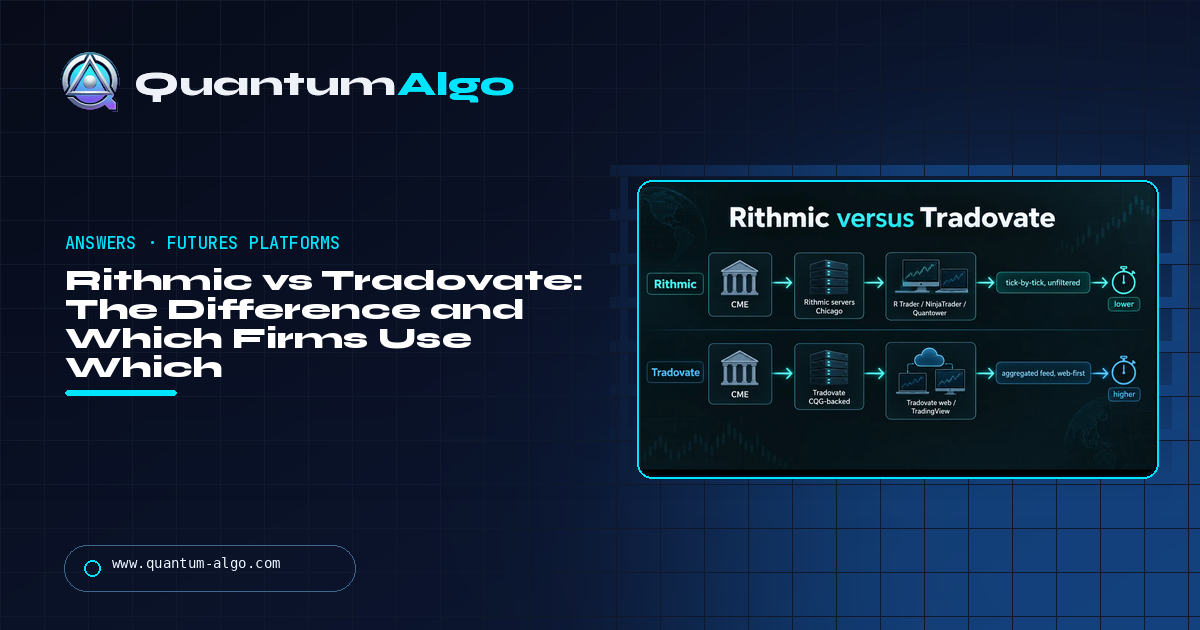
Rithmic is a Chicago-based market-data and order-routing network — a tick-by-tick, unfiltered feed you connect a platform to (R|Trader Pro, NinjaTrader, Quantower, Bookmap, Sierra, ATAS) — while Tradovate is a futures broker owned by NinjaTrader with its own cloud platform on a CQG backbone, tradeable from a browser, a phone or directly from a TradingView chart. Prop firms choose one and you inherit it: Apex, Take Profit Trader and Lucid run on Rithmic; My Funded Futures and Tradeify on Tradovate; Earn2Trade offers both; Topstep uses its own TopstepX. Choose Rithmic if you scalp or read footprints and DOMs and run a desktop platform; choose Tradovate if you execute from TradingView or want nothing to install. Count per-account fees before copying across several evaluations. The candle charts look identical on both.
Every funded futures trader hits this question the day they buy an evaluation, usually as a checkbox they do not understand. The confusion comes from comparing two things that are not the same kind of thing: a data pipe and a broker. Once you separate them the choice is short, and it is decided by where you execute and what you read, not by which one is "better". This page is what each actually is, the feed and latency difference and who it matters to, which prop firms run which and what that does to your platform and your fees, how to choose in five steps, the same opening trade worked on both, and a chooser that turns your setup into an answer.
Indicators that prove themselves in public.
One engine, four precision tools — the Gold (XAU) Scalper, the institutional Gravity Zone, the Zeno momentum Oscillator, and Zeno Stocks for equities.
The short version
Rithmic and Tradovate are not two versions of the same thing. Rithmic is a market-data and order-routing network based in Chicago: it takes the CME feed, delivers it tick by tick and unfiltered, and routes your orders back, and you look at it through a platform that connects to it — R|Trader Pro, NinjaTrader, Quantower, Bookmap, Sierra Chart, ATAS. Tradovate is a futures broker, owned by NinjaTrader since 2022, with its own cloud platform on a CQG backbone; you can trade from its web app, its mobile app, or directly from a TradingView chart. One is a pipe you attach a platform to; the other is a broker with the platform built in.
Most traders meet the question through a prop firm, because the firm chose the feed and the trader inherits it. Apex, Take Profit Trader and Lucid run on Rithmic; My Funded Futures and Tradeify run on Tradovate; Earn2Trade offers both; Topstep moved its Combines onto its own TopstepX platform. So the practical question is rarely "which feed do I prefer" and more often "which platform will I be on, what will it cost per account, and does it matter for how I trade". This page answers those in order, with a chooser at the end.
What each one actually is
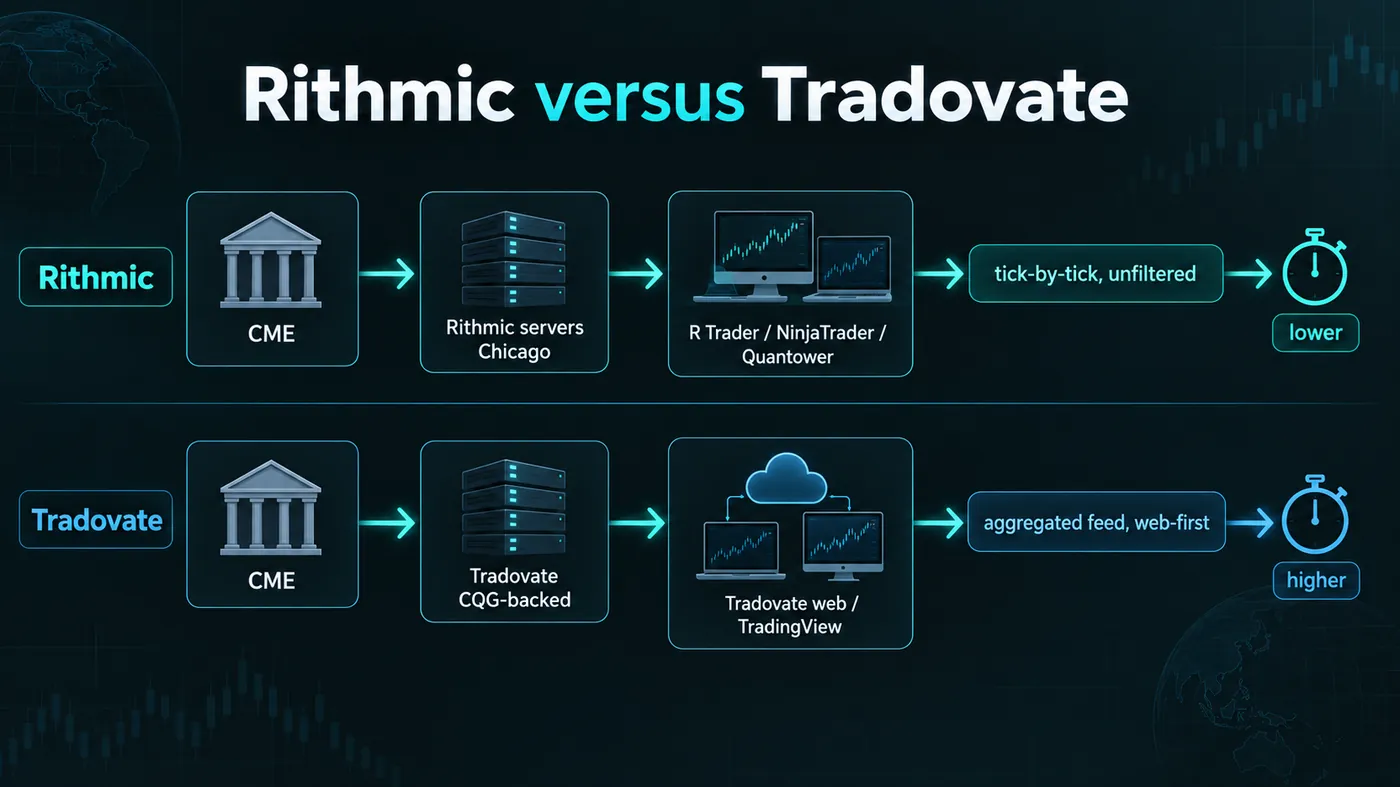
| Rithmic | Tradovate | |
|---|---|---|
| What it is | Data and order-routing infrastructure (Rithmic LLC, Chicago) | A futures broker (FCM) with its own platform, owned by NinjaTrader |
| Data | Tick-by-tick, unfiltered feed from the exchange | Aggregated feed via CQG; fine for charts, thinner for footprint work |
| Latency | Optimised for speed; the choice of high-frequency and order-flow traders | Adequate for most; delays reported in extreme volatility |
| Platforms | R|Trader Pro (required for login), NinjaTrader, Quantower, Bookmap, Sierra Chart, ATAS, MotiveWave | Tradovate web and mobile, TradingView (native), NinjaTrader |
| TradingView execution | Only through a CQG or Sierra bridge (extra $50–100/month) | Native — trade from the TradingView chart |
| Install | Desktop platforms; R|Trader Pro is Windows software | Browser and mobile; nothing to install |
| Fees | Data and routing fees per account, often bundled by the prop firm | Commission plans or memberships; prop firms usually bundle |
| Prop firms | Apex, Take Profit Trader, Lucid and others | My Funded Futures, Tradeify, Earn2Trade and others |
| Best for | Scalpers, DOM and footprint traders, multi-platform users | TradingView-first traders, anyone who wants a browser |
The technical difference that matters is the feed itself. Rithmic delivers every tick; Tradovate's CQG-based feed is aggregated, which is invisible on a candle chart and very visible on a footprint or a DOM, where the missing prints change what the tool shows. For a Smart Money trader reading structure on the 5-minute chart, the two are indistinguishable. For a trader who reads footprint charts or a heatmap, Rithmic is the feed the tools were built for.
Which firms use which, and why it decides your platform
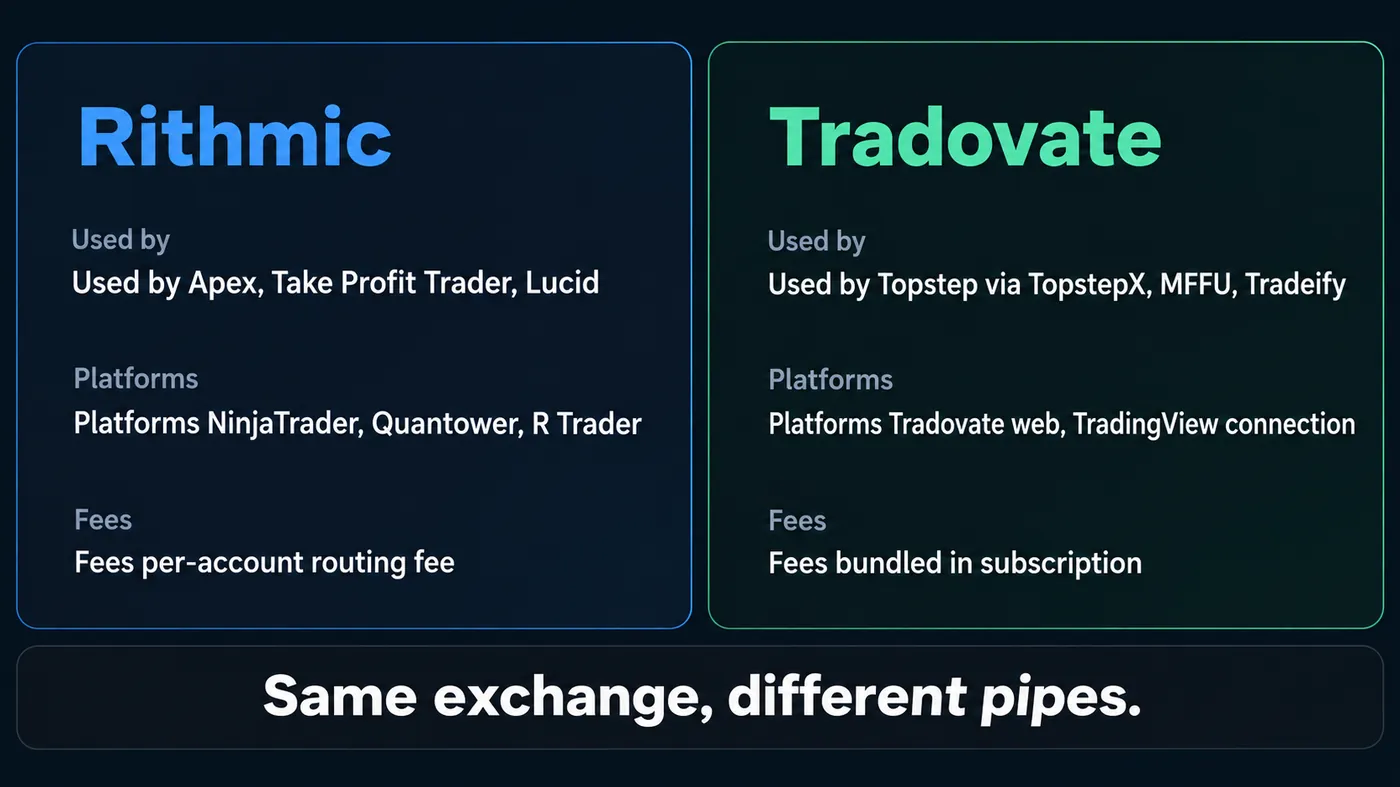
A firm on Rithmic hands you R|Trader Pro credentials, and from there you connect NinjaTrader, Quantower or whichever desktop platform you use; if you want to execute from TradingView you add a bridge, which is a monthly cost and one more thing to fail at 09:30. A firm on Tradovate hands you a Tradovate login, and TradingView execution is a checkbox. That single difference is why TradingView-native traders drift toward the firms on Tradovate and why order-flow traders live on the Rithmic firms.
The second difference is money. Rithmic-based firms often charge a data or routing fee per account — small on one account, material on five copies — while Tradovate-based firms tend to bundle the platform into the evaluation subscription. Read the fee page before buying multiple accounts for copy trading; the Apex review covers what that looks like in practice on a Rithmic firm, and the futures platform guide covers the platform choices behind both feeds.

Automate your trades. Let Quantum Algo trade for you.
Every signal executed on your own account — on your account, with the plan you define.
How to choose
- Start from where you execute. TradingView chart → Tradovate. Quantower, Bookmap, Sierra or ATAS → Rithmic. NinjaTrader → either.
- Ask whether order flow is part of the edge. If a footprint or DOM is essential, Rithmic's unfiltered ticks are the feed the tools expect.
- Count the accounts. Copying across several evaluations multiplies any per-account fee; bundle-priced Tradovate firms can be cheaper at scale.
- Match the speed to the style. Scalping in the first minute after the open rewards the lower-latency feed; a 15-minute structure trader will not notice.
- Then pick the firm. The feed narrows the list of firms; the firm's rules and payouts decide the rest.
- Test the demo on a data day. Watch both around a CPI or FOMC release before paying; that is where the feeds differ most.
Feed chooser
Tell the tool where you execute, whether order-flow tools are essential, how many accounts you will copy across and how fast you trade. It returns the feed, the reason, the firms on it and the fee point to check.
Reference data
| Item | Value |
|---|---|
| Rithmic | Chicago market-data and order-routing provider; tick-by-tick unfiltered feed; R|Trader Pro login; connects NinjaTrader, Quantower, Bookmap, Sierra, ATAS, MotiveWave |
| Tradovate | Futures broker owned by NinjaTrader (2022); cloud platform on a CQG backbone; web, mobile, native TradingView execution |
| TradingView from Rithmic | Via a CQG or Sierra bridge, roughly $50–100/month extra |
| Rithmic firms | Apex Trader Funding, Take Profit Trader, Lucid Trading and others |
| Tradovate firms | My Funded Futures, Tradeify, Earn2Trade (also Rithmic) and others; Topstep uses its own TopstepX |
| Where they differ | Feed granularity (footprint, DOM), latency under stress, install vs browser, per-account fees |
| Where they do not | The market data itself — both carry CME; candle charts look identical |
| Checked | September 2026 — firm platform pages and current platform comparisons |
Worked example: the same trade on both feeds
NQ, 09:31 ET, a sweep of the overnight low and a 1-minute close back above it — the standard opening setup. On the Rithmic side the trader runs Quantower with a footprint chart and sees the sweep candle absorb 1,400 contracts of selling at the low with delta flipping positive on the close; she is long at 18,412 on the next tick with a 12-point stop, filled in under 200 milliseconds through R|Trader routing. On the Tradovate side the trader runs a TradingView chart with the Liquidity Sweeps script; the sweep prints, the candle closes back inside, he clicks buy on the TradingView panel and is filled at 18,413.5 a moment later.
Same trade, one and a half points apart, both at the target 30 points higher inside eight minutes. The Rithmic trader had one more piece of evidence — the absorption on the footprint — and paid for a desktop platform, a bridge she does not use and a per-account fee to get it. The Tradovate trader had a browser and a TradingView chart. Neither was wrong; they are different ways of paying for the same setup, and the point of choosing is to pay for what you use.
Mistakes traders make with Rithmic and Tradovate
- Choosing the feed before the platform. Where you execute decides the feed, not the other way round.
- Buying five Rithmic accounts for copy trading without multiplying the per-account fee.
- Bridging Rithmic to TradingView when a Tradovate firm would have executed natively for nothing.
- Running a footprint on an aggregated feed and trusting the missing prints.
- Blaming the feed for a bad fill during a data release. Both slow down; the exchange is the bottleneck.
- Forgetting R|Trader Pro must be running for Rithmic logins on other platforms.
- Assuming Topstep is on either. Its Combines run on TopstepX.
Feeds, platforms and the free indicators
Whichever pipe the firm chose, the analysis for a Smart Money trader happens on TradingView, and the library is there: the Smart Money Concepts Engine for structure and order blocks, the Liquidity Sweeps script for the opening sweep, the Institutional Key Levels script for the overnight high and low, and the SessionScope script for the killzones. On a Tradovate firm the order goes straight from that chart; on a Rithmic firm it goes through the bridge or the desktop platform. The premium engine, Zeno, prints the signal with a stop and targets on the same chart either way, and QuantumBot is the executor for traders who want the webhook to place it. The futures indicators guide covers the rest of the toolkit.
Choose the platform first and the feed follows: TradingView or a browser means Tradovate, a desktop order-flow platform means Rithmic, NinjaTrader means either. Count per-account fees before copying evaluations, test both on a data day, and remember the candles are the same on both — the pipe, the platform and the bill are what differ.
◆ Interactive check
Do you know which pipe you are on?
Questions traders ask about Rithmic and Tradovate
Rithmic is a market-data and order-routing provider — an unfiltered tick-by-tick CME feed that you access through a connected platform such as R|Trader Pro, NinjaTrader or Quantower. Tradovate is a futures broker, owned by NinjaTrader, with its own cloud platform on a CQG backbone that you trade from a browser, a phone or a TradingView chart.
Neither in general. Rithmic is better for scalpers and order-flow traders who need the full tick stream and run desktop platforms; Tradovate is better for traders who execute from TradingView or want nothing to install. For a candle-chart structure trader the two are indistinguishable on screen.
Apex Trader Funding, Take Profit Trader and Lucid Trading are the best-known Rithmic-based firms; Earn2Trade offers Rithmic alongside Tradovate. The list changes, so check the firm's platform page.
My Funded Futures and Tradeify are the best-known Tradovate-based firms; Earn2Trade offers it as well. Topstep runs its Combines on its own TopstepX platform rather than either.
Only through a bridge — a CQG or Sierra Chart connection that adds roughly $50–100 a month. Tradovate connects to TradingView natively, which is the main reason TradingView-first traders end up on Tradovate-based firms.
Rithmic is built for low latency and is the choice of high-frequency and scalping traders; Tradovate is fast enough for most and has been reported to lag in extreme volatility. For trades measured in minutes rather than seconds the difference is not visible.
Footprint charts, DOMs and heatmaps reconstruct order flow from every print. Rithmic delivers every tick unfiltered; an aggregated feed drops prints, so the tool shows less than happened. Order-flow traders therefore stay on Rithmic.
Rithmic's own Windows platform and the login layer for Rithmic accounts. Even if you trade from NinjaTrader or Quantower, R|Trader Pro credentials are what connect you to the feed and, on many prop firms, where you accept the account agreement.
Often, per account. Rithmic-based firms tend to charge a data or routing fee for each account, which matters when you copy across several evaluations; Tradovate-based firms usually bundle the platform into the subscription. Read the fee page before buying multiple accounts.
The indicators run on TradingView, so the analysis is identical on both. On a Tradovate firm the order goes straight from the TradingView chart; on a Rithmic firm it goes through the desktop platform or a bridge. Zeno prints the signal with a stop and targets on the same chart either way, and QuantumBot can execute it by webhook.
References & Related Guides
Read next
- Best Futures Trading Platform
- Topstep Review
- Apex Trader Funding Review
- Futures Trading for Beginners
- Best Indicators for Futures Trading
- Footprint Chart Trading
- What Is a Prop Firm?
- Prop Firm Trading Strategy
- TradingView Platform Guide
- Liquidity Sweeps (free indicator)
- SessionScope (free indicator)
- Zeno — the premium engine