Prop Firm Trading Strategy: Pass Any Challenge in 2026
| Signal type | Evaluation strategy |
| Best context | Passing funded challenges with drawdown-first risk design |
| Confirmation | Hitting targets while staying far from daily/max loss limits |
| Invalidation | Any breach of daily loss or trailing drawdown |
1. What Are Prop Firms and How Do They Work?
Proprietary trading firms (prop firms) give traders access to large capital accounts — $10,000 to $400,000+ — in exchange for a share of the profits. Instead of risking your own money, you trade the firm's capital and keep 70-90% of the profits. The catch: you must first pass a trading challenge that proves you can trade profitably while respecting strict risk parameters.
Related: prop firms that use MT4.
The typical process works in three stages. Stage 1 (Challenge/Evaluation): You pay a one-time fee ($100-$600 depending on account size) and must hit a profit target (usually 8-10%) within 30 days without violating daily loss limits (typically 5%) or maximum drawdown limits (typically 10%). Stage 2 (Verification): A second phase with a lower profit target (usually 5%) over 60 days, proving consistency. Stage 3 (Funded): You receive a funded account and trade with real capital, keeping 70-90% of profits.
The appeal is obvious: a $50,000 funded account with an 80% profit split means that a 10% monthly return ($5,000) puts $4,000 in your pocket — without ever risking $50,000 of your own money. You risked only the challenge fee ($200-$400).
But here is what most traders get wrong: passing a prop firm challenge is not about making money — it is about not losing it. The challenge is a risk management test disguised as a trading evaluation. The firms do not care if you make 10% in one trade or 0.5% per day over 20 trades. They care that you never violate the drawdown limits. This fundamental misunderstanding is why 85-90% of traders fail their first challenge.
2. Challenge Rules — The Parameters You Must Respect
Every prop firm has slightly different rules, but the core parameters are consistent across the industry. Understanding these rules is not optional — a single violation ends your challenge instantly, regardless of how profitable you are.
Daily loss limit (typically 5%): Your account cannot decline more than 5% from its starting balance in any single day. On a $100,000 account, that means a maximum daily loss of $5,000. This is the rule that eliminates most traders — one bad day of revenge trading or oversizing can end your challenge.
Maximum drawdown (typically 10%): Your account cannot decline more than 10% from its peak balance at any point during the challenge. This is cumulative — if you make 5% profit (balance = $105,000), your maximum drawdown is now measured from $105,000, not $100,000. Some firms use static drawdown (from initial balance) while others use trailing drawdown (from peak balance). Know which type your firm uses.
Minimum trading days (typically 4-5): You must trade on at least 4-5 separate days. This prevents passing the challenge on a single lucky trade. You need to demonstrate consistency.
3. Risk Management for Prop Challenges
Standard risk management says 1-2% per trade. For prop challenges, reduce that to 0.5-1%. Why? Because the daily loss limit creates a hard ceiling that does not exist in personal trading. If you risk 2% per trade and take 3 consecutive losses, you are down 6% — already past the daily loss limit. Challenge over.
The prop firm position sizing formula:
Example: 5% daily limit / 3 max trades / 2 safety buffer = 0.83% per trade
The "/2 safety buffer" is critical. It accounts for slippage, spread widening during news, and the emotional state that makes you overtrade. By keeping risk at half the theoretical maximum, you build a cushion that protects you on your worst days.
Position sizing for drawdown protection: If the maximum drawdown is 10% and you risk 0.5% per trade, you can absorb 20 consecutive losses before failing. The probability of 20 consecutive losses with any strategy that has a 40%+ win rate is astronomically low. This buffer makes the challenge passable for any competent trader.
Correlation management: Never hold more than 2 correlated positions simultaneously. If you are long EUR/USD and long GBP/USD, that is effectively 2x risk on the same USD weakness thesis. If the dollar strengthens, both trades lose simultaneously, potentially breaching your daily limit even with conservative per-trade sizing.
See our backtest results across 240+ trades to understand how consistent risk management produces challenge-passing performance metrics.

Automate your trades. Let Quantum Algo trade for you.
Every signal executed on your own account — 24/7, hands-off.
4. The Best Strategy for Passing Challenges
The ideal prop firm strategy has three characteristics: high win rate (to avoid deep drawdowns), consistent small gains (to accumulate the profit target gradually), and clear rules (to prevent emotional decisions under pressure). The strategy that best fits all three criteria is the Smart Money Concepts (SMC) pullback entry during kill zones.
The Prop Firm SMC Setup
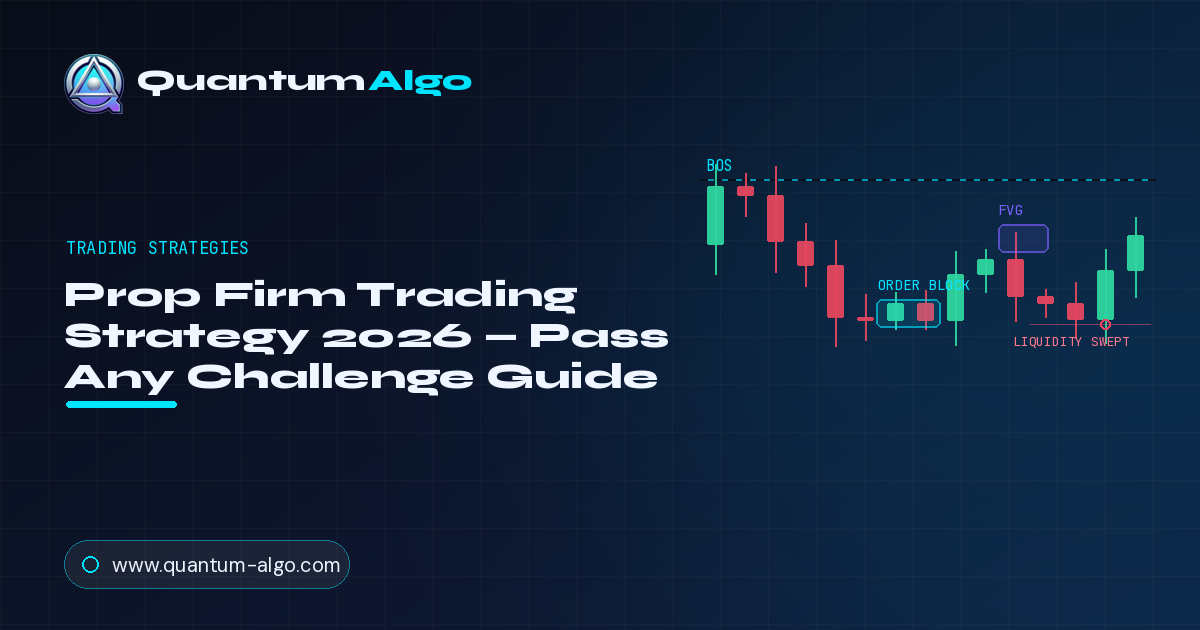
Step 1 — Daily bias: On the 4H/Daily chart, determine the trend direction using market structure (BOS for continuation, CHoCH for potential reversal). Only trade in the direction of the higher timeframe trend.
Step 2 — Mark zones: Identify the nearest order block and fair value gap in the direction of your bias. These become your entry zones.
Step 3 — Wait for kill zone: Only enter during the London open (2-5AM EST) or New York open (7-10AM EST). These sessions provide the volume and displacement needed for valid signals.
Step 4 — Entry trigger: When price pulls back to your OB/FVG zone during a kill zone, look for a lower timeframe (5M/15M) rejection candle (engulfing, pinbar, or internal BOS). This is your entry.
Step 5 — Execution: Enter with 0.5-1% risk. Stop-loss beyond the order block. Target 1: 1.5R (take 50% profit). Target 2: 2.5R (trail remaining to breakeven). This partial-take-profit approach locks in gains while letting winners run.
Why this works for prop challenges: At 0.5% risk per trade with a 1:2.5 average R:R and a 50% win rate, you generate approximately 0.5% net daily return. Over 20 trading days, that is 10% — exactly the Phase 1 target. The key is consistency: 5 trades per week, no overtrading, no oversizing.
Want to see this exact framework applied to live markets? Our public TradingView Ideas show timestamped, verifiable SMC setups with entries, stops, and targets.
5. The Prop Firm Daily Routine
Structure eliminates emotion. A fixed daily routine ensures you trade systematically instead of reactively. Here is the exact routine used by funded traders who maintain their accounts long-term:
The 2% daily profit cap: When you are up 2% for the day during a challenge, stop trading. The risk of giving back profits through overtrading outweighs the benefit of additional gains. Lock in the win. Come back tomorrow. This discipline is what separates traders who pass from those who blow up on a "great day" that turned into a disaster.
6. Challenge Psychology — Managing the Pressure
The prop firm challenge creates a unique psychological pressure that does not exist in demo trading or even personal live trading. You have a deadline, a profit target, and the knowledge that a single bad day can end everything. This pressure changes your decision-making in ways you may not expect.
The target fixation trap: As you approach the profit target (say you are at 7% with a 10% target), the temptation to "go for it" with a larger position becomes overwhelming. This is exactly when most traders blow their challenges — they increase risk at the worst possible time. The correct response is the opposite: maintain or even reduce your risk as you approach the target.
The drawdown spiral: After a losing streak, the urge to recover quickly leads to oversizing and revenge trading. If you are down 3% with a 10% max drawdown, you have 7% of buffer remaining. That is plenty of room for recovery at 0.5% risk per trade. But if you increase to 2% risk to "make it back faster," two more losses put you at 7% drawdown with only 3% remaining — now you are trading scared, which produces even worse decisions.
The solution: Pre-commit to your rules before the challenge starts. Write them down: "I will risk 0.5% per trade. I will take maximum 3 trades per day. I will stop trading after 2% daily profit or 2% daily loss. I will not change these rules regardless of my P&L." Sign it. Put it next to your screen.
7. Top Prop Firms Compared — 2026
The prop firm landscape changes rapidly. Here are the most reputable firms in 2026, compared on the metrics that actually matter for your trading:
Before choosing a firm: Research its payout history (do they actually pay funded traders?), check Trustpilot reviews from the last 3 months (not all time — firms change), verify the instrument list includes what you trade, and understand the exact drawdown rules (static vs trailing makes a massive difference in how you manage risk).
8. Test Your Knowledge
Seven questions on prop firm challenge strategy.
9. Tools That Give You an Edge
Passing a prop challenge requires consistency, and consistency requires automation. Manual analysis across multiple pairs during kill zones while managing emotions is where most traders break down. The right tools handle the analysis so you can focus on execution.
• Order block + FVG detection — institutional zones identified automatically on your chart
• Market structure mapping — BOS, CHoCH, MSS marked in real time for bias confirmation
• Multi-timeframe confluence — signals scored by HTF+LTF alignment for higher win rates
• ATR-based TP/SL — risk management built into every signal
• Kill zone session overlay — trade only during high-probability windows
• Smart alerts — get notified when a setup forms so you never miss an entry
Frequently Asked Questions
Challenge fees range from $100 for a $10,000 account to $500+ for a $200,000 account. Most firms refund the fee when you pass and receive your first payout. Treat the fee as a tuition cost, not a gamble.
Smart Money Concepts with kill zone timing produces the most consistent results. Focus on order block and FVG entries during London and New York sessions with 0.5-1% risk per trade and 1:2+ R:R. See our SMC and Liquidity guides for the complete framework.
Most Phase 1 challenges allow 30 days. With consistent 0.5% daily returns, you can hit the 8-10% target in 16-20 trading days. Do not rush — using all 30 days is perfectly fine and reduces the pressure to overtrade.
You lose the challenge fee but gain experience. Most successful funded traders failed 1-3 challenges before passing. Each failure teaches you something about your risk management or psychology. Many firms offer discounted retries.
Many prop firms now offer crypto pairs (BTC/USD, ETH/USD) alongside forex and indices. Check the firm instrument list before purchasing. Crypto pairs tend to have wider spreads and higher volatility, requiring wider stops and smaller position sizes.
Yes. Quantum Algo’s free public indicators mark order blocks and FVGs; Zeno provides confirmed Buy/Sell signals with SL/TP and built-in risk management for the execution layer — giving you consistent, high-probability setups during optimal trading windows.
References & Related Guides
More in this topic
- What Is a Prop Firm? How Proprietary Trading Firms Work, Make Money, Pay Out and Tax You
- Best Futures Trading Platforms and Futures Prop Firms in 2026: FCMs, Front Ends, Data and the Drawdown Rule
- Backtesting Trading Strategies 2026 — Complete Guide
- What Are the Best Indicators for Day Trading? (2026)
- What Are the Best Indicators for Scalping? (2026)
- What Are the Best Indicators for Swing Trading? (2026)
- Best TradingView Strategy 2026 — The Definitive Guide
- Breakout Probability: Complete Trading Guide (2026)
- Breakout Trading Strategy: Complete Guide (2026)
- Day Trading Strategies 2026 — The Complete Profitable Guide
- Gap Trading Strategy: Complete Guide (2026)
- Grid Trading Strategy: The Complete Guide (2026)
- Institutional Trading Strategy 2026: Trade Like Banks
- Position Sizing: The Complete Guide (2026)
- Prop Firm Strategy 2026: Pass Any Evaluation
Core reading
- BOS & CHoCH: Complete Market Structure Guide 2026
- Order Blocks Trading: Complete 2026 Guide
- Best TradingView Indicators 2026 — Complete Guide
- Risk Management in Trading 2026 — Complete Guide
- Candlestick Patterns Guide 2026 — Engulfing, Pinbar & More
- All Premium Guides
- Quantum Algo on TradingView
- Public Verified Track Record