Take Profit Trader Review: Day-One Withdrawals, the PRO Drawdown Switch, and What the Monthly Test Really Costs
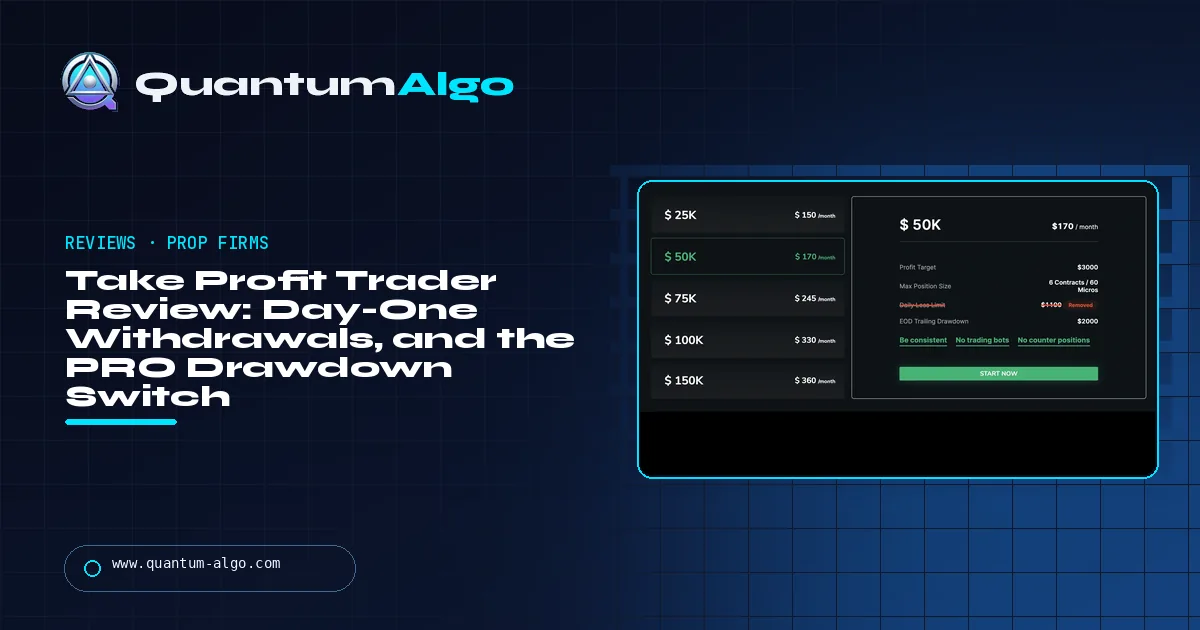
Take Profit Trader is a Florida futures prop firm whose Test is a monthly subscription ($150 to $360 for $25k to $150k) with an end-of-day trailing drawdown, no daily loss limit, a 50% best-day rule, a three-day minimum, no bots and no hedging. Pass, pay $130 for PRO, build a buffer, and withdraw from day one at 80/20. Rating 4.1/5.
Take Profit Trader is the futures firm people choose for one reason — you can withdraw from day one — and lose accounts at for one reason they did not read: the drawdown becomes intraday the moment you are funded. This review covers the monthly Test, the $130 PRO activation, the rules that change between the two, the withdrawal system, the platforms, and how TPT stands against My Funded Futures, Topstep and Apex, with a planner that prices the path from Test to first payout.
Indicators that prove themselves in public.
One engine, four precision tools — the Gold (XAU) Scalper, the institutional Gravity Zone, the Zeno momentum Oscillator, and Zeno Stocks for equities.
What is Take Profit Trader?
Take Profit Trader — TPT — is a futures prop firm out of Windermere, Florida, running since 2021–22, with one product and one promise: pass a monthly-subscription Test, activate a PRO account for $130, and withdraw from day one. No waiting thirty days, no five-winning-days rule, no minimum payout cycle: once the buffer is built you take money out whenever you like, at 80/20, and a discretionary PRO+ stage moves the best traders to a live account at 90/10. It runs on the CQG feed — which means Tradovate, TradingView and NinjaTrader — with Rithmic front ends available too.
This review is for the trader comparing TPT with the other futures firms — My Funded Futures, Topstep, Apex, Tradeify — and for the TPT customer trying to understand why a PRO account that was up $1,400 is suddenly breached. It covers the Test pricing and rules, the PRO activation and the intraday drawdown that arrives with it, the withdrawal system that is the firm's real strength, the news and automation rules, the platforms, and a planner that prices the whole path. Prices and rules were checked in September 2026.
What is the verdict on Take Profit Trader?
Rating: 4.1 / 5. The best withdrawal terms in futures prop trading — day-one payouts above the buffer, no cycle, no winning-day count — on a firm with a clean track record and a Trustpilot in the mid-4s across ten thousand reviews. Loses points for the monthly Test fee that keeps billing until you pass or cancel, for the switch from an end-of-day drawdown on the Test to an intraday trail on PRO, for a news rule and a bot ban that arrive with the funded account, and for a PRO+ stage that is at the firm's discretion.
Best for: disciplined intraday futures traders who take profit at targets rather than trailing, want to withdraw small amounts often, and trade by hand. Not for: anyone who lets winners round-trip (the PRO trail will find you), anyone who wants to run a bot, anyone who holds overnight, and anyone who takes several months to pass an evaluation — the subscription adds up.
What does the Test cost and what are its rules?
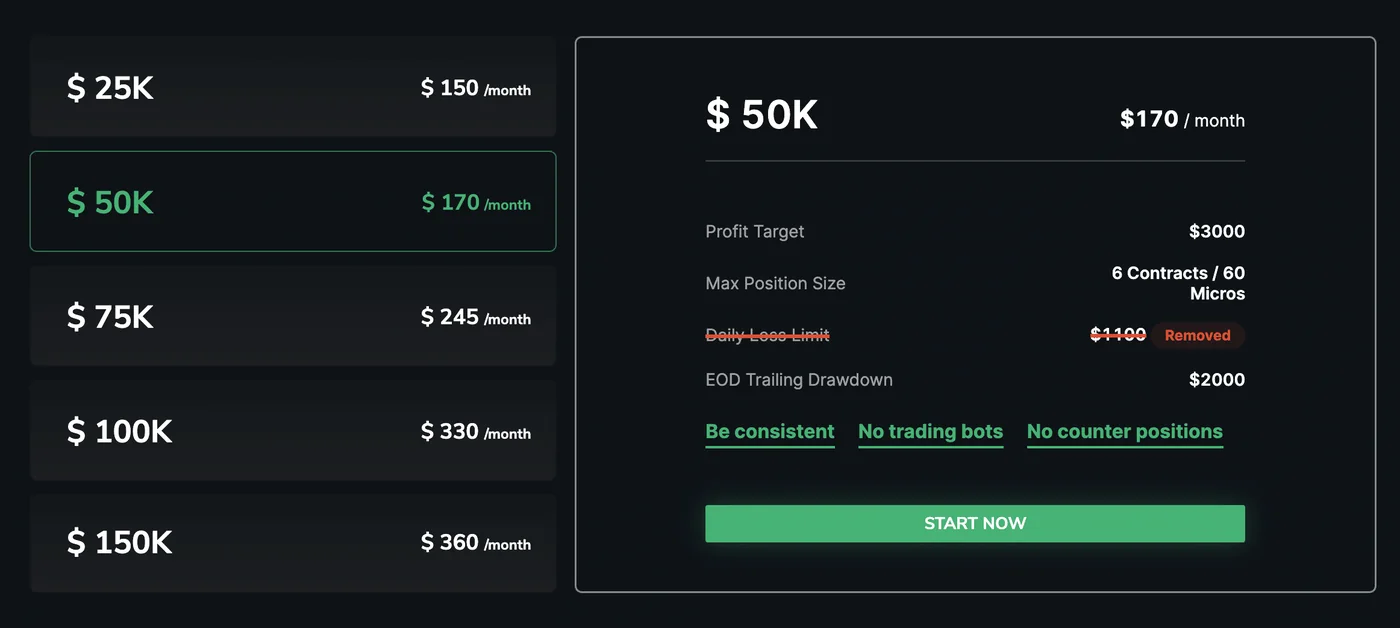
| Account | Monthly fee | Profit target | EOD trailing drawdown | Max contracts | Daily loss | Minimum days | Reset |
|---|---|---|---|---|---|---|---|
| $25k | $150 | $1,500 | $1,500 | 3 (30 micros) | None | 3 | $99 |
| $50k | $170 | $3,000 | $2,000 | 6 (60 micros) | None | 3 | $99 |
| $75k | $245 | $4,500 | $2,750 | 9 | None | 3 | $99 |
| $100k | $330 | $6,000 | $3,500 | 12 | None | 3 | $99 |
| $150k | $360 | $9,000 | $4,500 | 15 | None | 3 | $99 |
Three rules govern the Test beyond the numbers. Consistency: no single day may account for more than 50% of the profit at the moment you pass — a $2,000 day on a $3,000 target means trading on until the total is $4,000. No trading bots: automated trading is prohibited outright, on the Test and on PRO. No counter positions: no hedging the same contract long and short. The daily loss limit was removed in 2026, which the pricing card advertises with a strike-through; what replaced it is nothing — the end-of-day trailing drawdown is the only limit. Tests from mid-August 2026 carry a three-day minimum; earlier cohorts had five. The cheapest prop firms guide puts the monthly fee next to the one-time firms; the short version is that TPT is cheap if you pass in month one and expensive if you take four.
Does the Test fee keep billing after a breach?
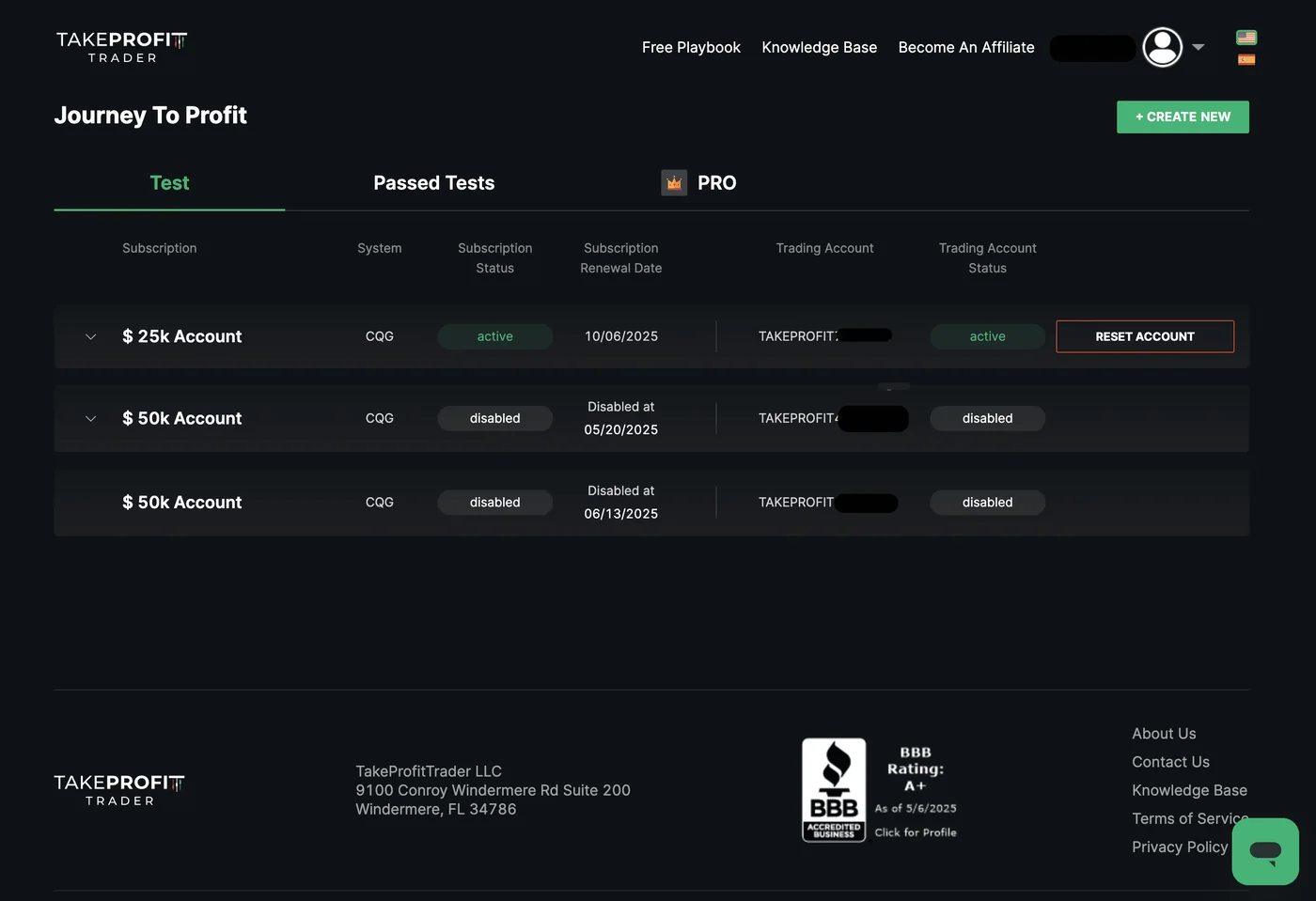
The dashboard lists every Test you have bought with its CQG trading account, a reset button and a status. The two disabled rows in the screenshot are the point: a Test that breaches its drawdown is disabled, the subscription that paid for it keeps billing on its renewal date, and the choice is a $99 reset or a new Test at the full monthly fee. Cancel what you are not using. The firm is not hiding this — the renewal dates are on the card — but the monthly model turns a slow month into a second and third fee in a way the one-time firms do not.

Automate your trades. Let Quantum Algo trade for you.
Every signal executed on your own account — on your account, with the plan you define.
Which rule changes when you activate PRO for $130?
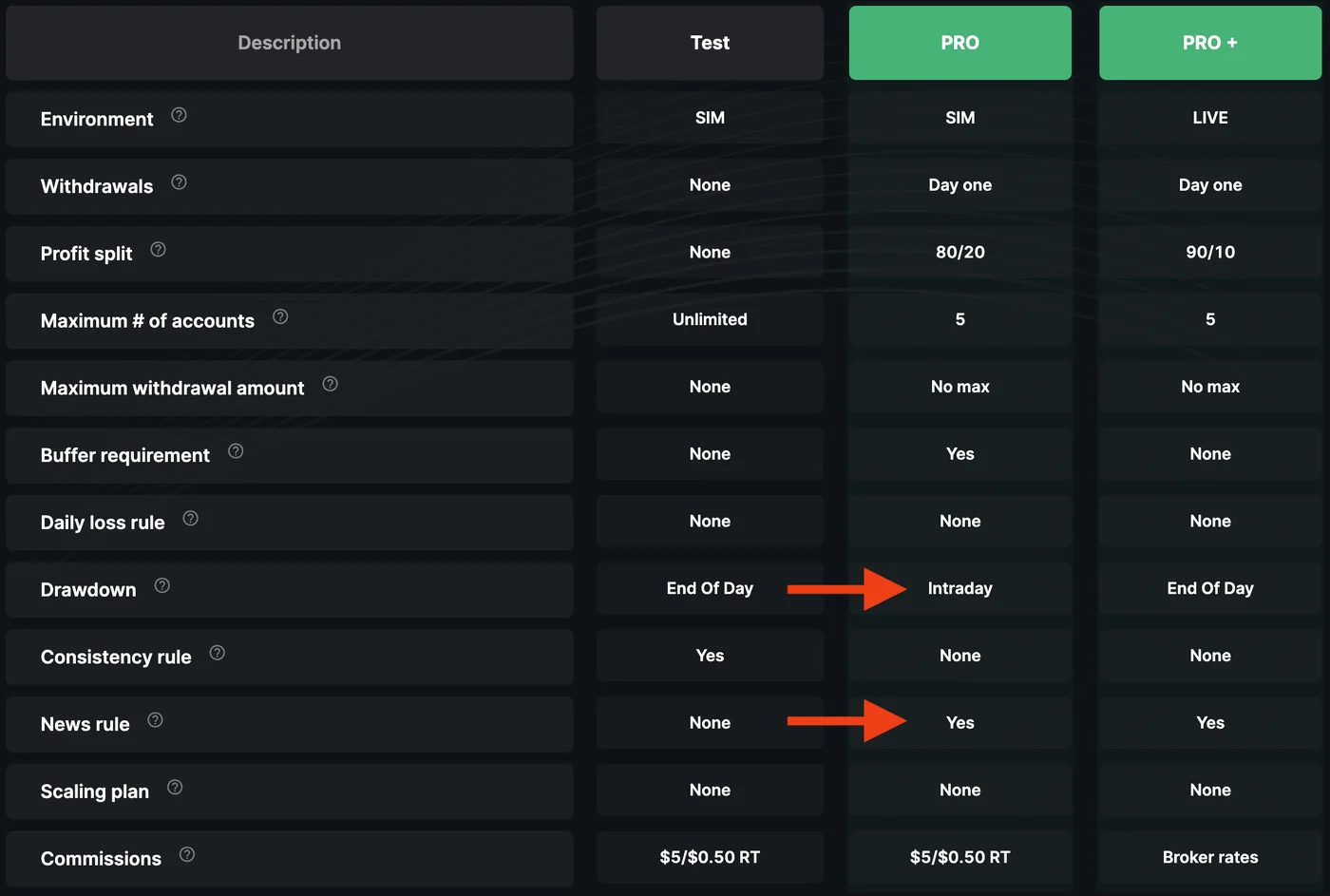
Pass the Test and PRO costs $130 to activate, once. Then the rules table above earns its arrows. On the Test the drawdown is calculated end of day from your closing balance; on PRO it is intraday, trailing your open equity in real time until it locks at the starting balance. A PRO trade that runs $1,200 in your favour and returns to break-even has moved the trail up $1,200 without a losing trade being taken. This is the single largest cause of PRO breaches and the reason this review keeps repeating one sentence: on PRO, take profit at the first pool. The trail locks once you are a full drawdown above the start, which is the same amount as the buffer — so the first weeks of PRO are spent, at small size, getting to the lock.
The other changes at PRO: a news rule switches on (flat around scheduled releases the firm names), a maximum of five PRO and PRO+ accounts, PRO resets that cost $449–$1,499 depending on size with a cap of three, and a buffer requirement — profit equal to the drawdown amount that stays in the account — before the first withdrawal. Overnight and weekend holds are prohibited throughout. The prop firm strategy guide covers sizing under an intraday trail; the MFFU review describes the same EOD-to-intraday switch at the other firm that does it.
When can you withdraw from a TPT account?
| Test | PRO | PRO+ | |
|---|---|---|---|
| Environment | Simulated | Simulated | Live |
| Withdrawals | None | From day one, once the buffer is built | From day one |
| Split | — | 80/20 | 90/10 |
| Minimum / fee | — | $50 fee on requests of $250 or less; none above | Broker terms |
| Cycle | — | None — request when you like | None |
| Buffer | — | Equal to the drawdown ($2,000 on $50k) | None |
| Consistency | 50% best-day | Applied | None |
| News rule | None | Yes | Yes |
| Commissions | $5 / $0.50 RT | $5 / $0.50 RT | Broker rates |
Most futures firms make you wait — five winning days, a fourteen-day cycle, a minimum number of trading days per payout. TPT makes you build the buffer once and then lets you withdraw whenever you like, with no cap. For a trader who wants to take $400 out every Friday that is the best structure in the industry, and it is why TPT has the following it has. PRO+ — the live account at 90/10 with an end-of-day drawdown and no consistency rule — is not automatic; the firm reviews PRO accounts and invites the ones it wants, and the transition can pause trading for a few days.
Which platforms work with Take Profit Trader?
TPT accounts run on the CQG feed, which is the good news for TradingView users: Tradovate, TradingView and NinjaTrader all connect, so Zeno's levels and the order ticket share a chart. Rithmic front ends — Bookmap, MultiCharts, MotiveWave, Quantower, ATAS, Jigsaw, R|Trader and others — are also available for the order-flow trader, though most of those licences are bought separately. Professional market-data fees may apply on PRO+. The TradingView prop firms guide compares the connection with the Tradovate firms; the Rithmic vs Tradovate answer explains why the choice of feed matters for fills.
How does TPT compare with other futures prop firms?
| Take Profit Trader | My Funded Futures | Topstep | Apex | |
|---|---|---|---|---|
| $50k entry | $170 / month | $157 one-time (Rapid), often ~40% off | $49 / month | $147 list, usually 80–90% off |
| Activation | $130 | $0 | $149 | PA fee (one-time or monthly) |
| Drawdown on Test / eval | End of day | End of day | End of day | Trailing |
| Drawdown when funded | Intraday (PRO); EOD on PRO+ | Intraday on Rapid; EOD on Pro | End of day | Trailing |
| Daily loss limit | None | None | Yes | None |
| First payout | Day one above the buffer | Daily eligibility (Rapid) | After 5 winning days | After a minimum number of days |
| Split | 80/20 → 90/10 on PRO+ | 90/10 (Rapid) | 90/10 after 100% of first $10k | 100% of first $25k, then 90/10 |
| Bots | Prohibited | Allowed with exclusions | Assisted only | Allowed with rules |
| TradingView | Yes (CQG) | Yes (Tradovate) | Yes (TopstepX) | On Tradovate plans |
TPT wins on withdrawal freedom and loses on split, on the monthly fee and on automation. The trader who wants money out weekly chooses TPT; the trader who wants the highest split and daily eligibility chooses MFFU Rapid and accepts the same intraday trail; the trader who wants an end-of-day drawdown on the funded account chooses Topstep (see the Topstep review) or MFFU Pro. The Apex review covers the discount-driven alternative.
Test-to-PRO planner
Choose the account, how long you expect the Test to take, an honest pass rate, how many resets you would buy, and your style. The planner returns the expected cost to a funded PRO account, the buffer you must build before the first withdrawal, and the sizing warning your style needs on the intraday trail.
Reference data
| Item | Value |
|---|---|
| Founded | 2021–22, Windermere, Florida; BBB-accredited |
| Test pricing | $150 / $170 / $245 / $330 / $360 a month for $25k / $50k / $75k / $100k / $150k |
| Test rules | EOD trailing drawdown; no daily loss limit; 50% best-day consistency; 3-day minimum (5 on older cohorts); no bots; no hedging; $99 reset |
| PRO | $130 activation; intraday trailing drawdown locking at the start balance; buffer equal to the drawdown before withdrawals; 80/20; withdraw from day one; news rule; resets $449–$1,499, max three; five PRO/PRO+ accounts |
| PRO+ | Live, 90/10, EOD drawdown, no consistency rule; by invitation after review |
| Withdrawal fee | $50 on requests of $250 or less; none above |
| Platforms | CQG: Tradovate, TradingView, NinjaTrader; Rithmic: Bookmap, MultiCharts, MotiveWave, Quantower, ATAS, Jigsaw, R|Trader and others |
| Prohibited | Automated trading; overnight and weekend holds; counter positions |
| Trustpilot | About 4.4 / 5 on roughly 10,500 reviews (August 2026) |
| Checked | September 2026 — the rules page overrides anything here |
Worked example: $50k Test to first PRO withdrawal
A trader buys the $50k Test at $170 in the first week of a month. Target $3,000, EOD trailing drawdown $2,000, six-contract limit, 50% best-day rule. She trades two micros on NQ at the New York open: days one to eight produce +$520, −$310, +$680, +$0, +$890, −$240, +$610, +$950 — $3,100 total, best day $950, under half. Passed in eight sessions; one month of fees, $170. PRO activation $130. Running total $300.
PRO, week one: the drawdown is now intraday and the buffer is $2,000. She halves size to one micro, takes profit at the first pool on every trade, and never lets an open winner give back more than a third of its peak. Fourteen sessions later the account is $2,350 above the start: the trail has locked, the buffer is built, and $350 is withdrawable. She requests $300 — above the $250 threshold, so no fee — and it arrives at 80%: $240. From here every profitable day is withdrawable the next morning. Total cost $300; time to first payout, five weeks; the discipline that did it was the profit-taking, not the entries. The evaluation strategy lesson is that plan written out.
What mistakes do traders make with Take Profit Trader?
- Forgetting the subscription is monthly. A disabled Test still renews; cancel what you are not using.
- Trading PRO like the Test. The drawdown becomes intraday; a round-tripped winner moves the trail.
- Trailing runners on PRO before the lock. Take profit at the first pool until the account is a full drawdown above the start.
- Having one big day on the Test. Over 50% of the total and the target is effectively raised.
- Holding into a scheduled release on PRO. The news rule is enforced and the Test did not have it.
- Connecting a bot or a webhook bridge. Automated trading is prohibited outright — this is the one large TradingView-connected firm where it is.
- Hedging with a counter position, or holding overnight. Both prohibited.
- Expecting PRO+ on a schedule. It is discretionary; plan on PRO as the destination.
How we trade a TPT account
The Test is passed the same way as any other evaluation: a 4-hour bias, a New York sweep of the overnight or previous-day extreme, displacement, an entry from the order block or fair value gap it left, a stop beyond the sweep. Zeno marks those on the TradingView chart connected through CQG, and the free session indicator keeps the trades inside the window where the sweeps hold. What changes on PRO is the exit: the first liquidity pool is the target, always, until the trail locks. QuantumBot is not for this firm — automation is banned — which makes TPT the firm for the discretionary trader and MFFU or Tradeify the firm for the systematic one.
Take Profit Trader pays you the way every prop firm should — whenever you like, once the buffer is built — and asks two things in return: pass a monthly Test without a hero day, and trade PRO with the discipline an intraday trail demands. Take profit at the first pool until the trail locks, stay flat through scheduled news, never connect a bot, cancel Tests you are not using, and the 80/20 with day-one withdrawals is the best deal in futures prop trading for a discretionary trader.
◆ Interactive check
Do you know what changes at PRO?
Questions traders ask about Take Profit Trader
Yes. Take Profit Trader LLC is based in Windermere, Florida, is BBB-accredited, has operated since 2021–22, and holds a Trustpilot rating around 4.4 across roughly ten thousand reviews as of August 2026. Complaints cluster around the intraday drawdown on PRO and the monthly Test fee, not around refused payouts; withdrawals from day one are its main selling point and are widely confirmed.
The Test is a monthly subscription, checked September 2026: $150 ($25k), $170 ($50k), $245 ($75k), $330 ($100k) and $360 ($150k) a month, with a $99 reset. Passing and activating PRO costs $130 one-time. PRO resets cost $449–$1,499 by size, with a maximum of three. There is no activation fee beyond the $130 and no data fee on Test or PRO.
Test: hit the profit target (6% of the account) under an end-of-day trailing drawdown, with no daily loss limit, a 50% best-day consistency rule, a three-day minimum (five on older accounts), no automated trading, no counter positions and no overnight or weekend holds. PRO: the drawdown becomes intraday and locks at the starting balance, a news rule applies around scheduled releases, a buffer equal to the drawdown must be built before withdrawals, and up to five PRO/PRO+ accounts may be held. PRO+: live, 90/10, end-of-day drawdown, no consistency rule.
On PRO, once your profit equals the drawdown amount (the buffer — $2,000 on a $50k), you can withdraw anything above it from day one, whenever you like, at an 80/20 split with no cycle and no cap. Requests of $250 or less carry a $50 fee; larger requests have no firm fee. PRO+ pays 90/10 on a live account. The firm has no waiting period, winning-day count or minimum-days-per-payout rule.
Test is the simulated evaluation with an end-of-day drawdown and no withdrawals. PRO is the simulated funded account: $130 to activate, intraday trailing drawdown, buffer requirement, 80/20 split, withdrawals from day one, news rule. PRO+ is a live-market account at 90/10 with an end-of-day drawdown and no consistency rule, granted at the firm's discretion after reviewing a PRO account — it is not automatic.
Because the PRO drawdown is intraday: it trails your open equity, including unrealised gains, until it locks at the starting balance. A trade that runs $1,200 in your favour and comes back to flat has moved the trail up $1,200. Take profit at the first target and reduce size until the account is a full drawdown above the start, at which point the trail locks and behaves like a static limit.
Yes. TPT accounts run on the CQG data feed, which connects to TradingView, Tradovate and NinjaTrader, so you can trade from the TradingView chart with your indicators on it. Rithmic front ends such as Bookmap, Quantower, ATAS, Jigsaw and MultiCharts are also available, mostly with separately purchased licences.
No. Automated trading is prohibited on both the Test and PRO — it is one of the three rules printed on the pricing card. This is the main reason a systematic trader chooses My Funded Futures or Tradeify instead.
TPT for withdrawal freedom — day one, no cycle — and no daily loss limit; Topstep for an end-of-day drawdown on the funded account, a daily loss limit that suits some traders, a cheaper $49 Combine and rules that change rarely. Both connect to TradingView; Topstep allows assisted automation, TPT allows none. Traders who take profit at targets do well at TPT; traders who hold through heat should be at Topstep or MFFU Pro.
Zeno marks the sweep, the displacement candle and the order block on the TradingView chart connected through CQG, on confirmed candles, so the Test and PRO see the same signals. On PRO the exit is the first liquidity pool every time until the trail locks; the free session indicator keeps trades inside the New York window where the sweeps hold. QuantumBot is not usable here because automation is banned.
References & Related Guides
Read next
- My Funded Futures Review
- Topstep Review
- Apex Trader Funding Review
- Cheapest Prop Firms
- Prop Firms That Use TradingView
- Prop Firms for US Traders
- Rithmic vs Tradovate
- Tradovate Review
- Prop Firm Trading Strategy
- Best Indicators for Futures Trading
- Prop Firm Evaluation Strategy (Academy)
- SessionScope — free session indicator