Futures Trading for Beginners: Contracts, Ticks, Margin, Micros and Futures vs Options
Futures are standardised exchange contracts to buy or sell an asset at a set price on a set date — closed before expiry and settled in cash daily, never delivered. For a trader they are the cleanest way to trade indices, gold, oil and currencies: deep liquidity, nearly 24-hour sessions, fixed contract sizes, exchange-set margin and no pattern day trader rule. Start on micro contracts (MES, MNQ, MGC), which are one-tenth the size of the E-minis on every line.
Micro contracts turned futures from a professional market into the place I send every US subscriber who asks how to day trade indices without $25,000. This is the beginner's version — what a contract actually is, the ES/MES spec card, how a 6-point stop becomes $30 on a micro, why futures margin is a bond rather than a loan, the futures-vs-options question answered with a payoff diagram, and one real session on the E-mini. The contract calculator below turns any stop in points into dollars per contract.
Indicators that prove themselves in public.
One engine, four precision tools — the Gold (XAU) Scalper, the institutional Gravity Zone, the Zeno momentum Oscillator, and Zeno Stocks for equities.
What is futures trading?
Futures trading is buying or selling a standardised contract to deliver an asset — an index, a commodity, a currency, a bond — at a set price on a set date, on a regulated exchange. Almost nobody takes delivery; the contract is closed before expiry and the difference is settled in cash daily. For a trader the practical meaning is simpler: futures are the cleanest way to trade the S&P 500, the Nasdaq, gold, oil and currencies with deep liquidity, nearly 24-hour sessions, fixed contract sizes, exchange-set margin and — for US day traders — no pattern day trader rule.
Micro contracts, one-tenth the size of the E-minis, are what made futures accessible to small accounts, and they are where I point every US subscriber who asks how to day trade indices without $25,000. This page is the beginner's version: what a contract is, how ticks and points turn into dollars, what margin means here, how futures compare with options, and what a first day on the E-mini S&P looks like.
Anatomy of a contract
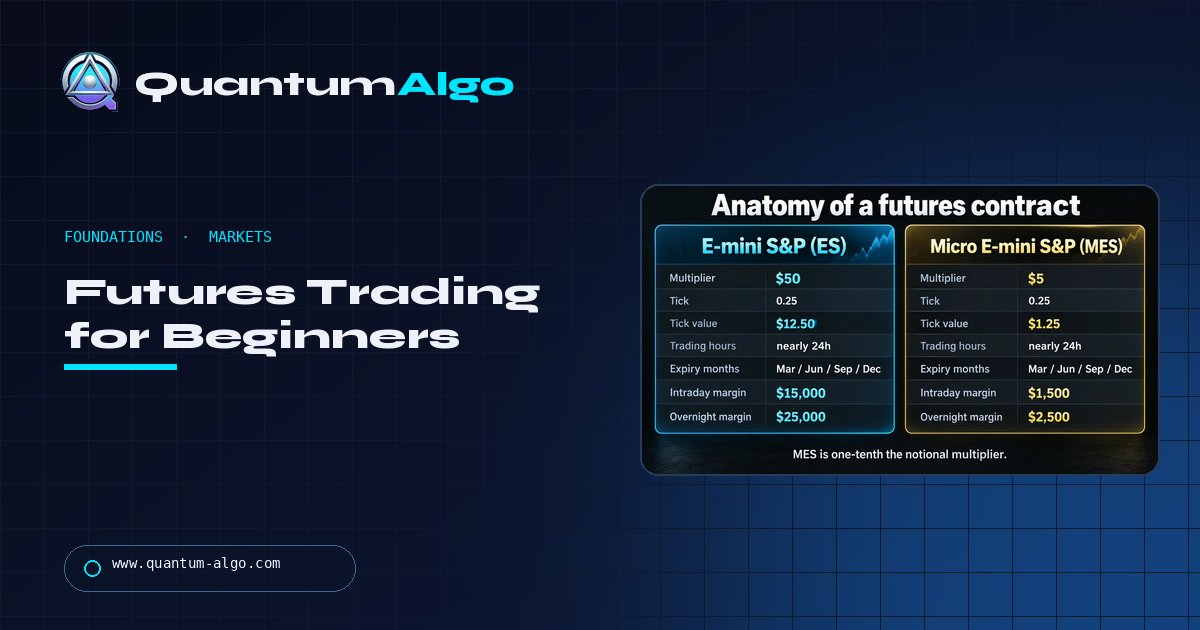
The spec card in this guide puts the E-mini S&P 500 (ES) next to its micro (MES):
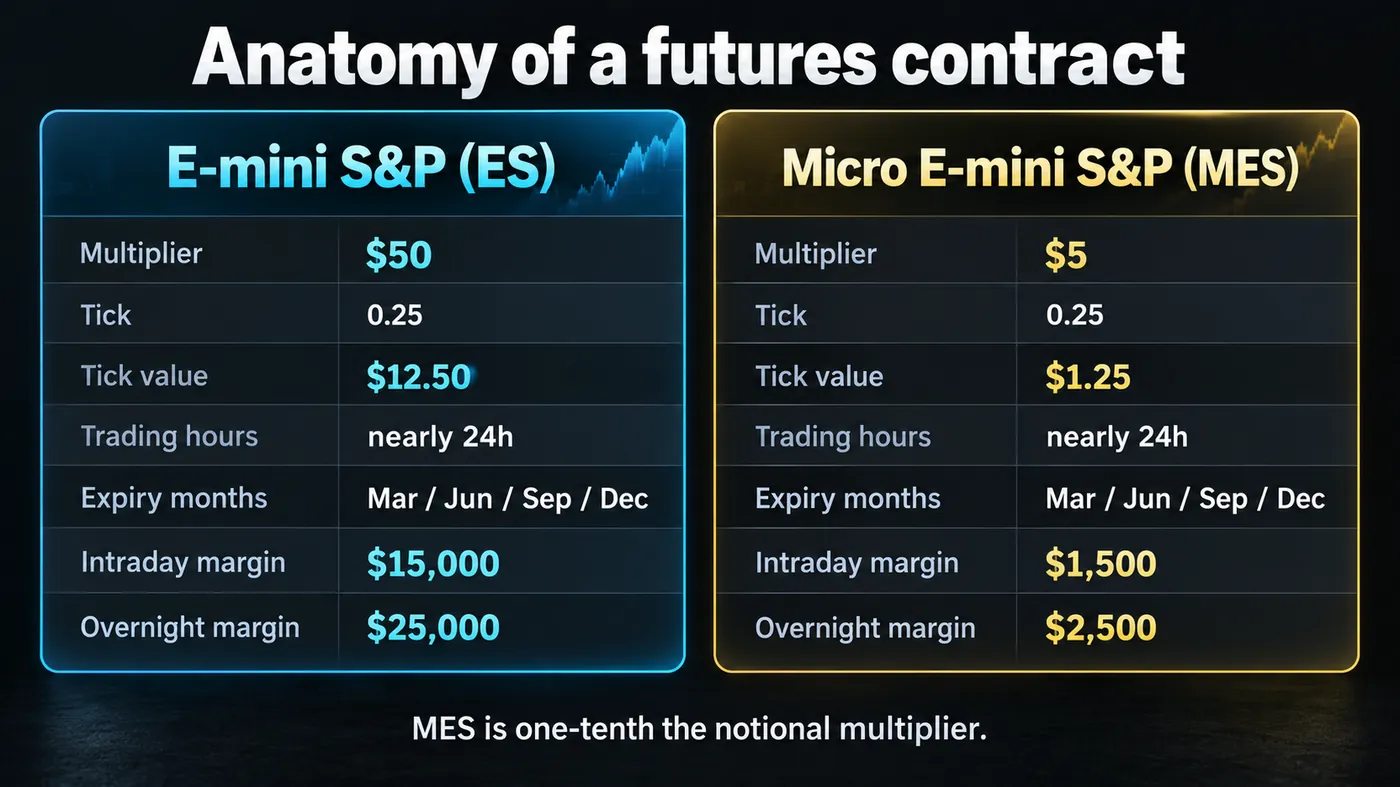
| ES | MES | |
|---|---|---|
| Multiplier | $50 per index point | $5 per index point |
| Tick size | 0.25 points | 0.25 points |
| Tick value | $12.50 | $1.25 |
| Trading hours | Sunday 6 pm – Friday 5 pm ET, with a daily 5–6 pm break | same |
| Expiry months | March, June, September, December | same |
| Intraday margin (typical) | ~$1,500 (broker-set) | ~$150 |
| Overnight margin (exchange) | ~$15,000 (varies) | ~$1,500 |
Every line on the micro is one-tenth. A 10-point move on ES is $500 per contract; on MES it is $50. That single fact is the beginner's whole reason to start on micros: the same chart, the same fills, one-tenth the consequences.
Other beginner-relevant contracts follow the same pattern: NQ/MNQ (Nasdaq-100, $20 and $2 per point), GC/MGC (gold, 100 oz and 10 oz), CL/MCL (crude, 1,000 and 100 barrels), and the currency micros. The contract calculator on this page has the specs for each and turns a stop in points into dollars per contract.
Points, ticks and dollars
Futures prices move in ticks — the minimum increment — and a contract's tick value is what one tick is worth in cash. ES ticks in 0.25 points, four ticks to a point, $12.50 a tick, $50 a point. Your risk on a trade is stop distance in points × point value × contracts. A 6-point stop on two MES contracts is 6 × $5 × 2 = $60.
That arithmetic is the reason futures suit systematic traders: there is no lot-size conversion, no account-currency drift, no broker-defined contract. The exchange publishes the multiplier and it never changes.
Margin in futures: a performance bond, not a loan
Futures margin is not borrowed money. It is a good-faith deposit — the exchange calls it a performance bond — that both buyer and seller post so that the daily settlement can be paid. Gains and losses are credited and debited to your account every day (variation margin). If the balance falls below the maintenance level you get a margin call to top it up, and the broker can liquidate if you do not.
Brokers offer lower intraday margin — often a tenth of the exchange's overnight figure — for positions closed before the session ends. That is where beginners get hurt: $150 to control $28,000 of MES notional is 180× leverage, and the broker will auto-liquidate at a tiny adverse move. Margin tells you what the broker requires; it tells you nothing about how much to trade. Size from the stop and your risk percentage, then confirm the margin, exactly as in every other market.

Automate your trades. Let Quantum Algo trade for you.
Every signal executed on your own account — on your account, with the plan you define.
Futures versus options
The comparison illustration in this guide covers the four differences that matter to a beginner:
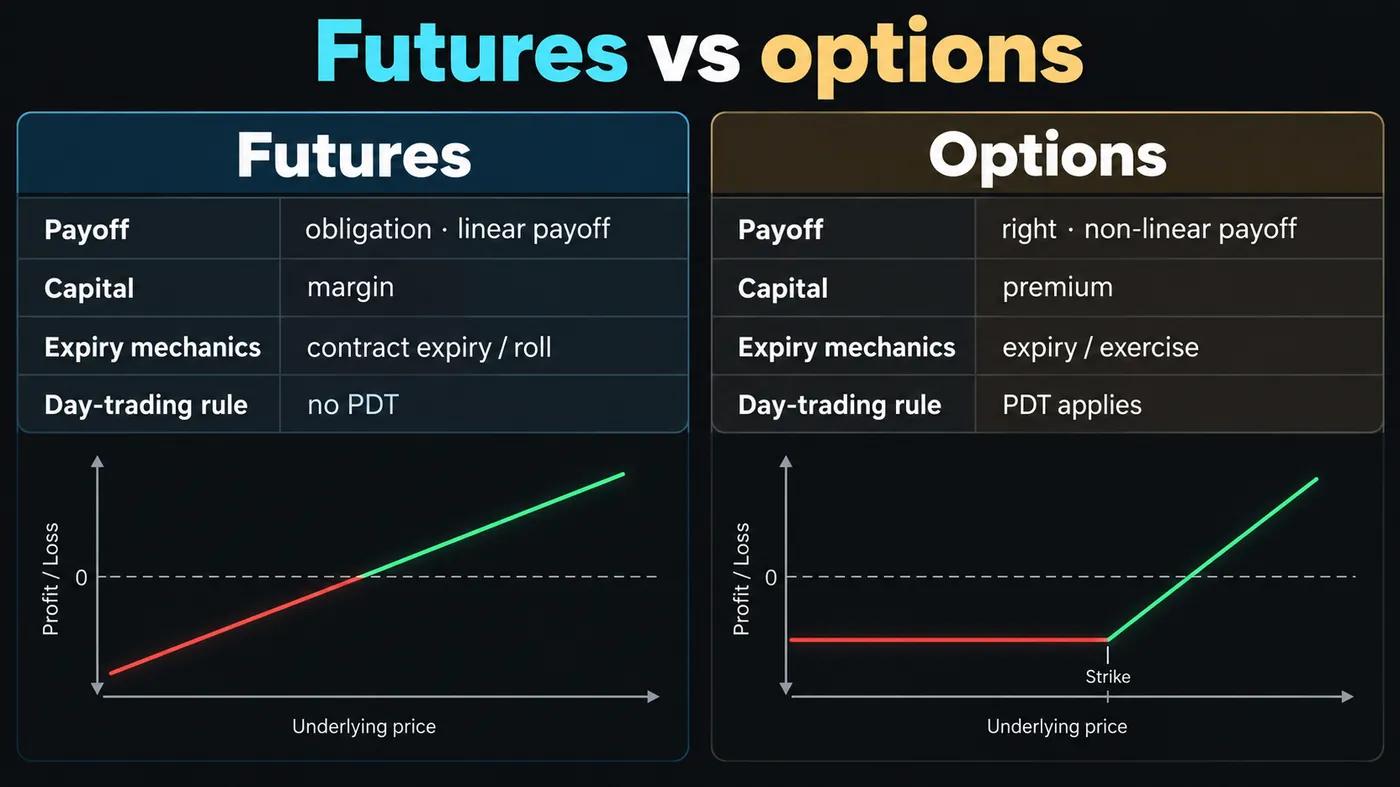
- Obligation versus right. A futures contract obliges both sides; an option gives the buyer a right and the seller an obligation.
- Payoff shape. Futures are linear — every point is worth the same in both directions. Options are non-linear: a long option's loss is capped at the premium, the gain is open, and the value decays with time and moves with volatility.
- Capital. Futures require margin that is marked daily; a long option costs its premium up front and nothing more.
- Rules. Futures have no pattern day trader rule; options are securities and the rule applies.
For a beginner learning price action, futures are simpler: what you see on the chart is what you earn or lose. Options add time and volatility as extra dimensions, and the "trading futures vs options" question usually resolves to: learn direction on futures first, add options when you have a reason to trade something other than direction.
A day in ES
The session chart in this guide walks through one trading day on the E-mini: the Globex overnight range shaded from 6 pm to 9:30 am, the cash open at 9:30 with the volume spike, and one opening-range-breakout trade marked with entry, a 6-point stop and a 12-point target — $30 risk and $60 target on one MES, $300 and $600 on ES.
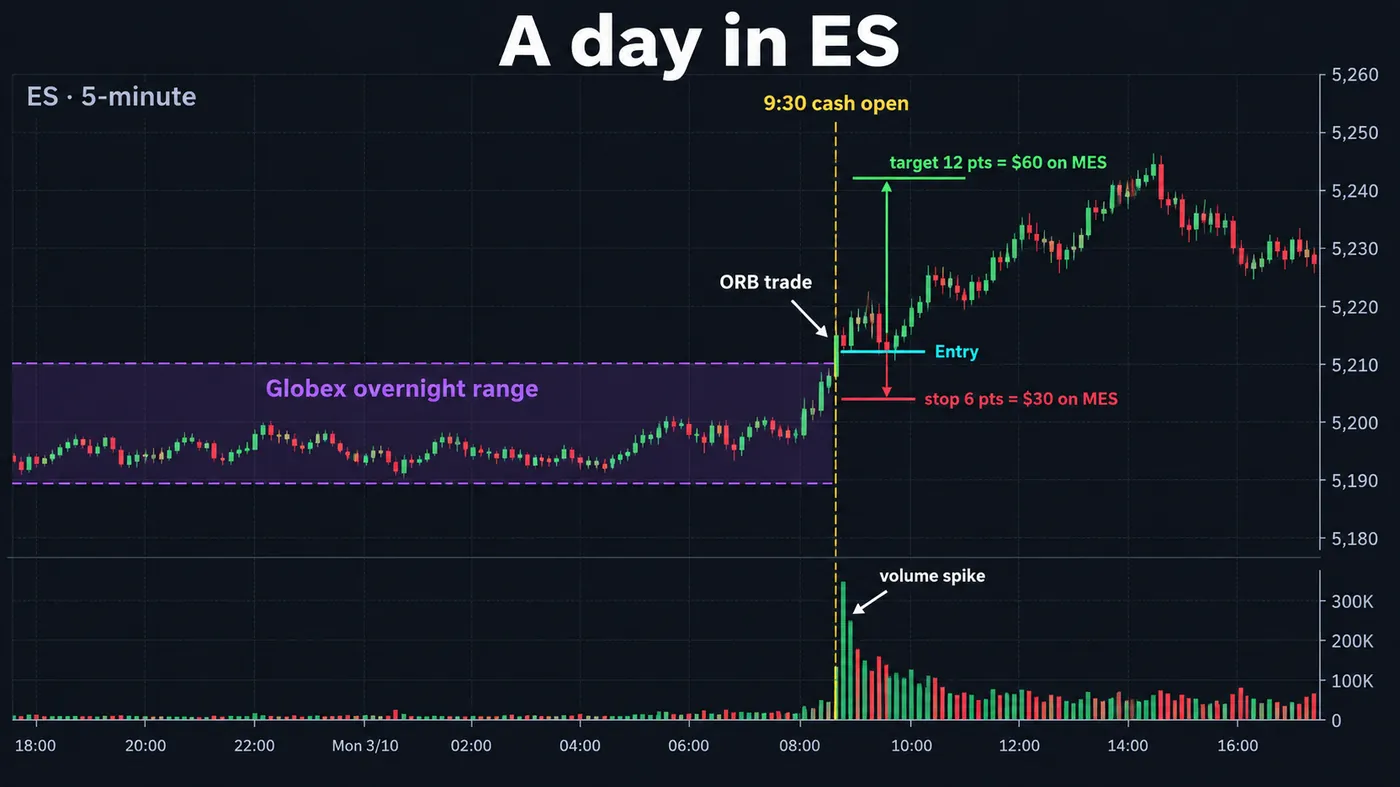
Two things beginners should notice. The overnight range is where the index reacted to news while the stock market was closed — futures are the venue that prices it, which is why the ES chart matters even to stock traders. And the first thirty minutes after 9:30 carry more volume than the next three hours; the setup exists because the liquidity does.
Contract roll and expiry
Contracts expire quarterly (March, June, September, December for indices) on the third Friday. Most volume moves to the next contract about a week before — the roll — and your platform's continuous chart stitches them together. As a beginner, trade the front month with the most volume, roll when the volume does, and never hold a position into expiry by accident; the exchange will close it for you at a price you did not choose.
How to start
- Open a futures account with a registered FCM or a broker that introduces to one; futures are CFTC-regulated and the account is separate from a stock account.
- Paper trade MES for a month using the same session and the same setup every day; log the trades.
- Go live with one MES contract, a fixed risk of 0.5–1% of the account, and stops measured in points.
- Scale to two, then five micros before touching a full-size contract. Ten micros equal one E-mini; there is no rush to consolidate.
Our futures indicators guide covers what to put on the chart; the position sizing guide covers step three in detail.
A futures contract is a fixed multiplier on an exchange with daily settlement and no loan. Micros give a beginner the same chart at one-tenth the size; ticks and points convert to dollars by arithmetic; margin is a bond that tells you what the broker needs, not what you should trade. Learn direction on futures, add options later, trade the front month, and never hold into expiry by accident.
◆ Interactive check
Do you know your contract?
Questions beginners ask about futures
Enough that a normal losing streak at 1% risk per trade is manageable — for MES with 5–8 point stops that means roughly $2,000–5,000. Intraday margin of $150 per contract is what the broker requires, not what you need.
Yes. The pattern day trader rule is a FINRA rule for stock margin accounts; futures are CFTC-regulated and exempt.
MES is one-tenth of ES on every line: $5 instead of $50 per point, $1.25 instead of $12.50 per tick, one-tenth the margin. Same price, same chart, same fills.
The instrument is leveraged, so the same account can lose faster. Sized correctly from the stop, a futures trade risks exactly what a stock trade does; sized to the intraday margin, it can wipe the account in an hour.
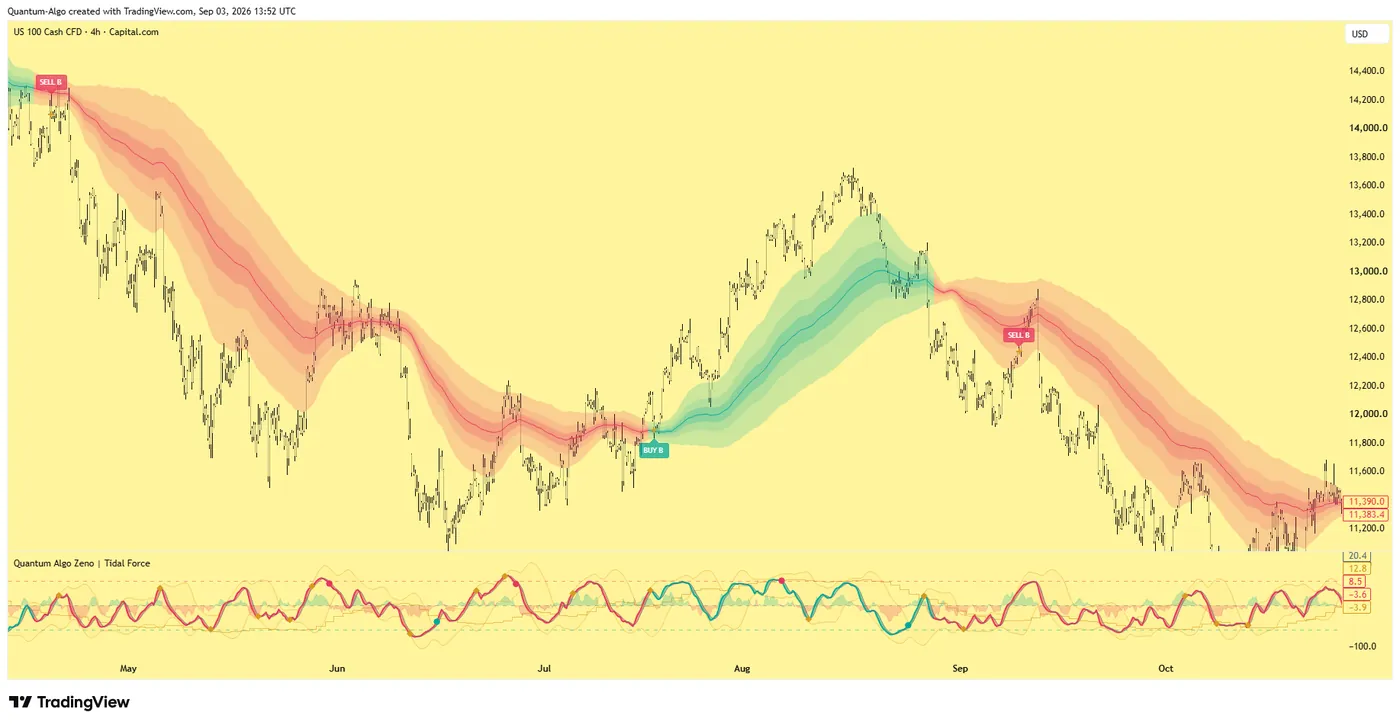
Yes — the free indicators and Zeno run on any futures symbol TradingView charts, including ES, NQ, GC and CL and their micros. The NAS100 chart at the top of this page is the same index engine on a CFD quote.
MES or MGC: liquid, one-tenth size, $1.25 or $1 per tick. The safety is in the size, not the market — a 6-point stop is $30 instead of $300.
Nearly 24 hours, Sunday 6 pm to Friday 5 pm Eastern with a daily break at 5 pm. The liquid window for index futures is the US cash session, 9:30 am–4 pm.
No. There is no loan; the contract price embeds the cost of carry. You post overnight margin, which is higher than intraday, and settle gains and losses daily.
Financially settled contracts (index futures) cash-settle at the final price; physically settled ones (crude, gold) create a delivery obligation most brokers close for you before that point, at a price you did not choose. Roll before expiry.
Yes. Zeno and the free indicators run on any futures symbol on TradingView — ES, NQ, GC, CL and the micros — and the levels they draw convert directly to ticks and dollars with the calculator above.
References & Related Guides
Read next
- Bookmap Review (2026): The Order-Book Heatmap, and What It Actually Shows a Smart Money Trader
- Best Indicators for Futures Trading
- Pattern Day Trader Rule
- What Is Margin Trading?
- What Is Notional Value in Trading?
- Opening Range Breakout (ORB)
- Best Indicator for NASDAQ
- Position Sizing: The Complete Guide
- Spot vs Futures Trading
Authoritative sources
- CME Group: introduction to futures
- CME Group: Micro E-mini S&P 500 contract specifications
- CME Group: futures margin (performance bonds)
- CFTC: futures advisories for retail traders
- NFA: investor resources