Do Trading Bots Work? The Honest Answer, the Four Things That Decide It, and How to Test One
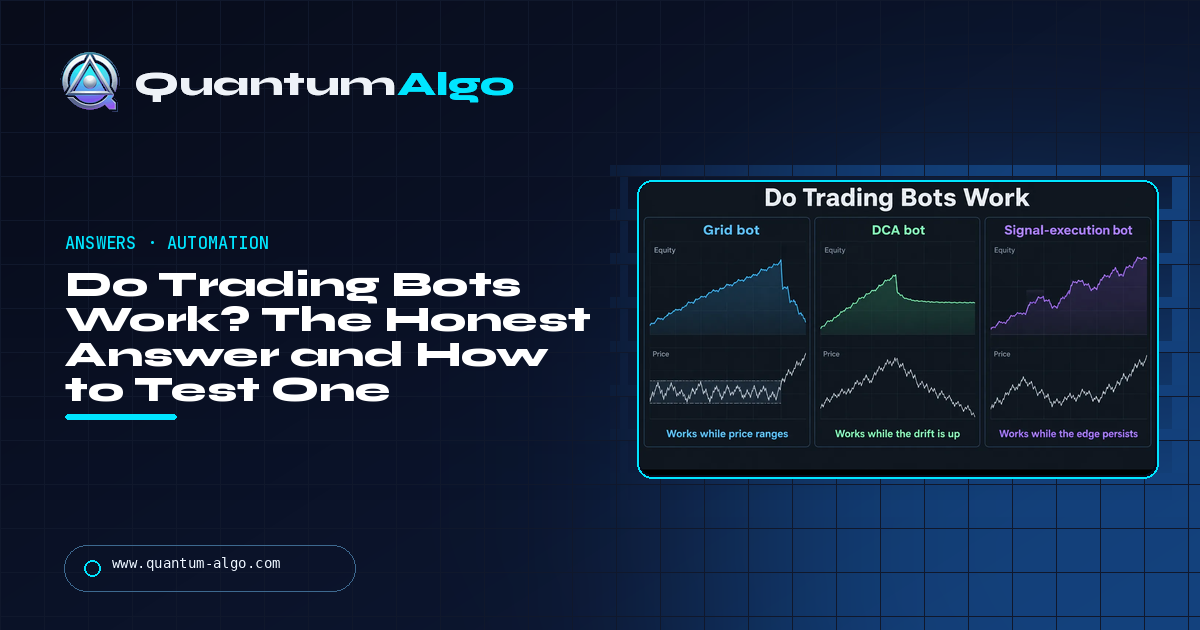
Trading bots work in one sense and not in the other. As executors they are better than humans — they place every trade the rules call for, at any hour, without fear. As a source of profit they are nothing: a bot inherits the expectancy of the strategy it runs, minus slippage and fees. Grid bots make money while price ranges and give it back when it trends; DCA bots make money while the asset rises and lock capital in drawdown when it does not; "AI" bots sold to retail are almost always one of those two with a label; only signal-execution bots — an indicator or strategy alert placed with a stop and a target — perform exactly as the underlying system does, which is why they are the only kind whose results can be verified before you run them. Four things decide it: an edge that exists, rules a bot can follow, execution that matches the backtest, and risk limits the bot cannot override.
The question is usually asked by someone who wants to skip the hard part, and the honest answer refuses to let them. Bots are the easiest thing in trading to build and the hardest thing to make profitable, because the profit was never in the bot. This page says what each kind of bot actually does and the regime that breaks it, the four conditions that decide whether one will work for you, how to test a vendor's claim before paying, a calculator that puts a backtest through real costs and a normal live haircut, a worked example where the same system is profitable with one stop and a fee machine with another, and the mistakes that separate the bots that run for years from the ones that run for a month.
Indicators that prove themselves in public.
One engine, four precision tools — the Gold (XAU) Scalper, the institutional Gravity Zone, the Zeno momentum Oscillator, and Zeno Stocks for equities.
The honest answer
Yes, trading bots work — in the narrow sense that a bot will place the trades it was told to place, every time, without fear or fatigue. Whether those trades make money is a different question, and it has nothing to do with the bot. A bot executing a strategy with a real edge will compound it; a bot executing a strategy with no edge will lose money faster and more consistently than a human, because it never hesitates. The bot is the last ten per cent of the job. The first ninety is the edge, and most people buying a bot are buying it to avoid that part.
That is why the honest numbers are so bleak and so misleading at the same time. Most retail bots lose because most retail strategies lose — the same reasons humans lose, automated. Grid and DCA bots, the most-sold kind, are not strategies at all; they are ways of expressing a view about the market's regime (it will range; it will go up eventually) and they pay exactly as long as that view holds and lose exactly when it stops. "AI bots" sold to retail are, in almost every case, one of those two with a marketing layer. The bots that work are execution layers for systems that already worked when a person ran them.
This page is the answer in usable form: what each kind of bot actually does and where it breaks, the four things that decide whether one will work for you, how to test the claim before paying, a calculator that puts a backtest through slippage, fees and a normal live haircut, and the questions to ask any vendor. The what is a trading bot guide covers the anatomy; the best trading bots guide ranks the products.
What each kind of bot does, and where it breaks
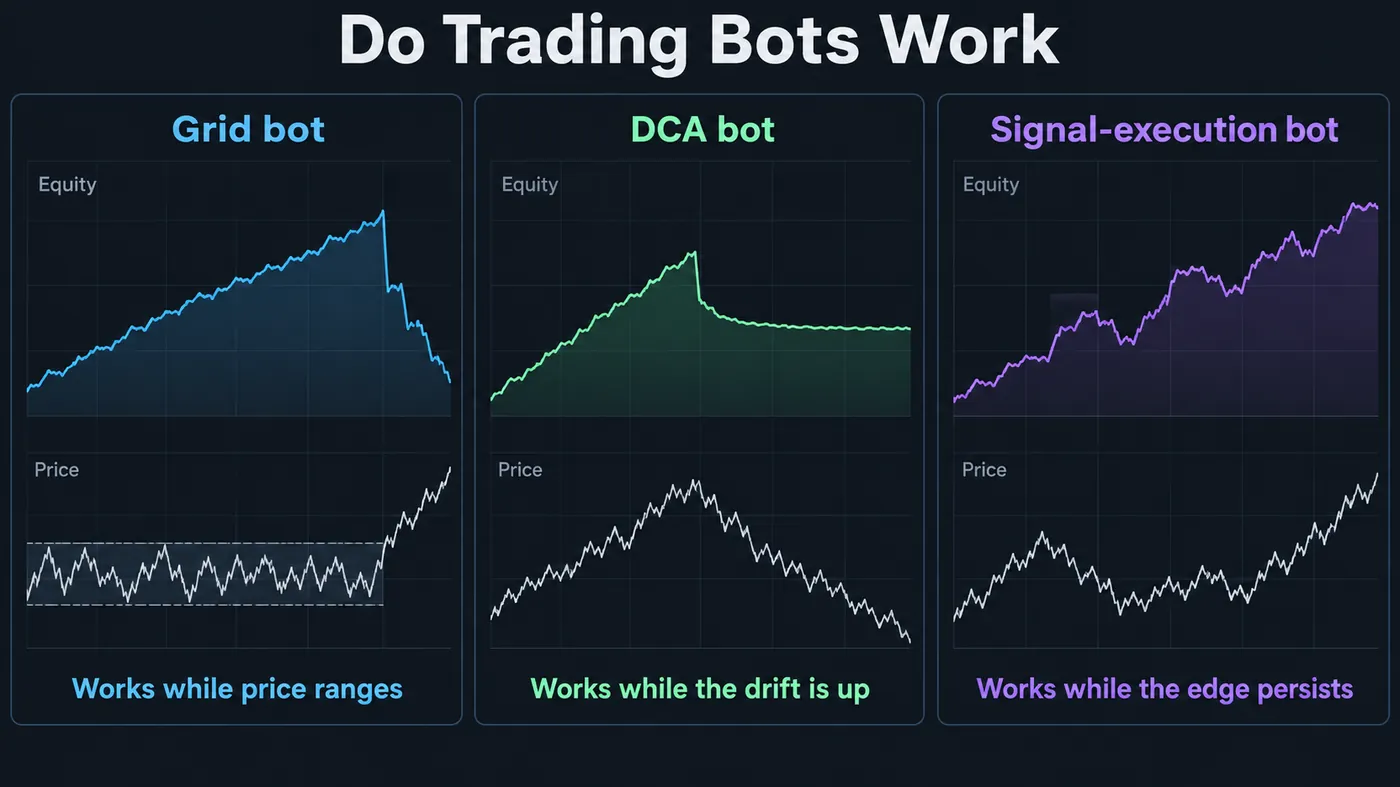
| Bot | What it actually does | Works while | Breaks when | Typical outcome |
|---|---|---|---|---|
| Grid bot | Places buy and sell orders at fixed intervals in a range and collects the oscillation | Price ranges inside the grid | Price trends out of the grid — every rung is now a losing inventory position | Steady small gains, then one large drawdown that returns them |
| DCA bot | Buys fixed amounts on a schedule or on dips and averages down | The asset eventually goes up | The asset does not, or takes years — capital is locked at a loss | Fine in bull markets; a long flat drawdown in bear markets |
| Signal-execution bot | Receives a signal (an indicator alert, a webhook) and places the trade with a stop and a target | The signal has an edge and the execution matches the test | The signal was curve-fit, or slippage eats the edge | Whatever the underlying system does, minus costs — no better, no worse |
| "AI" bot (retail) | Usually a grid or DCA bot with a model choosing parameters | Same as above | Same as above, with less transparency | Same as above, with a higher fee |
| Market-making / HFT | Captures spread with speed and inventory control | You have co-location, capital and the data | You are retail | Not available to you in any real sense |
The column that matters is "breaks when", because it is the one the sales page never shows. A grid bot's backtest over a three-month range looks like a money printer; the trend that ends the range is not in the sample. A DCA bot on bitcoin from 2020 looks like genius; the same bot on the coins that went to zero is not shown. Only the signal-execution bot is honest by construction, because its performance is the performance of a system you can inspect — which is also why it is the only kind whose results can be verified before you run it.
The four things that decide whether a bot works
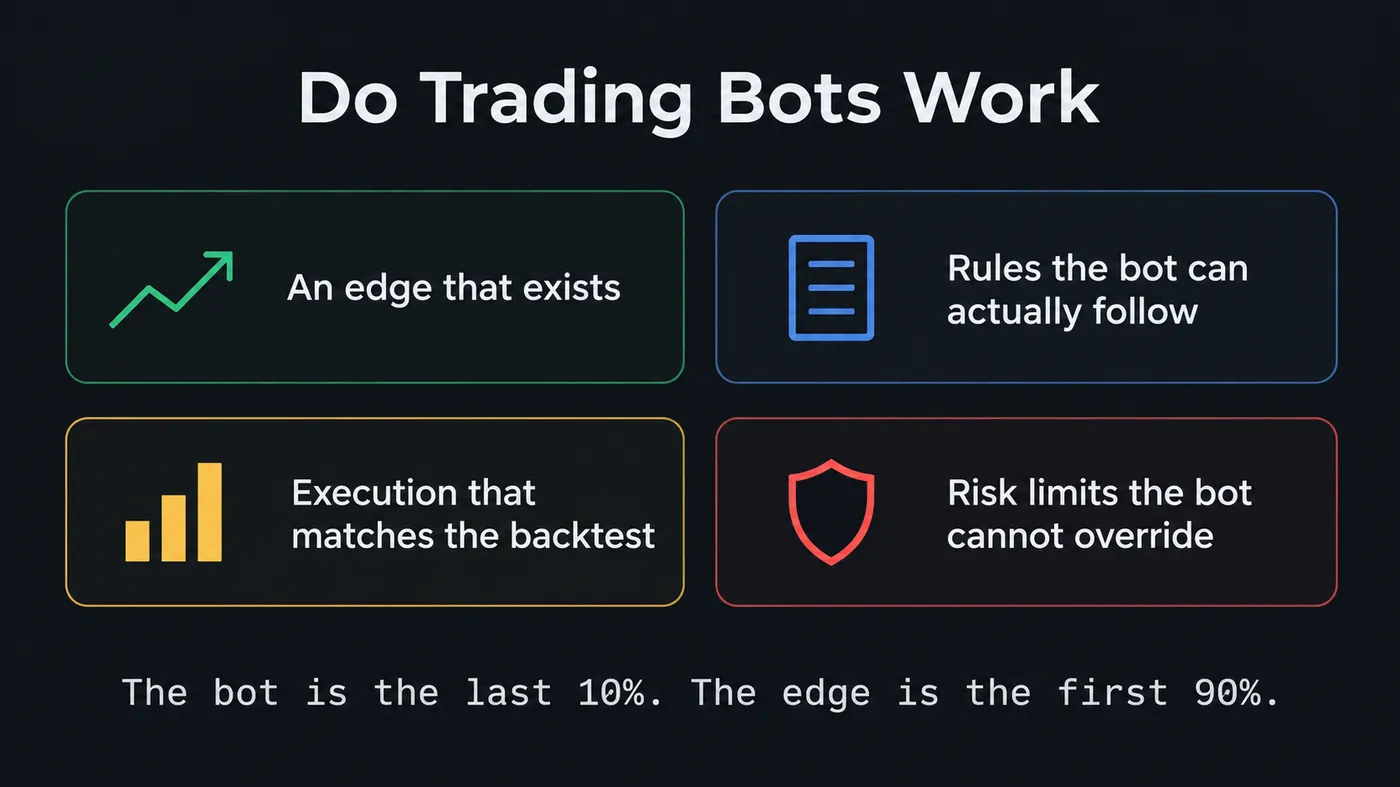
An edge that exists. A tested, rules-based reason the trades should have positive expectancy — a structure-based entry with a defined stop, a mean-reversion setup with a regime filter, anything with a walk-forward record. If you cannot state the edge in a sentence, the bot has nothing to execute. The backtesting guide is where that sentence gets tested.
Rules the bot can actually follow. "Buy the pullback into the order block when structure is bullish" is a discretionary sentence; "buy at the 50% of the last confirmed bullish order block on a 15-minute close above it, stop below the block, target the last swing high" is a rule. Bots run rules. Most of the work of automating a strategy is discovering that yours was never fully written down, which is what the algorithmic SMC lesson walks through.
Execution that matches the backtest. Slippage, fees, spread and latency are a fixed tax per trade, and the tighter the stop the larger that tax is in R. A backtest that assumes fills at the close of the signal candle on a 0.3% stop can lose its entire edge to a 0.05% round-trip cost. The calculator below makes this visible; the lookahead bias and repainting entries cover the two ways a backtest lies before costs are even counted.
Risk limits the bot cannot override. A maximum daily loss, a maximum position size, a kill switch — enforced outside the bot's own logic, at the exchange or account level where possible. Bots fail in two ways: they lose slowly because the edge is gone, or they lose everything in an hour because a feed glitch or a flash move met a loop with no ceiling. The second is the one that ends accounts, and it is entirely preventable.

Automate your trades. Let Quantum Algo trade for you.
Every signal executed on your own account — on your account, with the plan you define.
How to test a bot's claim before paying
- Ask for the strategy, not the returns. A vendor who cannot describe the entry, stop and exit rules is selling a regime bet. Walk away.
- Ask for a live, third-party-verified track record. Exchange-verified or broker-verified equity, over at least a year that includes a trend and a range. Screenshots are not records.
- Check the sample for the regime that breaks it. A grid bot with no trending period in its record, or a DCA bot with no bear market, has not been tested.
- Run the numbers through costs. Win rate, average winner and loser in R, trades per month, stop size, real round-trip cost. The calculator below; if the edge dies at realistic costs it is not an edge.
- Paper-run it for a month on your account's real fees. Live paper fills, not a backtest. Compare the fills to the backtest's assumptions.
- Set the limits outside the bot. Daily loss cap, position cap, kill switch — at the exchange or account level.
Bot reality calculator
Enter the backtest's win rate, average winner and loser in R, trades per month, the average stop distance and your real round-trip cost, plus the haircut you expect live performance to take against the backtest. The tool returns the expectancy before and after costs, the monthly R that survives, and the break-even cost that would erase the edge entirely.
Signal-execution bots: the kind that can work
The architecture is simple and it is the one every serious retail automation uses: an indicator or strategy on TradingView fires an alert; the alert carries a JSON payload to a webhook; a small executor receives it and places the order at the exchange or broker with the stop and target attached; a risk layer caps size and daily loss. The bot has no opinion about the market. Everything it does is inherited from the signal, which means everything about it can be checked — you can see the signal's history, its stop, its win rate, and its drawdown before you connect a dollar.
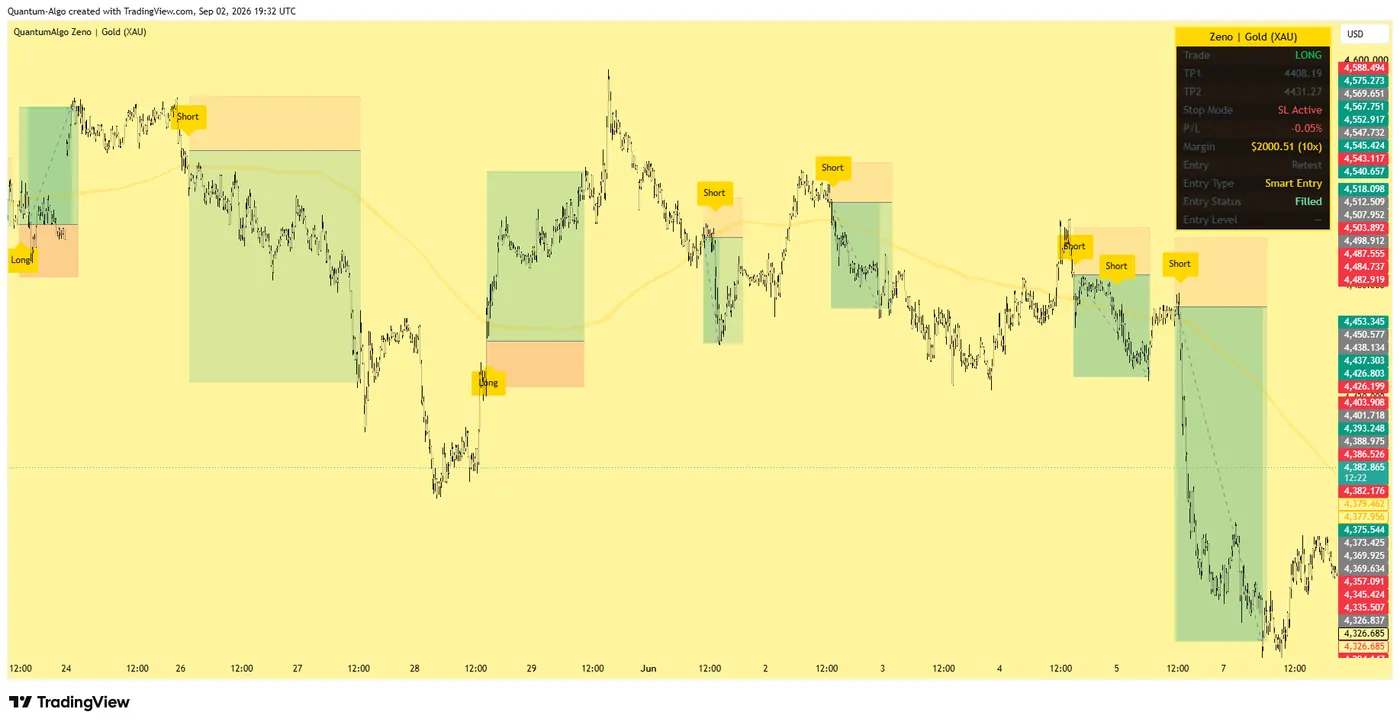
That is the design behind QuantumBot: it executes Zeno's signals — each with a stop and targets printed on the chart — on the exchanges it connects to, with position and daily-loss limits set by the trader, and the signals themselves have a public, timestamped ledger on the track record page. Whether that makes money for a given trader depends on the same four questions as any bot; the difference is that all four can be answered before running it. The copy trading vs automated trading guide covers the alternative of following a person instead of a system.
Reference data
| Item | Value |
|---|---|
| Do they work? | As executors, yes. As a source of edge, no — the bot inherits the strategy's expectancy minus costs |
| Grid bots | Profit from ranges; lose the accumulated gains when price trends out of the grid |
| DCA bots | Profit in uptrends; lock capital in long drawdowns in downtrends |
| Signal-execution bots | Execute an indicator or strategy; performance = the system's minus slippage and fees |
| "AI" retail bots | Usually grid or DCA with a parameter model; verify the strategy, not the label |
| The four conditions | An edge that exists; rules a bot can follow; execution matching the backtest; risk limits outside the bot |
| How backtests lie | Lookahead bias, repainting signals, no costs, a sample without the breaking regime |
| Cost rule of thumb | Round-trip cost ÷ stop distance = the R tax per trade; tight stops and many trades multiply it |
| Non-negotiable | Daily loss cap, position cap and kill switch enforced at the account or exchange level |
Worked example: the same backtest, two very different bots
A trader has a 4-hour BTCUSDT system: long on a liquidity sweep of a swing low with a 15-minute close back above it, stop under the sweep, target the last swing high. Backtest over two years, costs excluded: 58% win rate, average winner 1.4R, average loser 1R, 40 trades a month on a basket of five pairs, average stop 0.6% of price. Expectancy 0.41R per trade, 16.4R a month — the kind of number that sells a bot.
Now the costs. Exchange fees, spread and a realistic slippage on a market order into a sweep come to 0.08% round trip, which on a 0.6% stop is 0.13R per trade. Expectancy after costs 0.28R. Then the normal live haircut — signals that looked clean in the backtest but were ambiguous at the bar close, fills that were worse than the assumption — a 10% cut to the win rate: 52% live, expectancy 0.12R, 4.8R a month. Still positive, still worth running, and about a quarter of the backtest. Run the same system with a 0.25% stop to "tighten risk" and the cost becomes 0.32R per trade, the live expectancy goes negative, and the bot that was profitable is now a fee machine. Nothing about the bot changed. The stop did.
Mistakes people make with trading bots
- Buying a bot to avoid building an edge. The bot executes; it does not supply the reason to trade.
- Judging a grid bot on a range and a DCA bot on a bull market. Test the regime that breaks it.
- Believing a backtest with no costs. Round-trip cost divided by stop distance is the tax, per trade, forever.
- Trusting screenshots. Only third-party-verified live records count.
- Letting the bot manage its own risk. Daily loss and position caps live outside the bot.
- Tightening stops to "reduce risk" and doubling the cost tax in R.
- Running an "AI" bot whose strategy nobody can state. If the rules are secret, so is the edge — usually because there is none.
Bots, Zeno and the free indicators
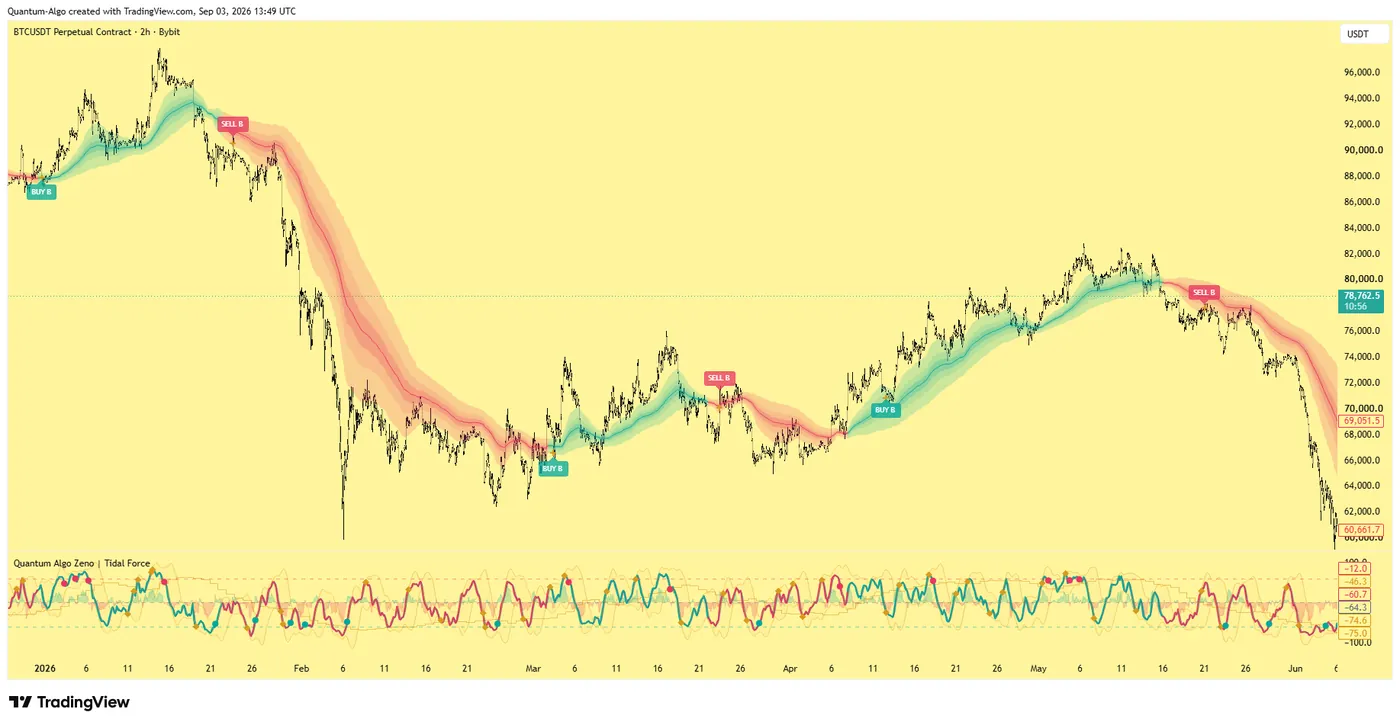
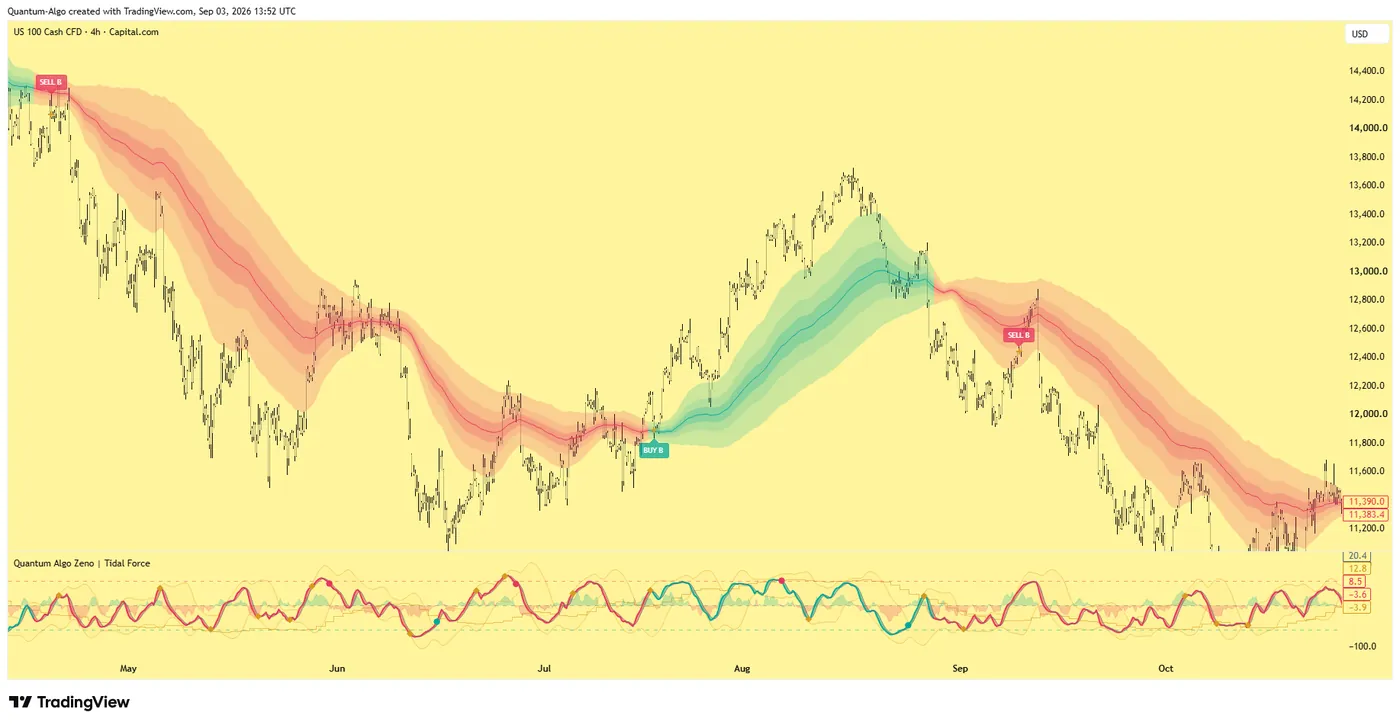
Every script in the free library fires TradingView alerts, which is the first half of a signal-execution bot: the Liquidity Sweeps script alerts on the sweep, the Smart Money Concepts Engine on the structure break and order block, the Supertrend Engine on the trend flip, and the Event Probability Engine on the news windows a bot should stand aside from. The free algorithmic trading course shows how the alert becomes an order. The premium engine, Zeno, is the signal with the stop and targets already in the payload, and QuantumBot is the executor built for it — the four questions answered in the open, which is the only version of "do bots work" worth paying for.
A bot is an executor; give it a system that already works and it will run it without flinching, and give it nothing and it will lose faster than you would. Test the regime that breaks the bot, put the backtest through real costs and a live haircut, insist on a strategy you can state and a record you can verify, and keep the daily loss cap and kill switch outside the bot's reach. Then, and only then, it works.
◆ Interactive check
Do you know what a bot can and cannot do?
Questions people ask about trading bots
As execution tools, yes — a bot places every trade its rules call for without hesitation. As a source of profit, no: a bot returns the expectancy of the strategy it runs minus slippage and fees. Bots running systems with a real edge compound it; bots running systems without one lose faster and more consistently than a person would.
Only when the strategy they execute is profitable after costs. Most retail bots lose because most retail strategies lose, and because grid and DCA bots are regime bets rather than strategies — profitable in the regime they were sold on and loss-making when it changes. Signal-execution bots are as profitable as the system behind them, which is inspectable in advance.
While price stays inside the grid, yes — they collect small gains from the oscillation. When price trends out of the grid, every rung becomes a losing inventory position and the accumulated gains are returned, often in one move. A grid bot is a bet that the range continues; test it on the trend that ends it.
In markets that go up, yes. In markets that do not, or that take years to recover, capital is locked in a long flat drawdown at a loss. A DCA bot on an asset that went to zero is the case the sales page never shows.
Retail "AI" bots are almost always a grid or DCA bot with a model choosing parameters, and they fail the same way with less transparency. Judge any bot by the strategy it runs, the verified live record and the risk limits, not by the label.
Insist on costs (fees, spread, slippage), no lookahead bias, non-repainting signals, and a sample that includes the regime that breaks the strategy. Then run the numbers through the calculator on this page and paper-run the bot for a month on your account's real fees, comparing fills to the backtest's assumptions.
A signal-execution bot with risk limits enforced outside it — an indicator or strategy alert placed with a stop and a target, a daily loss cap and a position cap at the account or exchange level, and a kill switch. Its performance is the visible system's, and the worst case is bounded by rules the bot cannot change.
Because costs are fixed per trade and stops are not. Round-trip cost divided by stop distance is the tax in R; a 0.08% cost on a 0.6% stop is 0.13R, on a 0.25% stop it is 0.32R. Tightening the stop to "reduce risk" can turn a profitable system into a fee machine without changing anything else.
Yes, once the rules are written precisely — a specific order block definition, a specific structure-break rule, a stop and target rule. Most of the work is discovering the parts of the method that were discretionary; the algorithmic SMC lesson and the free algorithmic trading course cover the translation.
QuantumBot is a signal-execution bot: it places Zeno's signals — each with a stop and targets — on the connected exchanges with trader-set position and daily-loss limits, and the signals have a public timestamped ledger on the track record page. Every free indicator also fires TradingView alerts that can drive a bot through a webhook.
References & Related Guides
Read next
- What Is a Trading Bot?
- Best Trading Bots
- Copy Trading vs Automated Trading
- Backtesting a Trading Strategy
- Free Algorithmic Trading Course
- Algorithmic SMC Trading (academy)
- Why Do Most Traders Lose Money?
- Monte Carlo Simulation in Trading
- QuantumBot
- Track Record
- Expectancy — glossary
- Lookahead Bias — glossary
Primary sources
- Bailey, Borwein, López de Prado & Zhu — Pseudo-Mathematics and Financial Charlatanism: the effects of backtest overfitting
- Barber & Odean — Trading Is Hazardous to Your Wealth: the performance of individual investors
- TradingView: Alerts and webhooks — the mechanism behind signal-execution bots
- Quantum Algo: QuantumBot and the public signal ledger