Cheapest Prop Firms: The Lowest Evaluation Prices and What They Really Cost
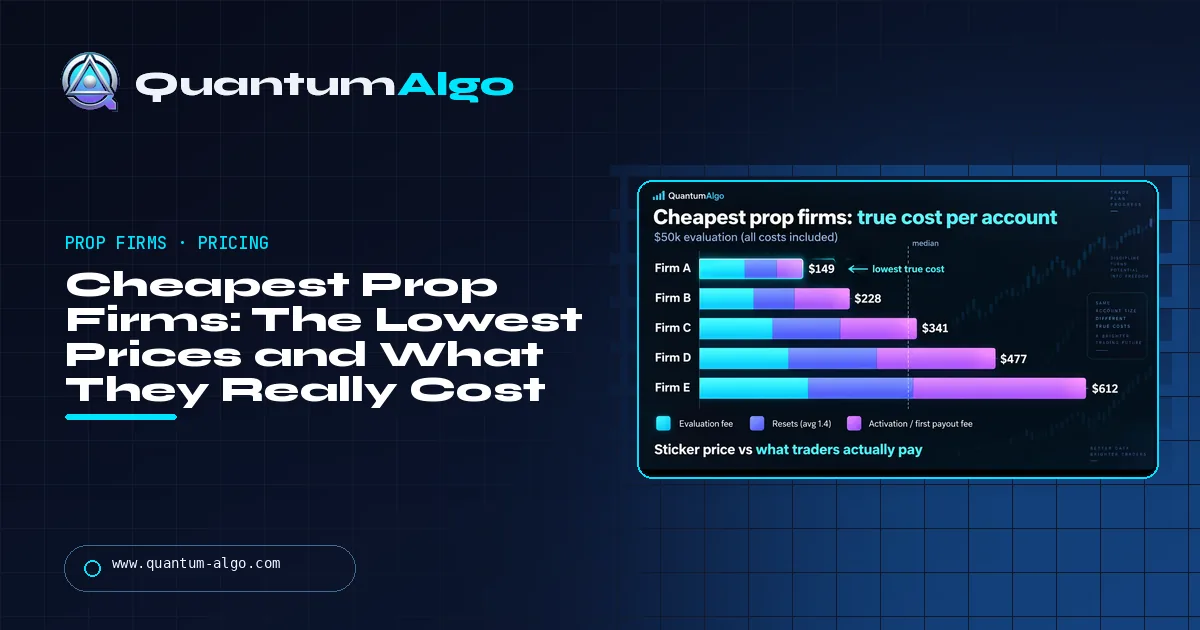
The cheapest prop-firm evaluations are about $39 for a $50k futures account (Top One Futures) and $16–$79 for $25k (Funded Futures Family with codes). A $5k forex challenge costs $17–$35 (Maven Trading, Goat Funded Trader, FundingPips, FundedNext, The5ers). Add resets, activation and data fees: a $49 evaluation at a 25% pass rate costs about $326. Compare cost per $1,000 funded.
Search for the cheapest prop firm and you get a list sorted by the buy button. This page sorts by what you actually pay: the evaluation, the resets, the activation fee, the data, and the rules that decide how many attempts it takes. It lists the lowest prices in futures and forex as of September 2026, explains what each cheap firm gives up, and gives you a calculator so the comparison is yours rather than the affiliate's.
Indicators that prove themselves in public.
One engine, four precision tools — the Gold (XAU) Scalper, the institutional Gravity Zone, the Zeno momentum Oscillator, and Zeno Stocks for equities.
What does "cheapest" actually mean for a prop firm?
Every list of the cheapest prop firms ranks them by the price on the buy button. That number is real, but it is the smallest part of what most traders end up paying. A prop-firm evaluation has four costs: the evaluation fee itself, the resets you buy when you breach a rule, the activation or first-payout fee some firms charge when you pass, and the monthly data or platform fees that run in the background. Then there is the cost you never see on a price page — the share of your profit the firm keeps, and the payout caps that decide how fast you get anything back.
So this guide does two things. It lists the cheapest evaluations on the market as of September 2026, futures and forex separately, because the two markets price very differently. And it shows you how to turn a sticker price into a true cost with a calculator, because the firm with the $17 evaluation and the firm with the $147 one are frequently the same price once you have failed once and paid to activate.
A word on what this page is not. It is not a ranking of the best prop firms — that is the prop firm hub, and the what is a prop firm guide is the place to start if the model itself is new to you. Cheap and good overlap less than you would hope, and the section on what you give up at low prices explains why.
Which futures prop firms have the cheapest evaluations?
Futures firms compete on price harder than forex firms because the product is more standardised: an account size, a profit target, a trailing drawdown, a contract limit. Prices below are list prices checked in September 2026; most of these firms run rolling discount codes of 20–90%, so treat the list price as the ceiling and the code price as what people actually pay.
| Firm profile | Cheapest evaluation | Account | Reset | Activation | Drawdown | What to know |
|---|---|---|---|---|---|---|
| Funded Futures Family (Velocity) | $79 list · ~$16 with codes | $25k | $78 | None | Intraday trailing | Lowest entry price on the market when a code is live; the reset costs as much as the evaluation |
| Top One Futures (Elite Access) | $39 | $50k | $35 | Yes | End of day | Cheapest $50k on the list; the activation fee is where the price is recovered |
| Take Profit Trader | $150 / month | $25k | $99 | $130 (PRO) | EOD on the Test; intraday when funded | Monthly subscription; withdraw from day one once funded — see the review |
| My Funded Futures (Rapid) | $109 | $25k | $84+ | None | EOD in evaluation, intraday when funded | Daily payouts, 90/10 split; see the MFFU review |
| Tradeify (Growth) | $145 | $50k | $95 | None | End of day | TradingView execution available |
| Apex Trader Funding | $147 list · often 80–90% off | $50k | $80 | Yes (one-time or monthly PA fee) | Trailing | Almost never sold at list; the Apex review explains the activation and payout rules |
| Topstep | $49 for $50k (monthly) | $50k | Included with renewal | Yes ($149 one-off) | End of day | Subscription model — cheap per month, expensive if you take three months to pass; see the Topstep review |
Notice the pattern in the reset and activation columns. The firms with the lowest evaluation price recover the money on the reset, on the activation, or on both. Top One's $39 is real, and so is its activation fee. Funded Futures Family's $16 is real, and so is a $78 reset that costs five times the evaluation. None of that makes them bad deals; it makes the sticker price the wrong number to compare.
Which forex and CFD prop firms have the cheapest evaluations?
Forex firms price per account size on a curve — a $5,000 challenge for under $50, a $100,000 one for $400–$600 — so the cheapest entry is almost always the smallest account. Small accounts have small payout caps, which matters more than the price. Prices checked August–September 2026.
| Firm profile | Cheapest challenge | Account | Phases | Drawdown | Split | What to know |
|---|---|---|---|---|---|---|
| Maven Trading | $17 | $5k | 3 | 3% static | 80% | Lowest price in forex; a $10k monthly payout cap and a tight 3% drawdown |
| Goat Funded Trader | $18 with first-order code | $5k | 2 | Static | 80–100% | Fee refundable on first payout |
| FundingPips | $29 | $5k | 2 | 6% max loss | 80–100% | Fee not refunded on this plan |
| FundedNext (Stellar Lite) | $32.99 | $5k | 1 | Static | up to 95% | One-phase model; the FundedNext review has the rules |
| The5ers | $35 | $5k | 2 | 6% trailing | 80–100% | Running since 2016; a two-minute news freeze is enforced |
| FXIFY | $39 | $5k | 3 | Trailing | up to 90% | On-demand first payout |
| FTMO | €155 for $10k | $10k | 2 | 10% static | 80–90% | Never the cheapest and never pretends to be; the FTMO review explains the premium |
A $5,000 account at a 5% monthly target pays $250 gross before the split. That is fine as a proof of concept and useless as an income. The forex firms that are cheapest at $5k are rarely cheapest at $100k, which is the size that matters if the goal is a payout rather than a badge.

Automate your trades. Let Quantum Algo trade for you.
Every signal executed on your own account — on your account, with the plan you define.
How do resets and fees change the true cost of an evaluation?
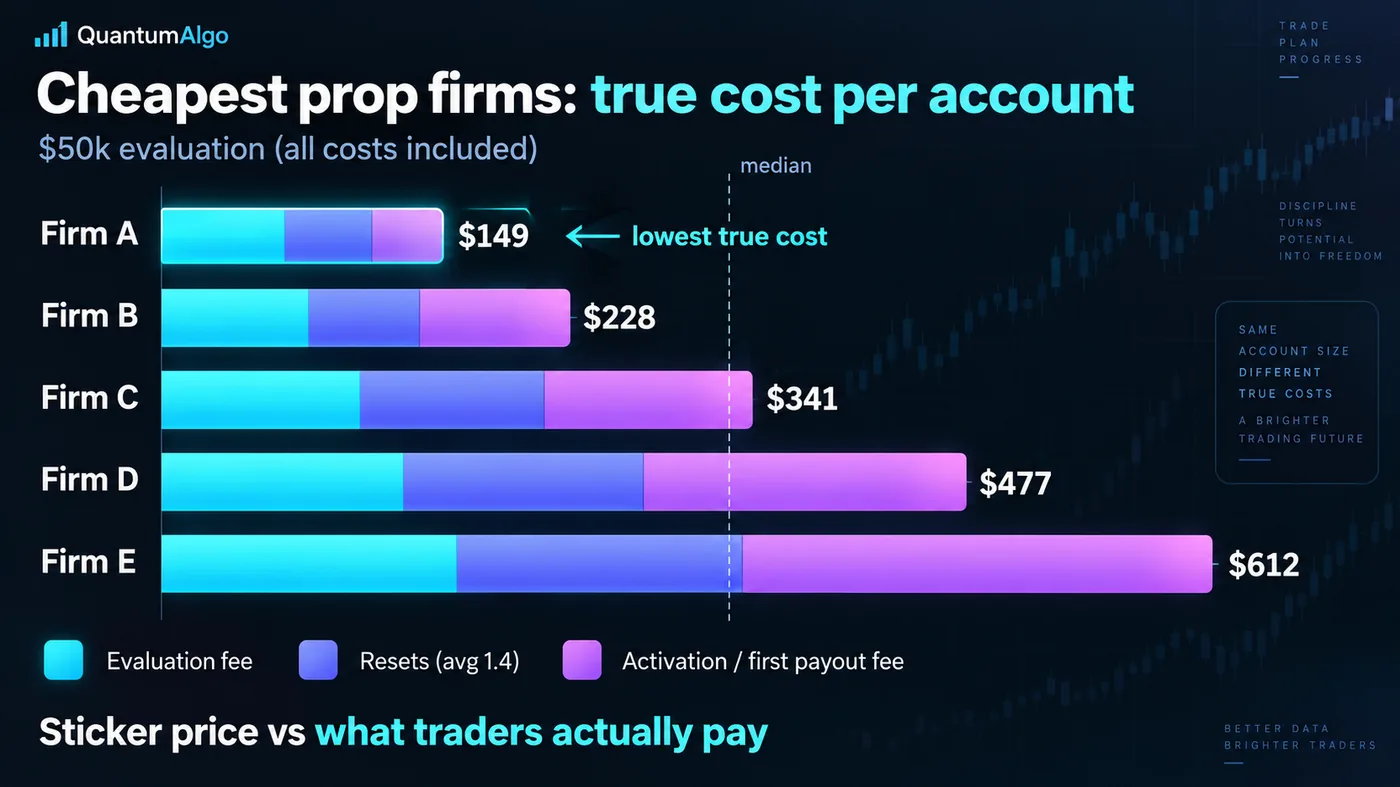
Take a $50k futures evaluation with a $49 fee, a $49 reset, a $130 activation and a realistic 25% pass rate per attempt. Expected attempts: four. Expected resets: three, $147. Activation: $130. True cost: $326 for a $49 sticker, or $6.52 per $1,000 funded. Now take a $147 evaluation with an $80 reset, no activation fee and the same pass rate: $147 + $240 = $387, $7.74 per $1,000. Closer than the sticker prices suggest — and if your pass rate is 40% rather than 25%, the order flips.
That is the whole argument of this page in two sentences. The evaluation fee is what you pay to start; the reset, the activation and your pass rate are what you pay to finish. The calculator below does the arithmetic for any firm, and a run of demo attempts under the firm's exact rules — the evaluation strategy guide shows how to set one up — is the honest place to get the fourth input from.
True cost calculator
Enter the fees from the firm's pricing page, your honest pass rate per attempt (most traders should start at 20–30%), and the profit split. The calculator returns the expected true cost, the cost per $1,000 of funded capital, and how much funded profit you need before the account has paid for itself.
What do you give up with a cheap prop firm?
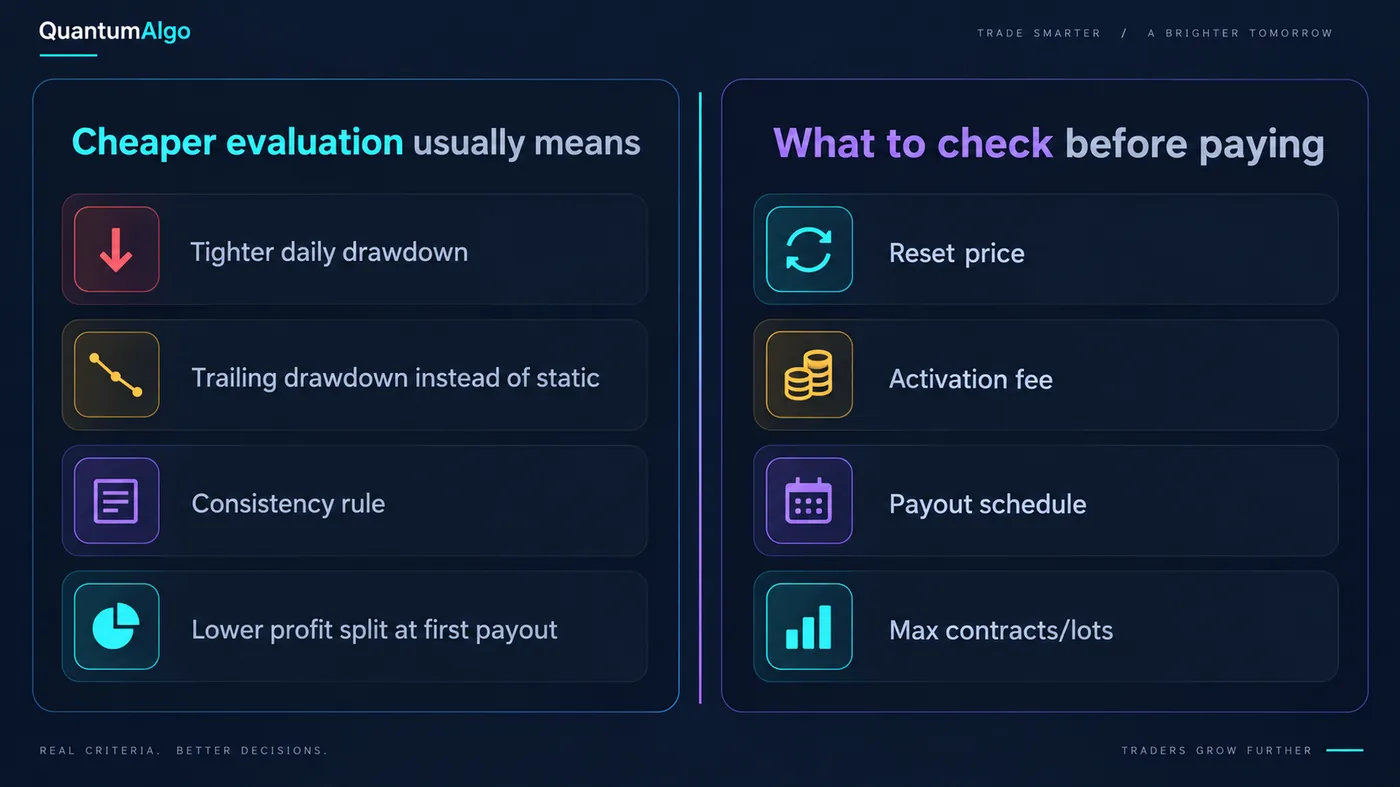
Prop firms are businesses; an evaluation priced below its cost of acquisition is paid for somewhere else. The five places to look, roughly in order of how much they cost the trader:
- Trailing drawdown instead of static. The single most expensive rule in prop trading. A trailing drawdown moves up with your equity and — on the intraday version — with your open-trade highs, so a winner that reverses can breach the account while you are still in profit on the day. The prop firm strategy guide works through the mechanics of sizing under a trailing drawdown; cheap futures accounts are overwhelmingly trailing.
- A consistency rule. No single day may exceed 30–50% of total profit. It sounds fair until one good day locks you out of a payout for weeks while you "balance" it. Common on the cheapest futures plans; rarer on forex.
- Payout caps and buffers. A first payout capped at $1,000–$2,000, a minimum number of winning days, a profit buffer that must stay in the account. These slow the return of your money, which is the point.
- A lower split on the first payouts. 80/20 instead of 90/10, or 100% of the first $10,000 as a headline with a lower split afterwards. Read the payout page, not the pricing page.
- An activation or "PA" fee. Up to about $150 to switch on the funded account after you pass — Topstep charges $149, Apex a PA fee that is one-time or monthly. This is the cheap evaluation's real price, deferred to the moment you are least likely to walk away.
None of these are hidden — they are all on the rules page — but they are never on the price page, and the price page is what the "cheapest prop firm" search lands on.
How do you compare prop firms by cost per $1,000 funded?
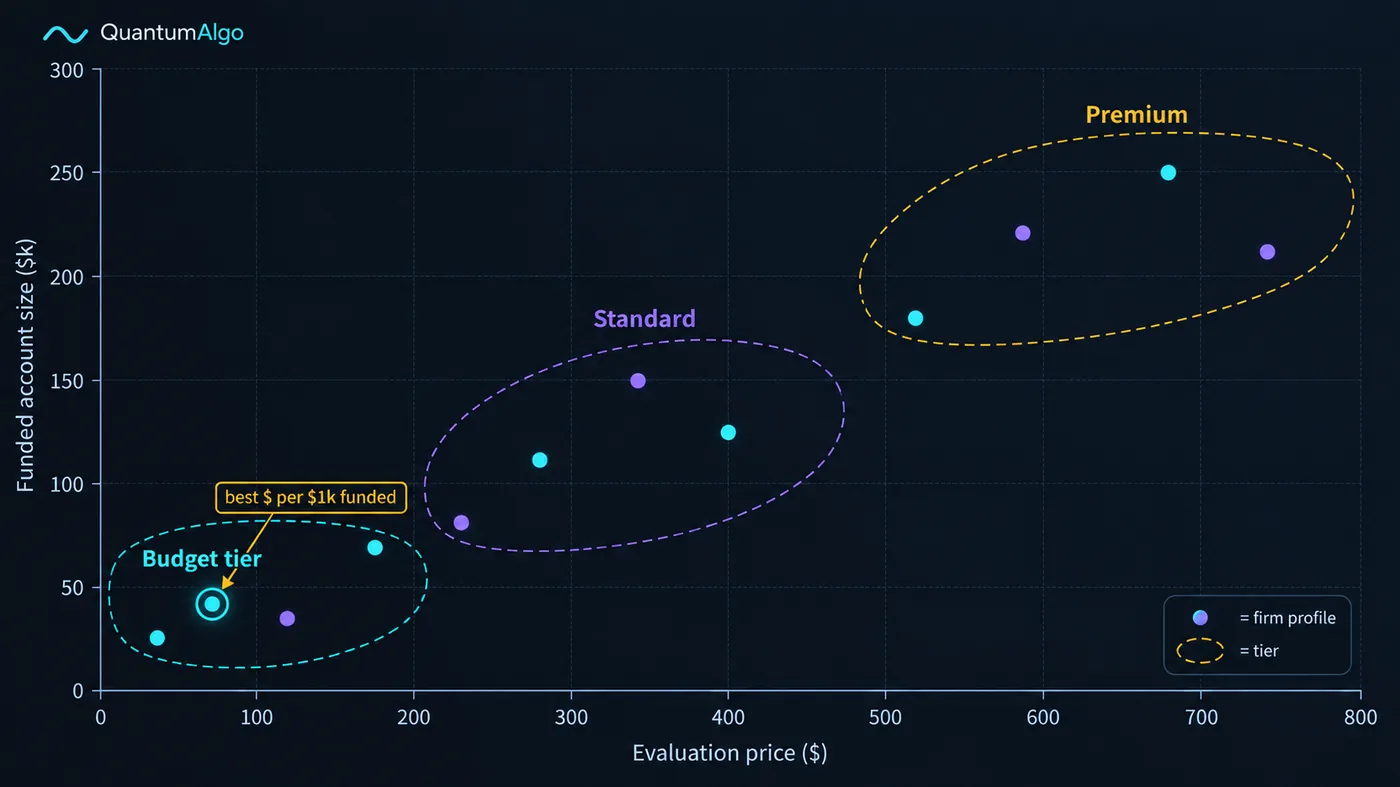
Divide the true cost by the account size in thousands and you can compare a $17 five-thousand-dollar forex challenge with a $147 fifty-thousand-dollar futures evaluation. On that measure the mid-priced $50k–$100k futures accounts are usually the best value on the market, the $5k forex challenges are the worst, and the premium firms sit in the middle — they cost more to enter and less to finish, because static drawdowns and no activation fee mean fewer resets and no deferred charge.
It also exposes the subscription trap. A $49-a-month $50k evaluation is the cheapest thing on the page if you pass in month one and the most expensive if you take four, and most traders take longer than they planned. Buy a monthly plan only if you are already consistent on a demo and are paying to prove it, not to learn.
Reference data
| Item | Value |
|---|---|
| Cheapest futures evaluation (list) | $39 for $50k (Top One Futures), $79 for $25k (Funded Futures Family; ~$16 with codes) |
| Cheapest forex challenge | $17 for $5k (Maven Trading), $18 with code (Goat Funded Trader) |
| Typical futures reset fee | $35–$100 |
| Typical activation / first-payout fee | $0 (MFFU, Tradeify) to about $150 (Take Profit Trader $130 PRO; Topstep $149; Apex and Top One charge a PA fee) |
| Realistic pass rate per attempt | 20–35% for a trader with a tested plan; under 10% without one |
| True cost at 25% pass rate, $49 eval / $49 reset / $130 activation | ≈ $326 (6.7× the sticker) |
| Best value measure | True cost ÷ funded size in $k — mid-priced $50k–$100k futures plans usually win |
| Prices checked | September 2026 — codes and list prices change monthly |
Worked example: two traders, two cheap firms
Trader A buys the $16 Velocity evaluation on a code. He fails twice on the intraday trailing drawdown — a winner ran 40 ticks against a $1,500 trail and came back — and resets twice at $78. Third attempt passes. No activation fee. Total: $172 for a $25k account, $6.88 per $1,000, and a 90/10 split from the first payout. Sixteen dollars became one hundred and seventy-two, which is still a fair price for a funded account.
Trader B buys Top One's $39 for $50k. End-of-day drawdown suits her swing-style entries and she passes first time. Activation fee to switch the account on: $149. Total: $188 for $50k, $3.76 per $1,000 — the best number on this page, and it came from the firm whose sticker was not the lowest but whose drawdown rule matched how she trades.
The difference between the two was not the price. It was that Trader B chose the drawdown rule first and the price second. The prop firm hub is organised that way for exactly this reason.
What mistakes do traders make chasing the cheapest prop firm?
- Comparing evaluation fees instead of true cost. The reset and activation columns decide it.
- Buying the smallest account because it is cheapest. A $5k account's payout cap makes the fee irrelevant; you cannot earn enough on it for the price to matter.
- Ignoring the drawdown type. Intraday trailing at a low price costs more in resets than end-of-day at a higher one.
- Taking a monthly subscription to learn on. Pay monthly only when you already pass demos.
- Not reading the payout page. The split, the cap, the minimum days and the buffer are the price of getting your money back.
- Stacking discount codes and treating the account as disposable. Ten cheap failures teach less than one properly prepared attempt, and cost more.
- Trading the evaluation with a different plan from the demo it was tested on, because the fee felt small enough to gamble. The evaluation strategy lesson is the plan.
Cheap evaluations and the way we trade them
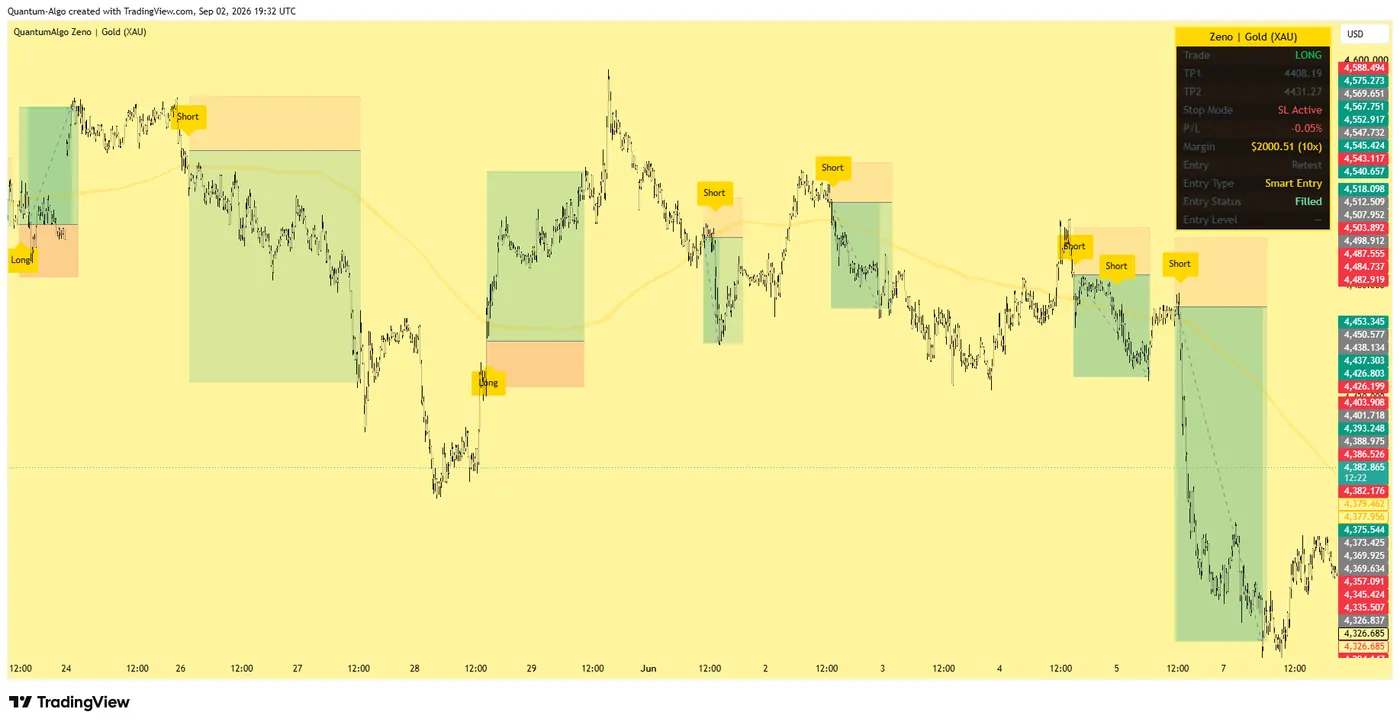
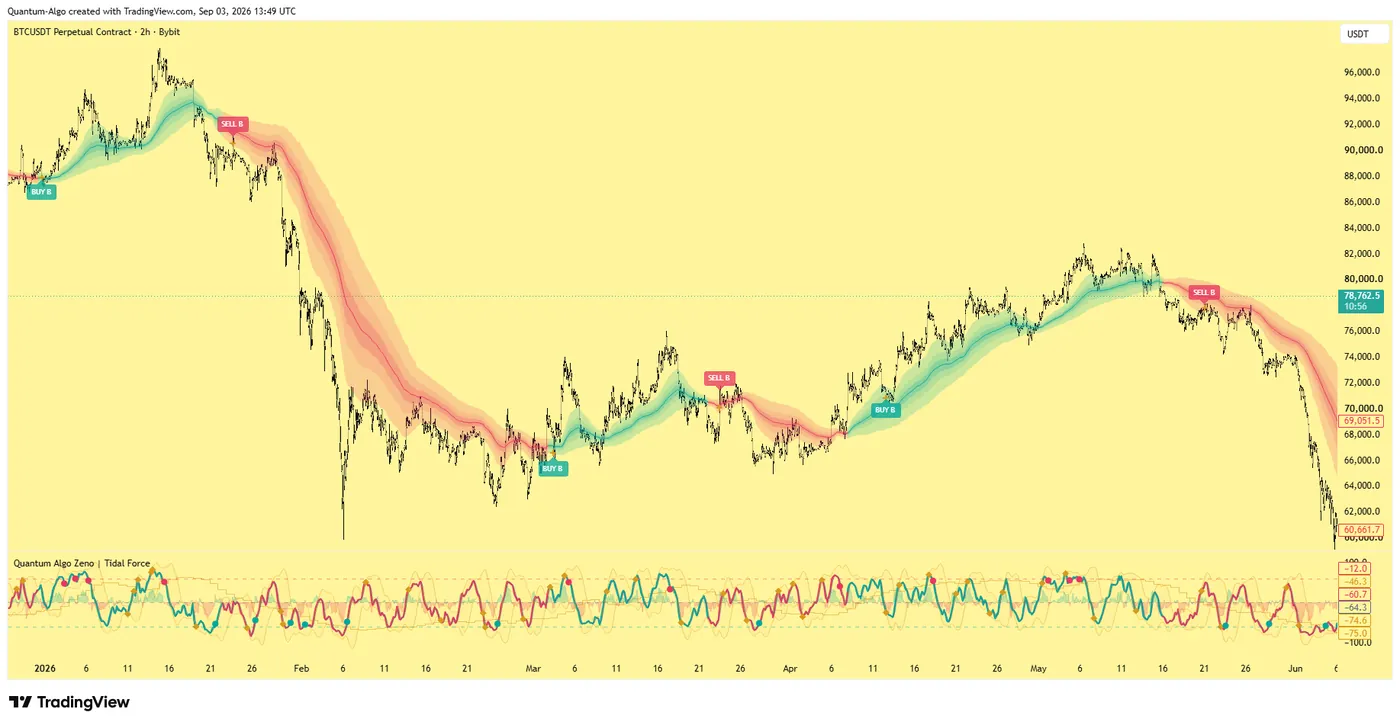
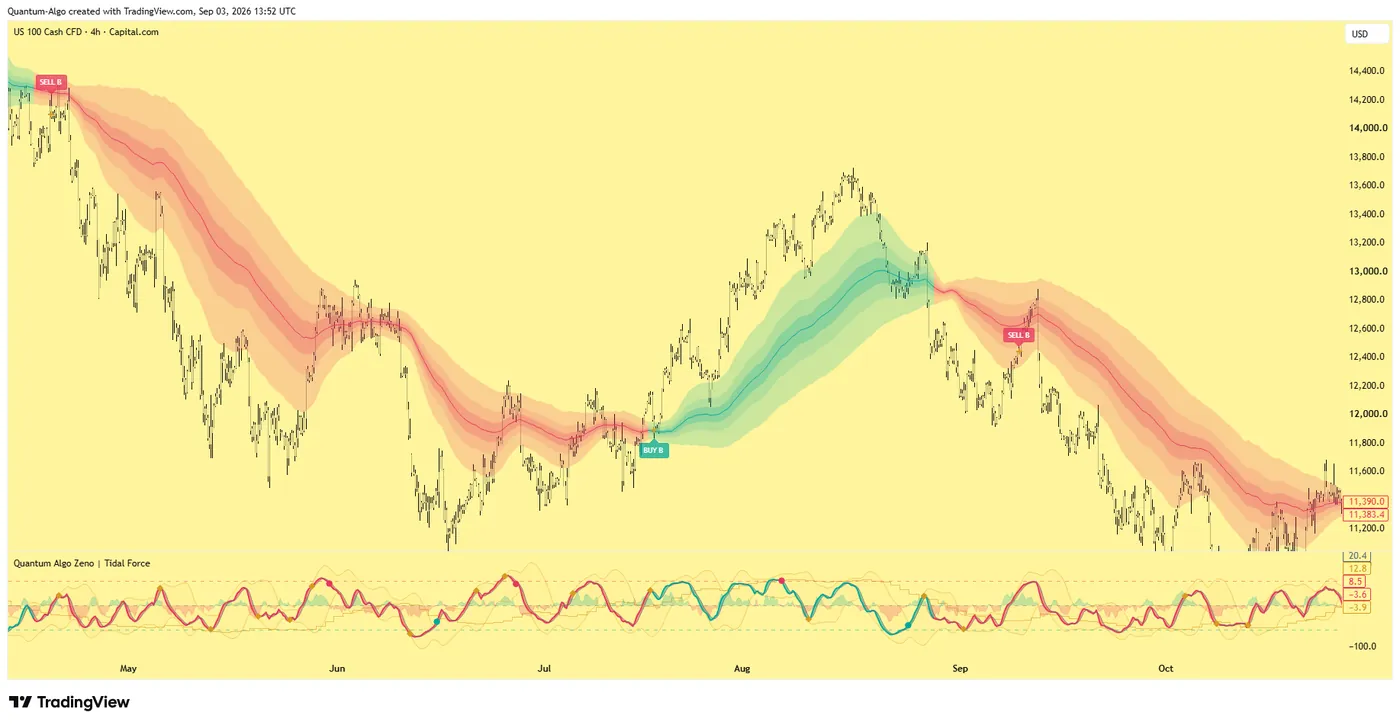
Whatever the price, the account is passed the same way: a higher-timeframe bias, a sweep of an obvious level, displacement, an entry from the block it left, and a stop that respects the drawdown rule. Zeno draws the structure — order blocks, fair value gaps, liquidity sweeps — on a confirmed-candle basis so nothing repaints between the evaluation and the funded account, and the free indicators cover the session and key-level work if you are not ready to pay for a subscription on top of an evaluation. The prop firms that use TradingView guide lists which of these put the order ticket on your chart, the MT4 list is its forex sister, and the Rithmic vs Tradovate answer explains the two data feeds the futures firms above run on.
QuantumBot is for the trader who wants the entries executed automatically; check the firm's algo rule first — the options prop firms guide shows how differently the same firms treat non-standard trading.
The cheapest evaluation is rarely the cheapest funded account. Price the resets and the activation, be honest about your pass rate, divide by the funded size, and choose the drawdown rule before the fee. Mid-priced $50k–$100k futures plans with end-of-day drawdowns and no activation fee are usually the best value; $5k forex challenges are the worst, whatever they cost.
◆ Interactive check
Do you know what a cheap evaluation really costs?
Questions traders ask about cheap prop firms
For futures, Top One Futures at $39 for a $50k evaluation and Funded Futures Family at $79 list (around $16 with a code) for $25k are the lowest we found in September 2026. For forex, Maven Trading at $17, Goat Funded Trader at $18 with a first-order code, FundingPips at $29, FundedNext at $32.99 and The5ers at $35 for $5k accounts. Prices and codes change monthly; the true cost, including resets and activation fees, is what to compare.
Because the firm recovers the money elsewhere: a reset fee that costs as much as the evaluation, an activation fee of up to about $150 when you pass, a trailing drawdown that produces more failures, a consistency rule that delays payouts, or a lower profit split on the first withdrawals. A cheap evaluation is a customer-acquisition price, not the price of the account.
Evaluation fee, plus the reset fee multiplied by your expected number of failures (one divided by your pass rate, minus one), plus any activation or first-payout fee, plus monthly data or platform fees for the months it takes. At a 25% pass rate a $49 evaluation with a $49 reset and a $130 activation costs about $326. The calculator on this page does the arithmetic.
As a proof of concept, yes — $17–$35 to find out whether your plan survives a live rule set is cheap tuition. As a path to income, no: a 5% target on $5,000 is $250 gross, payouts are capped, and the same firm's $100k account is where the money is. Pass the small one once, then price the larger account on true cost.
Only if you pass quickly. Topstep's $49 a month for a $50k account is the cheapest thing on the page if you pass in month one and one of the most expensive if you take four months, plus a $149 activation. Take a subscription plan when you already pass demo evaluations and are paying to prove it, not to learn.
My Funded Futures, Tradeify and Funded Futures Family advertise $0 activation on their current plans. Take Profit Trader ($130 PRO), Apex, Topstep and Top One charge one; on those firms the activation fee is a larger part of the true cost than the evaluation.
Not necessarily worse, but usually stricter: intraday trailing drawdowns, consistency rules and payout buffers are more common at the low end. Firms like FTMO and The5ers charge more up front and take fewer resets to pass because their drawdowns are static. Compare the rules and the true cost together.
Yes, and most futures firms expect you to — Apex is almost never sold at list price and Funded Futures Family's $16 price is a code price. Codes reduce the evaluation fee, not the reset or activation fee, so they change the sticker more than the true cost.
Choose a firm whose drawdown rule matches your style (end-of-day for swing entries, static if you can get it), with no activation fee and a cheap reset, at the $50k–$100k size; prove the plan on a demo with the firm's exact rules first; then buy one evaluation and pass it. One prepared attempt at $150 is cheaper than five careless ones at $16.
Among the futures firms above, Tradeify, My Funded Futures, Topstep and Take Profit Trader (CQG feed) offer TradingView execution through their broker connections, and Apex does on its Tradovate plans; the prop firms that use TradingView guide keeps the current list.
References & Related Guides
Read next
- Best Prop Firms for SMC Traders
- What Is a Prop Firm?
- Prop Firm Trading Strategy
- Options Prop Firms
- My Funded Futures Review
- Apex Trader Funding Review
- Topstep Review
- FTMO Review
- FundedNext Review
- Prop Firms That Use MT4
- Rithmic vs Tradovate
- Prop Firm Evaluation Strategy (Academy)