Alpha Futures Review: Zero vs Standard vs Advanced vs Direct, the Rules and Our Verdict
Alpha Futures is a UK-registered futures prop firm with three one-step evaluations (Zero, Standard, Advanced) and a Direct plan with no evaluation. Every plan uses an end-of-day trailing loss limit and a 90% split. Evaluations cost $89 to $489 a month, and payouts are capped per request on all plans except Advanced. Rating: 4.0/5.
Alpha Futures sells four ways to get a funded futures account, and the right one depends on a number most pricing tables hide: how much you are allowed to withdraw. I went through the firm's plans, rules and FAQ line by line on 10 November 2026. This review sets out what each plan costs, which rules end accounts, and where the payout caps bite.
What is Alpha Futures?
Alpha Futures is a futures-only prop firm run by Alpha Futures Limited, a UK company (number 15655643) registered in Harpenden, England. It belongs to Alpha Group, the same group behind Alpha Capital, ACG Markets and Alpha Prime, and third-party trackers date its launch to 2024.
You pay a monthly fee for a simulated evaluation, hit a profit target without breaching the loss limit, and move to what the firm calls a Qualified Account. That account is also simulated: the firm states that performance fees are "based on simulated profits". This is the standard model across retail prop firms, and it is why you should know how futures contracts, ticks and margin work before paying for a test, and it matters because your counterparty is the firm, not an exchange.
I checked every figure in this review against the firm's own pricing and rules pages on 10 November 2026. Where review sites disagree with the firm's site, I use the firm's numbers and say so.
What plans does Alpha Futures offer?
There are four paths. Zero, Standard and Advanced are one-step evaluations billed monthly until you pass. Direct skips the evaluation for a one-time fee and starts you on a Qualified Account with tighter payout rules.
| Zero | Standard | Advanced | Direct | |
|---|---|---|---|---|
| Evaluation | One step | One step | One step | None |
| Sizes | 25K, 50K, 100K | 50K, 100K, 150K | 50K, 100K, 150K | 25K to 150K |
| Price | $89 to $279 / month | $129 to $349 / month | $209 to $489 / month | $349 to $859 once |
| Profit target | 6% of size | 6% of size | 8% of size | Set per payout |
| Minimum days | 1 | 2 | 3 | 5 on the Qualified Account |
| Daily loss guard (evaluation) | Yes | No | No | Yes |
| Consistency (evaluation) | None | 50% | 40% | 20% per payout |
| Consistency (Qualified) | 40% | 40% | None | 20% |
| Largest payout per request | $1,000 to $2,500 | $3,000 to $5,000 | $15,000 | $1,000 to $3,000 |
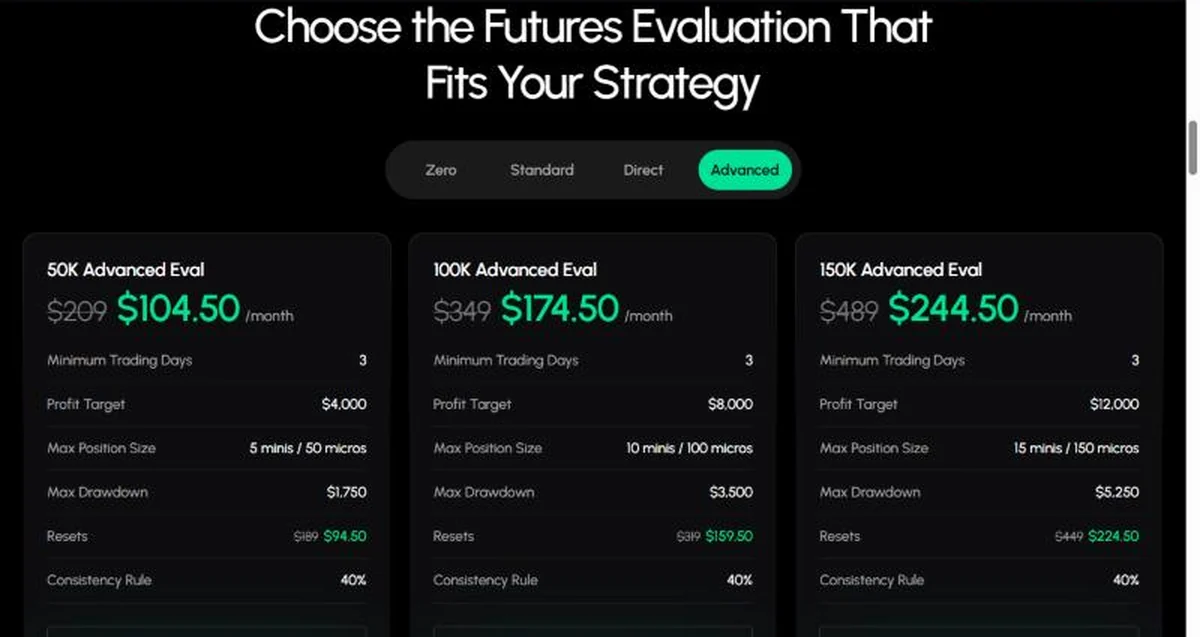
The trade-off is plain once you see it in one table. Zero is the cheapest way in and has no consistency rule while you are being tested, but it caps position size and payouts hardest. Advanced costs the most and asks for an 8% target, then removes the consistency rule and lifts the payout cap to $15,000 once you qualify. Standard sits between them.
How much does each Alpha Futures account cost?
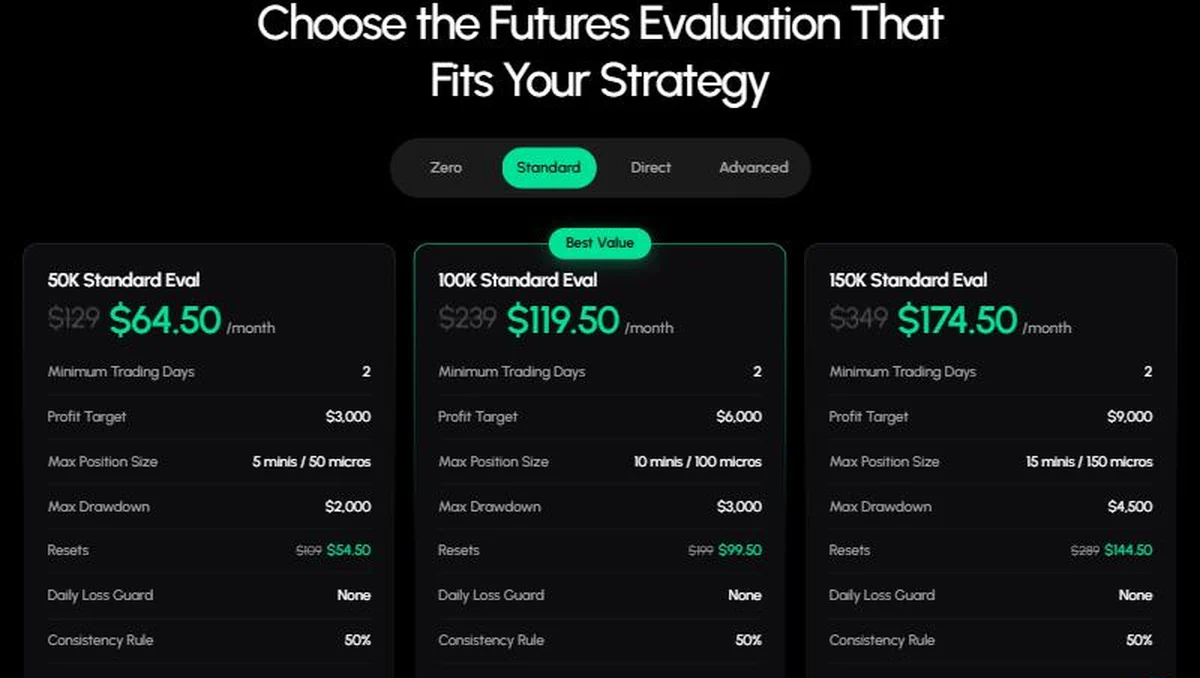
These are the list prices on the firm's site in November 2026. On the day I checked, the site was running a 50% promotion and a no-activation-fee offer, so a 50K Standard showed $64.50 against a struck-through $129. Promotions change often; treat the list price as the ceiling. Review sites report a one-time activation fee on Standard and Advanced when no promo is running, so confirm it at checkout.
| Plan | Price | Profit target | Maximum loss | Max position (minis / micros) | Reset fee |
|---|---|---|---|---|---|
| 25K Zero | $89 / mo | $1,500 | $1,000 | 1 / 10 | $79 |
| 50K Zero | $169 / mo | $3,000 | $2,000 | 3 / 30 | $149 |
| 100K Zero | $279 / mo | $6,000 | $3,000 | 6 / 60 | $249 |
| 50K Standard | $129 / mo | $3,000 | $2,000 | 5 / 50 | $109 |
| 100K Standard | $239 / mo | $6,000 | $3,000 | 10 / 100 | $199 |
| 150K Standard | $349 / mo | $9,000 | $4,500 | 15 / 150 | $289 |
| 50K Advanced | $209 / mo | $4,000 | $1,750 | 5 / 50 | $189 |
| 100K Advanced | $349 / mo | $8,000 | $3,500 | 10 / 100 | $319 |
| 150K Advanced | $489 / mo | $12,000 | $5,250 | 15 / 150 | $449 |
| 25K Direct | $349 once | $1,500 first payout | $1,000 | 2 / 20 | — |
| 50K Direct | $519 once | $3,000 first payout | $2,000 | 4 / 40 | — |
| 100K Direct | $689 once | $6,000 first payout | $3,000 | 8 / 80 | — |
| 150K Direct | $859 once | $9,000 first payout | $4,500 | 10 / 100 | — |
Because evaluations bill monthly, the real cost is price times the months you take, plus any resets. A 50K Standard passed in the second month with one reset costs $129 + $129 + $109 = $367 before any activation fee. The calculator further down does this sum for every plan.
Indicators that prove themselves in public.
One engine, four precision tools — the Gold (XAU) Scalper, the institutional Gravity Zone, the Zeno momentum Oscillator, and Zeno Stocks for equities.
How does the Alpha Futures drawdown work?
Alpha Futures uses an end-of-day trailing Maximum Loss Limit. The limit is set a fixed distance below your highest end-of-day balance, it only moves up after a session closes at a new high, and it stops trailing once it reaches your starting balance.
Two details decide whether this rule helps you. First, an intraday spike does not drag the limit up, which is kinder than an intraday trailing design. Second, the limit is still enforced during the session. The firm's FAQ says equity can breach the active limit intraday, so a deep pullback before the close ends the account even if you would have finished the day green. Size each trade from the distance to the limit, not from the account's headline size; the position sizing guide and a hard stop loss matter more here than on a personal account.
Zero evaluations and all Zero, Standard and Direct Qualified Accounts add a Daily Loss Guard: $500 on 25K, $1,000 on 50K, $2,000 on 100K and $3,000 on 150K. Standard and Advanced evaluations have none. If you want that guard rail anyway, set your own daily stop as part of a written risk management plan.
What are the Alpha Futures payout rules?
The split is 90% to the trader on every plan. On Zero, Standard and Advanced Qualified Accounts you can request a payout after five winning days of at least $200 each, up to four times a month. Direct accounts use profit targets and a 20% consistency rule in place of winning days.
| Qualified Account | Payout trigger | Consistency | Largest payout per request | Reset fee |
|---|---|---|---|---|
| Zero 25K / 50K / 100K | 5 winning days of $200+ | 40% | $1,000 / $1,500 / $2,500 | $399 / $499 / $799 |
| Standard 50K / 100K / 150K | 5 winning days of $200+ | 40% (removable for $70 to $110) | $3,000 / $4,000 / $5,000 | $599 / $799 / $999 |
| Advanced 50K / 100K / 150K | 5 winning days of $200+ | None | $15,000 | No resets |
| Direct 25K to 150K | Profit target, then a lower target | 20% | $1,000 / $2,000 / $2,500 / $3,000 | — |
The firm's FAQ says approved payouts are "currently paid within five business days or less". Its home page also mentions same-day payment without tying that claim to a plan, so plan around the five-day figure. The Maximum Loss Limit stays where it is after a withdrawal.
Read the cap column before you choose a size. A 100K Zero account that makes $6,000 in a cycle still pays at most $2,500 per request. Advanced is the only plan where the cap is unlikely to bind. For how other firms structure the same trade-off, see Take Profit Trader and Lucid Trading.
How does the consistency rule work?
A consistency rule limits how much of your total profit can come from one day. At 50%, your best day cannot be more than half of everything you have made. At 40%, it cannot be more than two fifths.
Failing the rule does not close the account. It means you keep trading until the big day shrinks as a share of the total. Take ten trading days with $4,800 of total profit and one $2,300 day. That day is 48% of the total: it passes the 50% Standard evaluation rule, but a 40% rule would not clear until total profit reached $5,750, another $950. Standard traders can buy the rule off their Qualified Account for $70 to $110 depending on size; Advanced Qualified Accounts have no rule at all.
Which Alpha Futures rules end the most accounts?
Four rules do most of the damage, and three of them are not on the pricing table.
| Rule | What it says | Where it applies |
|---|---|---|
| Maximum Loss Limit | End-of-day trailing, but enforced intraday | Every account |
| Daily Loss Guard | $500 to $3,000 by size | Zero evaluations; Zero, Standard and Direct Qualified |
| News window | No orders 2 minutes before or after high-impact news | Zero, Standard and Direct Qualified |
| Prohibited practices | Applies across all accounts; review sites list tick scalping, all-or-nothing trading and automated trading | Every account |
The news rule is narrower than it sounds. Evaluations and Advanced Qualified Accounts have no news restriction at all, and on the other accounts you may hold an existing position through the release. What you cannot do is execute an order inside the four-minute window. That rules out most opening-range and news-spike entries on release days, so know your order types and cancel resting orders before the window.
The firm's pricing page says prohibited practices apply to all accounts without listing them there. Review sites report that bots and fully automated strategies are banned and that copying trades between your own accounts is allowed. Read the firm's current policy page before you rely on either point. Our guide to whether trading bots work explains why most prop firms restrict them.
Which platforms does Alpha Futures support?
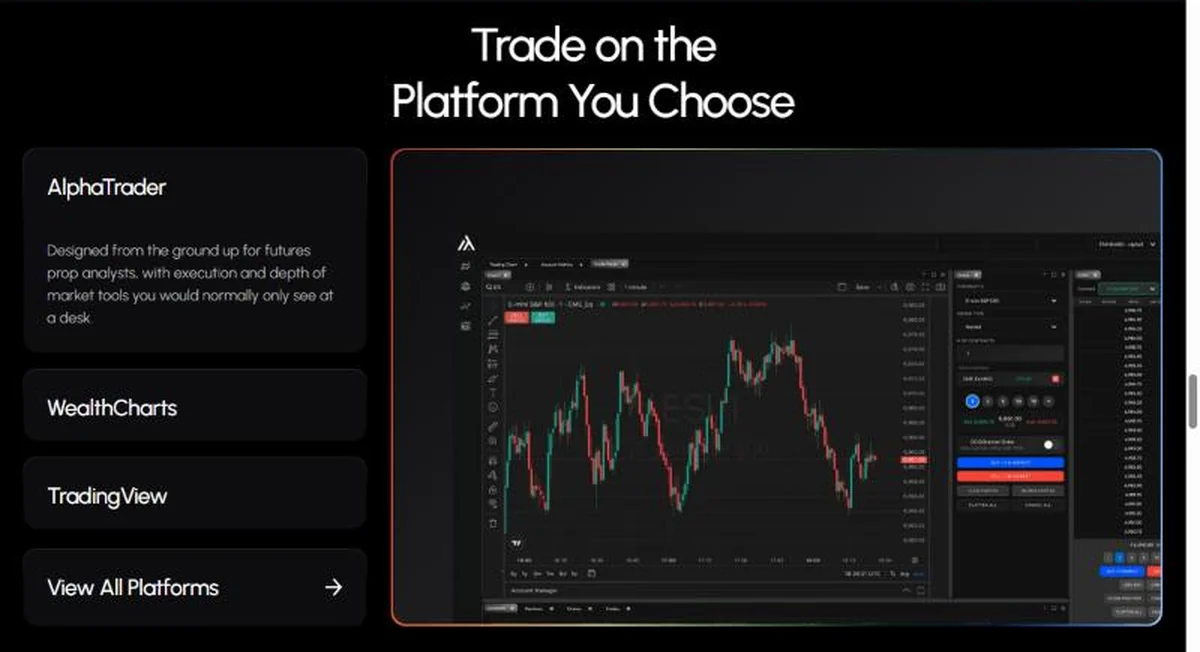
The firm lists five platforms: its own AlphaTrader, TradingView, Quantower, WealthCharts and DeepChart. TradingView access is chosen at checkout. Older reviews still mention Tradovate, NinjaTrader and ProjectX, and they contradict each other, so go by the list shown when you buy.
If charting on TradingView is the reason you are choosing a firm, compare it with the others in prop firms that use TradingView first. Platform choice is usually fixed for the life of the account. If you are weighing data feeds and execution, Rithmic vs Tradovate and the best futures trading platforms cover the options, and the best indicators for futures trading covers what to put on the chart.
Alpha Futures cost calculator
Pick a plan and size, then say how long you expect to take. The calculator adds up the subscription and resets, and shows the target, loss limit and the payout cap you would be working under.
Reference data
| Item | Value (checked November 2026) |
|---|---|
| Company | Alpha Futures Limited, UK company 15655643, part of Alpha Group |
| Markets | Futures only (CME group products) |
| Evaluation | One step; Zero, Standard, Advanced. Direct has none |
| Drawdown | End-of-day trailing Maximum Loss Limit; stops at the starting balance |
| Split | 90% to the trader |
| Payout rhythm | After 5 winning days of $200+, up to 4 per month (Direct: profit targets) |
| Payout timing | Within five business days or less (firm FAQ) |
| Platforms | AlphaTrader, TradingView, Quantower, WealthCharts, DeepChart |
| Trustpilot | 4.4 / 5 from more than 6,000 reviews (firm's site, October 2026) |
What are the pros and cons of Alpha Futures?
| Strengths | Weaknesses |
|---|---|
| End-of-day trailing limit that locks at the starting balance | The limit is still enforced intraday |
| 90% split on every plan | Monthly billing: slow passes cost more |
| No consistency rule on Advanced Qualified Accounts | Low payout caps on Zero, Standard and Direct |
| No news restriction in evaluations | News window on most Qualified Accounts |
| Backed by an established group with a public UK company record | Qualified Accounts are simulated; payout totals are self-reported |
| Direct plan for traders who want to skip the test | Reviews disagree on platforms and activation fees |
How does Alpha Futures compare with other futures prop firms?
The closest comparisons are the firms that also use an end-of-day drawdown. I have reviewed each of these separately, so the links go to the full rulebooks.
| Firm | Drawdown | Split | Our review |
|---|---|---|---|
| Alpha Futures | End-of-day trailing, locks at start balance | 90% | This page |
| Tradeify | End-of-day trailing | 90% | Tradeify review |
| Topstep | End-of-day trailing | Up to 90% | Topstep review |
| MyFundedFutures | End-of-day on core plans | Up to 90% | MyFundedFutures review |
| Apex Trader Funding | Intraday trailing on most plans | Up to 100% on first profits | Apex review |
US-based traders should also check prop firms for US traders. If price is the deciding factor, the cheapest prop firms compares cost per funded dollar. Note that Alpha Futures is a different business from Alpha Capital Group, the forex and CFD firm in the same group.
Who is Alpha Futures for, and what is our verdict?
Alpha Futures suits a trader who makes steady, medium-sized days and can pass within a month or two. The end-of-day limit forgives intraday spikes, the split is 90% everywhere, and Advanced removes the two rules that frustrate funded traders most: consistency and small payout caps.
It suits a trader with one or two outsized days a month less well. The consistency rules on Zero and Standard, combined with caps of $1,000 to $5,000 per request, turn a big week into several small withdrawals.
My rating is 4.0 out of 5. The rules are clear and the group behind the firm is established, but monthly billing, simulated funded accounts and capped payouts on three of the four plans keep it below the top mark. Pass the evaluation with a plan that respects the loss limit first; a prop firm strategy matters more than which logo is on the account, and a trading journal is the cheapest way to find out whether you are ready for one.
Alpha Futures offers Zero, Standard and Advanced one-step evaluations and a Direct instant plan, all with an end-of-day trailing loss limit and a 90% split. Zero is cheapest and most capped, Advanced is dearest and least restricted. Budget for months, not the headline price, and check the payout cap for your size before you buy.
◆ Interactive check
Do you know the Alpha Futures rules?
Questions traders ask about Alpha Futures
Alpha Futures Limited is a registered UK company (number 15655643) and part of Alpha Group, which also runs Alpha Capital. The firm shows a 4.4 Trustpilot score from more than 6,000 reviews as of October 2026. Its funded accounts are simulated and its payout totals are self-reported, so read the rules before buying.
Evaluations cost $89 to $489 a month depending on plan and size, billed until you pass. Direct accounts cost $349 to $859 once. Resets cost $79 to $449 in the evaluation. Prices are list prices checked in November 2026; promo codes are common.
The split is 90% to the trader on Zero, Standard, Advanced and Direct accounts.
Yes. The Maximum Loss Limit trails your highest end-of-day balance and stops at the starting balance. It is still enforced during the session, so equity touching the limit intraday fails the account.
The firm's FAQ says approved payouts are paid within five business days or less. You can request one after five winning days of at least $200 each, up to four times a month.
Zero is the cheapest, has no consistency rule in the evaluation, and has the lowest position sizes and payout caps. Standard has a 50% consistency rule in the evaluation and mid-sized caps. Advanced has an 8% target, then no consistency rule and a $15,000 payout cap once qualified.
Yes in evaluations and on Advanced Qualified Accounts. On Zero, Standard and Direct Qualified Accounts you cannot execute orders within two minutes before or after high-impact news, though existing positions may be held.
Yes. TradingView is one of five listed platforms, selected at checkout, alongside AlphaTrader, Quantower, WealthCharts and DeepChart.
No. Both belong to Alpha Group, but Alpha Futures is the futures-only firm and Alpha Capital Group funds forex and CFD traders under different rules.
Zeno signals from Quantum Algo are chart signals you place by hand, so they can inform manual trades on any platform the firm supports. Check the firm's current policy on automation before connecting any tool that places orders for you.
References & Related Guides
Read next
- Tradeify Review
- Topstep Review
- MyFundedFutures Review
- Apex Trader Funding Review
- Alpha Capital Group Review
- Cheapest Prop Firms
- Prop Firms That Use TradingView
- Prop Firms for US Traders
- What Is a Prop Firm?
- Futures Trading for Beginners
- TradeDay Review