What Is a Prop Firm? How Proprietary Trading Firms Work, Make Money, Pay Out and Tax You
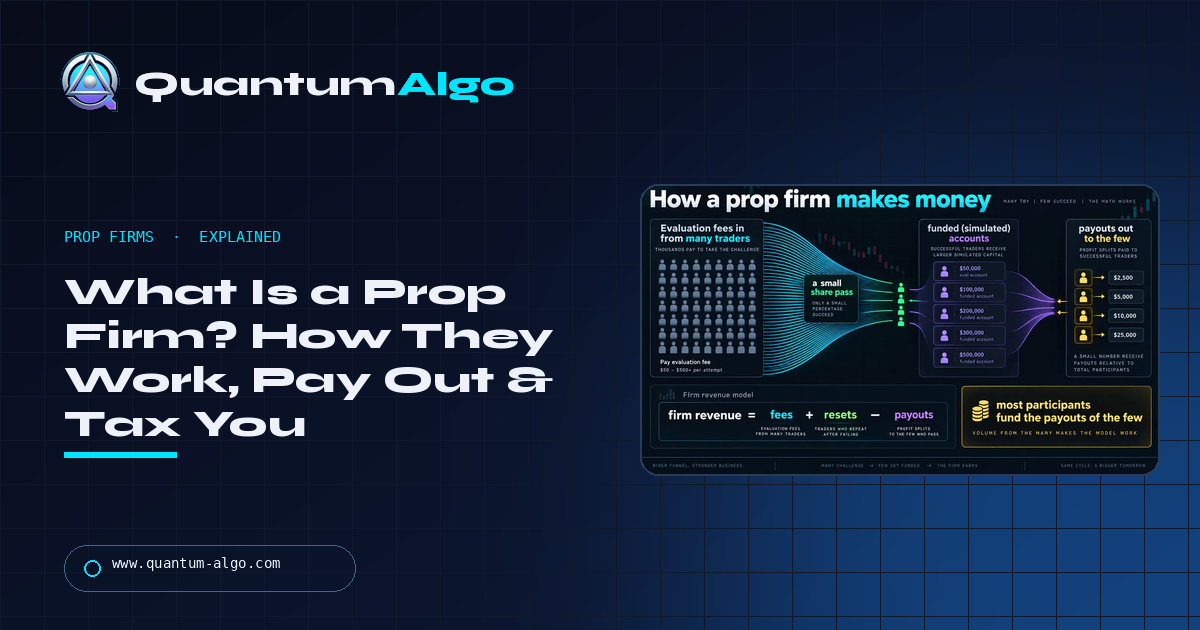
A prop firm — proprietary trading firm — originally meant a company trading its own capital with hired traders. In retail it means a company that sells an evaluation: you pay a fee, trade a simulated account under its rules, and if you pass you get a "funded" (usually still simulated) account from which the firm pays you 70–90% of profits. Its revenue is fees plus resets minus payouts, so most participants fund the payouts of the few — a legitimate model that works for the minority who can pass, and one whose rules are written accordingly.
Our prop-firm strategy guide covers how to pass a challenge; the futures-platforms guide covers the futures firms and trailing drawdown; the Apex review is one firm in depth. This page explains the industry they sit in: the fee-and-payout model, the three account stages, the rules that decide who passes, instant funding, futures versus forex firms, the tax treatment of payouts almost no firm explains, and the checklist below for choosing one worth paying.
Indicators that prove themselves in public.
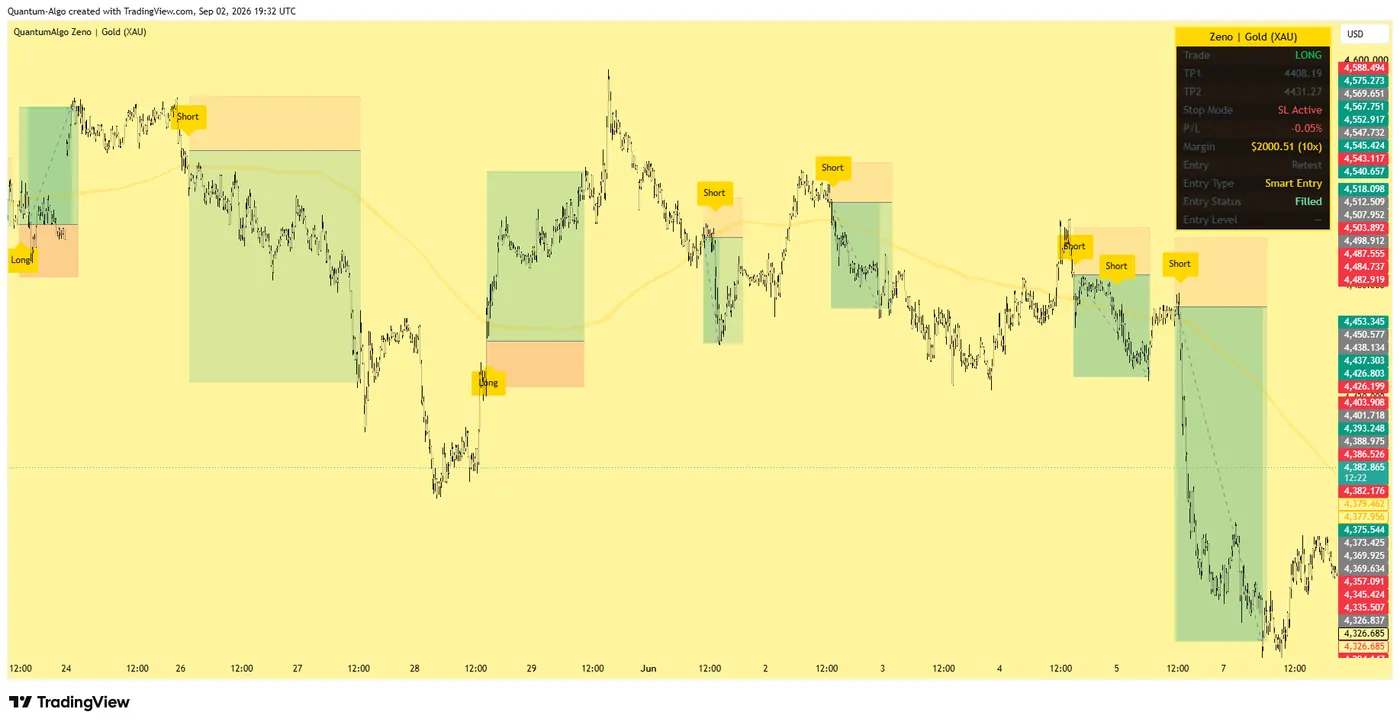
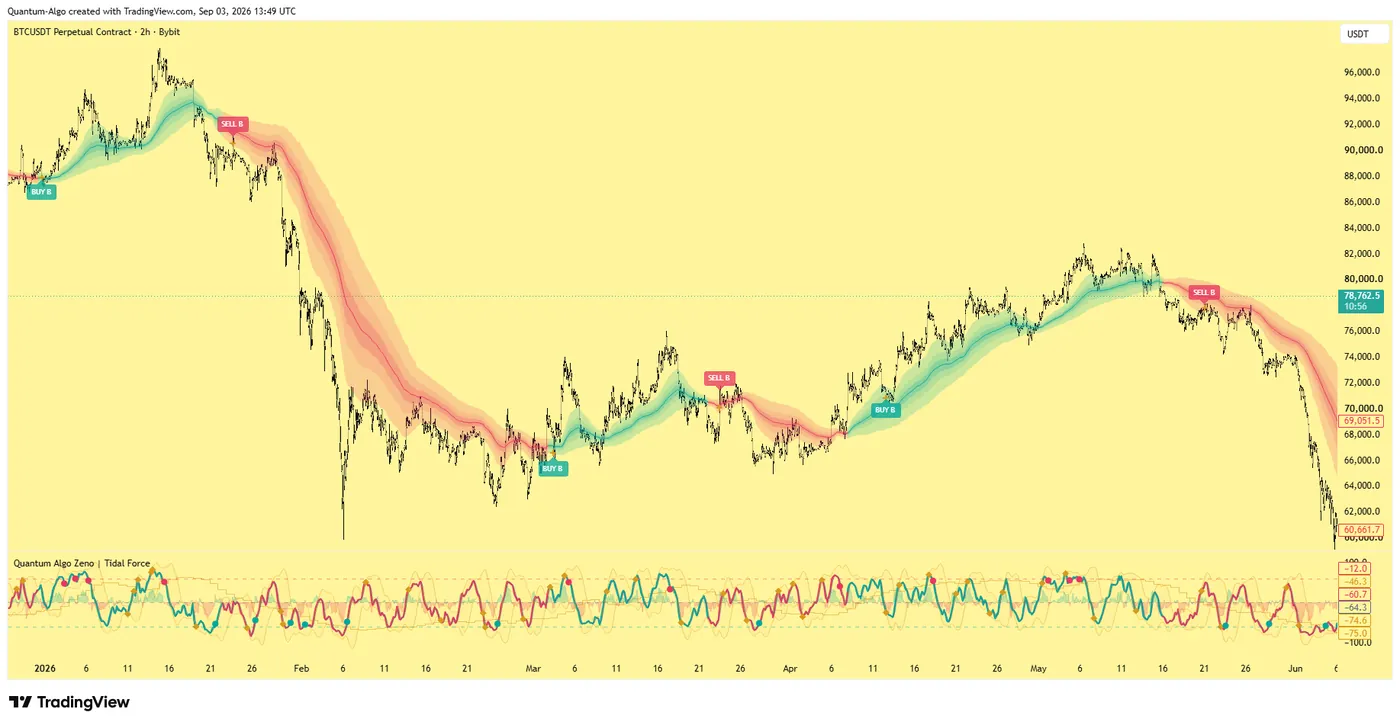
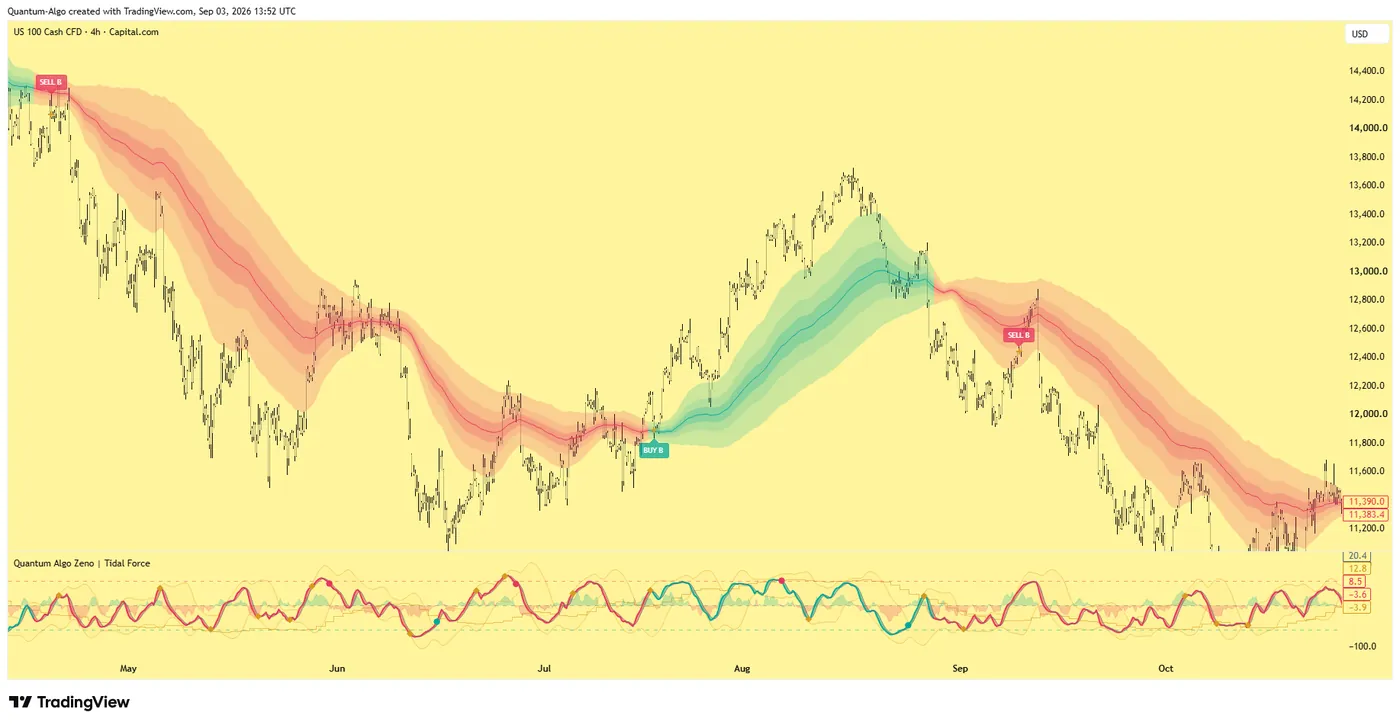
One engine, four precision tools — the Gold (XAU) Scalper, the institutional Gravity Zone, the Zeno momentum Oscillator, and Zeno Stocks for equities.
What is a prop firm?
A prop firm — a proprietary trading firm — is, in its original meaning, a company that trades its own capital and hires traders to do it, paying them a share of the profits. In its retail meaning, which is what almost everyone searching the term now means, a prop firm is a company that sells an evaluation: you pay a fee, trade a simulated account under the firm's rules, and if you pass you are given a "funded" account — also usually simulated — from which the firm pays you a share of the profits you generate. The firm's revenue is the fees; its costs are the payouts to the minority who pass and profit. Understanding that model is the whole of understanding prop firms, and it is what this page is about: how they make money, what the three account stages actually are, the rules that decide who passes, instant-funding offers, the tax treatment of payouts, and how to tell a firm worth paying from one that sells resets.
Our prop-firm strategy guide covers how to pass an evaluation; the futures-platforms guide covers the futures firms and the trailing-drawdown rule; the Apex review is one firm in depth. This page is the one that explains the industry they sit in.
How a prop firm makes money
The flow illustration in this guide is the business model in one picture. Evaluation fees come in from many traders — $50 to $600 each depending on account size. A small share pass, typically well under a fifth on the first attempt by most estimates (firms do not publish the figure). Those who pass get a funded account, which at most firms is still a simulated account: the firm does not put its own capital into the market on your behalf, or does so only selectively by copying the trades of its best performers. Payouts go out to the few who are profitable on the funded account, at a split of 70–90% in the trader's favour.
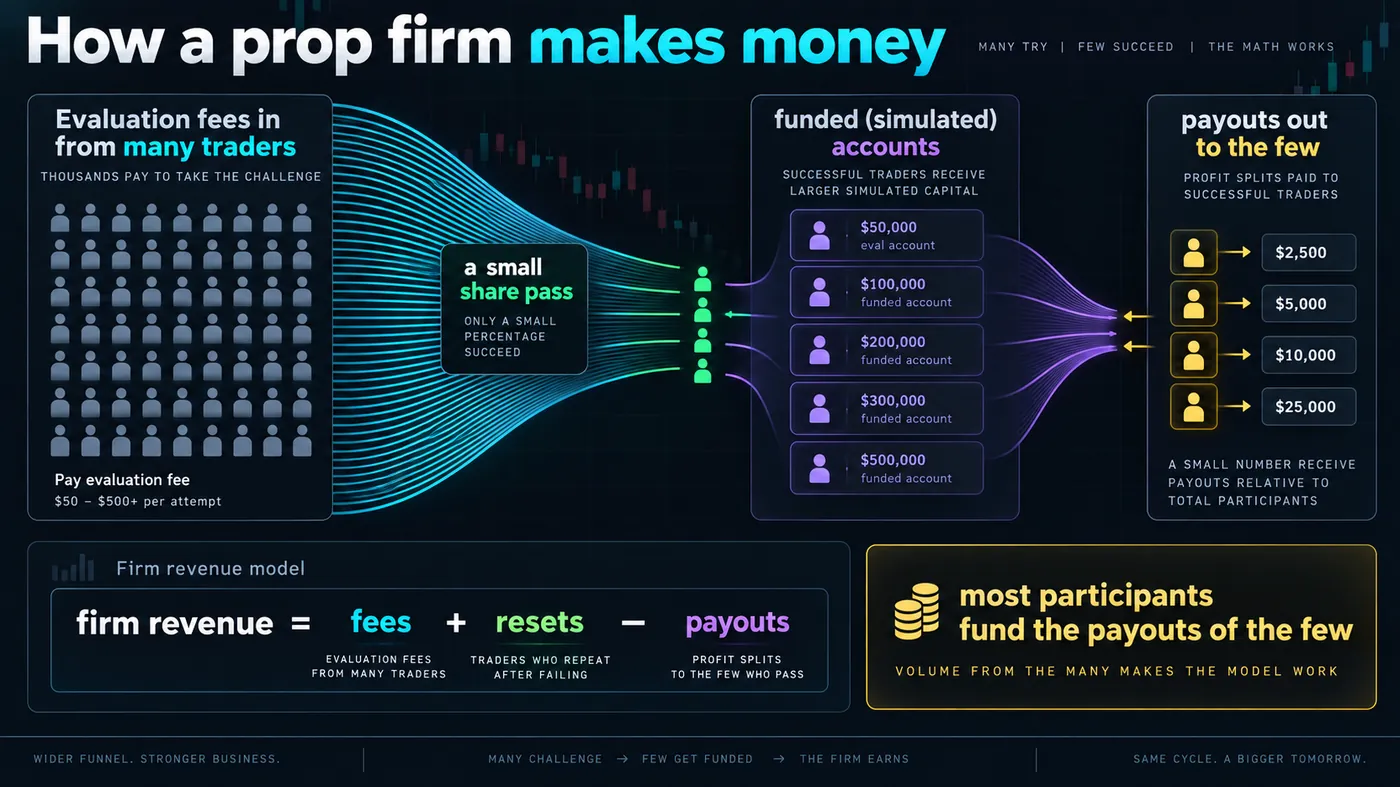
The firm's revenue is therefore fees plus resets minus payouts, and the callout on the diagram is the honest summary: most participants fund the payouts of the few. That is not an accusation — it is the same structure as a poker tournament or a certification exam, and it works for the minority who can pass. It does mean the firm's incentive is to sell evaluations and resets, which is why the rules are written the way they are.
The three account stages
The stages illustration in this guide puts them side by side:
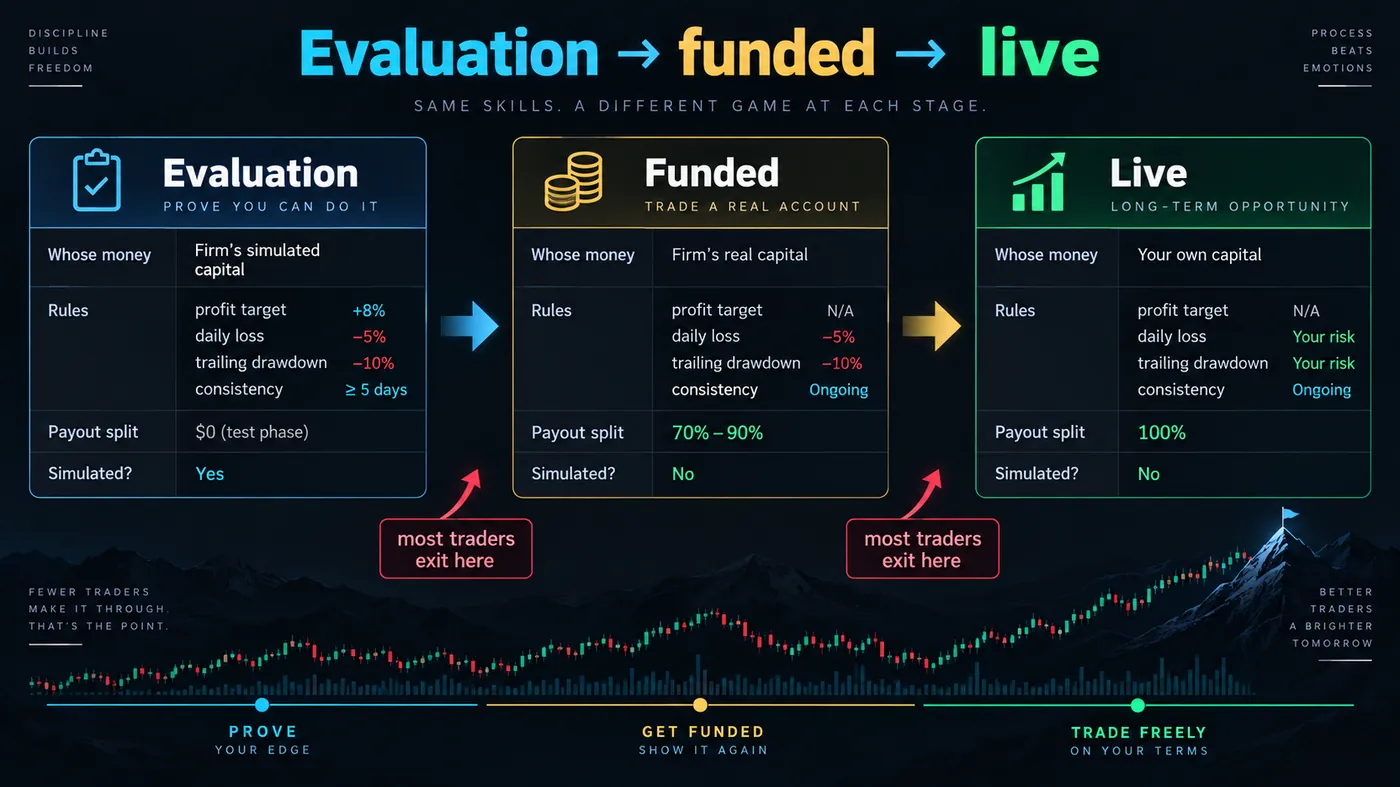
Evaluation (the challenge). Your fee, the firm's simulated capital. Rules: a profit target (usually 6–10% of the account), a daily loss limit (3–5%), a maximum or trailing drawdown (5–10%), sometimes a minimum number of trading days and a consistency rule capping how much of the profit any one day can contribute. One-step and two-step versions exist. Most traders exit here.
Funded. Still simulated at most firms. Rules loosen slightly — the profit target goes away — but the daily loss and drawdown remain, and a consistency rule often applies to the first payout. Payout split 70–90% to you, paid on request or on a schedule after a minimum period, with a first-payout threshold. The second point where most exit: a breach of the drawdown ends the funded account and the firm offers a new evaluation.
Live. A small number of firms move consistently profitable funded traders onto real capital, or copy their trades into a real account; the payout split may improve and the rules may change again. Few traders reach it, and few firms offer it — check before assuming a "funded" account is real money.
The rules that decide who passes
- Trailing drawdown is the rule most people misunderstand and most evaluations end on: a drawdown limit that follows your equity high — sometimes the intraday, unrealised high — so a profitable trader can fail on a normal pullback. Our futures-platforms guide has the chart. Static and end-of-day trailing versions are far more survivable.
- Daily loss limit ends the day, or the account, at a fixed loss; trade at half of it.
- Consistency rule caps any single day's share of profit (30–50%), so the one big day that would pass you can disqualify the pass.
- Minimum trading days prevent a single-day pass; maximum time (on some challenges) forces trades.
- Prohibited practices — news trading, holding over weekends, copy trading between accounts, hedging across firms — are grounds for denial of payout at some firms; read the list.
The best strategy for passing is not a trading strategy; it is a sizing strategy that respects the drawdown definition. That is the subject of the strategy guide.

Automate your trades. Let Quantum Algo trade for you.
Every signal executed on your own account — on your account, with the plan you define.
Instant funding, and what it costs
"Instant funding" firms skip the evaluation: you pay a larger fee and trade a funded (simulated) account immediately, usually with a tighter drawdown, a smaller starting size that scales with profit, and a lower initial payout split. The trade-off is explicit: you pay more to skip the exam, and the rules on the funded account are stricter to compensate. For a trader with a documented record it can be worth it; for one without, it is the same lottery ticket at a higher price. The volume of searches for it says more about the marketing than the product.
Futures firms versus forex/CFD firms
Futures prop firms (Apex, Topstep, TradeDay and the rest) run on real exchange data and CME contracts, with a CFTC-regulated FCM behind any live stage; their rules are dominated by trailing drawdown and consistency. Forex and CFD prop firms (FTMO-class) run on CFD pricing at a broker of their choosing, with two-step challenges, daily loss limits and prohibited-practice lists; leverage and instrument range are wider. Same business model; different rulebooks and different underlying markets. Our futures guide covers the first group; the strategy guide covers the second.
The tax picture
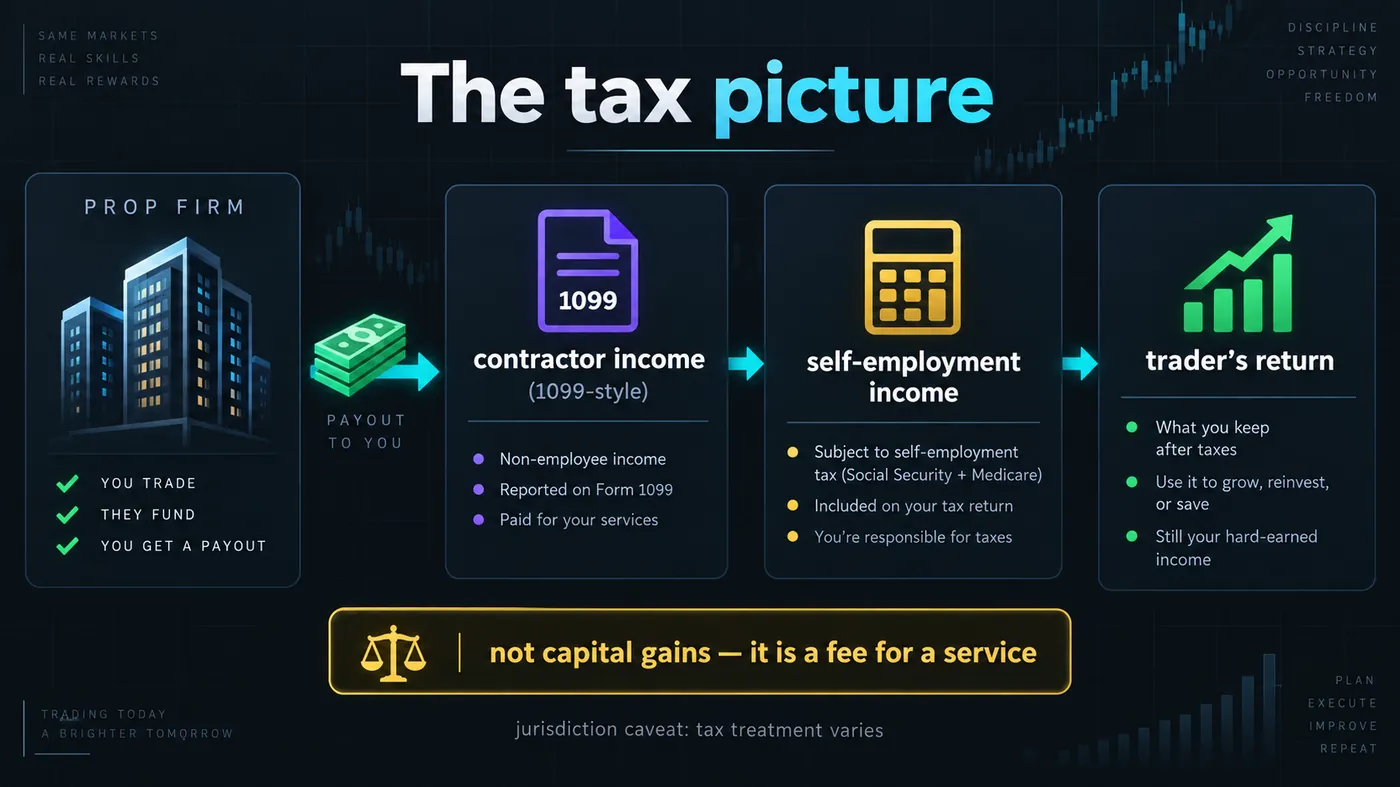
The tax illustration in this guide is the part almost no firm explains. A prop-firm payout is not trading income and not a capital gain: you were never trading your own money on a real market. It is a fee the firm pays you for a service — in the US, reported on a 1099-NEC as contractor income and taxed as self-employment income, with self-employment tax on top of income tax and the ability to deduct related expenses (evaluation fees, resets, data, platform subscriptions). In other jurisdictions the same logic applies — the payout is income from services, not a trading gain — and the treatment of the fees you paid varies. The consequence most traders miss: capital-loss rules and trader-tax elections do not apply, and the evaluation fees for challenges you failed may or may not be deductible against payouts you later receive. Keep every receipt and ask an accountant who has seen a prop-firm 1099 before; the "how to file prop firm taxes" query exists because most have not.
Is a prop firm worth it?
For a trader with a written setup, fifty logged trades and a sizing rule that respects the drawdown, an evaluation is a cheap way to trade larger size than they could fund — the fee is small against the capital, and the discipline the rules impose is genuinely useful. For a trader without a record it is a paid exam with rules designed to be failed, and the resets are where the money goes. The honest sequence: prove the setup on your own account or a testnet, then buy the evaluation, then trade it exactly as you traded the record, at a size the drawdown allows.
How to choose a prop firm
- Drawdown type — static or end-of-day trailing over intraday trailing.
- Payout record — recent, public, verifiable; the industry has seen firms close with unpaid balances.
- Whether the funded stage is real money — usually not; know it.
- Fees — evaluation, reset, activation, monthly data or platform; the total, not the headline.
- Rules on payout denial — prohibited practices, consistency, minimum days.
- Platform — the front end you already use.
- Jurisdiction and the regulator behind any live stage.
The prop-firm checklist on this page runs those seven from your inputs.
A prop firm sells a paid exam: fees in from many, payouts out to few, on a funded account that is usually simulated. Pass rates are low by design, trailing drawdown is the rule that ends most attempts, and payouts are service income, not capital gains. Worth the fee for a trader with a proven edge and a sizing rule; a reset machine for everyone else.
◆ Interactive check
Do you know the model?
Questions people ask about prop firms
The business model is legitimate; the firms vary. A firm with a public payout record, clear rules and a regulated FCM or broker behind any live stage is legitimate; one that sells resets and denies payouts on vague "rule violations" is not. Check the payout record before the fee.
$50–150 for a small futures evaluation, $100–600 for a $50,000–200,000 forex/CFD challenge, plus resets ($80–150) and sometimes an activation fee on passing. Instant-funding accounts cost more up front.
At most firms the funded account is simulated and the firm pays profits from its own revenue; a minority move consistently profitable traders to real capital. "Funded" does not mean "live" unless the firm says so.
Firms do not publish it; independent estimates put first-attempt passes well under 20%, and the share who both pass and reach a payout lower still. The model depends on it.
As income from services — contractor income on a 1099-NEC in the US, subject to self-employment tax — not as capital gains or trading income. Fees and related expenses are typically deductible; consult an accountant familiar with prop firms.
Zeno's signals include the stop and targets, which is what sizing to a drawdown needs; the strategy guide covers the sizing rule, and TradeZella's prop-firm sync tracks the limits. We are not a prop firm and have no partnership with any.
A broker executes your trades with your money on a real market; a retail prop firm sells access to a simulated account under rules and pays a share of the simulated profits. Your capital at a prop firm is the fee, not the account balance.
The one whose drawdown definition you can trade under, with a verifiable payout record, explicit denial rules and a regulated firm behind any live stage. Names change yearly; the checklist above does not. Our futures guide covers the futures firms; the Apex review is one in depth.
A minority do, by passing repeatedly and keeping funded accounts alive; the income is variable, taxed as self-employment, and dependent on the firm continuing to pay. Treat it as leverage on a proven edge, not as a job.
You lose the fee and are offered a reset or a new evaluation, usually at a discount. The resets are where much of the industry's revenue comes from; decide before the first attempt how many you will buy.
References & Related Guides
Read next
- Prop Firm Trading Strategy: How to Pass
- Best Futures Platforms & Prop Firms
- Apex Trader Funding Review
- Prop Firms That Use MT4
- Position Sizing: The Complete Guide
- TradeZella Review (prop-firm sync)
- Is Day Trading Worth It?
- What Is a Stop Loss?
Authoritative sources
- CFTC: advisories on trading products and evaluations
- NFA BASIC: registered FCMs behind live stages
- IRS: self-employed individuals tax center (1099 income)
- IRS: Form 1099-NEC (nonemployee compensation)
- FINRA: day trading rules (why futures firms dominate)