Is Interactive Brokers Good for Day Trading? Fees, Platforms, the New Margin Rules and Our Verdict
Yes, for active and experienced day traders. IBKR Pro charges $0.0035 to $0.005 a share with low margin rates, fast routing and Trader Workstation, one of the most complete desktop platforms. Since FINRA replaced the pattern day trader rule in June 2026, small accounts need $2,000 for margin rather than $25,000, though brokers may phase the change in until October 2027. It is less friendly for beginners: the platforms are dense and data subscriptions cost extra. Rating: 4.3/5.
Interactive Brokers is usually the first name professional traders mention and the last one beginners try. Both reactions are fair. I checked IBKR's commission pages, its platforms and the new FINRA intraday margin rules on 11 November 2026. This guide answers the question directly: what day trading at IBKR costs, which plan to pick, what changed with the PDT rule, and who should look elsewhere.
Is Interactive Brokers good for day trading?
Yes, if you trade actively and know what you are doing. IBKR combines three things day traders care about: low per-share commissions that fall with volume, fast order routing across many venues, and a platform, Trader Workstation, that does almost anything an order-entry screen can do. Margin rates on IBKR Pro start at the benchmark rate plus 1.5%, among the lowest at any retail broker.
The catch is the learning curve. TWS is dense, real-time data for some markets is a paid subscription, and the account application asks more questions than a zero-commission app. Beginners who want to learn on simple screens may be better served elsewhere first; our guide on how to start trading stocks covers the basics, and whether day trading is worth it covers the odds.
What does day trading cost at Interactive Brokers?
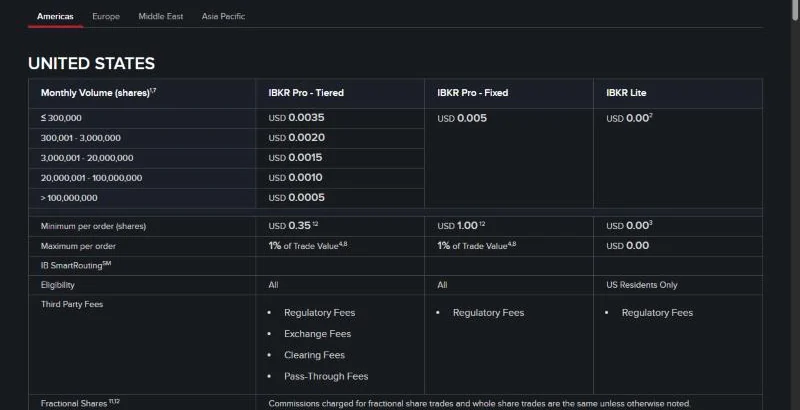
IBKR has two account types. IBKR Lite charges no commission on US exchange-listed stocks and ETFs and is open to US residents only. IBKR Pro charges per share, either Fixed (everything bundled except regulatory fees) or Tiered (a lower commission plus exchange, clearing and pass-through fees, falling as your monthly volume rises).
| IBKR Pro Fixed | IBKR Pro Tiered | IBKR Lite | |
|---|---|---|---|
| US stocks and ETFs | $0.005 a share | $0.0035 a share (≤300,000 shares a month), down to $0.0005 | $0 (US-listed) |
| Minimum / maximum per order | $1.00 / 1% of trade value | $0.35 / 1% of trade value | — |
| Third-party fees | Regulatory only | Exchange, clearing, regulatory, pass-through | Regulatory only |
| Options | $0.65 a contract | $0.15 to $0.65 a contract | Fixed pricing |
| Futures | $0.85 a contract | $0.25 to $0.85 a contract | Fixed pricing |
| Margin loan rate | Benchmark + 1.5% and lower | Benchmark + 1.5% and lower | Benchmark + 2.5% |
For a day trader, Pro Tiered is usually cheapest once you trade a few thousand shares a day, because the rate drops to $0.002 a share above 300,000 shares a month and exchange rebates can offset part of the cost when you add liquidity with limit orders. Fixed is simpler and cheaper for small orders, where the $0.35 tiered minimum plus fees can exceed $1. Lite is cheapest on paper, but you give up Pro features, pay a higher margin rate (benchmark plus 2.5% against plus 1.5% on Pro) and earn less on cash.
IBKR day trading cost calculator
Enter a typical trade and how often you trade. The calculator estimates commissions and fees per round trip and per month on each plan, so you can see where Fixed, Tiered and Lite cross over.
Tiered estimates assume you take liquidity at about $0.003 a share in exchange fees, plus clearing and pass-through fees; adding liquidity with limit orders often earns rebates instead. All plans pay the SEC fee on sales (0.00206% of value in November 2026). Treat the result as an estimate and check your first statements.
Indicators that prove themselves in public.
One engine, four precision tools — the Gold (XAU) Scalper, the institutional Gravity Zone, the Zeno momentum Oscillator, and Zeno Stocks for equities.
Do you still need $25,000 to day trade at IBKR?
Not under the new rules, but check your account. The SEC approved FINRA's replacement of the pattern day trader rule on 14 April 2026, and the new intraday margin standard took effect on 4 June 2026. It removes the $25,000 minimum and the four-trades-in-five-days count. Instead, your equity must cover your positions during the day, and a margin account still needs at least $2,000.
Firms have a transition period until 20 October 2027 and may keep the old rules until they switch. IBKR told customers that accounts may still be subject to the existing PDT rules during that period, so read the margin notice in your account before you plan on day trading a small balance. Under the new standard, repeated failures to cover intraday deficits can get an account restricted for up to 90 days. Our pattern day trader rule guide explains the change in full, and what margin trading is covers maintenance requirements.
A cash account avoids margin rules entirely, but you can only trade with settled funds, and US stock trades settle the next business day.
Which IBKR platform is best for day trading?
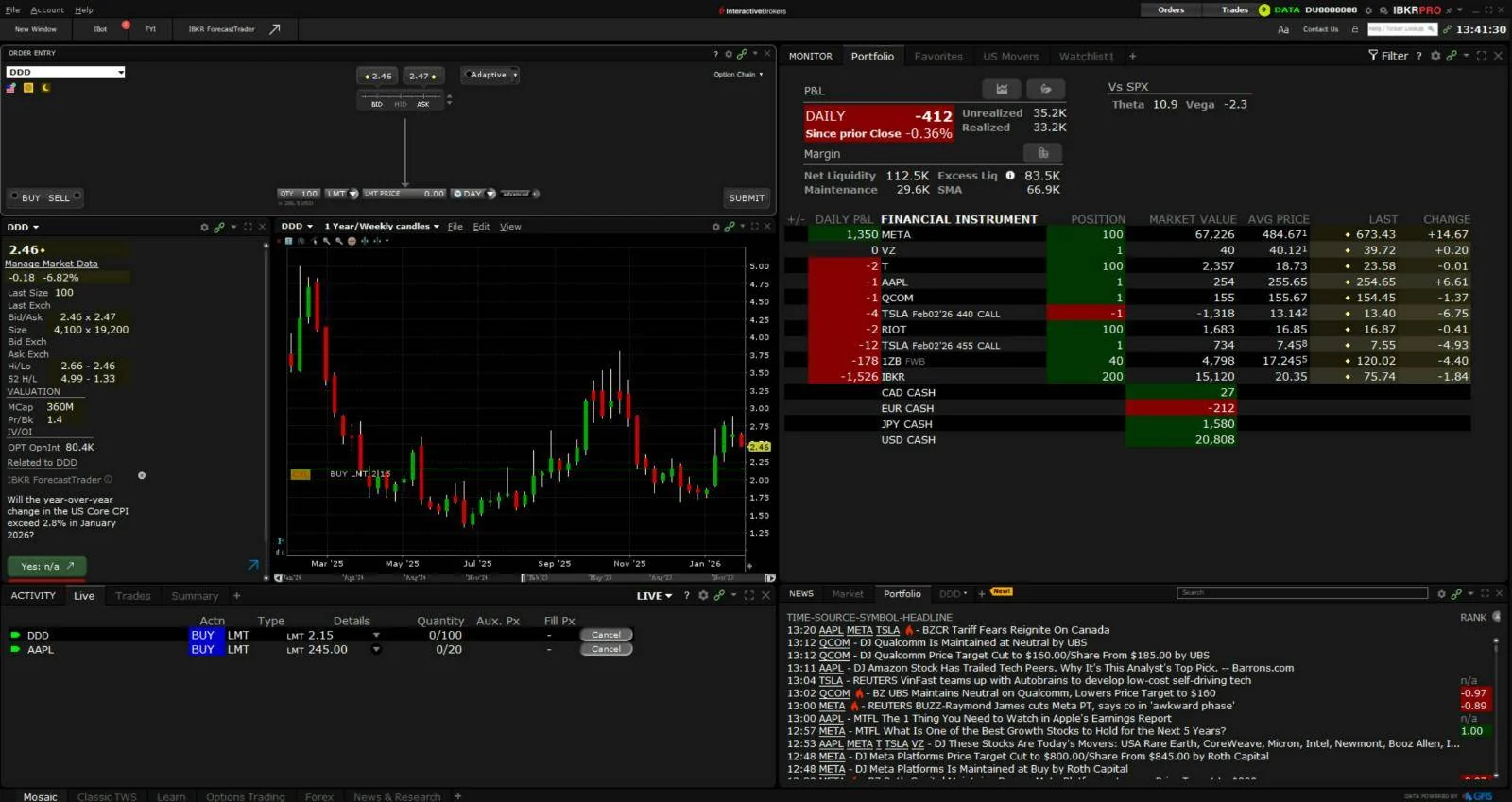
Trader Workstation (TWS) is the one to use. It has hotkeys, bracket and OCO orders, more than 100 order types and algos, a price ladder (BookTrader), real-time P&L by position, and customisable layouts like the Mosaic view above. It is also where IBKR's risk tools live, including the margin and what-if checks before you send an order.
IBKR Desktop is a newer, cleaner desktop app that is easier to learn but has fewer advanced tools. The web portal and the mobile app are fine for monitoring and simple orders, not for fast entries. Many day traders chart elsewhere: IBKR connects to TradingView for trading from charts, and its API is used by automation services such as TradersPost.
Whatever you use, set up hotkeys and default order sizes on a paper account first. Most expensive beginner mistakes on TWS are wrong quantities and wrong order types, which our order types guide helps avoid.
How good is IBKR's order execution for day traders?
IBKR Pro routes orders through IB SmartRouting, which searches across exchanges and dark pools for the best available price and can re-route parts of an order. Pro also lets you direct-route to a chosen exchange, useful for traders who want a specific queue or rebate.
For day trading, execution quality matters most on fast stocks and around the open. Use limit orders where you can, watch slippage on market orders, and learn to read Level 2 before trading small caps. Extended hours are available too, including overnight trading on many US stocks; liquidity there is thin, so see our after-hours trading guide before trading outside the session.
What about margin rates and short selling at IBKR?
IBKR Pro's margin loans start at the benchmark rate plus 1.5% and fall for larger balances; Lite is benchmark plus 2.5%. Day traders who close by the bell pay no overnight interest, but anyone who holds positions on margin will notice the difference quickly.
Shorting is one of IBKR's strengths. It has a large lending inventory, shows borrow availability and fees before you trade, and supports short selling across many markets. Hard-to-borrow stocks can carry high daily fees, and a lender can recall shares, so read our short selling guide before you short a crowded name.
How much does market data cost at IBKR?
IBKR provides free non-consolidated real-time streaming quotes for US stocks and ETFs from primary exchanges on both Pro and Lite. Day traders who want consolidated quotes across all exchanges, Level 2 depth, options or futures data pay for subscriptions, typically a few dollars to a few tens of dollars a month per package, and some fees are waived once you pay enough commission in a month.
Budget for data before you compare brokers. A broker with free commissions but weak data can cost more in missed fills than an IBKR data bundle costs in fees. If you chart on TradingView, you may already pay for data there; check whether you need the same feed twice.
How does IBKR compare with other brokers for day trading?
The comparison below is for active stock and options day traders in the US. Futures-only traders should also look at dedicated futures platforms.
| Broker | Stock commissions | Platform for day trading | Our review |
|---|---|---|---|
| Interactive Brokers Pro | $0.0035 to $0.005 a share | Trader Workstation | This page |
| Schwab (thinkorswim) | $0 online stock trades | thinkorswim desktop | thinkorswim review |
| TradeStation | $0 on US stocks and ETFs | TradeStation desktop | TradeStation review |
| NinjaTrader | Futures only | NinjaTrader desktop | NinjaTrader review |
If futures are your market, compare IBKR with NinjaTrader and Tradovate; per-contract costs and day-trade margins differ widely. For prop trading with someone else's capital, see prop firms for stock trading.
Reference data
| Item | Value (checked November 2026) |
|---|---|
| Broker | Interactive Brokers LLC (IBKR) |
| Pro Fixed, US stocks | $0.005 a share, $1.00 minimum, 1% of value maximum |
| Pro Tiered, US stocks | $0.0035 to $0.0005 a share by monthly volume, $0.35 minimum, plus fees |
| Lite, US stocks | $0 on US exchange-listed stocks and ETFs, US residents only |
| Options | $0.65 a contract fixed; $0.15 to $0.65 tiered |
| Futures | $0.85 a contract fixed; $0.25 to $0.85 tiered |
| Margin loans | Pro from benchmark + 1.5%; Lite benchmark + 2.5% |
| Account minimum | $0; $2,000 equity for margin trading |
| Day trading rule | FINRA intraday margin standard effective 4 June 2026; transition to 20 October 2027 |
What are the pros and cons of IBKR for day traders?
| Strengths | Weaknesses |
|---|---|
| Low per-share pricing that falls with volume | Tiered fees are hard to predict before your first statement |
| Trader Workstation: hotkeys, ladders, algos, 100+ order types | Steep learning curve; dense screens |
| Lowest-tier margin rates among major brokers | Some real-time data is a paid subscription |
| SmartRouting and direct routing on Pro | Lite gives up Pro features and pays more on margin |
| Stocks, options, futures and global markets in one account | Account opening asks for more detail than app brokers |
Who should day trade at IBKR, and how should you set it up?
IBKR fits traders who place many orders, trade size where per-share pricing beats a flat fee, use options or futures alongside stocks, or want API access. It fits less well for someone making a few trades a week who values a simple app, or for anyone still deciding whether to day trade at all.
- Pick Pro if you day trade; switch between Fixed and Tiered after a month of real statements.
- Open a paper account and practise hotkeys and brackets there first.
- Subscribe only to the data you use, and review subscriptions each quarter.
- Check which margin regime applies to your account in the transition to the new intraday rules.
- Use a daily loss limit and a journal; low costs make overtrading cheap, not harmless.
Our verdict on Interactive Brokers for day trading
Interactive Brokers is one of the best brokers for experienced day traders in the US and abroad. The cost structure rewards active trading, TWS covers every order you will ever need, and margin and shorting are strong. It is not the easiest place to learn, and its fees take some reading to understand.
My rating is 4.3 out of 5. Choose IBKR Pro if you trade actively and are willing to learn TWS; start with a simpler broker if you are still building a strategy. Either way, the edge comes from the plan, not the broker: our day trading strategies and best day trading indicators guides are the next step.
Interactive Brokers is good for day trading if you are experienced and active: Pro costs $0.0035 to $0.005 a share, margin rates are low and TWS is very complete. FINRA's new intraday margin rules removed the $25,000 PDT minimum in June 2026, but brokers can apply the old rule until October 2027. Expect a learning curve and budget for market data.
◆ Interactive check
Are you ready to day trade at IBKR?
Questions traders ask about day trading at Interactive Brokers
Yes for active, experienced traders: low per-share commissions on IBKR Pro, low margin rates and Trader Workstation. Beginners may find it complex.
Pro. Lite is commission-free on US-listed stocks but charges more on margin and lacks Pro's routing and pricing options. Active traders usually come out ahead on Pro.
Not under FINRA's new intraday margin rules, effective 4 June 2026. A margin account needs $2,000. Brokers may keep the old PDT rule until 20 October 2027, and IBKR says accounts may still be subject to it during the transition.
IBKR Pro Fixed charges $0.005 a share with a $1 minimum. Pro Tiered charges $0.0035 a share or less with a $0.35 minimum plus exchange and clearing fees. Lite charges $0 on US-listed stocks and ETFs.
Trader Workstation (TWS), for hotkeys, ladders, bracket orders and algos. IBKR Desktop is simpler; the web and mobile apps suit monitoring.
Yes, with a large lending inventory and borrow fees shown before you trade. Hard-to-borrow stocks can carry high fees.
Non-consolidated real-time US stock quotes are free. Consolidated quotes, Level 2, options and futures data need paid subscriptions.
Yes. IBKR accounts can be connected to TradingView for trading from charts, and its API works with automation tools.
References & Related Guides
Read next
- The Pattern Day Trader Rule
- What Is Margin Trading?
- What Is Short Selling?
- thinkorswim Review
- TradeStation Review
- How Much Money to Start Day Trading
- How to Find Stocks for Day Trading
- Day Trading Options
- TradersPost Review
- Best Trading Platforms