How Much Money Do You Need to Start Day Trading? Realistic Minimums by Market
How much money do you need to start day trading?
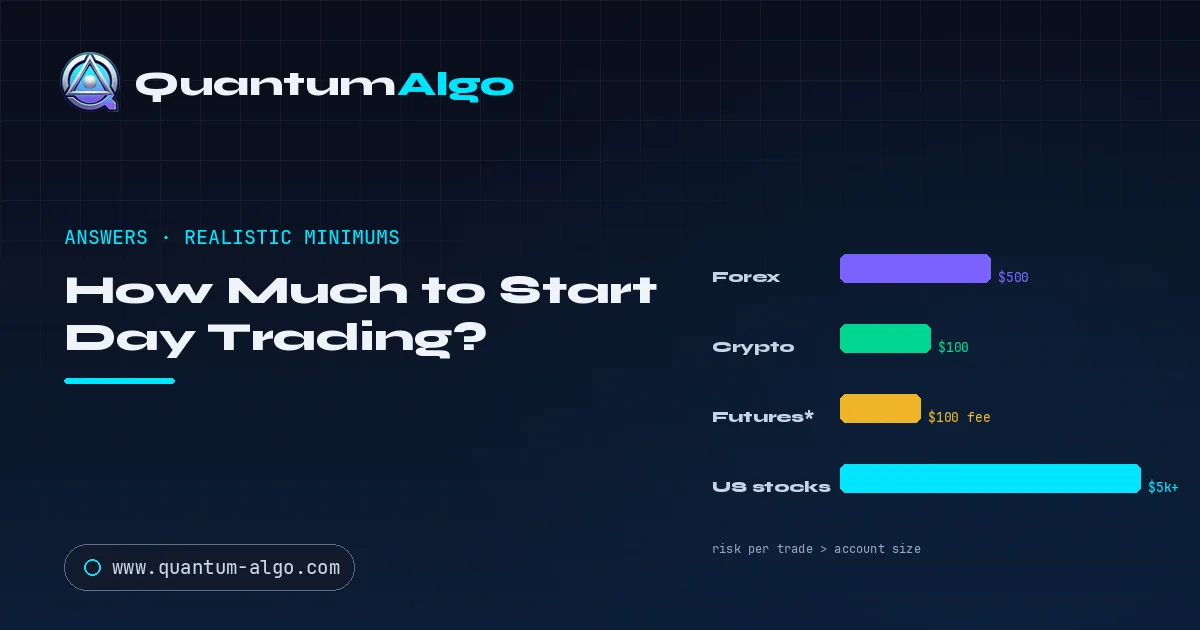
You can start day trading with a few hundred dollars in forex or crypto, a $100–$600 prop-firm challenge fee for futures, and realistically $5,000+ for US stocks now that FINRA has replaced the $25,000 PDT minimum (brokers may keep it until 20 October 2027). Realistic: $500–$2,000 forex, $100–$1,000 crypto. Survival depends on risk per trade, not account size: risk a fixed 0.5–1% on a documented edge.
You can technically start day trading with a few hundred dollars in forex or crypto, around $2,000–$5,000 for futures via a prop-firm challenge, and more for US stocks — but the account size is not what decides whether you survive. Risk per trade does. A $500 account risking 1% ($5) survives longer than a $50,000 account risking 10%. A common realistic starting range is $500–$2,000 in forex, $100–$1,000 in crypto, a $100–$600 challenge fee for funded futures, and $5,000+ for US stocks. Whatever the size, the survival rule is the same: risk a small fixed percent per trade and trade a documented edge.
Indicators that prove themselves in public.
One engine, four precision tools — the Gold (XAU) Scalper, the institutional Gravity Zone, the Zeno momentum Oscillator, and Zeno Stocks for equities.
It's the first question almost everyone asks, and most answers are either a scary round number or a marketing pitch. The honest answer is that the minimum depends on the market you trade — and that the account size matters far less than most beginners think. This guide gives realistic starting figures by market, explains the risk-of-ruin math that actually decides survival, and covers what changed now that FINRA has replaced the old US $25,000 day-trading rule.
| Forex | $500–$2,000 — micro-lots let you risk under 1% on a small account |
| Crypto | $100–$1,000 — fractional coins, but volatility punishes oversizing |
| Futures (prop) | A $100–$600 challenge fee for a funded account — cheapest route to size |
| US stocks | $5,000+ realistically — the $25k PDT minimum was replaced (brokers may keep it until 20 Oct 2027), but risk-of-ruin still applies |
| What really matters | Risk per trade, not account size |
| Survival rule | Risk a small fixed percent (0.5–1%) on a documented edge |
What is the realistic minimum for each market?
There's no single number because the markets have completely different mechanics. Forex is the most accessible: micro-lots let you risk well under 1% on a $500–$2,000 account, which is why it's a common starting point. Crypto is similar — fractional coins mean you can start with $100–$1,000, though its volatility means oversizing is punished brutally. Futures traditionally need meaningful capital and margin, but the modern route is a prop-firm challenge: you pay a $100–$600 fee to prove yourself on a simulated account and trade the firm's capital if you pass, which is the cheapest way to access real size. US stocks realistically need more — historically $25,000 to day trade actively — though FINRA replaced that specific barrier on 4 June 2026, with brokers allowed to phase in the change until 20 October 2027.
What happened to the US $25,000 day-trading rule?
For over two decades, US traders faced the Pattern Day Trader rule, which required a $25,000 minimum equity balance to place more than a handful of day trades per week in a margin account. Effective 4 June 2026, FINRA replaced that rule and its $25,000 minimum with intraday margin standards — firms now monitor intraday margin deficits instead of counting day trades — which lowers the formal barrier to day trading US stocks considerably; brokers may keep the old limits until 20 October 2027, so check yours.
But — and this matters — removing a regulatory floor doesn't remove the math. A trader who could barely fund an account before is now allowed to day trade actively with far less, which means the discipline that keeps a small account alive matters more than ever. The rule that used to be enforced by regulation now has to be enforced by you.
Why is account size the wrong question?
Beginners fixate on the account number because it feels like the barrier. The real barrier is risk of ruin — the probability that a normal losing streak wipes you out before your edge can play out. That probability is driven almost entirely by your risk per trade, not your balance. Risk 1% per trade and you can survive 20+ consecutive losses; risk 10% and a handful of losses ends you, no matter how big the account. This is why undercapitalisation is really a symptom of oversizing: a $500 account "isn't enough" only because the trader is risking $50 a trade instead of $5. Fix the risk fraction and a small account becomes a legitimate, survivable place to learn — just with smaller absolute dollars.
| $50,000 · 10% risk | $500 · 1% risk | |
|---|---|---|
| Risk per trade | $5,000 | $5 |
| Losses to blow up | ~7 in a row | 20+ in a row |
| Survives a normal streak | No | Yes |
| Room to learn | Gone after a bad week | Intact for months |
| What decides it | Not the size | The risk fraction |
What hidden costs eat small trading accounts?
Two things quietly shrink a starting account faster than beginners expect. First, trading costs: spreads, commissions and slippage are a fixed drag on every trade, and they hurt small accounts proportionally more. Overtrading multiplies that drag until a break-even edge becomes a losing one. Second, undercapitalised emotion: when the account is so small that meaningful profit feels impossible, traders oversize to "make it worth it" — which is exactly the behaviour that blows accounts. The fix for both is the same: a small fixed risk per trade, fewer and higher-quality setups, and realistic expectations about what a small account can compound to.
What should you do with a small starting account?
The goal of a first account isn't to get rich — it's to survive long enough to build a verifiable edge. Start in an accessible market (forex or crypto) where micro-sizing lets you risk under 1%. Risk a small fixed percent per trade and never deviate. Trade a documented, structural edge rather than hunches — position with institutional order flow using Smart Money Concepts so you're not getting run out of obvious levels. Consider a prop-firm challenge once you're consistent, to access real size without risking real capital. And keep a journal so you can prove to yourself the edge is real before you scale the dollars.
Prove the edge before you scale the size
The reason to start small and disciplined is simple: the account size only matters once you have an edge worth funding. Quantum Algo's approach is built to give a beginner a documented, structural edge from day one — non-repainting signals with an exact entry, stop and two targets, and a public, timestamped record (a 75% win rate over 160 closed signals) so you can see the edge is real before you risk more. Pair that with fixed-fractional risk and a modest account is enough to learn, survive, and then scale on your terms.
So the real answer to "how much do I need?" is: enough to risk a small fixed percent on a documented edge — which in forex or crypto can be a few hundred dollars. Start small, protect the account, prove the edge, and let the size follow the results rather than lead them.

Automate your trades. Let Quantum Algo trade for you.
Every signal executed on your own account — 24/7, hands-off.
Frequently Asked Questions
It depends on the market. Realistic starting ranges are $500–$2,000 for forex, $100–$1,000 for crypto, a $100–$600 challenge fee for funded futures via a prop firm, and $5,000+ for US stocks. But account size matters far less than risk per trade — a small account with 1% risk survives longer than a big one risking 10%.
In crypto or forex, technically yes — fractional coins and micro-lots let you place tiny positions. The catch is that $100 leaves little room to risk a sensible fraction per trade, and trading costs hurt proportionally more. It's better as a learning/practice stake than a serious income account.
Usually not — FINRA replaced the US Pattern Day Trader rule and its $25,000 minimum equity requirement with intraday margin standards effective 4 June 2026, lowering the formal barrier considerably; brokers may keep the old limits until 20 October 2027, so check yours. But the risk-of-ruin math hasn't changed: without that regulatory floor, disciplined risk management matters even more on a small stock account.
A prop-firm challenge is often the cheapest route to real size: you pay a $100–$600 fee to prove yourself on a simulated account and trade the firm's capital if you pass, rather than funding a large account yourself. Forex and crypto are the cheapest markets to start trading your own capital.
Because risk of ruin — the chance a normal losing streak wipes you out — is driven by your risk fraction, not your balance. Risking 1% per trade lets you survive 20+ consecutive losses; risking 10% ends you in about 7, regardless of account size. Survival is a function of sizing, not capital.
A small, constant percentage — commonly 0.5% to 1% of the account per trade. On a $1,000 account that's $5–$10 of risk per trade. This fixed-fractional approach is what lets a modest account absorb the inevitable losing streaks and stay in the game long enough for an edge to work.
Only in absolute dollars, not in survival. A small account with proper risk management can learn and compound safely; the disadvantage is that profits are small until it grows. The real danger is treating a small account as a reason to oversize to 'make it worth it' — which is how small accounts blow up.
Realistically, modest amounts at first — the profitable minority target steady percentage returns, not life-changing sums per month. A small account's job is to prove your edge and build discipline; the dollars grow as the account compounds and you scale, not overnight.
Only as a tool to reach a sensible risk fraction, never to amplify it. Leverage lets you size micro-positions on a small account so you can risk under 1%, which is useful. Using it to risk more per trade is the fastest way to blow the account — the discipline is the same at any size.
It replaces guesswork with a process you can verify before risking more. A structural, non-repainting system like Quantum Algo gives exact entries, stops and targets and a public, timestamped record, so a beginner can see the edge is real, trade it with small fixed risk, and scale the size only once the results justify it.
References & Related Guides
More in this topic
- What Is a Prop Firm? How Proprietary Trading Firms Work, Make Money, Pay Out and Tax You
- Is Day Trading Worth It? The Honest Answer With the Loss Rates, the J-Curve and the Arithmetic
- How to Start Trading: A 90-Day Roadmap (One Market, Fifty Paper Trades, Then Live)
- What Is the Pattern Day Trader (PDT) Rule? What Changed, What Counts, and What Brokers Still Apply
- What Is Paper Trading? How to Practise Without Risking Money (and When to Go Live)
- What Is Trading? How Markets, Trades and Traders Actually Work
- Free Algorithmic Trading Course: A 12-Week Roadmap from Idea to Live Deployment
- ADX Indicator: Complete Trading Guide
- AlphaTrend Indicator: Complete Trading Guide
- ATR (Average True Range): Complete Trading Guide
- Awesome Oscillator: Complete Indicator Guide
- What Are the Best Volume Indicators?
- Bollinger Bands — Complete Trading Indicator Guide
- CCI Indicator: Complete Guide
- Chandelier Exit: Complete Trading Guide
- Donchian Channels: Complete Indicator Guide
- Fibonacci Bollinger Bands: Complete Trading Guide
- Fibonacci Retracement — Complete Trading Guide
- Hull Moving Average (HMA): Complete Trading Guide
- Gaussian Channel Indicator Guide
- Best Buy/Sell Indicator Guide
Core reading
- BOS & CHoCH: Complete Market Structure Guide
- Order Blocks Trading: Complete Guide
- Best TradingView Indicators — Complete Guide
- Risk Management in Trading — Complete Guide
- Candlestick Patterns Guide — Engulfing, Pinbar & More
- All Premium Guides
- Quantum Algo on TradingView
- Public Track Record
Authoritative sources
For the next decision, continue with the capital needed for a trading plan and keep the execution rule separate from the context.