Day Trading Options: Can You, Should You, and How the Ones Who Survive Do It
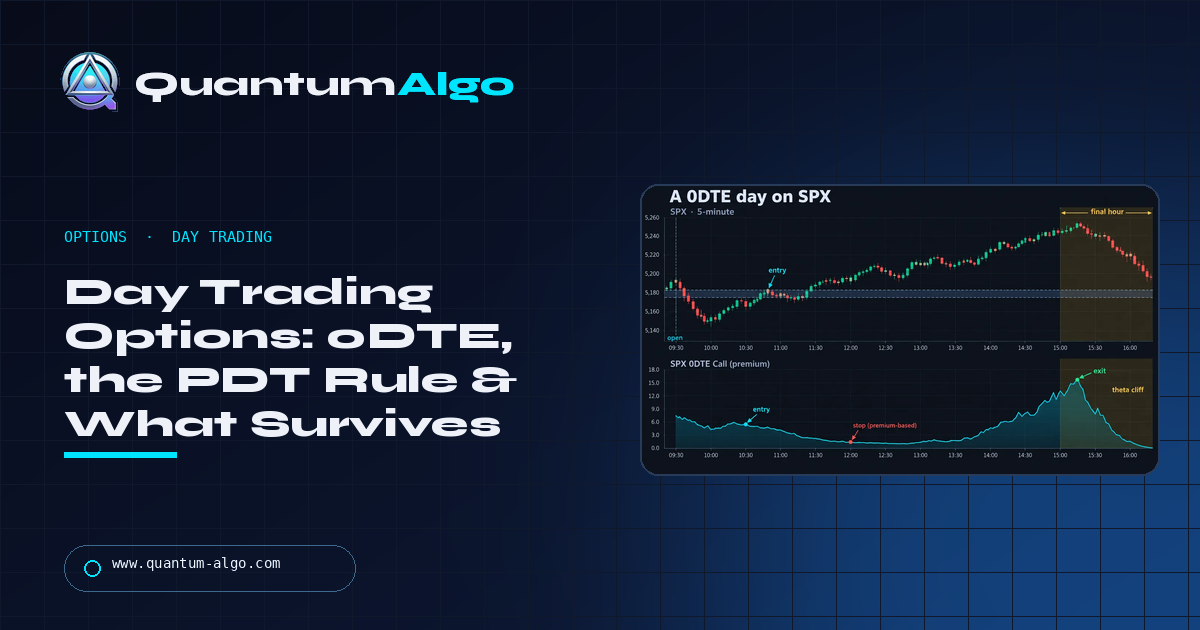
Yes, you can day trade options — same-day trading on SPX, SPY and QQQ is now a large share of all options volume, driven by zero-days-to-expiration (0DTE) contracts. Two things change the picture for a retail trader: the pattern day trader rule applies to options, so four same-day round trips in five business days under $25,000 restricts the account; and time decay, spreads and volatility work against an intraday buyer far more than in stocks. Direction is the only edge you can have; the contract has to be chosen to keep the other two from eating it.
I trade structure intraday and I watched the 0DTE wave arrive. This is the honest version of day trading options: one 0DTE trade on SPX from entry to the theta cliff, the three reasons most options day traders lose, the triangle of direction, time and volatility, the names and contracts that are actually tradeable, and the four strategies that survive contact with time decay. The sizer below turns a premium into a position that respects both your risk and your PDT count.
Indicators that prove themselves in public.
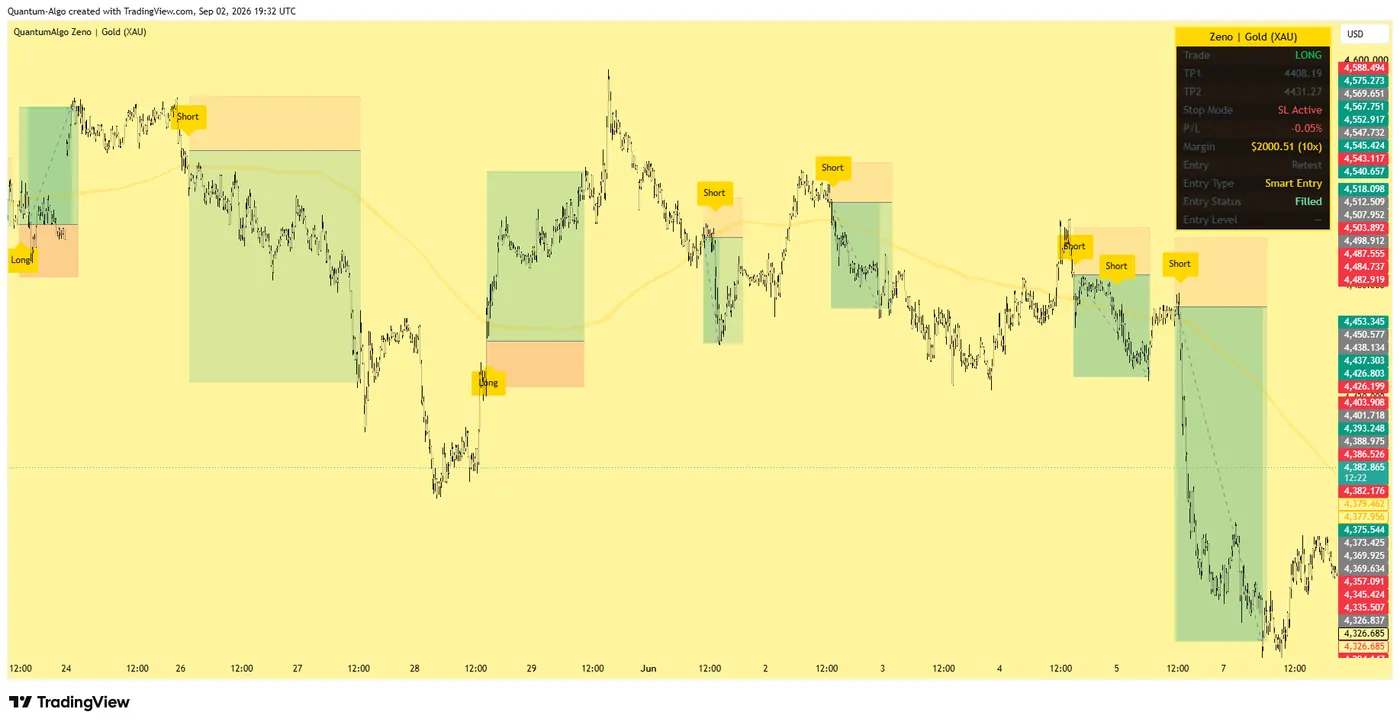
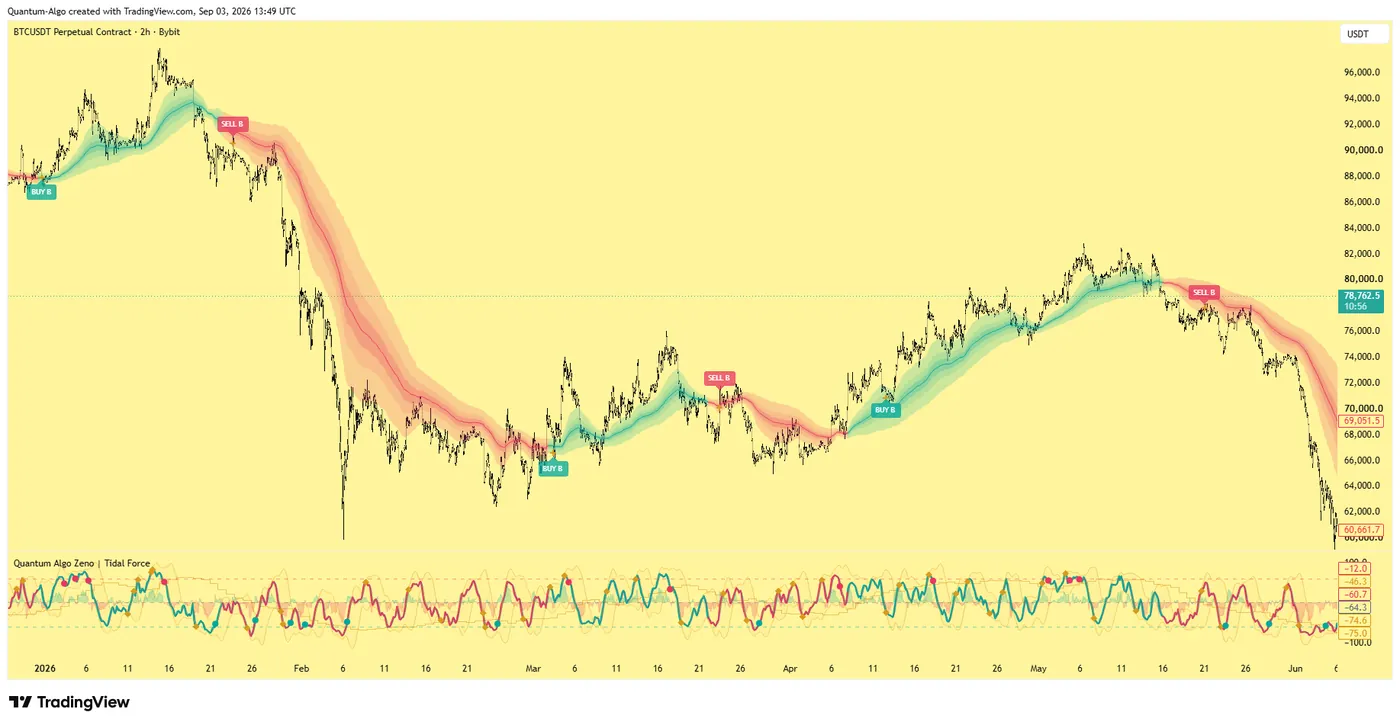
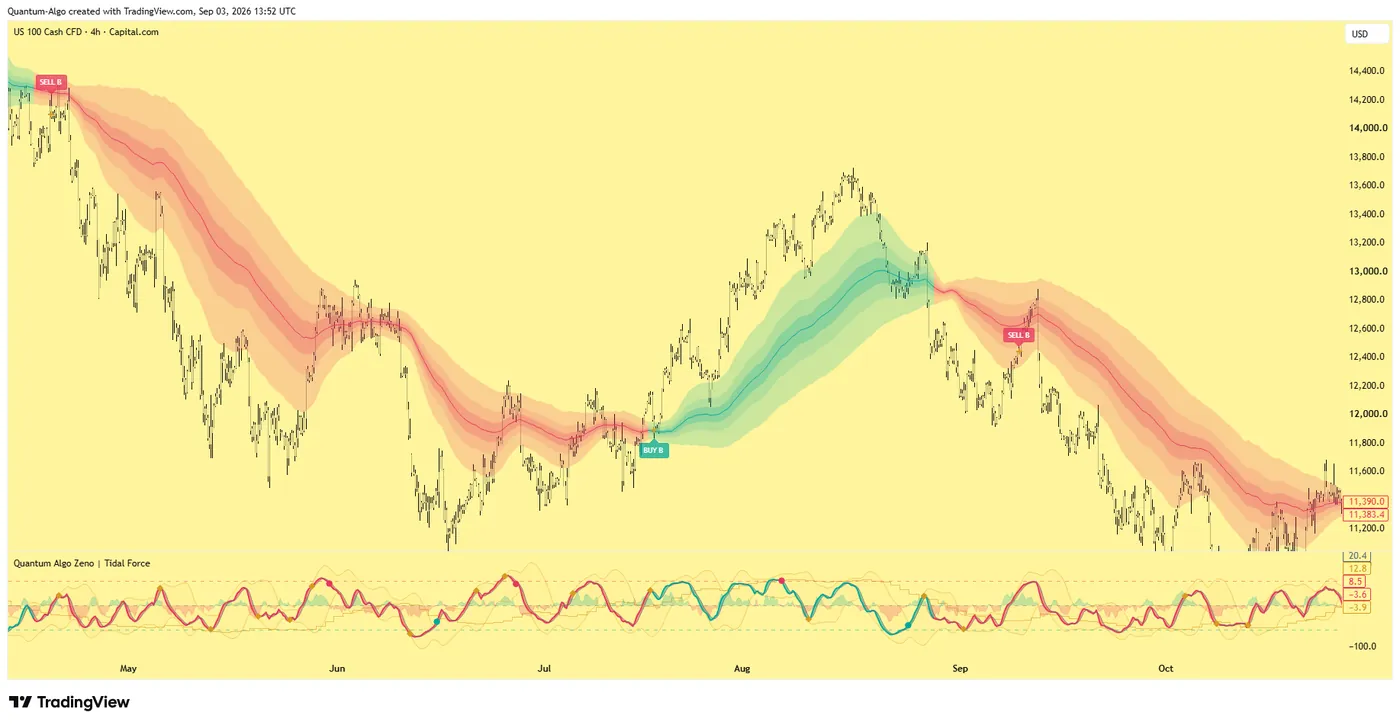
One engine, four precision tools — the Gold (XAU) Scalper, the institutional Gravity Zone, the Zeno momentum Oscillator, and Zeno Stocks for equities.
Can you day trade options?
Yes — options can be bought and sold the same day like any security, and same-day options trading on SPX, SPY and QQQ is now a large share of all options volume, driven by zero-days-to-expiration (0DTE) contracts that expire the day they are traded. Two rules change the picture for a retail trader: the pattern day trader rule applies to options exactly as to stocks, so four same-day round trips in five business days in a margin account under $25,000 restricts the account; and the economics of intraday options — time decay, spreads and volatility — work against a buyer far more than they do in stocks. So the answer is yes, you can; whether you should is the rest of this page.
I trade structure intraday and I have watched the 0DTE wave arrive. This guide is for the trader who has already read the beginner options page and wants the honest version of day trading them: what a 0DTE day looks like on a chart, why most options day traders lose, which contracts and names are tradeable, the strategies that survive contact with theta, and a sizer that turns a premium into a position that respects both your risk and the PDT count.
What 0DTE options are
Zero-days-to-expiration options are contracts that expire at the close of the trading day. SPX has expiries every weekday; SPY, QQQ and a growing list of large stocks have daily or several-times-weekly expiries. Because there is no time left, a 0DTE option is almost pure intrinsic value plus a thin, fast-decaying layer of time value: it moves nearly one-for-one with the index if it is in the money and evaporates if it is not. That makes it the cheapest way to express an intraday direction — and the fastest way to lose the whole premium.
A 0DTE day on SPX
The session chart in this guide is one 0DTE trade from start to finish. Top panel: SPX on 5 minutes, the open, a retest of structure at 10:40, an entry, a target. Bottom panel: the premium of a 0DTE call, bought on that retest, drifting lower for two hours while the index went nowhere — theta at work — then spiking when the move came, then falling off a cliff in the last hour as the remaining time value went to zero. The trade worked because the exit was taken at the target on the chart, not held for "more"; the shaded final hour is where every 0DTE long that has not exited becomes a lottery ticket.
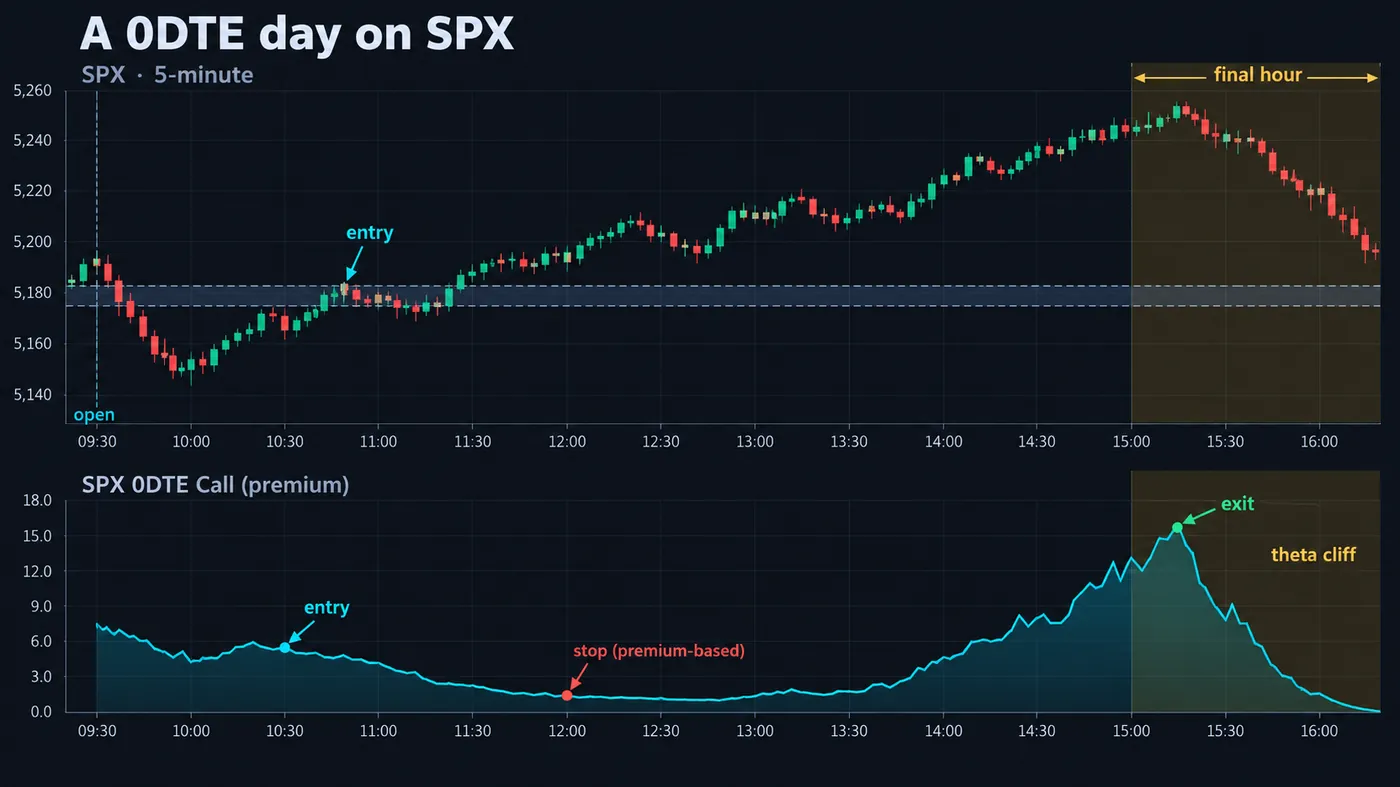
Three things to take from the picture: the entry came from the chart, not from the option; the stop was on the premium (a 40% loss on the contract, which coincided with the level failing); and the time of day decided the exit as much as the price did.
Why most options day traders lose
The three-tile illustration in this guide names the causes, and none of them is the chart:
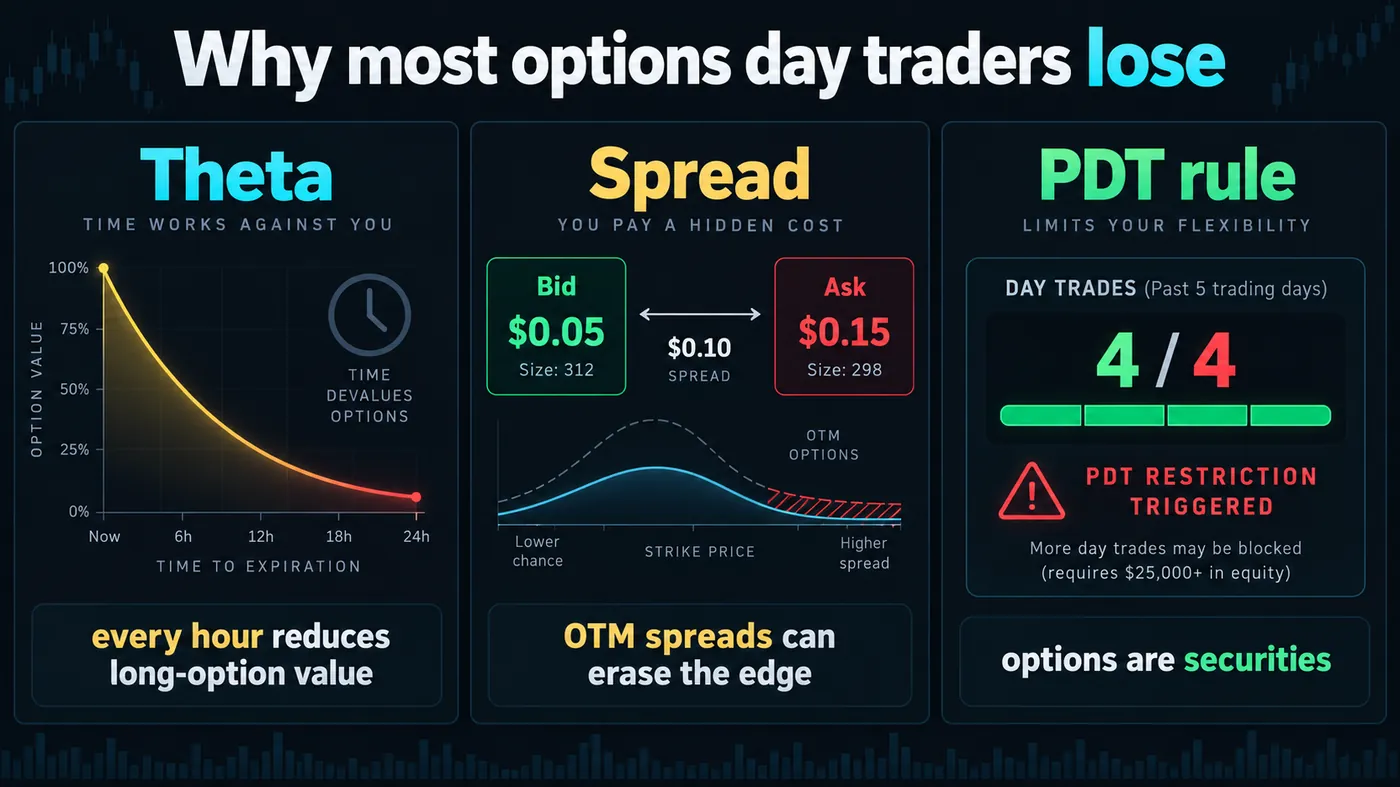
- Theta. Time decay is a cost every hour a long option is open. On a 0DTE contract it is the dominant cost: an at-the-money SPY 0DTE can lose a third of its value in a flat two hours. Every long intraday option starts the day behind.
- Spread. Out-of-the-money strikes on anything but the largest names trade with bid-ask spreads that are a large fraction of the premium — $0.05 bid, $0.15 ask on a $0.10 option is a 100% round trip. The edge is gone before the trade begins.
- The PDT rule. Options are securities. Four same-day round trips in five days under $25,000 in a margin account, and the broker restricts you — which is why most small-account "options day traders" are actually taking one or two trades a week and calling it day trading.
Add the retail instinct to buy far out-of-the-money contracts because they are cheap, and the loss rate for options day traders exceeds the already-poor rate for stock day traders in every study that isolates them.

Automate your trades. Let Quantum Algo trade for you.
Every signal executed on your own account — on your account, with the plan you define.
Direction, time and volatility
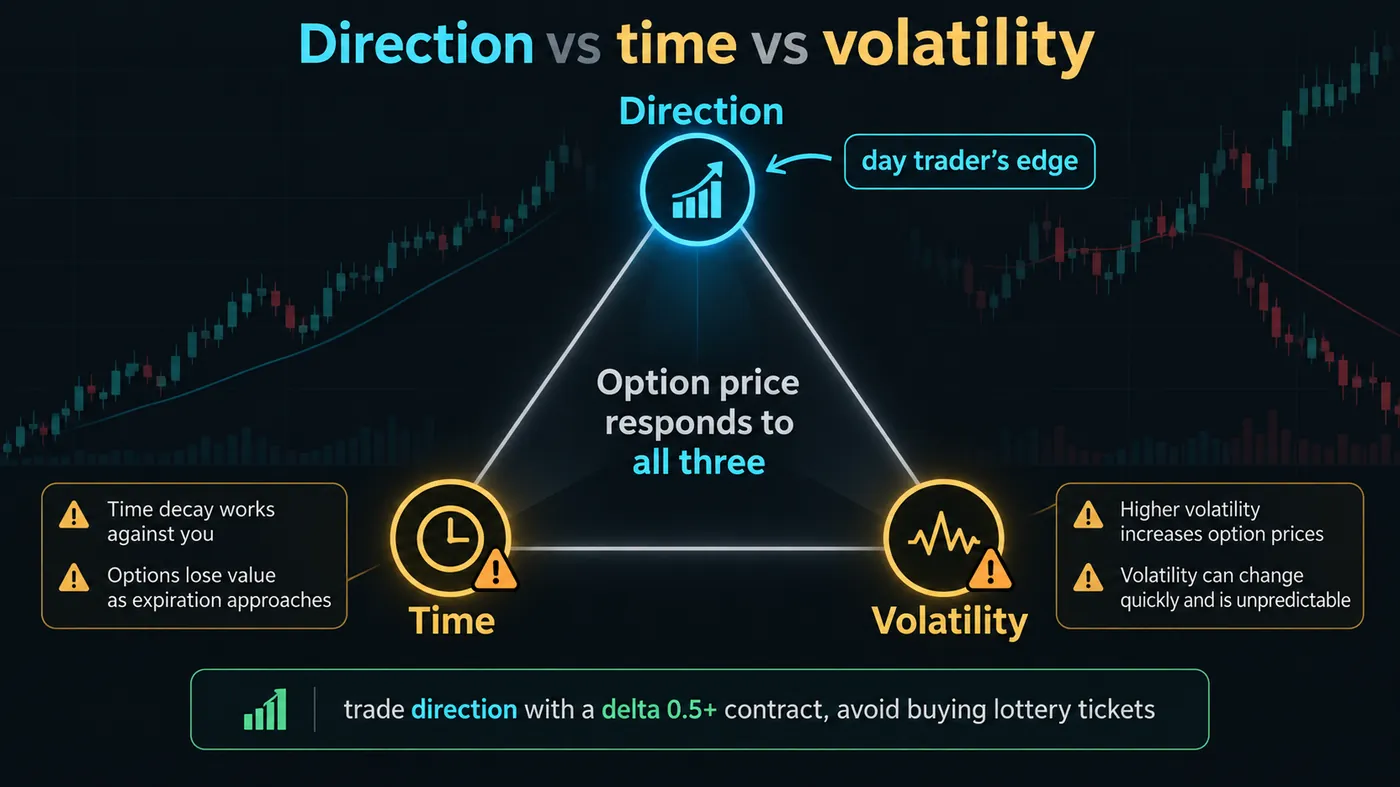
The triangle illustration in this guide is the framework for everything else: an option's price responds to three things, and a day trader's edge lives on one of them. Direction is where a structure read gives you an advantage. Time works against every long option, every minute. Volatility can move the premium against you even when the direction is right — a call bought into a volatility spike loses when the spike fades. The way to trade direction and minimise the other two is in the callout: choose a contract with delta 0.50 or higher, so the option behaves like the underlying, and avoid the cheap far-out-of-the-money strikes that are mostly time and volatility.
What to day trade: names and contracts
- SPX — cash-settled index options, no assignment risk, daily expiries, the deepest 0DTE liquidity, and Section 1256 tax treatment in the US. Large contract size (10× SPY); one contract can be a $2,000–5,000 premium.
- SPY and QQQ — the retail-sized versions; daily expiries; tight spreads on near-the-money strikes; American-style, so early assignment on short positions is possible.
- The largest single stocks — Apple, Nvidia, Tesla, Amazon and a handful of others have the volume for intraday options; most stocks do not, and their spreads make day trading impossible.
- Contracts: at-the-money or slightly in-the-money (delta 0.50–0.70), the nearest expiry that is not today for anyone new to it, and 0DTE only once the same setup has fifty logged trades on longer-dated contracts.
Day trading options strategies that survive
- Structure retest with a delta 0.60 contract. The Smart Money setup — sweep, change of character, retest of the order block — on SPY or QQQ on the 5-minute chart, expressed with a near-the-money option expiring one to three days out. Stop on the premium at 40–50% loss; target on the chart; exit by 3 pm regardless.
- Opening-range break, first hour only. The first 30–60 minutes carry the day's volume; a break of the opening range with structure behind it, traded with an in-the-money contract, closed by 11 am. Theta is smallest and spreads tightest in that window.
- Scalping the overlap of structure and gamma. For experienced traders only: dealer gamma levels (see the Unusual Whales review) mark where the index pins or accelerates; a structure signal at those levels, on 0DTE, held minutes. High frequency, high skill, PDT-restricted below $25,000.
- Defined-risk spreads instead of naked longs. A debit spread (buy one strike, sell the next) caps both the cost and the theta bleed; the trade-off is a capped gain. For most retail day traders it is the better instrument once they understand it.
What does not survive: buying 0DTE lottery tickets at the open, holding a losing option into the last hour "because it only needs one push", and averaging down on premium.
The rules of the trade
- Size by premium, not contracts. Risk per trade is a percentage of the account; the premium at risk (or the stop on the premium) must fit it. The sizer on this page does the arithmetic and counts your PDT window.
- Stop on the premium, target on the chart. A 40–50% premium stop usually coincides with the chart level failing; a target is where the structure says the move ends.
- Time stop. Out by 3 pm ET on any long; out of 0DTE by 2 pm unless in the money.
- No trades in the last hour as a buyer. The cliff is real.
- Count the round trips. Under $25,000, you have three in five business days; the fourth restricts the account.
- One name, one setup, fifty trades on a longer expiry first. Then 0DTE, if ever.
Day trading SPY options: a worked example
Account $20,000, risk 1% = $200 per trade. SPY at $525 after a sweep of the pre-market low and a change of character on the 5-minute chart; entry on the retest at $525.40. A $525 call expiring in two days is $3.20 — delta 0.55 — so one contract costs $320 and a 50% premium stop risks $160: one contract fits the $200 budget; two do not. Target at the pre-market high, $528.60, roughly +$1.75 on the option at delta 0.55 plus a little gamma — about +$175 on the contract, 1.1R. Exit at the target or by 3 pm. Logged as one day trade; two remain in the five-day window.
The same trade on a 0DTE $525 call at $1.40 would have cost $140 and risked $70 at the 50% stop — cheaper, but the option would have lost a third of its value in any two-hour stall, and a 3 pm time stop becomes a 2 pm one.
How this fits our workflow
Zeno reads SPY, QQQ and the large stocks the same way it reads gold: sweep, order block, entry, stop, targets. The option is the instrument that expresses the read with capped risk; the contract choice (delta, expiry) and the premium stop are the options-specific layer this page adds. Nothing about theta, spread or the PDT rule changes the structure — they change whether you are the right person, with the right account size, to trade it intraday with options.
You can; most should not, and the ones who survive treat the option as an instrument for a chart read, not as the trade. Delta 0.50 and above, expiry beyond the hold, stop on the premium, target on the chart, out by 3 pm, three round trips in five days below $25,000 — and 0DTE only after fifty logged trades on longer expiries. Theta, spread and the PDT rule do not care how good the setup was.
◆ Interactive check
Do you know what is working against you?
Questions people ask about day trading options
Three same-day round trips in five business days in a margin account; the fourth triggers the pattern day trader restriction. A cash account avoids the rule but is limited by settlement. Most small-account options day traders are, in practice, taking one or two trades a week.
No. They are the most theta-exposed, most volatility-exposed instrument on the exchange. Learn the setup on one-to-three-day expiries first; 0DTE only with a fifty-trade record on the same setup.
The first hour after the open, when volume is highest and time decay smallest, and the 2:00–3:00 pm window when the afternoon trend sets up. Never the last hour as a buyer.
For a small, disciplined minority with a documented edge on direction, delta-0.50-plus contracts and premium-based stops, yes. For most retail traders it is less profitable than day trading the underlying, because theta and spread are costs the stock does not have.
SPX for size, cash settlement and the tax treatment; SPY for a smaller contract and the same liquidity. Beginners start on SPY.
The structure read on SPY, QQQ and large stocks is what Zeno provides; the option is your instrument for expressing it. The sizer on this page turns the chart stop into a premium stop and a contract count.
Yes, without the PDT rule, but proceeds settle the next business day (T+1) and using unsettled funds triggers good-faith violations. In practice a cash account limits you to trading settled cash, which is a different constraint, not no constraint.
SPX for size and cash settlement, SPY and QQQ for retail-sized contracts with tight spreads, and a handful of the largest stocks. Near-the-money strikes with delta 0.50–0.70; nothing with a wide spread relative to the premium.
For experienced traders on SPX/SPY 0DTE with structure and dealer-gamma levels, held minutes — yes, and it is the hardest version of the activity. Below $25,000 the PDT rule makes it impossible to do at frequency.
Not to start. Structure on the underlying is the read; the option chain's bid/ask and volume at your strike are the execution check. Order-flow tools are useful for confirmation, not as the reason for the trade.
References & Related Guides
Read next
- Options Trading for Beginners
- Pattern Day Trader Rule
- Best Indicator for Options Trading
- Unusual Whales Review
- Opening Range Breakout (ORB)
- Best Indicator for NASDAQ
- Best Trading Platforms
- Is Day Trading Worth It?
Authoritative sources
- Cboe: SPX options (daily expirations, cash settlement)
- FINRA: day trading and the pattern day trader rule
- OCC Options Industry Council: options education
- SEC: characteristics and risks of standardized options
- IRS Publication 550: Section 1256 contracts (SPX tax treatment)