What Is the Pattern Day Trader (PDT) Rule? The $25,000 Rule, What Counts, and the Real Ways Around It

The pattern day trader rule is a FINRA rule for US margin accounts: four or more day trades within five business days (and more than 6% of your trades) flags you as a pattern day trader, after which you need at least $25,000 of account equity to keep day trading. Cash accounts, futures, forex and crypto are outside the rule; the legitimate ways around it are a cash account, futures, or funding the account past $25,000.
Most people learn the PDT rule from the restriction email. This is the rule itself: the three conditions, exactly what counts as a day trade (with the cases that trip people up), what the rule does not cover, and the workarounds — including the one that is not as clever as the forums make it sound. The counter below does the broker's arithmetic so you know before the fourth trade.
Indicators that prove themselves in public.
One engine, four precision tools — the Gold (XAU) Scalper, the institutional Gravity Zone, the Zeno momentum Oscillator, and Zeno Stocks for equities.
What is the pattern day trader rule?
The pattern day trader rule is a FINRA regulation that applies to US margin accounts: if you make four or more day trades within five business days, and those day trades are more than 6% of your total trades in that window, you are flagged as a pattern day trader and must keep at least $25,000 of equity in the account to keep day trading. Below $25,000 the broker restricts you to closing positions only — usually for 90 days, or until you deposit enough to cross the line.
It is the single most-searched rule in US retail trading and the most misunderstood, because most people learn it from the restriction email rather than from the rule itself. This page is the rule, what counts, what does not, the legitimate ways around it, and the one workaround that is not as clever as it sounds.
The three conditions, in order
The rule graphic in this guide shows the three gates you have to pass through to be flagged:
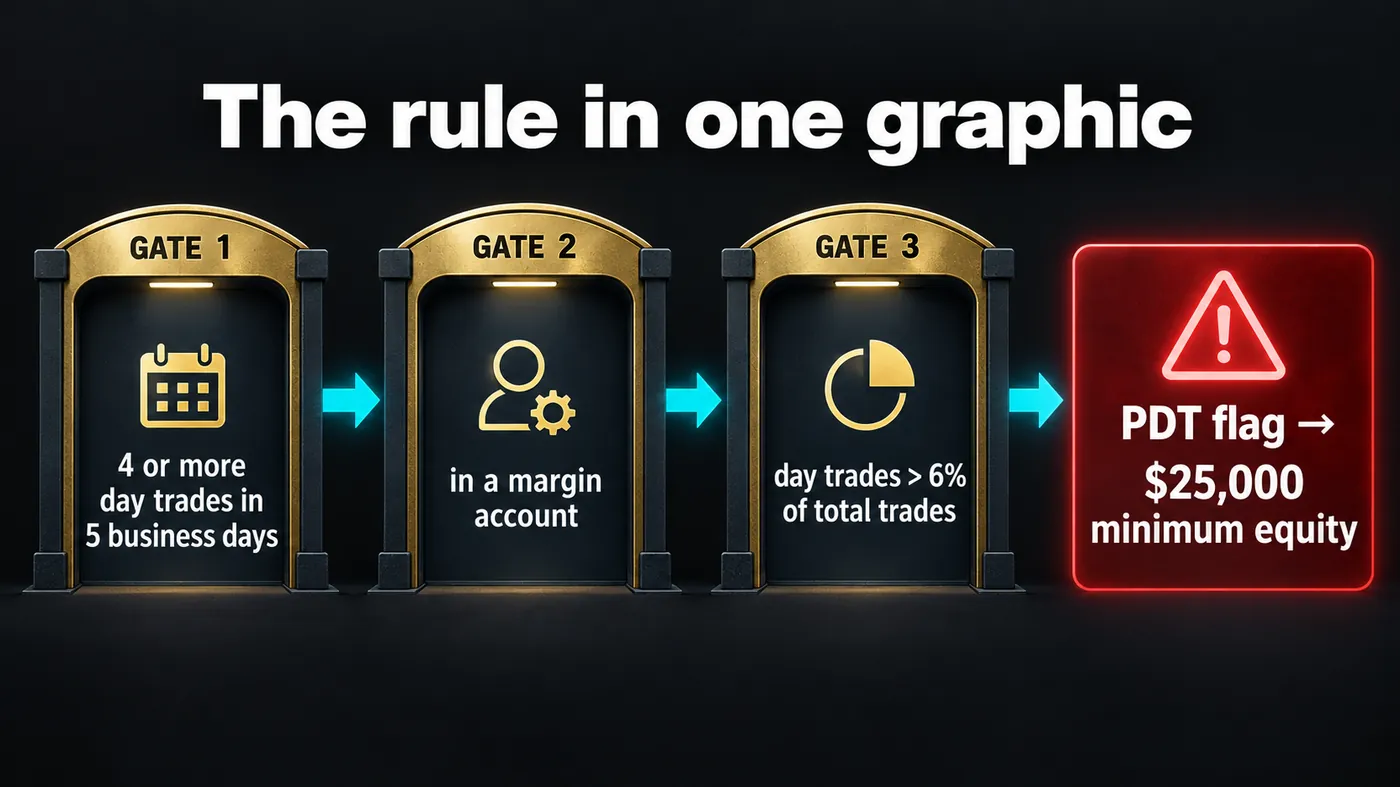
- Four or more day trades in any rolling five-business-day window. Not a calendar week — any five consecutive trading days.
- In a margin account. Cash accounts are outside the rule entirely.
- Day trades exceeding 6% of total trades in that window. This gate rarely matters in practice; if you made four day trades and sixty swing trades in the week, you are not a pattern day trader.
Pass all three and the broker applies the flag. From then on you need $25,000 of equity — cash plus the marked value of positions, not buying power — at the close of the previous day to make a day trade. If equity is below that and you day trade anyway, the account is set to closing-only until it is topped up.
What counts as a day trade
A day trade is opening and closing the same position in the same security on the same trading day. The strip illustration in this guide covers the cases that cause confusion:
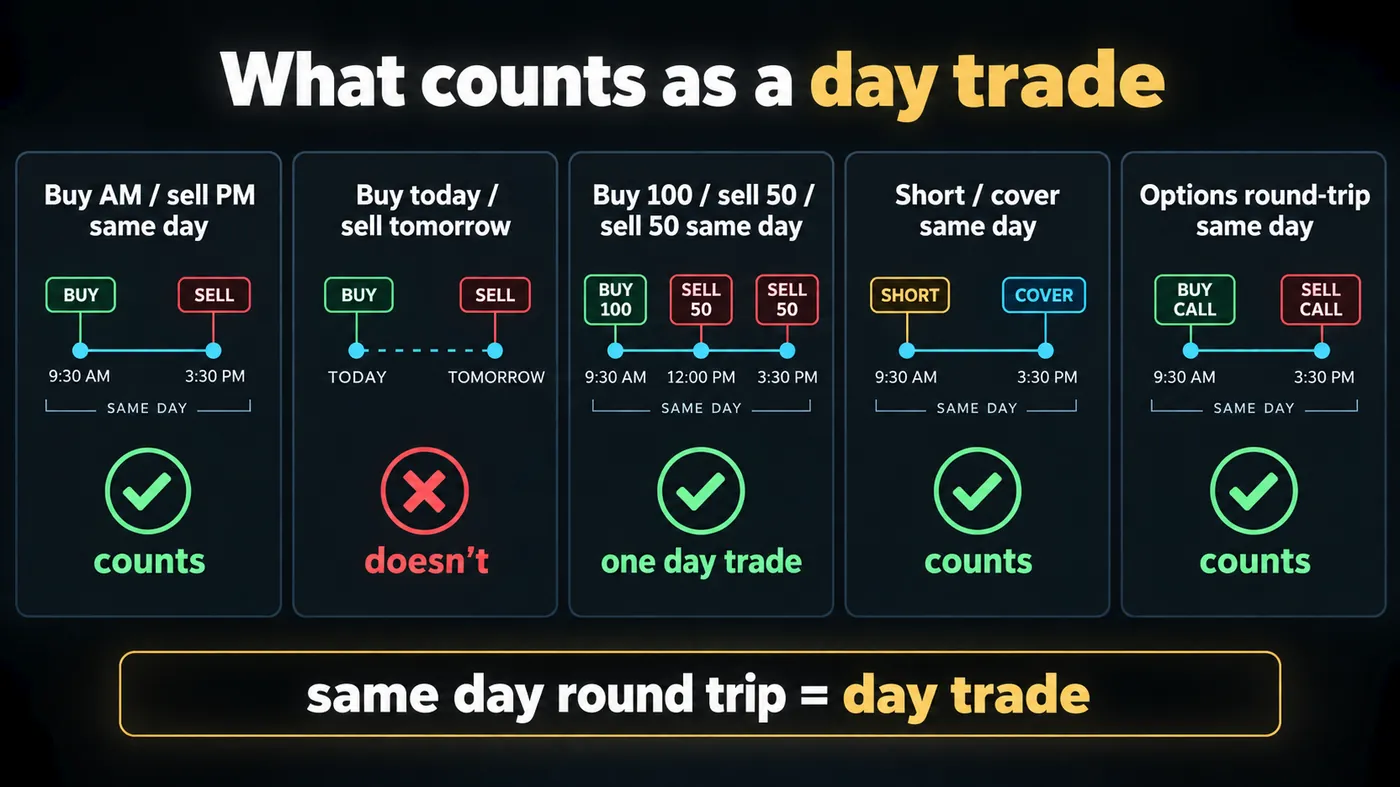
- Buy in the morning, sell in the afternoon — counts.
- Buy today, sell tomorrow — does not count, however short the hold.
- Buy 100 shares, sell 50, sell 50, same day — one day trade, not two. The count is per round trip of the opening position.
- Short then cover the same day — counts.
- Options: buy a call, sell it the same day — counts; options are securities under the rule.
- Buy 100, buy 100 more, sell 200 — one day trade.
- Buy 100, sell 100, buy 100, sell 100 — two day trades.
Pre-market and after-hours trades are part of the same trading day. A position opened at 9:35 and closed at 4:15 in the extended session is a day trade.

Automate your trades. Let Quantum Algo trade for you.
Every signal executed on your own account — on your account, with the plan you define.
What the rule does not cover
- Cash accounts. No margin, no PDT rule. The constraint instead is settlement: proceeds from a sale settle the next business day (T+1 since 2024), and using unsettled funds to buy and then sell is a "good faith violation", three of which restrict the account. In practice a cash account lets you day trade with the cash that has settled, which is a different limit, not no limit.
- Futures. Regulated by the CFTC, not FINRA; no PDT rule. Micro contracts make it accessible with small accounts, which is why so many US day traders end up on MES and MNQ.
- Forex and CFDs. Not securities; not covered. CFDs are not available to US retail traders at all.
- Crypto. Not covered. Spot and perpetuals on exchanges have their own rules and none of them is this one.
- Non-US brokers. The rule is FINRA's; a broker outside FINRA's jurisdiction does not apply it, though many international brokers apply it to US persons anyway.
Ways around it — and the honest trade-offs
The tiles illustration in this guide lays them out:
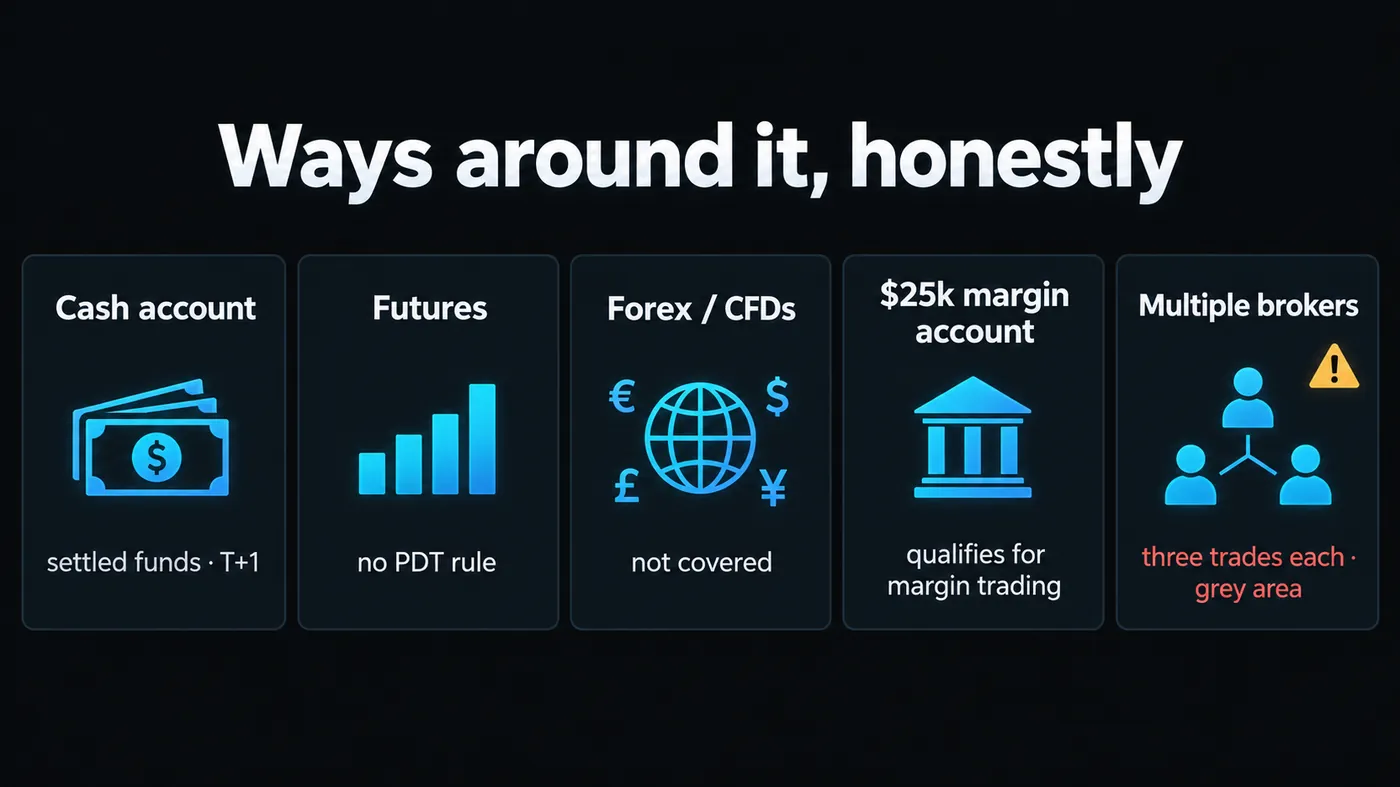
- Cash account. Legitimate. Limit becomes settled cash rather than a trade count; you cannot short, and you cannot use leverage.
- Futures. Legitimate. Different product, different risk profile, and the leverage is real — a micro E-mini contract is $5 per index point.
- Forex. Legitimate for US residents at a CFTC-registered broker; 50:1 leverage cap on majors.
- Deposit $25,000. The rule's own answer. Note the equity has to stay above the line; a losing streak that takes you to $24,900 restores the restriction.
- Multiple brokers. The workaround everyone mentions: three day trades at each of three brokers. It is not illegal, but each account is still a margin account subject to the rule, brokers share data more than people assume, and splitting a small account three ways makes every position tiny. It is a grey area that solves the wrong problem.
The wrong problem, to be blunt: if your edge only exists with fifteen day trades a week on a $8,000 margin account, the rule is protecting you from your own maths. Our position sizing guide has the numbers.
What happens when you are flagged
The broker sends a notice; some give a one-time reset on request, once per lifetime of the account. Until equity is above $25,000, you can close positions but not open new day trades. The flag is per broker, not per person, but it does not expire on its own — a flagged account stays flagged until the broker removes it, which most will not do if you keep meeting the criteria.
Day-trading buying power for a flagged account above the line is 4× the maintenance margin excess, and a day-trading margin call — from exceeding that buying power — has its own five-day deadline and its own restriction if unmet.
Using the counter
The PDT counter on this page takes your trades over the last five business days, marks which ones are day trades, applies the 6% test and tells you whether the next day trade would trigger the flag and how many days until the oldest one rolls off. It is the arithmetic the broker does; running it yourself before the fourth trade is cheaper than the email.
Four day trades in five business days in a margin account, over 6% of your trades, flags you; then you need $25,000 of equity to keep day trading. Same-day round trips count, holds overnight do not. Cash accounts, futures, forex and crypto are outside the rule. The honest answers are a cash account, futures or funding past $25,000 — not three brokers.
◆ Interactive check
Do you know when you get flagged?
Questions traders ask about the PDT rule
No. It applies only to margin accounts. Cash accounts are limited by settlement instead: you can only buy with settled funds, and proceeds settle the next business day.
Yes. Options are securities, and buying and selling the same contract on the same day counts as a day trade under the rule.
No. Futures are CFTC-regulated and have no PDT rule; crypto is outside the rule entirely. Both are the usual routes for US day traders with small accounts.
No. It is account equity — cash plus the marked value of securities — at the close of the previous day. It can be met with positions, but if a drawdown takes equity below $25,000 the restriction applies again.
Most brokers allow one reset per account on request. After that, the flag stays until equity is above $25,000 or the account is switched to a cash account.
It is a FINRA rule, so it applies to accounts at FINRA-member brokers, which includes most US brokers serving non-US clients. Brokers outside FINRA's jurisdiction do not apply it, though some apply it to US persons voluntarily.
In a cash account, buying a security with unsettled funds and then selling it before those funds settle. Three violations in twelve months typically restrict the account to settled-cash-only for 90 days.
No — $25,000 in equity, which includes the marked value of positions. But if losses take equity below the line at a close, the restriction applies the next day.
The PDT rule decides whether you may day trade; day-trading buying power (4× maintenance margin excess) decides how large your intraday positions can be once you may. Exceeding buying power triggers a separate day-trading margin call.
Only indirectly: most of our subscribers trade forex, gold, indices and crypto, where the rule does not exist, and Zeno's stop and targets are designed for trades held for hours to days rather than for rapid intraday round trips.
References & Related Guides
Read next
- Futures Trading for Beginners: Contracts, Ticks, Margin, Micros and Futures vs Options
- Is Day Trading Worth It? The Honest Answer With the Loss Rates, the J-Curve and the Arithmetic
- What Is Margin Trading?
- How Much Money to Start Day Trading?
- What Is After-Hours Trading?
- Best Indicators for Futures Trading
- What Is Trading?
- Position Sizing: The Complete Guide
- Day Trading for Beginners
- Best Forex Indicator
Authoritative sources
- FINRA: day trading and the pattern day trader rule
- FINRA Rule 4210: margin requirements (pattern day trader)
- SEC: day trading — your dollars at risk
- CFTC: advisories (futures are outside FINRA rules)
- SEC: T+1 settlement