What Is After-Hours Trading? Extended Hours, Earnings Gaps and Why the Spread Is the Catch
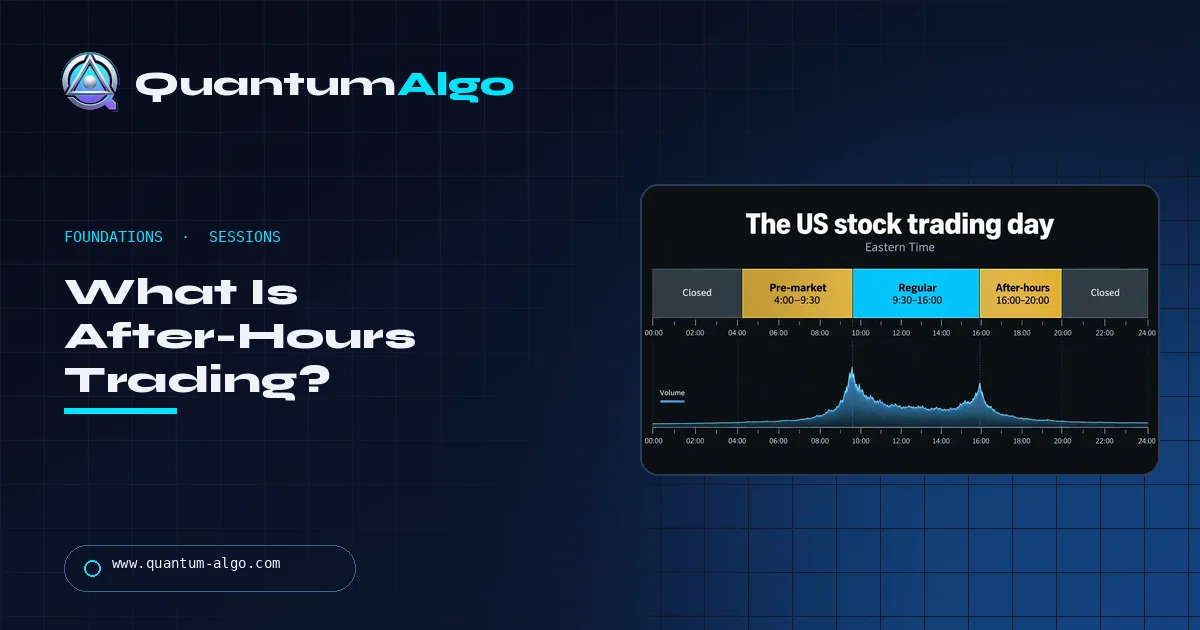
After-hours trading is buying and selling US stocks between 4:00 pm and 8:00 pm Eastern, after the regular session, through electronic networks rather than the exchange; pre-market runs 4:00–9:30 am. The biggest single-day moves in stocks now happen in these windows around earnings. The catch: no market-maker obligation, spreads many times wider, partial fills, and prices the 9:30 open reprices.
Most of the largest single-day moves in individual stocks happen while the exchange is closed — earnings after the bell, guidance before the open. This page is how extended hours actually work: who is on the other side, why the spread widens from a cent to forty, what the after-hours gap tells you and what it doesn't, and the narrow set of conditions under which trading it is worth the cost. The session clock below shows what is open right now in your timezone.
Indicators that prove themselves in public.
One engine, four precision tools — the Gold (XAU) Scalper, the institutional Gravity Zone, the Zeno momentum Oscillator, and Zeno Stocks for equities.
What is after-hours trading?
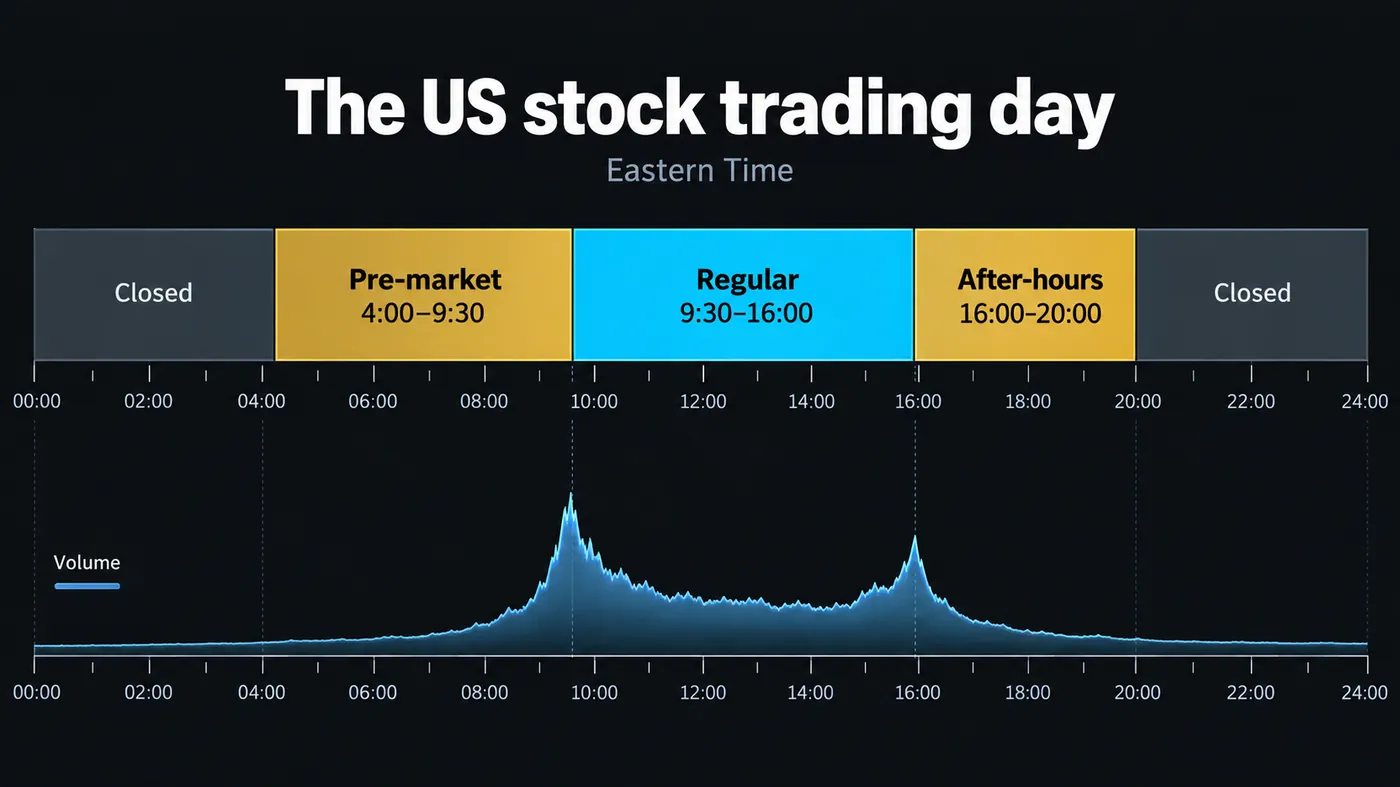
After-hours trading is buying and selling US stocks after the regular session closes at 4:00 pm Eastern, typically until 8:00 pm, through electronic communication networks rather than the exchange floor. Pre-market is the mirror session from 4:00 am to 9:30 am. Together they are called extended hours, and the trading-day timeline in this guide shows how they sit around the regular session — and how thin the volume is outside it.
Most of the biggest single-day moves in individual stocks now happen in these windows, because companies report earnings after the close or before the open. That is the attraction. The spread, the liquidity and the order types are the catch, and they are what this page is about.
What are the extended-hours trading sessions?
| Session | Eastern time | Who trades | Liquidity |
|---|---|---|---|
| Pre-market | 4:00 am – 9:30 am | Institutions reacting to overnight news; retail from 7:00 am at most brokers | Thin until 8:00 am, building into the open |
| Regular | 9:30 am – 4:00 pm | Everyone; the exchange auction opens and closes it | Deepest at 9:30 and 3:50–4:00 |
| After-hours | 4:00 pm – 8:00 pm | Earnings reactions, institutional rebalancing, retail at most brokers until 8:00 | Heavy for 30 minutes after a report, then very thin |
The regular-session volume profile on the illustration is the shape to remember: a spike at the open, a spike at the close, and a long flat middle. Extended hours are the tails of that curve, and the tails are where the price is least reliable.
How does after-hours trading work?
Regular hours route your order through exchanges with market makers obliged to quote. Extended hours route it through ECNs — electronic order books where your order only fills if someone else's order is there to match it. There is no market maker obligation, no opening auction, and the consolidated tape you see on your chart may be missing venues.
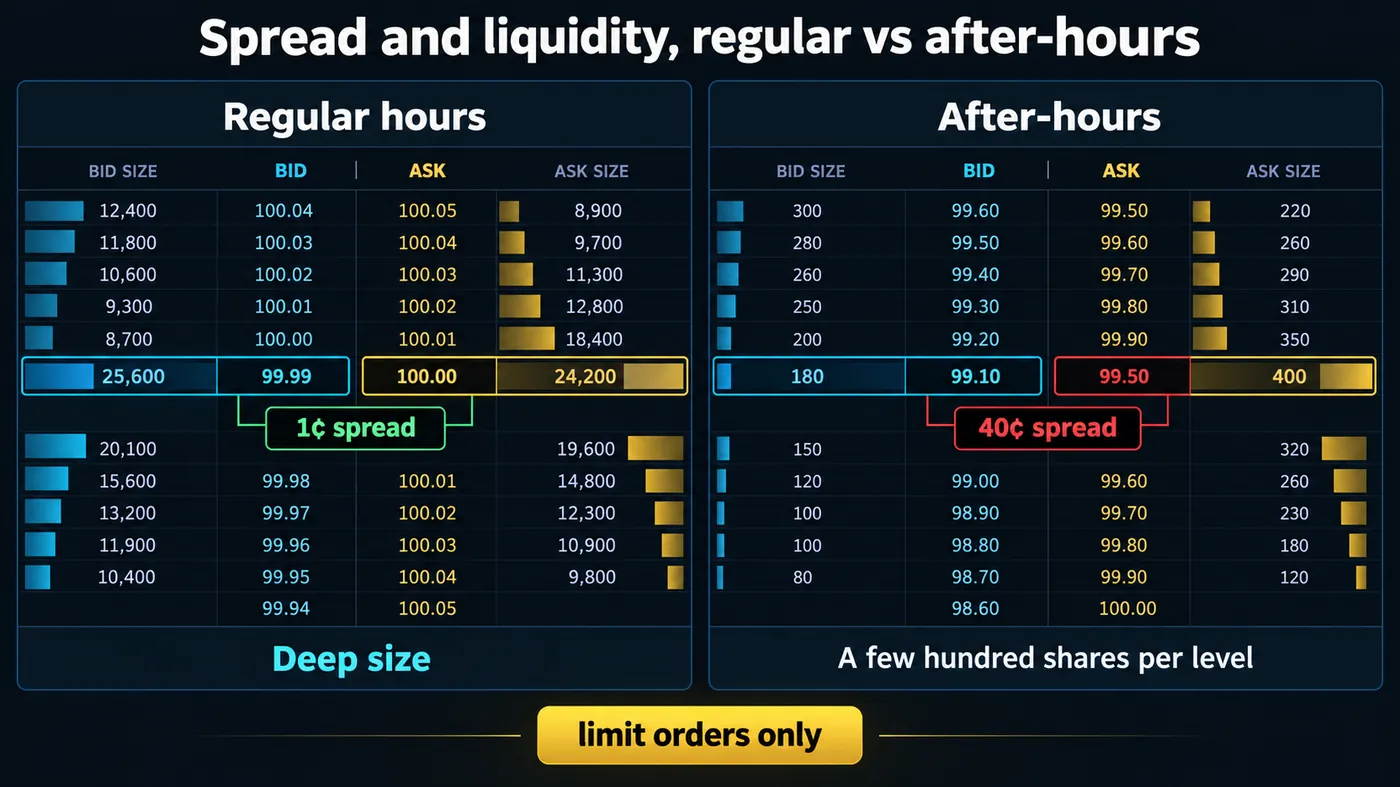
Practically that means three things. Spreads are wide: the spread illustration in this guide shows the same stock at a 1-cent spread with deep size during the session and a 40-cent spread with a few hundred shares per level after hours. Fills are partial: a 1,000-share order may fill 200 and rest. And prices are fragile: a single 500-share market order can move a mid-cap stock 1% at 6:30 pm.
Brokers respond by restricting order types. Most allow only limit orders in extended hours, and the ones that allow market orders are doing you no favours.
Why do stocks move after hours on earnings?
The reason anyone trades after hours is the earnings illustration in this guide: a stock closes flat at 4:00, the report hits at 4:05, and price gaps 8% within minutes on thin volume and a wide spread. By the time the regular session opens at 9:30 the next day, the price is already near the after-hours level — the move happened while most participants could not, or would not, trade it.
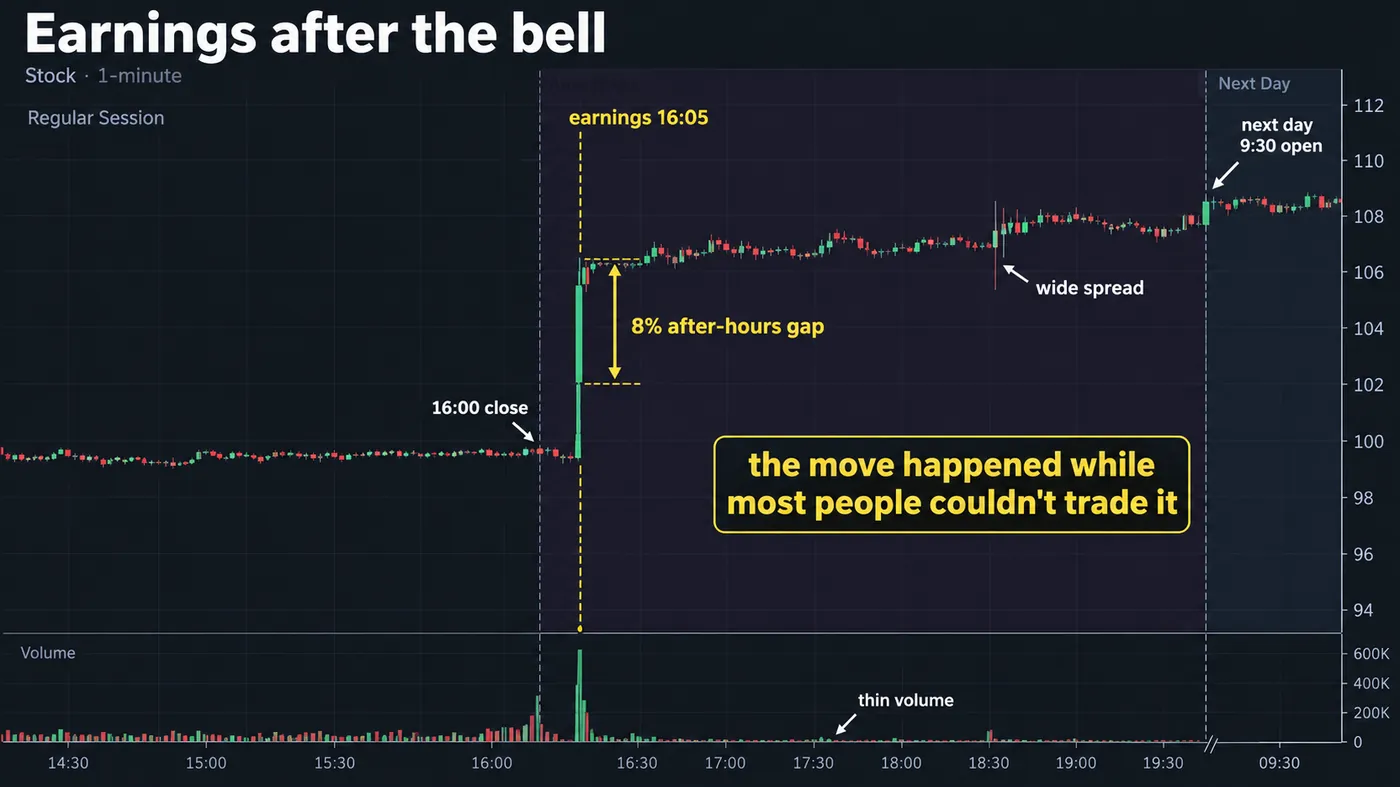
Two honest points. First, the first prints after a report are unreliable; the 4:05 price is frequently reversed by 4:30 once the call starts and the guidance is parsed. Second, the after-hours gap is not free money for anyone: the trader who sold into it at 4:06 paid a 40-cent spread on a $2 move, and the trader who bought the gap at 4:20 often watched it fade into the open.
Who should trade after hours, and how?
If you hold a position into earnings you may want the ability to exit after hours; that is the strongest case for it. If you are entering a fresh position after hours, the conditions have to be right and the order has to be a limit:
- Trade only names with real after-hours volume — large caps after their own report, not sympathy moves in small caps.
- Use limit orders, placed inside the spread, and accept partial fills.
- Size for the spread: if the spread is 0.5% and your target is 2%, a quarter of the edge is gone before the trade starts.
- Do not trust the chart's volume bars; the tape is incomplete.
- Expect the regular-session open to disagree with the after-hours close, sometimes violently.
Smart Money Concepts apply here with a caveat: the structure printed after hours on thin volume is frequently swept at the 9:30 open, which makes the pre-open high and low two of the most reliable liquidity levels of the day.
Do other markets have extended trading hours?
Index futures trade nearly 23 hours a day on CME Globex, which is why ES and NQ, not the ETFs, are where the overnight reaction to news actually prices. Forex trades 24/5 with no extended-hours concept at all. Crypto never closes. The "after-hours" problem is specific to stocks, and the session clock on this page shows what is open right now in your timezone across all four.
Extended hours are where earnings moves happen and where the market is least fair: ECNs instead of market makers, 40-cent spreads instead of 1-cent, partial fills, and an opening auction that reprices everything at 9:30. Trade them with limit orders only, in liquid names after their own news, sized for the spread — or watch and trade the open.
◆ Interactive check
Do you know the extended-hours rules?
Questions traders ask about after-hours trading
4:00 pm to 8:00 pm Eastern for US stocks at most brokers. Pre-market runs 4:00 am to 9:30 am, though many brokers open retail access at 7:00 am.
Most brokers only allow limit orders in extended hours. Where market orders are allowed, avoid them — the spread and the depth are not what they are during the session.
The after-hours price is set by a small number of participants on thin volume. The 9:30 opening auction brings in everyone else, and the price is repriced — sometimes in the same direction, often partially back.
Yes, at brokers that still apply the PDT rule (FINRA replaced it on 4 June 2026, but brokers may keep it until 20 October 2027): a position opened in the regular session and closed at 5:00 pm the same day counts as a day trade.
The indicators read whatever the chart shows, so they print on extended-hours data if your TradingView symbol includes it. We treat structure formed after hours as provisional until the regular session confirms it.
Most brokers allow it with limit orders, but the conditions punish beginners: wide spreads, partial fills and prices that reverse at the open. Learn the regular session first; use after hours only to manage a position you already hold through news.
Institutions have mostly finished for the day, market makers are not obliged to quote, and many retail brokers restrict access. What remains is earnings reactions and a thin layer of resting limit orders.
They set expectations, and the opening auction usually prints near the after-hours level — but "near" can mean several percent away, because the auction brings the full market in.
Pre-market from 8:00 am builds liquidity into the open and reacts to overnight news and pre-open earnings; after-hours is thin after 4:30 pm. Both are limit-only territory.
Enable extended hours in the chart settings for US stock symbols; the chart shades pre- and post-market. Structure formed there is worth treating as provisional until the regular session confirms it.
References & Related Guides
Read next
- Forex Market Hours: When the Forex Market Opens, Closes and Actually Moves
- How Many Trading Days in a Year?
- Pattern Day Trader Rule
- Order Types Explained
- What Is Slippage in Trading?
- Best Indicators for Futures Trading
- Best Indicator for Stocks
- Liquidity Sweep Trading
- Opening Range Breakout (ORB)
Authoritative sources
- SEC Investor.gov: after-hours trading
- FINRA: extended-hours trading — know the risks
- NYSE: hours and calendars
- Nasdaq: trading hours (pre-market and after-hours)
- CME Group: Globex trading hours