Prop Firms for Stock Trading: The Three Routes, Who Funds Real Shares, and How Equity Evaluations Really Work
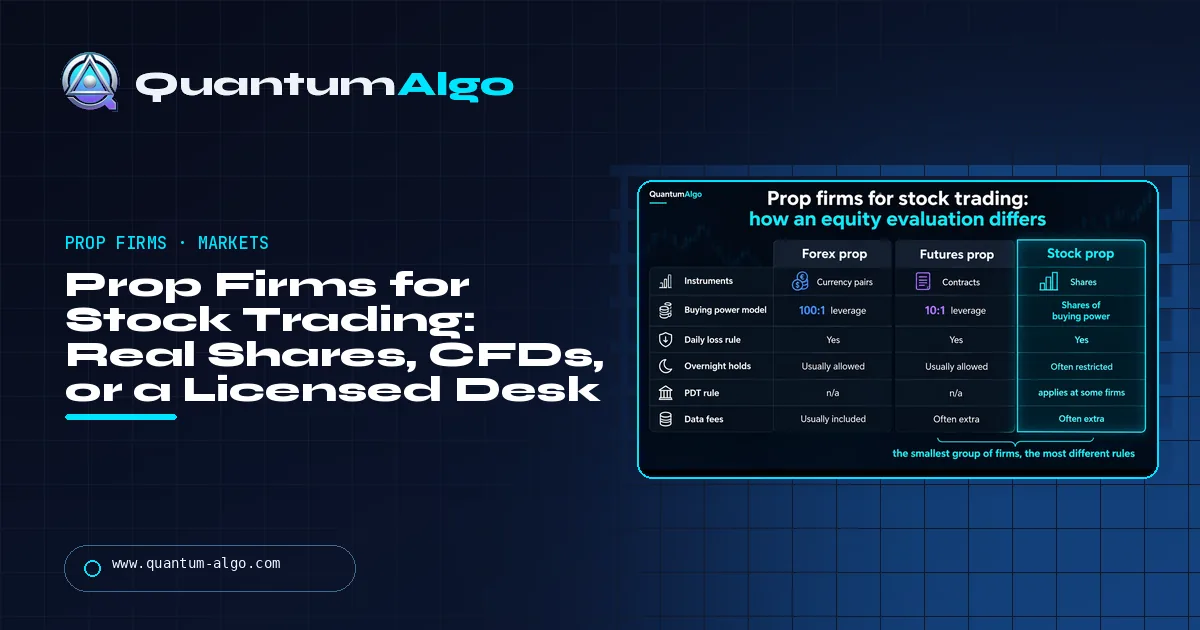
Stock prop trading has three routes. Real-share evaluations (Trade The Pool, Interactive Brokers): $5k–$200k for $47–$1,475, 6% target, 1–2% daily loss, 3–4% max loss, 70–80% split, US-eligible. CFD-stock challenges (FTMO, FundedNext, FXIFY) are CFDs, not shares, mostly non-US. Licensed desks (SMB Capital, T3, Seven Points) give Series 57 traders 10–30x their $5k–$25k contribution. Size from daily loss, not buying power.
Type "stock prop firms" into a search engine and most of what comes back is forex firms with equity CFDs on the symbol list. That is not stock trading, and it is closed to most Americans. This guide separates the three things the phrase can mean — the real-share evaluation, the CFD challenge and the licensed prop desk — with the costs, rules and eligibility of each, and a sizing tool built for the buying-power model that catches out every trader arriving from forex.
Indicators that prove themselves in public.
One engine, four precision tools — the Gold (XAU) Scalper, the institutional Gravity Zone, the Zeno momentum Oscillator, and Zeno Stocks for equities.
Why are stock prop firms a category of their own?
Almost every prop firm you have heard of funds forex, CFDs or futures. Stocks are different in three ways that keep the list short. An equity account needs a broker-dealer, real share borrowing for shorts, exchange data fees per user and a compliance regime — pattern-day-trader rules, locate requirements, earnings halts — that a CFD shop never touches. The economics are worse for the firm: a $100,000 stock account moves a few hundred dollars a day, not the thousands a leveraged CFD account can, so the evaluation fee has to do more of the work. And the genuine equity prop desks — the New York and Chicago firms that have funded stock traders for thirty years — do not sell evaluations at all; they take licensed traders with a capital contribution.
So "prop firms for stock trading" is really three routes, and the searcher usually does not know which one they are asking about. This guide separates them: the real-share evaluation firms, the CFD-stock evaluations at forex firms, and the licensed prop desks; what each costs, what you actually trade, what the rules look like, who they accept (US residents in particular), and a sizing tool built for the buying-power model that trips up every trader who arrives from forex.
What are the three routes to a stock prop account?
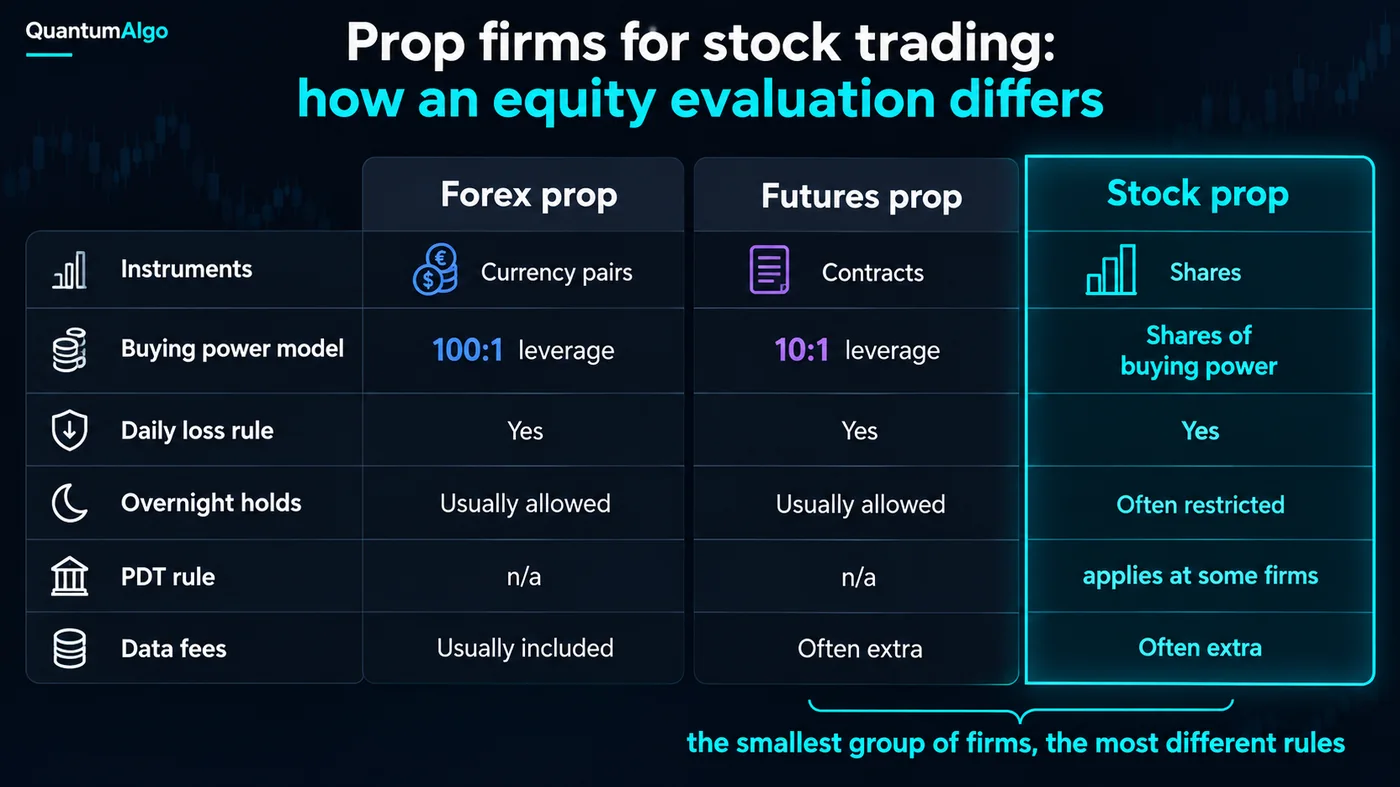
| Route | What you trade | How you get in | Typical cost | Split | US residents | Examples |
|---|---|---|---|---|---|---|
| Real-share evaluation | US stocks and ETFs through a broker (12,000+ symbols), real locates | Buy an evaluation; hit a target under daily and max loss rules | $47–$1,475 for $5k–$200k of buying power | 70–80% | Yes | Trade The Pool |
| CFD-stock evaluation | Stock CFDs on a forex platform — not shares, no ownership, no locates | Standard two-phase challenge | €89–€1,080 for $10k–$200k | 80–95% | Mostly no | FTMO, FundedNext, FXIFY, 100X Club |
| Licensed prop desk | Real equities on the firm's broker-dealer with 10–30× buying power on your contribution | Interview, Series 57 licence, capital contribution | $5,000–$25,000 contribution plus desk, software and data fees | 80–95% or more | Yes (US firms) | SMB Capital, T3 Trading, Seven Points, Bright Trading |
The first route is what most searchers mean and there is essentially one firm doing it at scale. The second is what most "stock prop firm" lists actually contain, and it is not stock trading — it is a forex challenge with equity tickers on it, closed to Americans for the reasons the US traders guide explains. The third is the original prop model, still running, and the only route that leads to a real desk. The what is a prop firm guide has the history of how the evaluation model split off from it.
Route one: the real-share evaluation
Trade The Pool is the sister firm of The5ers, registered in Israel, executing through Interactive Brokers on its TraderEvolution platform, and it funds real US-equity trading: 12,000-plus stocks and ETFs, short selling with free hard-to-borrow locates during the evaluation, and a single-phase test. Its plans, checked September 2026:
| Plan | Buying power | Price | Target | Daily loss | Max loss | Holds | Payouts |
|---|---|---|---|---|---|---|---|
| FLEX Day Trade | $5k – $200k | $59 – $1,475 | 6% | 2% of buying power | 4% | Intraday only | Every 14 days, $300 minimum |
| MAX Day Trade | $5k – $200k | $47 – $1,100 | 6% | 1% | 3% | Intraday only | Every 14 days |
| FLEX Swing | $2k – $40k | $87 – $1,240 | 15% | 3% | 7% | Overnight and weekend allowed | Weekly |
| MAX Swing | $2k – $40k | $69 – $800 | 15% | Tighter | Tighter | Overnight allowed | Weekly |
Split starts at 70% and scales to 80%; commissions are $0.01 a share with a $0.50 minimum; at least ten trades are required to pass; there is no time limit. The rule set is where it stops looking like forex: a 60-second minimum hold, a 10-cent minimum profit per share on winners, a 30% cap on how much of the target any one trade may contribute, a volume limit tied to the previous minute's traded volume, and no new positions on a name's earnings day. Those rules exist to stop the account being passed on one lucky halt, and they are exactly the rules a scalper of thin names will breach. Trustpilot sits around 4.5 with a visible minority reporting payout reviews under "account integrity" — read the rules twice, because the rules are the product.

Automate your trades. Let Quantum Algo trade for you.
Every signal executed on your own account — on your account, with the plan you define.
Route two: the CFD-stock evaluation, and why it is not the same thing
FTMO, FundedNext, FXIFY, 100X Club and most forex firms list "stocks" among their instruments. What they list are stock CFDs from an offshore broker: a contract that tracks the share price, with the firm's broker as the counterparty, no ownership, no dividends beyond an adjustment, no locates, and swap charges for holding overnight. The evaluation is the same two-phase challenge as for forex, at the same prices, with the same static or trailing drawdowns, and it works — if what you want is to trade stock price movements with leverage inside a forex firm's rules.
What it is not: US stock trading. The CFD firms mostly exclude US residents, the symbol lists run to a few hundred large caps rather than twelve thousand, pre-market and after-hours are usually closed, and the spreads on the CFD are wider than the stock's. A Smart Money trader who wants the open-range sweep on a mid-cap gapper cannot get it here; the FTMO review and FundedNext review cover the instruments each actually offers.
Route three: the licensed prop desk
Before evaluations existed, proprietary trading meant this: a registered broker-dealer takes on a trader, gives them buying power many times their own money, and splits the profit. It still exists, mostly in the United States, and it is the only route on this page that ends at a real trading desk with real capital at scale.
- How you get in. An application and interview; the SIE and Series 57 exams (the firm usually sponsors you); a capital contribution that sits as your first-loss cushion, typically $5,000 to $25,000; and desk, software and data fees that can run a few hundred dollars a month. Some firms (SMB Capital is the best-known) run a training programme first and fund the traders who come through it.
- What you get. Buying power of ten to thirty times your contribution on the firm's broker-dealer, real shares, real locates, direct-market-access routing, a risk manager who can and will cut you off intraday, and a profit split that starts high — 80–95% — because you are risking your own contribution first.
- Who it suits. Traders who want the job, not the badge: full-time, US-based (most desks require it), willing to be licensed and to sit under a risk manager. It is not a route for someone who wants to pass a test from home in a month.
- The risk. Your contribution is at risk; a bad quarter can consume it. The desk is a business, and unprofitable traders are let go.
Firms in this category include SMB Capital and T3 Trading Group in New York, Seven Points Capital, and Bright Trading, among others; terms vary and are negotiated, so treat the figures above as ranges. If you are outside the US, this route mostly does not exist for you, and the real-share evaluation is the practical answer.
Why do forex traders fail the stock buying-power model?
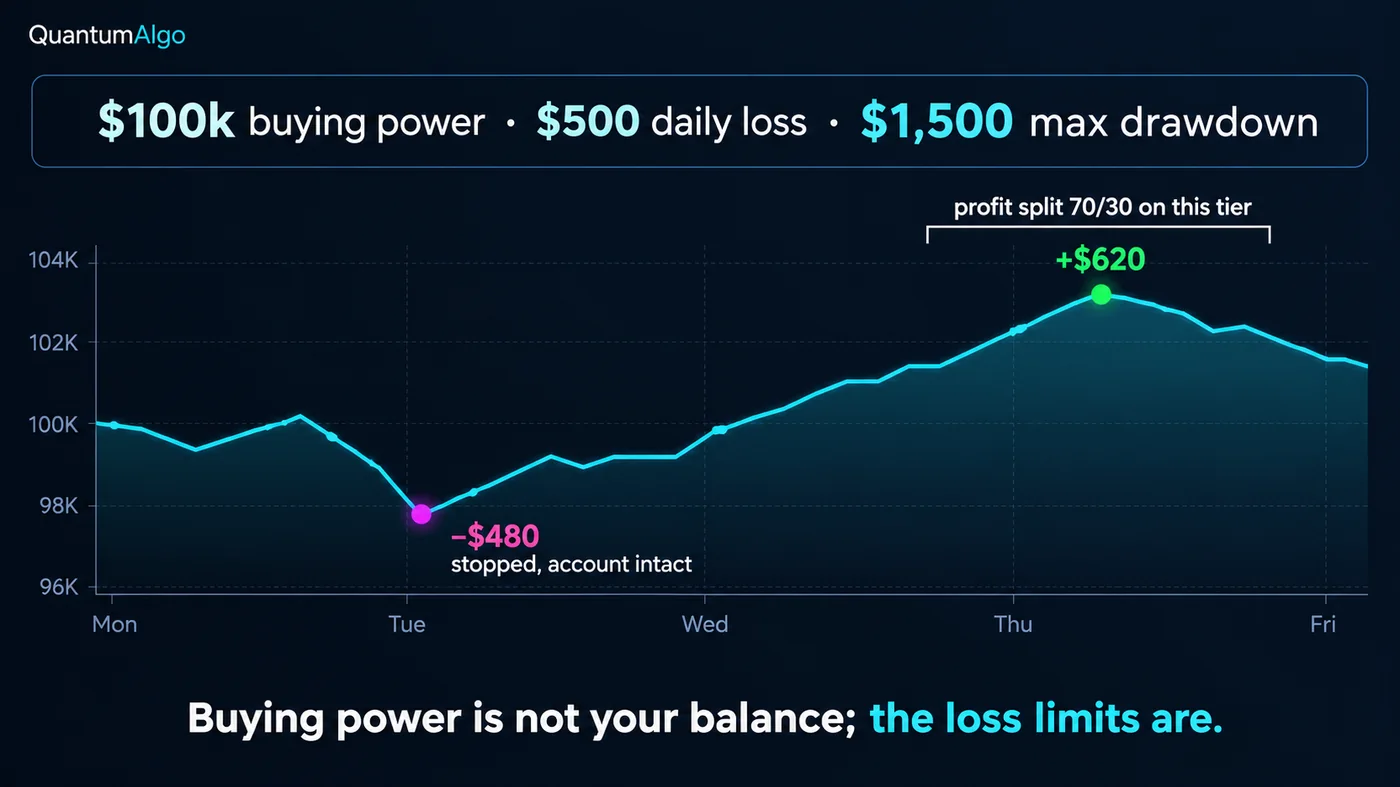
Every stock evaluation quotes an account in buying power — $100,000 — and every forex trader reads it as a balance. It is not. It is the notional you may hold; the balance that matters is the daily loss limit, typically 1–2% of buying power, and the max loss, 3–4%. A $100,000 FLEX account can hold $100,000 of stock and lose $2,000 in a day. Size 2,000 shares of a $50 stock with a 40-cent stop and one full stop is $800 — fine. Size the same 2,000 shares into a name that gaps a dollar through your stop on a halt and the day is over, and a second such day ends the account.
The sizer below is built for this. It starts from the daily loss, not the buying power, and returns how many shares your stop distance allows, what fraction of buying power that uses, and how many bad days the max drawdown gives you. The habit it teaches — risk a fixed slice of the daily limit per trade, never the buying power — is the one equity prop traders share and forex traders arriving at Trade The Pool lack. The stock-finding guide and the best indicator for stocks cover the rest of the day.
How many shares can you trade in a stock evaluation?
Enter the account's buying power, daily loss and max drawdown, the share price and your stop distance, the share of the daily limit you risk per trade and the profit target. The sizer returns the position size, the buying power it uses and how many losing days or trades the account can absorb.
Reference data
| Item | Value |
|---|---|
| Real-share evaluation firm | Trade The Pool — Interactive Brokers execution, TraderEvolution platform, 12,000+ US stocks and ETFs, US residents accepted |
| Trade The Pool prices | $47–$1,475 for $5k–$200k day-trading buying power; $69–$1,240 for $2k–$40k swing accounts |
| Trade The Pool rules | 6% target (day) / 15% (swing); 1–3% daily loss; 3–7% max loss; 10 trades minimum; 60-second hold; $0.10/share minimum profit; 30% per-trade contribution cap; no earnings-day entries |
| Split and payouts | 70% rising to 80%; every 14 days (day) or weekly (swing); $300 minimum |
| CFD-stock evaluations | FTMO, FundedNext, FXIFY, 100X Club — stock CFDs, not shares; mostly closed to US residents; a few hundred large caps |
| Licensed prop desks | SMB Capital, T3 Trading, Seven Points Capital, Bright Trading — Series 57, $5k–$25k contribution, 10–30× buying power, 80–95% splits; US-based |
| Futures and forex firms | Do not fund stocks (Topstep, Apex, MFFU are futures only) |
| Checked | September 2026 — Trade The Pool changes plan names and limits often; the plan page overrides this table |
How do you pass a $100k FLEX day-trade account?
Buying power $100,000, target $6,000, daily loss $2,000, max loss $4,000, price $1,475 (frequently discounted). A trader who takes opening-range sweeps on liquid mid-caps — average volume above two million, price $20–$80 — sizes every trade to risk $600, thirty per cent of the daily limit: at a 40-cent stop that is 1,500 shares, about $60,000 of buying power on a $40 name, comfortably inside the rules. Three losses in a day and she stops at $1,800, account intact.
Over four weeks she takes 38 trades, wins 21 at an average $1,050 (1.75R) and loses 17 at $600: net $11,850 gross, $22,050 minus $10,200. She passes at $6,000 on day nine, but the rules make her keep going: the largest single winner was $2,400 and the 30% cap means no trade may contribute more than $1,800 of the target, so the target is met on the trades that count by day twelve. First payout after the 14-day cycle: 70% of the profit above the target. Nothing in that month required a stock pick; it required sizing from the daily limit, avoiding earnings days, and holding every trade for at least a minute.
What mistakes do traders make with stock prop firms?
- Reading buying power as a balance and sizing from it. The daily loss is the balance.
- Scalping thin names for a few cents. The 60-second hold and the 10-cent minimum profit rule exist to fail that style.
- Opening a position on an earnings day. Prohibited, and the fastest breach in the rule book.
- Buying a CFD-stock challenge at a forex firm and expecting US-equity trading. It is a CFD; it is not the same instrument, and it is probably closed to you if you are American.
- Assuming a futures or forex firm funds stocks. None of the large ones do.
- Letting one lucky halt do 60% of the target. The per-trade contribution cap means it does not count.
- Treating the licensed-desk route as a scam because it asks for a contribution. That is what proprietary trading has always been; the evaluation firms are the newer model.
Stocks, Zeno Stocks and the free indicators
The Smart Money read is the same on a stock as on an index future: the pre-market high and low are the pools, the opening sweep is the trigger, the displacement candle leaves the order block you enter from. Zeno Stocks marks those on the TradingView chart — Trade The Pool executes on its own platform, so TradingView is the analysis screen and TraderEvolution the order screen, which is how most equity prop traders run anyway. The free key-levels indicator draws the pre-market and prior-day levels the evaluation rules make you respect, and the pattern day trader rule explains the one US rule the evaluation account spares you from.
Decide which of the three routes you actually want: real shares in an evaluation (Trade The Pool), a leveraged CFD challenge at a forex firm, or a licensed desk with your own contribution at risk. Then learn the buying-power model before you pay: size every trade from the daily loss limit, respect the minimum hold, the per-trade cap and the earnings-day ban, and the evaluation becomes a sizing exercise rather than a stock-picking contest.
◆ Interactive check
Do you know what a stock prop account is?
Questions traders ask about stock prop firms
Three kinds. Trade The Pool funds real US stocks and ETFs through Interactive Brokers with a single-phase evaluation. Forex firms such as FTMO, FundedNext, FXIFY and 100X Club offer stock CFDs inside their standard challenges — contracts that track share prices, not shares. Licensed prop desks such as SMB Capital, T3 Trading, Seven Points Capital and Bright Trading fund Series 57 traders who make a capital contribution. Futures firms like Topstep, Apex and My Funded Futures do not fund stocks.
It is a registered company (Five Percent Online, the parent of The5ers), executes through Interactive Brokers, and has a Trustpilot record around 4.5 with a visible minority of complaints about payout reviews under account-integrity rules. Its rule set — minimum hold, minimum profit per share, per-trade contribution cap, earnings-day ban, volume limits — is stricter than anything in forex prop trading, and most negative reviews trace to a rule the trader had not read. Read the rules page before buying; they are the product.
At Trade The Pool, $47–$1,475 for $5,000–$200,000 of day-trading buying power and $69–$1,240 for $2,000–$40,000 swing accounts, checked September 2026 and frequently discounted. CFD-stock challenges at forex firms cost €89–€1,080 for $10k–$200k. Licensed desks charge no evaluation but require a $5,000–$25,000 contribution plus desk, software and data fees.
The notional value of shares you are allowed to hold, not a balance you can lose. A $100,000 buying-power account typically carries a daily loss limit of 1–2% ($1,000–$2,000) and a max loss of 3–4%. Size every trade from the daily loss limit and your stop distance; the buying power only caps the position.
Yes at Trade The Pool and at the licensed US prop desks. The CFD-stock challenges at forex firms mostly exclude US residents, because the underlying contracts come from offshore CFD brokers and MetaTrader is unavailable to US clients. The prop firms for US traders guide covers the full picture.
Not in an evaluation or funded simulation account — you are trading the firm's account, not a margin account in your name under $25,000. At a licensed desk you trade the firm's broker-dealer account and the rule likewise does not bind you. It applies only to your own retail margin account — and only while your broker still applies it, since FINRA replaced the rule effective 4 June 2026 (brokers may keep it until 20 October 2027).
At Trade The Pool, yes — short selling is allowed and hard-to-borrow locates are free during the evaluation. At licensed desks, yes, with the desk's locate costs. In CFD-stock challenges you can sell a CFD short, which is a different thing from borrowing shares and carries swap charges overnight.
A prop desk (SMB, T3, Seven Points) is a broker-dealer that takes licensed traders, holds their capital contribution as the first-loss cushion, gives them real buying power many times that contribution and splits the profit; you are effectively a member of the firm. An evaluation firm sells a simulated test and pays traders from its own funds; you are a customer. The desk route is the original model and leads to a real trading job; the evaluation route is faster and open from home.
Trade The Pool runs TraderEvolution with Interactive Brokers execution; licensed desks run direct-access platforms such as Sterling, DAS or the broker-dealer's own; CFD-stock challenges run the forex firm's platform (MetaTrader, cTrader, DXtrade). None executes from TradingView directly, so TradingView is the analysis screen and the firm's platform the order screen.
It marks the pre-market and prior-day levels, the opening sweep, the displacement candle and the order block on the TradingView chart, on confirmed candles. The evaluation's rules — daily loss, minimum hold, no earnings-day entries — are enforced in your sizing and your watchlist, and the free key-levels indicator draws the levels the rules make you respect.
References & Related Guides
Read next
- Prop Firms for US Traders
- What Is a Prop Firm?
- Cheapest Prop Firms
- How to Find Stocks for Day Trading
- Best Indicator for Stocks
- Pattern Day Trader Rule
- How to Start Trading Stocks
- FTMO Review
- FundedNext Review
- Options Prop Firms
- Institutional Key Levels (free indicator)
- Zeno Stocks — the premium engine