What Is Short Selling and How Does It Work? Costs, Margin, Squeezes and the Rules
Short selling is selling shares you have borrowed, hoping to buy them back cheaper later. If a stock is shorted at $50 and bought back at $40, the short seller keeps the $10 difference minus borrowing costs. It needs a margin account, a locate for the shares, and enough equity to meet margin calls. Losses are unlimited in theory, because a price can keep rising, which is what makes short squeezes dangerous.
Short selling sounds like a trick: selling something you do not own. In practice it is an ordinary transaction with a lender, a broker and a set of rules that most traders never read until a margin call arrives. This guide walks through how a short works, what it really costs, how margin and the uptick rule apply, and why shorting is harder than buying even when you are right about the direction.
What is short selling?
Short selling, or shorting, is a way to profit from a falling price. You borrow shares from someone who owns them, usually through your broker's lending desk, and sell them at today's price. Later you buy the same number of shares back, ideally cheaper, and return them to the lender. The gap between the sale and the buy-back, minus costs, is your profit or loss.
It is the mirror image of buying. A buyer makes money when the price rises and can lose at most what they paid. A short seller makes money when the price falls, can gain at most 100% if the stock goes to zero, and can lose without limit if the price keeps rising. That asymmetry shapes everything about how shorts are sized and managed.
Traders short for three reasons: to speculate on a decline, to hedge a long position they want to keep, and, in market-making and arbitrage, to provide liquidity. This guide focuses on the first: shorting a stock you expect to fall.
How does short selling work, step by step?
- Locate. Your broker confirms shares are available to borrow. Easy-to-borrow stocks are located automatically; hard-to-borrow stocks may need a request or may not be available.
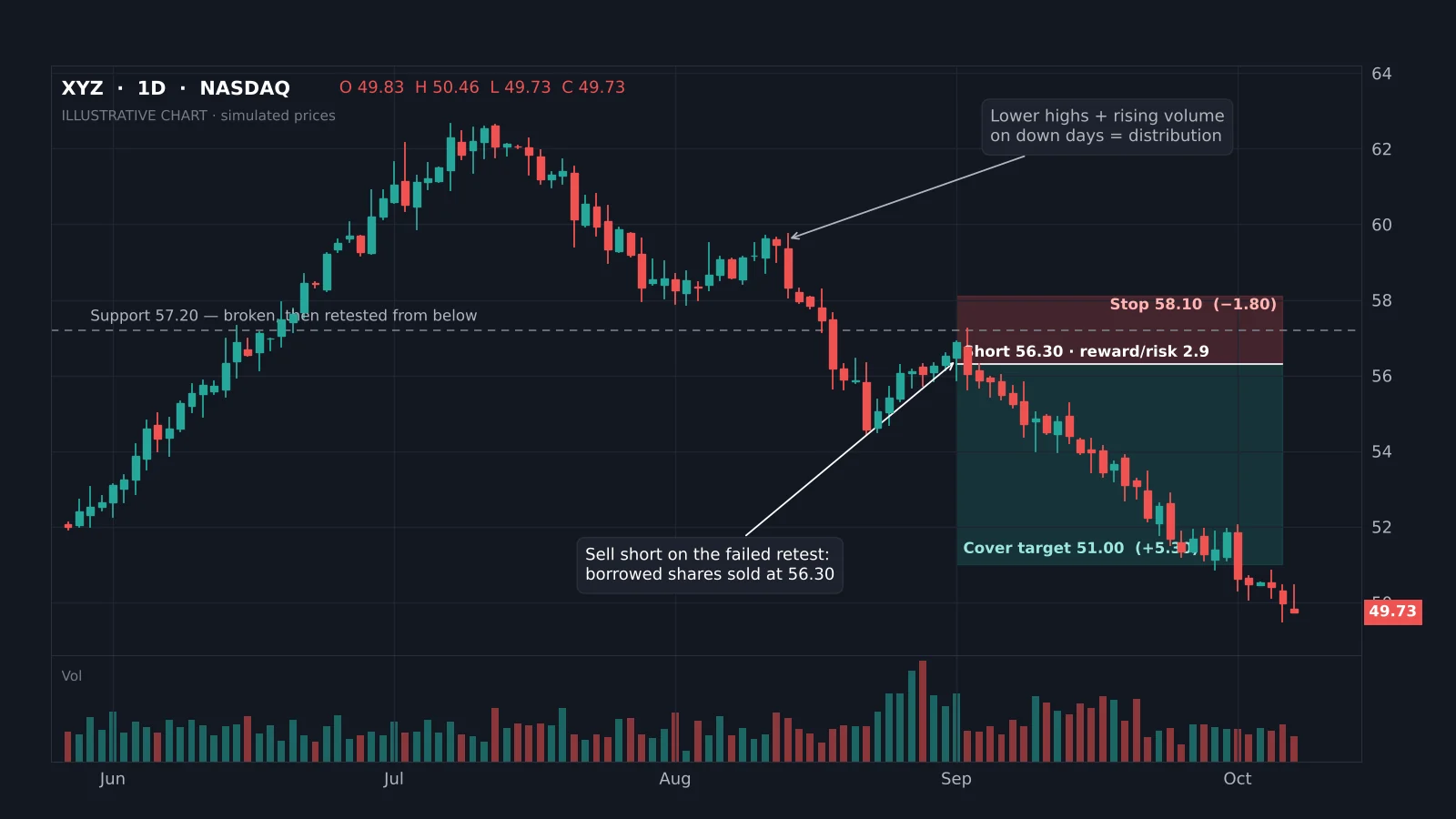
- Sell short. You enter a sell short order, here 100 shares at $56.30. The $5,630 of proceeds stays in your account as collateral, and you must post extra margin on top.
- Hold. While the short is open you pay a borrow fee, and if the company pays a dividend you owe it to the lender.
- Cover. You buy 100 shares to close, here at $51.00, and the shares go back to the lender.
- Settle up. $5,630 minus $5,100 is $530 before costs. Had the stock risen to the $58.10 stop instead, the loss would have been $180 plus costs.
The chart shows the kind of setup discretionary traders look for: a broken support level that fails on the retest, with a stop just above the retest and a target at the next area of demand.
How much does it cost to short a stock?
Shorting has costs a buyer never pays. They are small on liquid large caps held for a day, and large on crowded small caps held for weeks.
| Cost | How it works | Typical size |
|---|---|---|
| Borrow fee | Annual rate charged daily on the shares' value | Under 1% a year for easy-to-borrow; 10% to over 100% for hard-to-borrow |
| Margin interest | On any cash borrowed beyond the short proceeds | Broker's margin rate |
| Dividends | You pay the lender any dividend paid while you are short | The full dividend per share |
| Commissions and fees | As for any trade, plus the SEC fee on the sale | Broker-dependent |
| Buy-in risk | The lender recalls shares and your broker closes the short | Whatever the price is at the time |
The borrow fee is quoted as an annual rate but charged daily on the value of the shares. A stock with a 40% borrow fee costs about 0.11% of the position for each day you hold it, which wipes out a slow-moving short quickly. Day traders who open and close the same day usually pay no borrow fee at many brokers, but check yours; some charge for any short held at the end of the day.
Indicators that prove themselves in public.
One engine, four precision tools — the Gold (XAU) Scalper, the institutional Gravity Zone, the Zeno momentum Oscillator, and Zeno Stocks for equities.
Short selling calculator: profit, borrow cost and margin call price
Enter the trade. The calculator shows the profit or loss after borrow costs and dividends, the equity you need up front under Reg T, and the price at which a 30% maintenance requirement would trigger a margin call if you added no cash.
Brokers often set higher maintenance requirements than the 30% FINRA minimum, especially on volatile or low-priced stocks, so your real margin call can come sooner. Commissions are left out.
What margin do you need to short a stock?
You cannot short in a cash account. Short sales need a margin account, and in the US that means at least $2,000 of equity under FINRA rules, unchanged by the 2026 replacement of the pattern day trader rule.
- Initial margin (Regulation T): 150% of the short position's value. The sale proceeds cover 100%; you post the other 50% in cash or securities.
- Maintenance margin (FINRA Rule 4210): for stocks at $5 or more, the greater of $5 a share or 30% of the current value; for stocks under $5, the greater of $2.50 a share or 100%.
Example: short 100 shares at $50. Proceeds are $5,000 and you post $2,500, so $7,500 sits as collateral. If the stock rises to about $57.70, the position is worth $5,770, your equity has fallen to about $1,730, and that is the 30% maintenance line. Above it the broker issues a margin call or closes the short for you. Our guide to margin trading explains margin calls in detail, and leverage trading covers how leverage changes the arithmetic.
What are the risks of short selling, and what is a short squeeze?
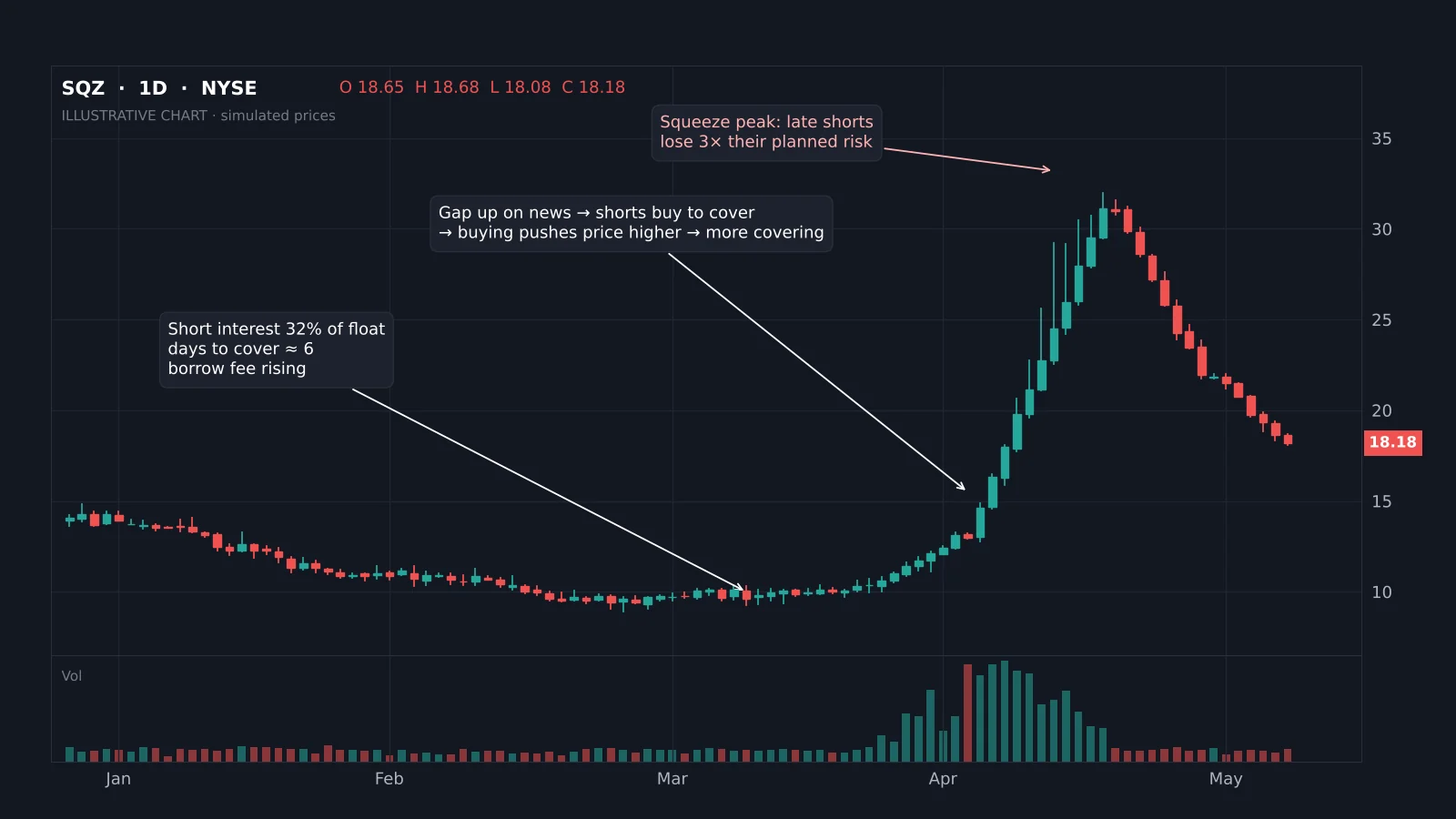
A short squeeze happens when a heavily shorted stock starts rising and short sellers rush to buy back shares to limit their losses. That buying pushes the price higher, which forces more shorts to cover. The best-known modern example is GameStop in January 2021; Volkswagen briefly became the world's most valuable company during a squeeze in 2008.
Two numbers warn you: short interest as a percentage of the free float (above 20% is crowded) and days to cover, short interest divided by average daily volume. FINRA publishes short interest twice a month. A crowded short with a rising borrow fee is a trade where the timing has to be very good.
The other risks: gaps over your stop on news, a lender recalling shares and forcing a buy-in, borrow fees jumping while you hold, and dividends you owe. Each is a reason to keep shorts smaller than equivalent long trades and to use hard stops. Our guides to the squeeze momentum indicator and bull and bear traps help spot moves that trap short sellers.
What rules apply to short selling in the US?
- Locate requirement (Regulation SHO, Rule 203). Before a short sale, your broker must have reasonable grounds to believe the shares can be borrowed and delivered. Selling short without a locate, so-called naked shorting, is prohibited for customers.
- Alternative uptick rule (Rule 201). If a stock falls 10% or more from the prior day's close, short sales for the rest of that day and the next can only be executed above the national best bid. You can still short, but not by hitting the bid.
- Threshold securities. Stocks with persistent delivery failures go on a threshold list with stricter close-out rules.
- Reporting. Brokers report short interest to FINRA twice a month. The SEC's institutional short position reporting on Form SHO has a compliance date of 2 January 2028.
Rules differ in other markets: some European regulators require disclosure of large short positions, and regulators have banned shorting temporarily during crises. If you trade outside the US, check the local rules first.
How do traders find stocks to short?
Most profitable shorts come from one of two places: a weakening trend on the chart, or a fundamental story the market has not priced yet. Technical traders look for:
- A break of support followed by a failed retest, as in the first chart.
- Lower highs and lower lows, with volume rising on down days: see swing points.
- Continuation patterns such as the bear flag and reversal patterns such as the double top.
- Rallies into a prior supply zone that sweep the highs and reverse, covered in liquidity sweep trading.
Avoid shorting a stock only because it "has gone up too much". Strong stocks can stay strong much longer than a short seller can stay solvent, and the market's most violent rallies happen in heavily shorted names.
How else can you bet against a stock?
Shorting shares is not the only way to profit from a fall. Each alternative changes the risk profile.
| Instrument | Maximum loss | Main trade-off |
|---|---|---|
| Short the shares | Unlimited | Borrow fees, margin calls, squeezes |
| Buy a put option | The premium paid | Time decay; you must be right on timing |
| Inverse ETF | The amount invested | Index or sector only; daily reset on leveraged versions |
| Short a future | Unlimited | Contract size and margin; see futures guides |
| CFD short (outside the US) | Can exceed deposit unless protected | Financing costs; not available to US residents |
If you are new to options, start with our options trading for beginners guide before buying puts. Leveraged inverse ETFs reset daily and drift away from the index over weeks, so they suit short-term trades only.
Reference data
| Item | Value (US rules, November 2026) |
|---|---|
| Account type | Margin account; FINRA minimum equity $2,000 |
| Initial margin (Reg T) | 150% of the short position's value |
| Maintenance (FINRA 4210), stocks ≥ $5 | Greater of $5 a share or 30% of value |
| Maintenance, stocks < $5 | Greater of $2.50 a share or 100% of value |
| Locate | Required before a short sale (Reg SHO Rule 203) |
| Uptick rule | After a 10% drop: shorts only above the national best bid, rest of day and next day (Rule 201) |
| Short interest data | Reported to FINRA twice a month |
| Form SHO compliance | 2 January 2028 |
| Maximum gain / loss | 100% of the sale value / unlimited |
Is shorting crypto or forex the same?
The idea is the same, the mechanics are not. In forex every trade is short one currency and long another, so "shorting EURUSD" needs no borrow and has no uptick rule; you pay or earn the interest-rate difference overnight. In crypto you short through perpetual futures, margin trading on an exchange, or options, and the cost is the funding rate rather than a borrow fee. Liquidation levels on crypto exchanges work like an automatic margin call.
Our guides to spot vs futures trading and day trading crypto cover those markets in detail.
What mistakes do new short sellers make?
- No hard stop. A short without a stop has unlimited downside. Place it with the order; see what a stop loss is.
- Sizing like a long. Because losses can exceed the planned risk on gaps, many traders cut short positions to half their normal size. Use position sizing rules, not instinct.
- Ignoring the borrow fee. A 60% fee on a two-week swing costs over 2% of the position before the price moves.
- Shorting into earnings or news. Gaps of 20% or more against you are common.
- Fighting the trend. Picking tops is the most expensive habit in trading; wait for structure to break first.
Is short selling right for you?
Short selling is a normal tool and an important one: it lets traders profit in falling markets and hedge long portfolios, and short sellers have exposed real frauds. It is also less forgiving than buying. The payoff is capped, the risk is not, and costs run every day you hold.
If you are learning, practise on a simulator first, short only liquid stocks with easy borrow, size smaller than your longs and always use a stop. Brokers differ in borrow availability and fees; our guide to Interactive Brokers for day trading covers one of the larger lending inventories.
Short selling means borrowing shares, selling them and buying them back later. It profits from falling prices but has unlimited loss potential, daily borrow costs and margin requirements of 150% initially and at least 30% maintenance. Watch short interest and days to cover for squeeze risk, respect the locate and uptick rules, and always short with a stop.
◆ Interactive check
Do you understand how shorting works?
Questions traders ask about short selling
Borrowing shares, selling them, and buying them back later to return them. You profit if the price falls in between and lose if it rises.
By selling borrowed shares at a high price and buying them back at a lower one. The difference, minus borrow fees, dividends and commissions, is the profit.
Yes. A stock's price has no upper limit, so losses on a short are unlimited in theory, and gaps can jump past a stop.
Yes. Short sales require a margin account with at least $2,000 in equity and 150% initial margin under Regulation T.
A rapid rise in a heavily shorted stock that forces short sellers to buy back shares, and that buying pushes the price even higher.
Easy-to-borrow stocks usually cost under 1% a year. Hard-to-borrow stocks can cost 10% to over 100% a year, charged daily.
Under SEC Rule 201, once a stock falls 10% from the previous close, short sales for that day and the next can only execute above the best bid.
Yes, when the shares are located before the sale. Naked short selling without a locate is prohibited, and regulators can restrict shorting in emergencies.
References & Related Guides
Read next
- What Is Margin Trading?
- The Pattern Day Trader Rule
- Is Interactive Brokers Good for Day Trading?
- Bear Flag Pattern
- Bull Trap and Bear Trap
- Options Trading for Beginners
- Best Stocks for Covered Calls
- Spot vs Futures Trading
- Risk Management
- What Is a Stop Loss?