What Is Margin Trading? Initial vs Maintenance Margin, Margin Calls and a Calculator
Margin trading is borrowing from your broker or exchange to control a position larger than your cash, used as collateral. You post initial margin, borrow the rest, pay interest, and gains and losses apply to the full position. Equity below maintenance margin triggers a margin call; miss it and the position is closed. Size from the stop, then check margin.
Margin is the word every product uses and each one means something slightly different by it — a loan in a stock account, a performance bond in futures, a close-out level in forex and CFDs, a liquidation engine in crypto. What they share is the arithmetic of the margin call, and that is what this page is built around: the ledger, the step-by-step call on a real chart, the product-by-product rules, the cost, and a calculator that tells you the price at which a position gets closed for you.
Indicators that prove themselves in public.
One engine, four precision tools — the Gold (XAU) Scalper, the institutional Gravity Zone, the Zeno momentum Oscillator, and Zeno Stocks for equities.
What is margin trading?
Margin trading is borrowing from your broker or exchange to control a position larger than the cash in your account, using the cash as collateral. Buy $10,000 of stock in a cash account and you need $10,000. Buy it on margin and you post $5,000, borrow $5,000, and pay interest on the loan — the cash-vs-margin comparison in this guide shows both ledgers side by side. Your gains and losses are on the full $10,000, which is why margin is described as leverage: it multiplies both directions.
The mechanics differ by product — stocks, futures, forex, crypto and CFDs all use the word "margin" for slightly different things — but the logic is the same everywhere, and so is the failure mode: a position that loses more than the collateral can absorb gets closed for you. Understanding exactly when that happens is the point of this page.
What are initial margin, maintenance margin and buying power?
Initial margin is what you must post to open the position. For US stocks, Regulation T sets it at 50% of the purchase. For futures, the exchange sets a "performance bond" per contract. For forex and CFDs the broker sets a percentage — 3.33% at 1:30 leverage in the UK and EU. For crypto perpetuals, it is the notional divided by your chosen leverage.
Maintenance margin is the minimum equity you must keep while the position is open. Stocks: 25% under FINRA rules, often 30–40% at the broker's discretion. Futures: usually 80–90% of initial. Crypto: a tiered percentage that rises with position size.
Buying power is how much you could still buy: for a stock margin account it is roughly twice your available cash, minus what is already committed.
Equity is what would be left if the position were closed now — the market value of what you hold minus what you borrowed. Everything about margin comes back to this number.
How does a margin call happen, step by step?
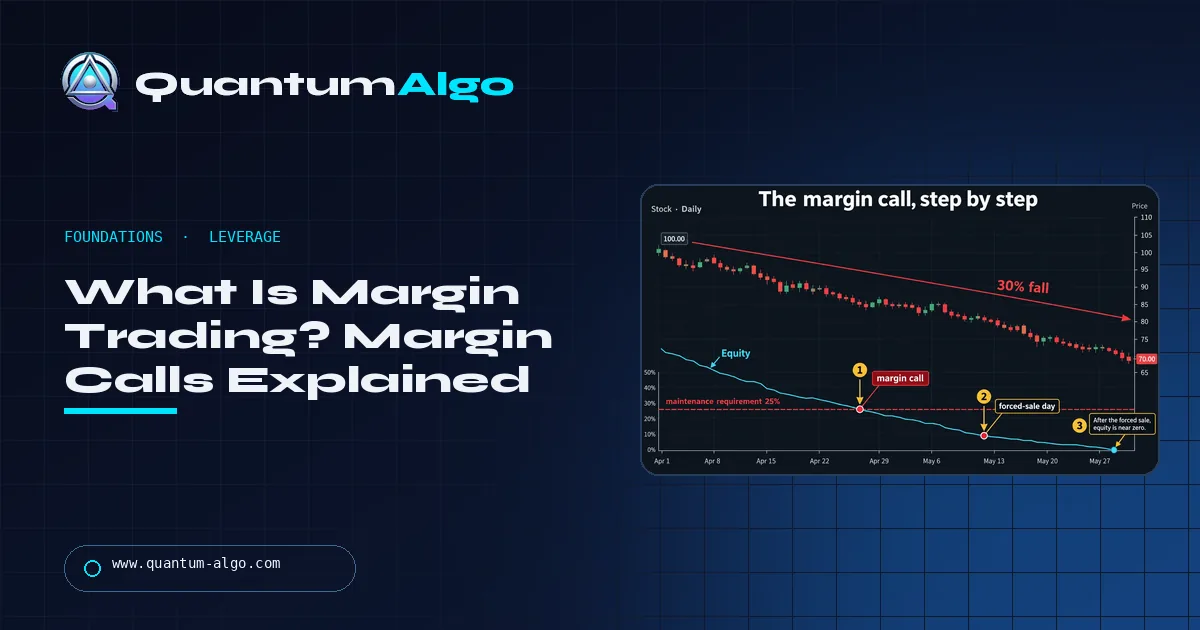
The chart in this guide walks through it. You buy $10,000 of stock with $5,000 of your own money. Equity is 50%. The stock falls 30%: the position is worth $7,000, the loan is still $5,000, your equity is $2,000 — 28.6% of the position value. At a 25% maintenance requirement you are almost there. A few more percent down and equity crosses the line: that is the margin call, a demand to deposit cash or sell. If you do neither, the broker sells — the forced-sale day — and after commissions and the gap, your $5,000 is close to zero.
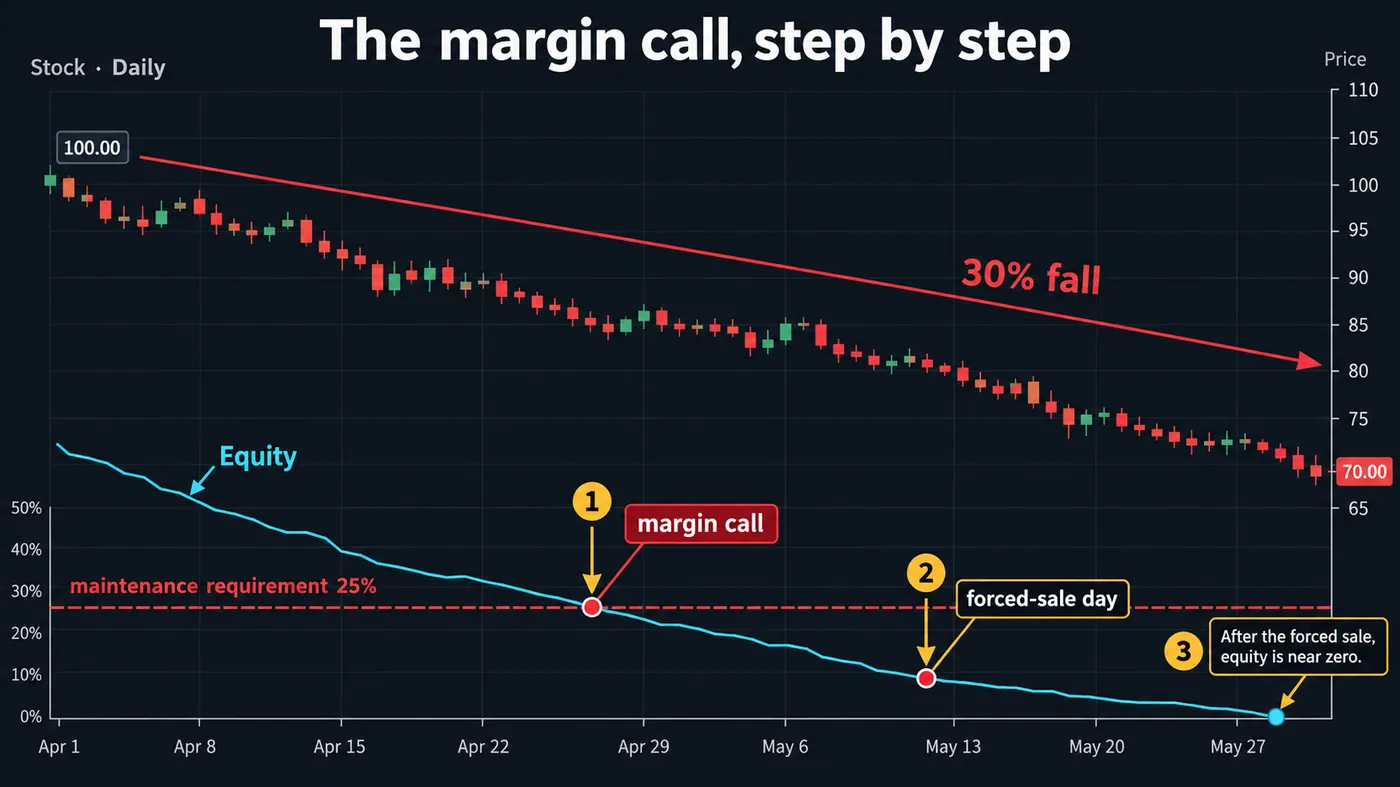
The arithmetic that beginners miss: a 30% fall in the stock became a roughly 60% fall in your equity, because the loan does not shrink when the price does.
The margin-call price is calculable in advance: price × (1 − maintenance) ≥ loan per share. With $50 shares, $25 borrowed per share and 25% maintenance, the call comes at $33.33. The calculator on this page does that for any position.
How does margin differ across products?
The table illustration in this guide lines up the five common products:
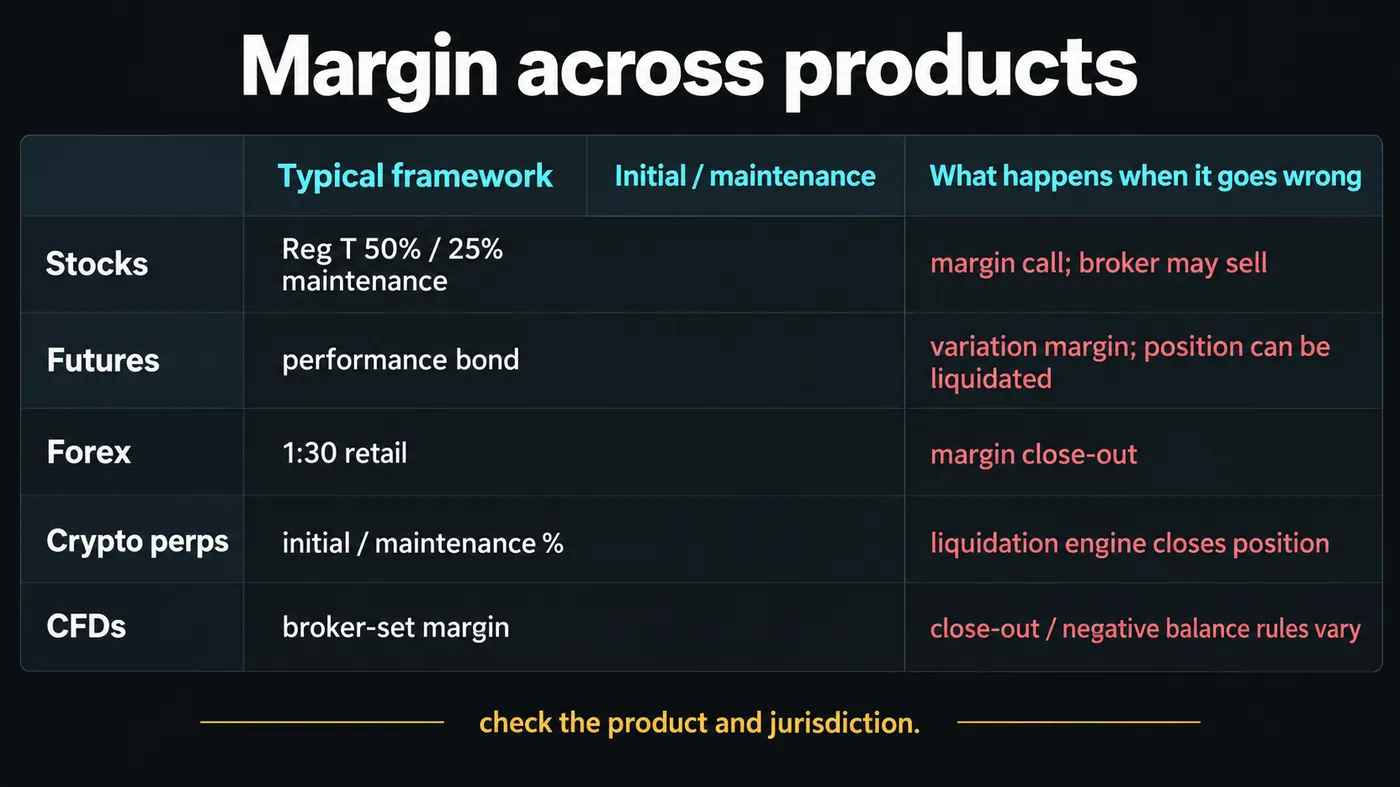
| Product | Framework | When it goes wrong |
|---|---|---|
| Stocks | Reg T 50% initial / 25% maintenance | margin call; broker may sell your shares |
| Futures | exchange performance bond, marked daily | variation margin call; position liquidated |
| Forex (retail, UK/EU/AU) | 1:30 majors, 1:20 gold / indices | margin close-out at 50% of required margin |
| Crypto perpetuals | initial and maintenance %, tiered by size | liquidation engine closes the position |
| CFDs | broker-set margin, changes around news | close-out; negative balance protection varies |
The forex and crypto rows are where beginners get hurt, because the leverage is high and the close-out is automatic. A 1:30 forex position needs only a 3.3% adverse move to wipe the margin; a 50× crypto perpetual needs 2%. Neither is "margin trading" in the stock sense of a loan you can top up — the venue closes you out on its own schedule.
Is margin the same as risk?
The most useful sentence on this page: margin is what the broker holds, risk is what the stop costs you. A position can require $500 of margin and risk $2,000 if the stop is far away, or require $5,000 and risk $50 if the stop is tight. Size from the stop and your risk percentage, then check that the margin is available — never the other way round. Our notional value guide and position sizing guide walk through the order of operations.
How much does margin trading cost?
Stock margin loans charge interest at a broker rate, typically a benchmark plus a few percent, accrued daily. Futures charge nothing to hold but require daily settlement of gains and losses. Forex and CFDs charge overnight financing on the full notional. Crypto perpetuals charge funding every eight hours. On a $10,000 position held for a month, these range from about $40 (a competitive stock broker) to $100 or more (CFD financing), and they are paid whether or not the trade works.
When does margin trading make sense?
Margin is reasonable when the borrowed money buys a position you would want to hold anyway at a size your risk rules already allow, and the interest is cheaper than the opportunity. It is unreasonable when it is the only way to reach a position size your account cannot otherwise support — that is not leverage, it is a loan to gamble with. If a trade only works at 20×, the problem is the trade.
How do you use the margin calculator?
Enter the price, quantity, your cash, the initial requirement and the maintenance requirement. The calculator returns the loan amount, your equity percentage, buying power, and the price at which a margin call or liquidation would be triggered. Try it with a 30% drop to see the equity arithmetic in the margin-call chart for yourself.
Margin is borrowed exposure secured by your cash. Initial margin opens the position, maintenance margin keeps it open, and equity falling through the maintenance line is the margin call — deposit, sell, or be sold. The rules differ by product but the arithmetic is the same: a 30% fall in the asset is a 60% fall in your equity at 2×. Size from the stop and your risk percentage; margin is the last thing you check, not the first.
◆ Interactive check
Do you know when the call comes?
Questions people ask about margin trading
Leverage is the ratio of position size to your own capital; margin is the collateral you post to get it. Trading on margin is how you obtain leverage.
The broker sells enough of your positions to bring the account back above the maintenance requirement, usually without asking which ones. In products with negative balance protection you cannot owe more than your deposit; elsewhere you can.
The pattern-day-trader rule has required $25,000 of equity in a margin account to make more than three day trades in five business days; below that, you were limited to three. FINRA replaced it with intraday margin standards effective 4 June 2026, but brokers may keep the old limit until 20 October 2027, so check your broker.
In a US stock margin account, yes — if a gap takes the position below the loan value, you owe the difference. Under UK/EU/AU retail rules for forex and CFDs, negative balance protection caps the loss at your deposit. Crypto exchanges liquidate before equity reaches zero but can leave a small negative balance in extreme gaps.
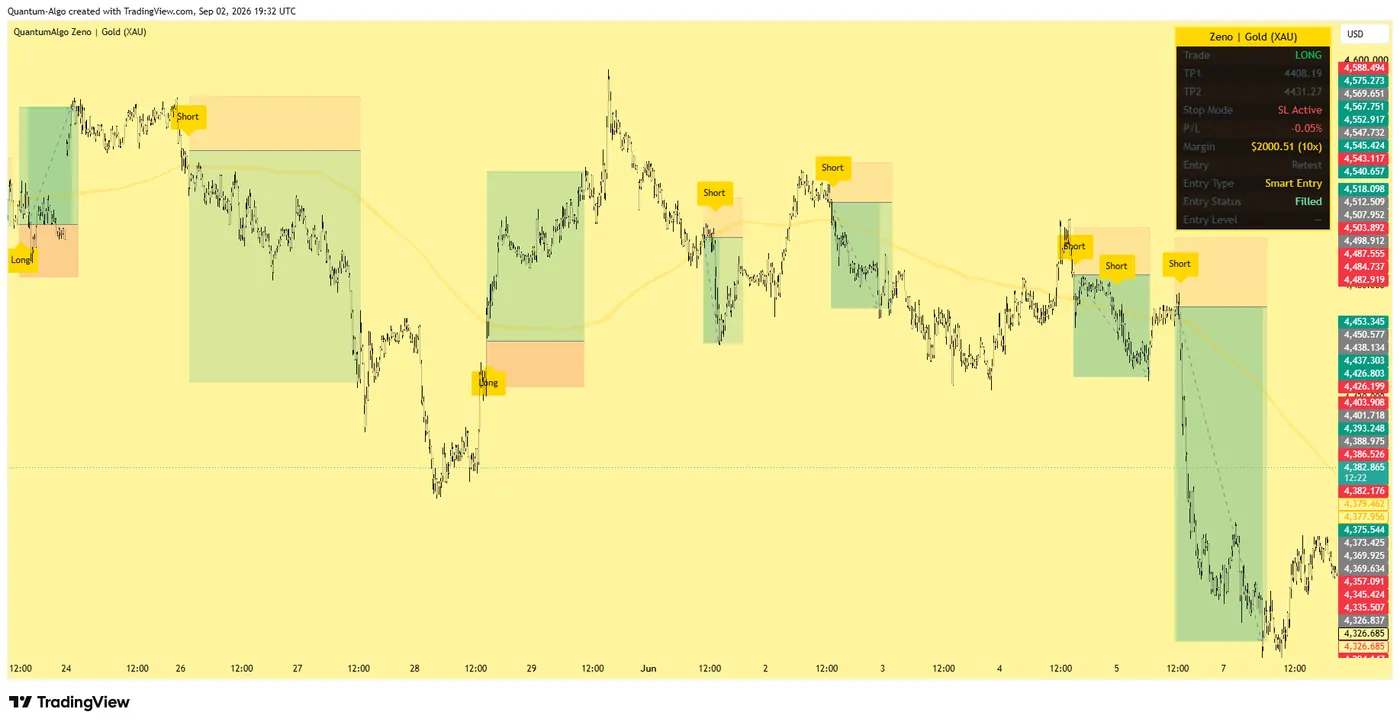
Zeno's dashboard shows the margin and leverage on each signal so you can see the exposure behind the trade; QuantumBot executes at the leverage you configure on your own exchange account. Neither changes the rule: size from the stop, then confirm the margin.
No. Learn to size from the stop and keep a defined loss on a cash account first. Margin multiplies mistakes as efficiently as it multiplies gains, and a beginner has more mistakes than gains.
Daily, on the borrowed amount, at the broker's rate (a benchmark plus a mark-up). $5,000 borrowed at 8% costs about $33 a month whether or not the trade works.
The level — 50% of required margin under UK/EU/AU rules — at which the broker automatically closes positions to stop the account going negative. It is the forex equivalent of a forced sale, without the phone call.
Used margin is what your open positions require; free margin is equity minus used margin — the amount available for new positions before a call.
Yes. The dashboard on every Zeno chart shows the margin and leverage on the position beside the stop and targets, so the exposure behind the signal is visible before you take it.
References & Related Guides
Read next
- How to Start Trading Stocks: Accounts, Rules, Your First Trade, and the Week That Follows
- Futures Trading for Beginners: Contracts, Ticks, Margin, Micros and Futures vs Options
- What Is the Pattern Day Trader (PDT) Rule? What Changed, What Counts, and What Brokers Still Apply
- Order Types Explained: Market vs Limit vs Stop vs Bracket Orders (and Which to Use When)
- Leverage Trading: Complete Guide
- What Is Notional Value in Trading?
- Liquidation in Trading
- Position Sizing: The Complete Guide
- Lot Size Calculator for Forex and Gold
- Funding Rate Trading Guide
- Spot vs Futures Trading
- What Is Trading?
Authoritative sources
- FINRA: purchasing on margin and maintenance requirements
- SEC: margin — borrowing money to pay for stocks
- eCFR: Regulation T (12 CFR Part 220)
- CME Group: futures margin (performance bonds)
- ESMA: retail leverage limits and margin close-out rule