Is Day Trading Worth It? The Honest Answer With the Loss Rates, the J-Curve and the Arithmetic
For most people, no. Regulated brokers publish retail loss rates of 65–82%, and studies that follow day traders put consistent profitability in the low single digits. Day trading is worth it if you have a documented edge, enough capital that the expected income beats the hours (usually $25,000 and up), a free session every day, and the temperament to sit through a six-month J-curve. As a way to turn $5,000 into a salary, it is not.
I day trade and publish every trade, so this is not the "impossible" answer — it is the arithmetic that decides whether it is worth it for you: the loss rates brokers are required to print, what a genuinely good strategy earns at three account sizes, the J-curve most traders quit inside, and the honest profile of the people it pays. The calculator below turns your own numbers into a monthly figure and the drawdown you would have to sit through to earn it.
Indicators that prove themselves in public.
One engine, four precision tools — the Gold (XAU) Scalper, the institutional Gravity Zone, the Zeno momentum Oscillator, and Zeno Stocks for equities.
Is day trading worth it?
For most people, no — and the people it is worth it for can tell you exactly why, with a record. Regulated brokers in the UK and EU are required to publish the share of retail accounts that lose money, and the figures cluster between 65% and 82%; academic studies of day traders specifically put the share who are consistently profitable in low single digits. Day trading is worth it if you have a documented edge, enough capital that the expected income beats the hours, and the temperament to sit through a six-month J-curve. It is not worth it as a way to turn $5,000 into a salary.
I am not going to tell you it is impossible, because I do it and publish every trade. I am going to show you the arithmetic that decides whether it is worth it for you, which is a different and more useful question.
What the disclosures say
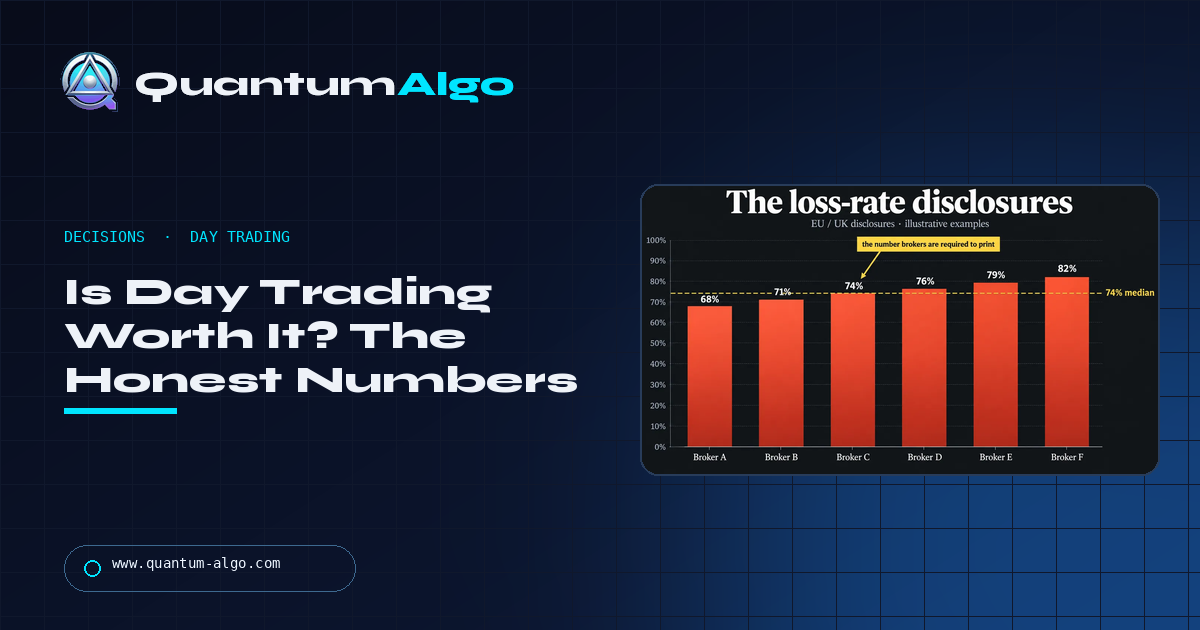
The loss-rate chart in this guide shows the figures six regulated brokers print under their risk warnings: 68%, 71%, 74%, 76%, 79%, 82% of retail CFD accounts losing money over the reporting period, median around 74%. Those numbers cover all retail clients, not just day traders. Studies that isolate day traders are harsher: the best-known Brazilian study of futures day traders found that 97% of those who persisted for more than 300 days lost money, and only around 1% earned more than the local minimum wage.
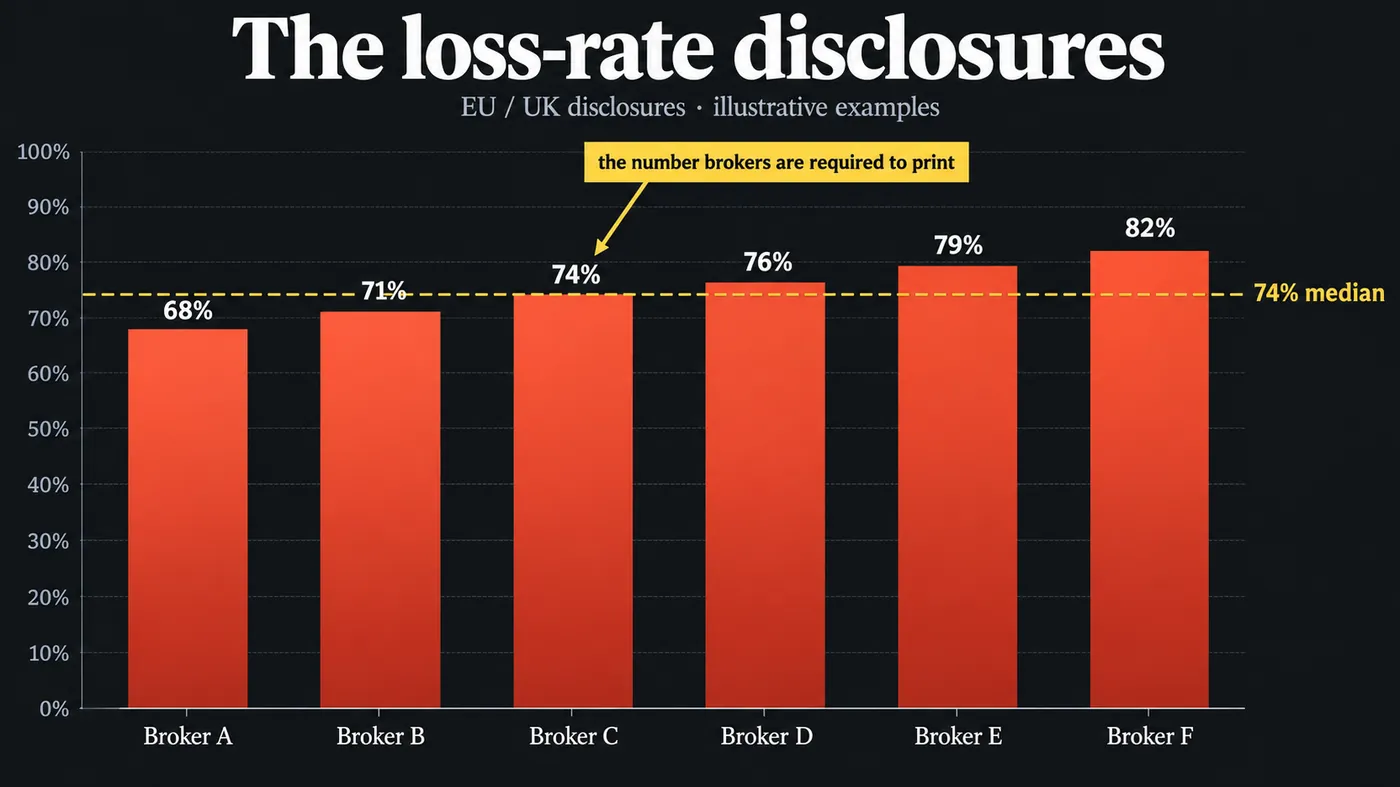
Two things to take from that. First, the base rate is against you, and anyone selling you day trading without saying so is selling. Second, the base rate is an average over people who mostly did none of the things the how-to-start roadmap describes. The question is whether you can be in the tail, and whether the tail pays enough.
"Worth it" is an arithmetic question, not a feeling
The three-column illustration in this guide runs the same decent strategy — 0.5R expectancy, three trades a day, 1% risk — on three account sizes:
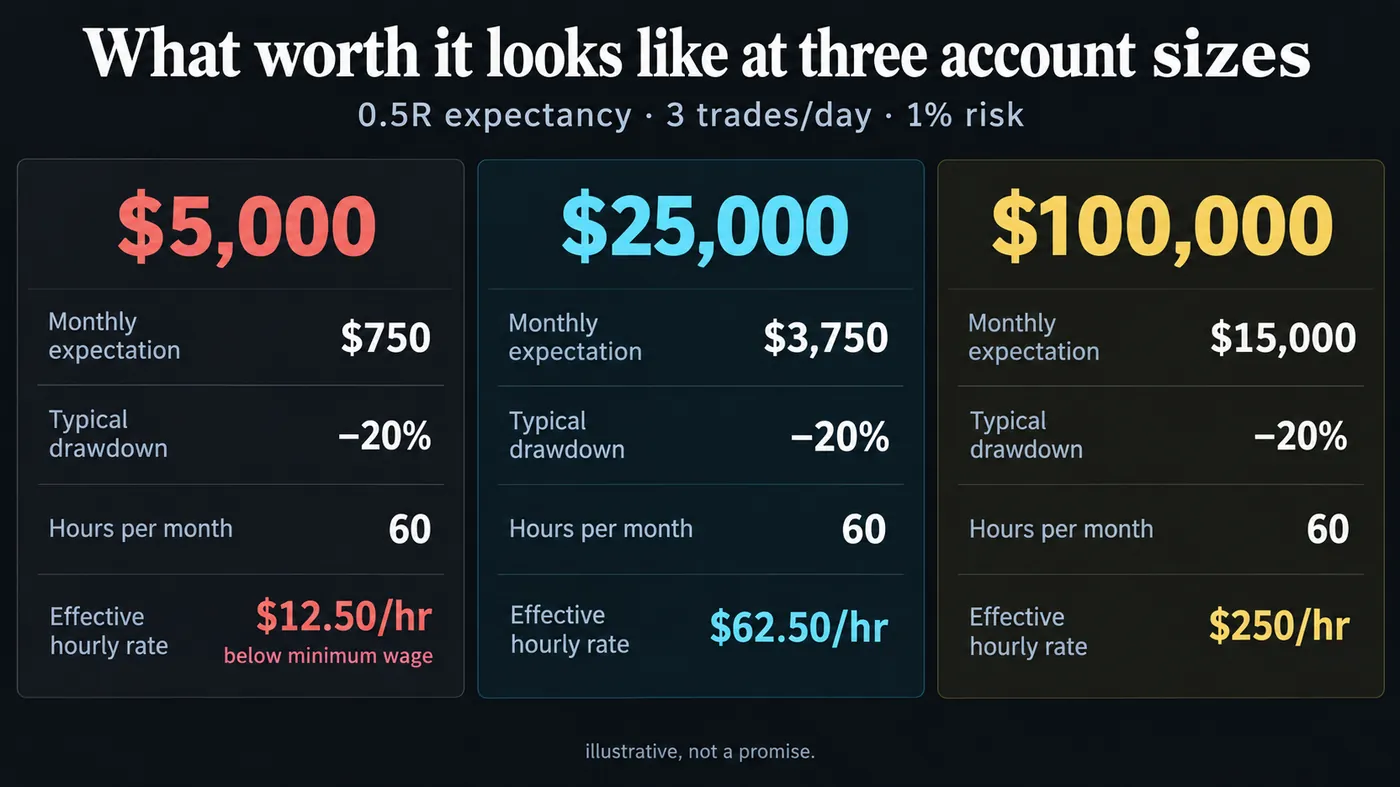
- $5,000: about $750 a month expected, with a typical 20% drawdown, for sixty hours of screen time. Roughly $12.50 an hour — below minimum wage in most of the countries our readers live in.
- $25,000: about $3,750 a month, same drawdown, same hours: $62 an hour.
- $100,000: about $15,000 a month: $250 an hour.
The strategy is identical. What changed is that day trading is a percentage game and percentages need a base. Below roughly $25,000 the expected income of a good day trader is a part-time job that costs more attention than a full-time one; the small-account trader who "makes it" does so by growing the account first and treating the early years as unpaid. The calculator on this page runs your own numbers.

Automate your trades. Let Quantum Algo trade for you.
Every signal executed on your own account — on your account, with the plan you define.
The J-curve
The equity chart in this guide is the shape of a career that works: six months of decline while the trader learns what their setup actually is, six months flat while execution catches up with knowledge, then a slow rise. Most people quit in months four to nine — at the bottom of the curve, exactly where the losses stop being expensive lessons and start being tuition already paid.
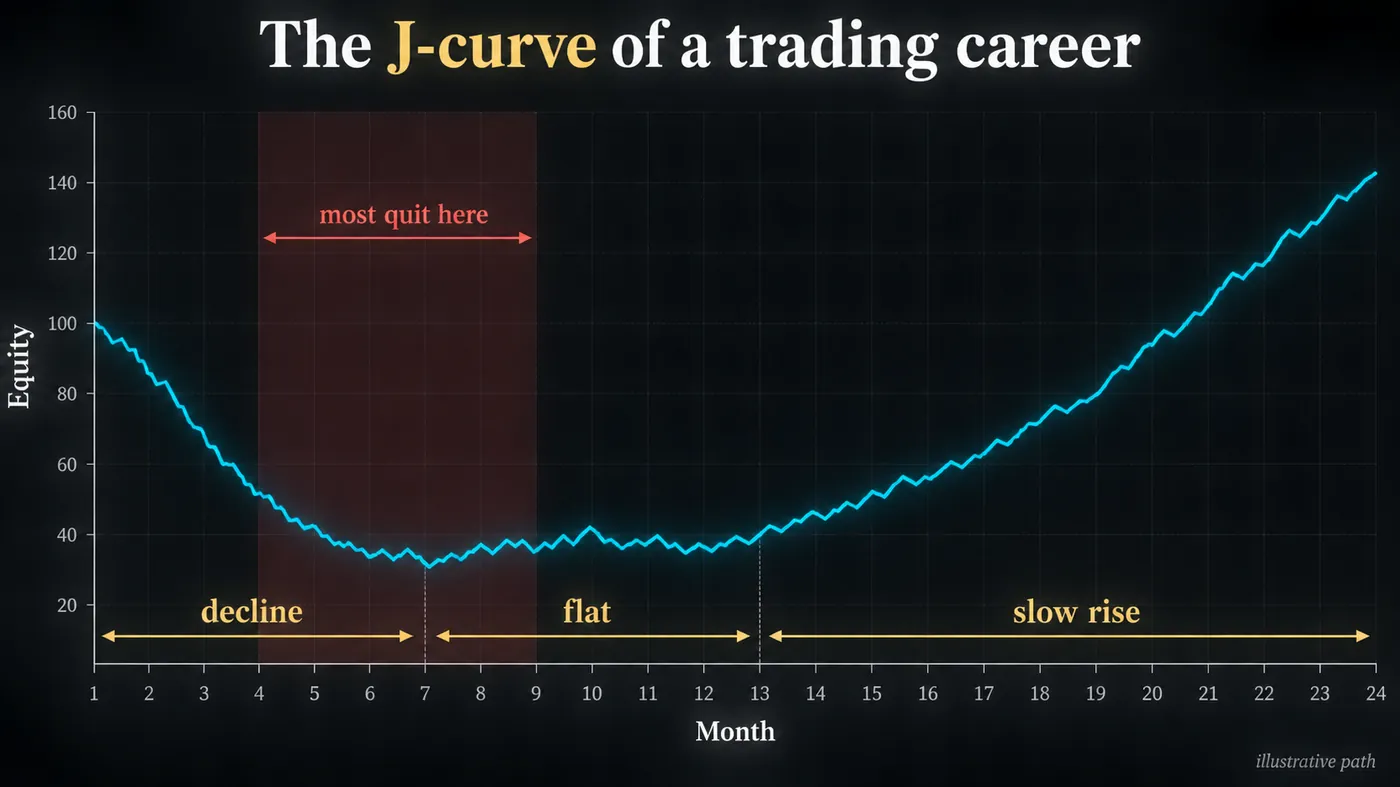
Worth it, then, includes the question of whether you can afford the J: financially (the drawdown comes out of savings, not income) and emotionally (a year of doing something badly on purpose). The traders who make it are not the ones who avoided the curve; they are the ones who planned for it.
Who day trading is worth it for
- Someone with a written setup that has a positive expectancy across at least fifty logged trades, after costs.
- Someone with capital large enough that the expected monthly income exceeds what the same hours earn elsewhere — usually $25,000 and up, more for stocks.
- Someone whose day allows a full session, every day, in the market's active hours.
- Someone who can lose the drawdown without it changing their life.
- Someone who enjoys the process enough to do the boring version — fixed risk, one setup, a journal — for a year.
If two or more of those are missing, swing trading is the honest alternative: the same edge, a tenth of the trades, no session requirement, and no PDT rule. It is how most profitable retail traders actually trade.
Who it is not worth it for
The person day trading to escape a job they hate, on money they need, in the evenings after work in a session with no liquidity, on the strength of a signal group. That is the median profile behind the 74%, and the outcome is not a mystery.
What "worth it" means for us
Quantum Algo publishes 160 posted trades on TradingView with a 75% win rate at the stated stops and targets. That is a record, not a promise — it was built on gold in the London and New York sessions with fixed risk, and the losing trades are in the ledger next to the winners. The reason we publish it is the reason this page exists: the only honest answer to "is it worth it" is a set of numbers you can check.
The base rate is against you and the disclosures prove it. Day trading is worth it for a minority who can show a documented edge, fund the drawdown, give it a full session daily and sit through the J-curve — and even for them it only pays once the account is large enough for percentages to mean something. For everyone else, swing trading is the honest version of the same edge.
◆ Interactive check
Do you know the numbers?
Questions people ask about whether day trading is worth it
As education, yes; as income, rarely. Below about $25,000 the expected return of a good day trader is less per hour than most jobs. Use the small account to build a record, and grow it slowly.
Studies that follow day traders over time put consistent profitability in the low single digits — around 1–3%. Broker disclosures for all retail CFD clients show 65–82% losing over a year.
For most people swing trading is better: fewer trades, no session requirement, no pattern day trader rule and the same edge. Day trading wins only when capital, time and temperament are all present.
With a documented 0.5R-per-trade edge at 1% risk and three trades a day, roughly 15% a month before costs and drawdowns — which is $750 on $5,000 and $15,000 on $100,000. Most traders do not have that edge.
Yes, through a regulated broker. The US pattern day trader rule restricts frequent day trading in stock margin accounts under $25,000; futures, forex and crypto have no such rule.
The economics have not changed: the base rate is against you, the edge is real for a minority with a process, and the income scales with capital. What has changed is access — micro futures and paper accounts make the learning phase cheaper than it was.
It scales with the account. A documented 0.5R edge at 1% risk and three trades a day is roughly 15% a month before costs; on $100,000 that is a living, on $5,000 it is not. Most reported "day trader salaries" are for prop-firm or bank traders with someone else's capital.
Investing in an index fund has a positive expected return with no screen time; day trading has an unknown expectancy that is negative for most people. Day trading is worth it only if you can prove your edge beats the index after costs and hours.
Yes, and the stress is part of the cost: the J-curve is emotional as well as financial. Fixed risk, one setup and a journal reduce it; they do not remove it.
Because the only honest answer to "is it worth it" is a set of numbers you can check. 160 posted trades with the stop and targets stated before the outcome, wins and losses kept, is our version of that answer.
References & Related Guides
Read next
- How to Start Trading: 90-Day Roadmap
- Is Day Trading Gambling?
- How Much Money to Start Day Trading?
- Pattern Day Trader Rule
- Monte Carlo Simulation for Trading
- Trading Psychology
- Why Do Most Traders Lose Money?
- Quantum Algo Track Record
Authoritative sources
- ESMA: retail CFD measures and mandatory loss-rate disclosure
- FCA: permanent CFD restrictions and risk warnings
- Chague, De-Losso & Giovannetti: "Day Trading for a Living?" (SSRN)
- SEC: day trading — your dollars at risk
- FINRA: day trading