How to Start Trading Stocks: Accounts, Rules, Your First Trade, and the Week That Follows
You start trading stocks by opening a regulated brokerage account — a cash account for a beginner, margin only once you know the rules that come with it — funding it with money you can afford to learn with, paper trading one written setup on the same platform until fifty logged trades show a stable result, and then placing your first live trades in fractional or single shares with a bracket order. The general roadmap applies; the stock-specific decisions are the account type, settlement, the pattern day trader rule, and the trading day.
Our general roadmap deliberately does not pick a market; this page picks stocks and adds what that choice brings: the cash-versus-margin decision most beginners make by accident, the broker checklist, the first trade annotated on a real chart with the five decisions numbered, the shape of the trading day and week, the rules learned the hard way, and the stock edition of the 90-day plan. The account chooser below tells you which account type fits your capital and intentions, and what the PDT rule means for you.
Indicators that prove themselves in public.
One engine, four precision tools — the Gold (XAU) Scalper, the institutional Gravity Zone, the Zeno momentum Oscillator, and Zeno Stocks for equities.
How do you start trading stocks?
You start trading stocks by opening a regulated brokerage account — a cash account for a beginner, a margin account only once you know the rules that come with it — funding it with money you can afford to learn with, paper trading a single written setup on the same platform until fifty logged trades show a stable result, and then placing your first live trades in fractional shares or single shares with a bracket order. The general roadmap on our how-to-start-trading page applies; this page adds the stock-specific decisions it deliberately leaves out — the account type, the settlement and pattern-day-trader rules, the trading week, and the first trade annotated on a real chart.
Cash account or margin account
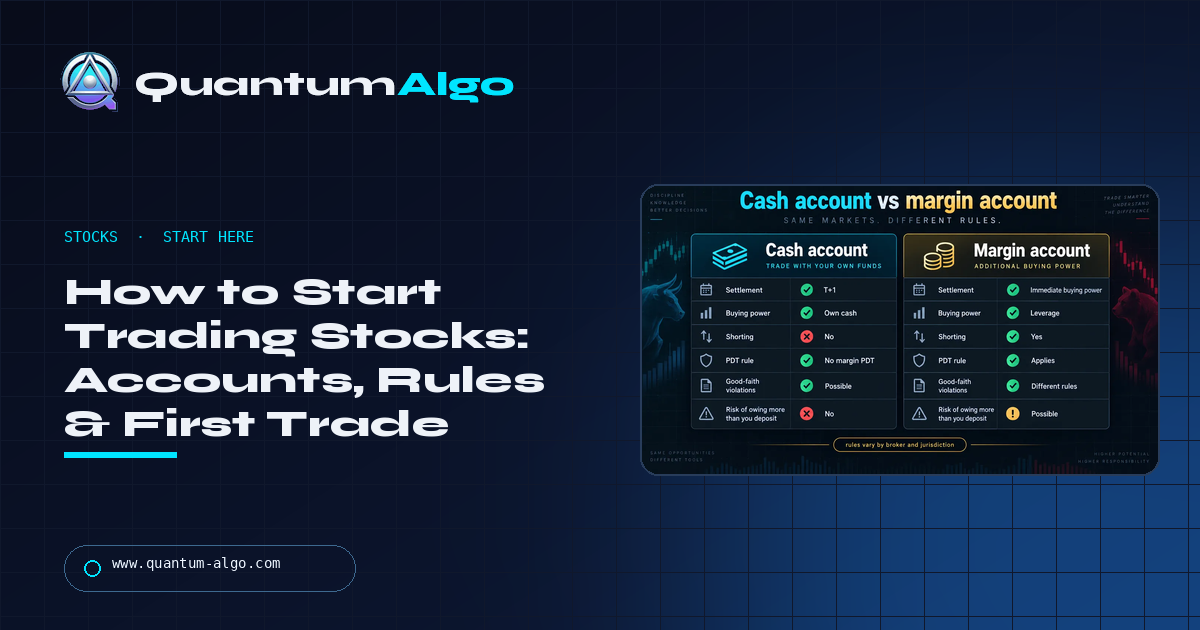
The comparison illustration in this guide is the first decision, and most beginners make it by accident when the broker's form defaults to margin:
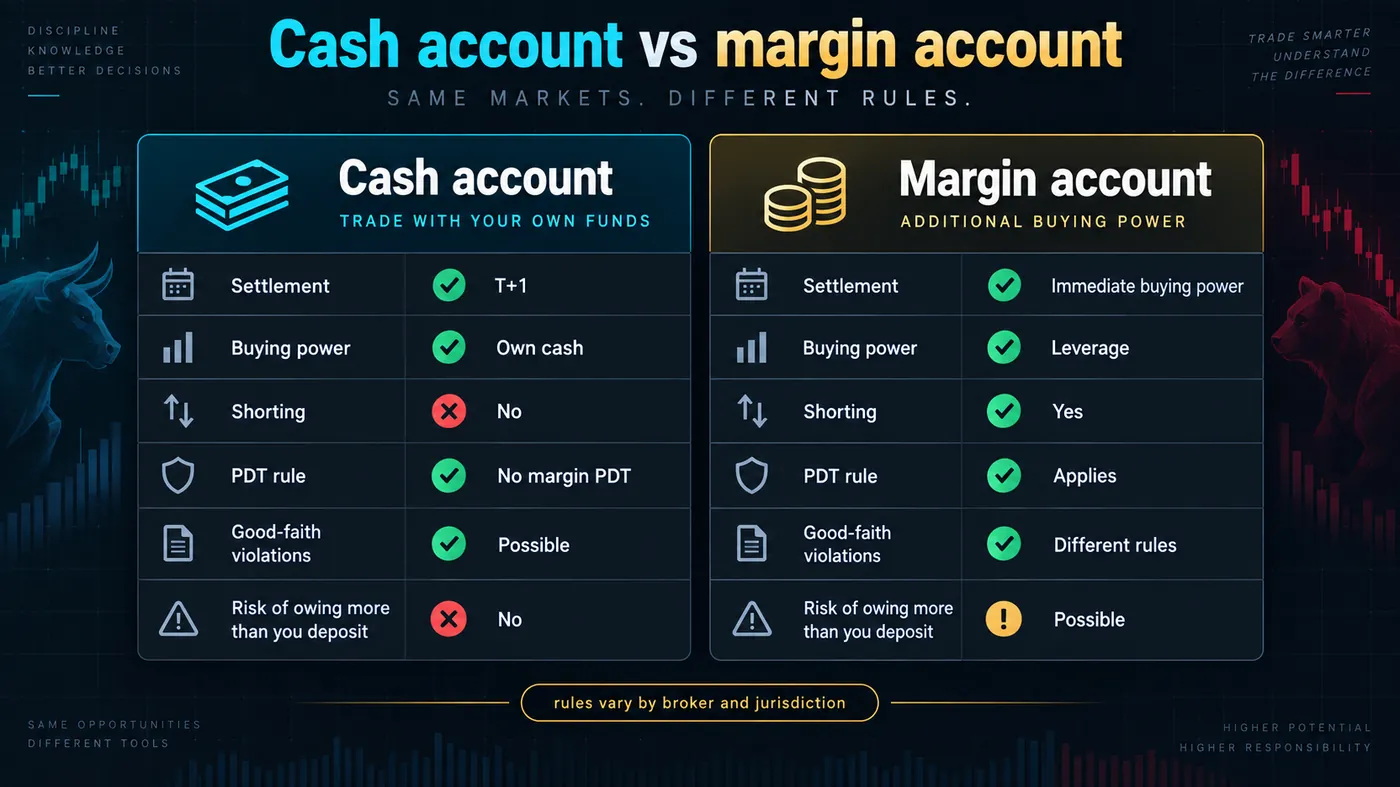
| Cash account | Margin account | |
|---|---|---|
| Settlement | Buy with settled cash; sale proceeds settle next business day (T+1) | Immediate buying power against your balance |
| Buying power | Your cash | Up to 2× overnight, 4× intraday for a pattern day trader |
| Shorting | No | Yes |
| Pattern day trader rule | Does not apply | Applies: four day trades in five business days under $25,000 restricts the account |
| Good-faith violations | Possible — buying with unsettled funds then selling | Not applicable |
| Can you owe more than you deposited? | No | Yes |
For a beginner the cash account is the right default: no PDT rule, no leverage, no possibility of owing the broker. The constraint is settlement — you can only spend cash that has settled, which limits how many round trips a small account can make in a day, and buying with unsettled funds then selling is a good-faith violation (three in a year restricts the account). A margin account becomes worth it when you want to short, or when you have $25,000 and intend to day trade. Our margin-trading and PDT guides cover both rules in full.
Choosing the broker
Regulated (SEC/FINRA, SIPC-covered), fractional shares, a paper-trading account on the live platform, bracket orders in the ticket, transparent pricing (spread and payment-for-order-flow disclosures if commission-free), and — ideally — TradingView integration so you analyse and execute on one chart. Our best-trading-platforms pillar ranks the platform types; the stock section there is the one to read. Beginners should ignore the welcome bonus and the app's social feed.
Your first stock trade, annotated
The chart illustration in this guide is a large-cap daily chart with the five decisions of a trade numbered:
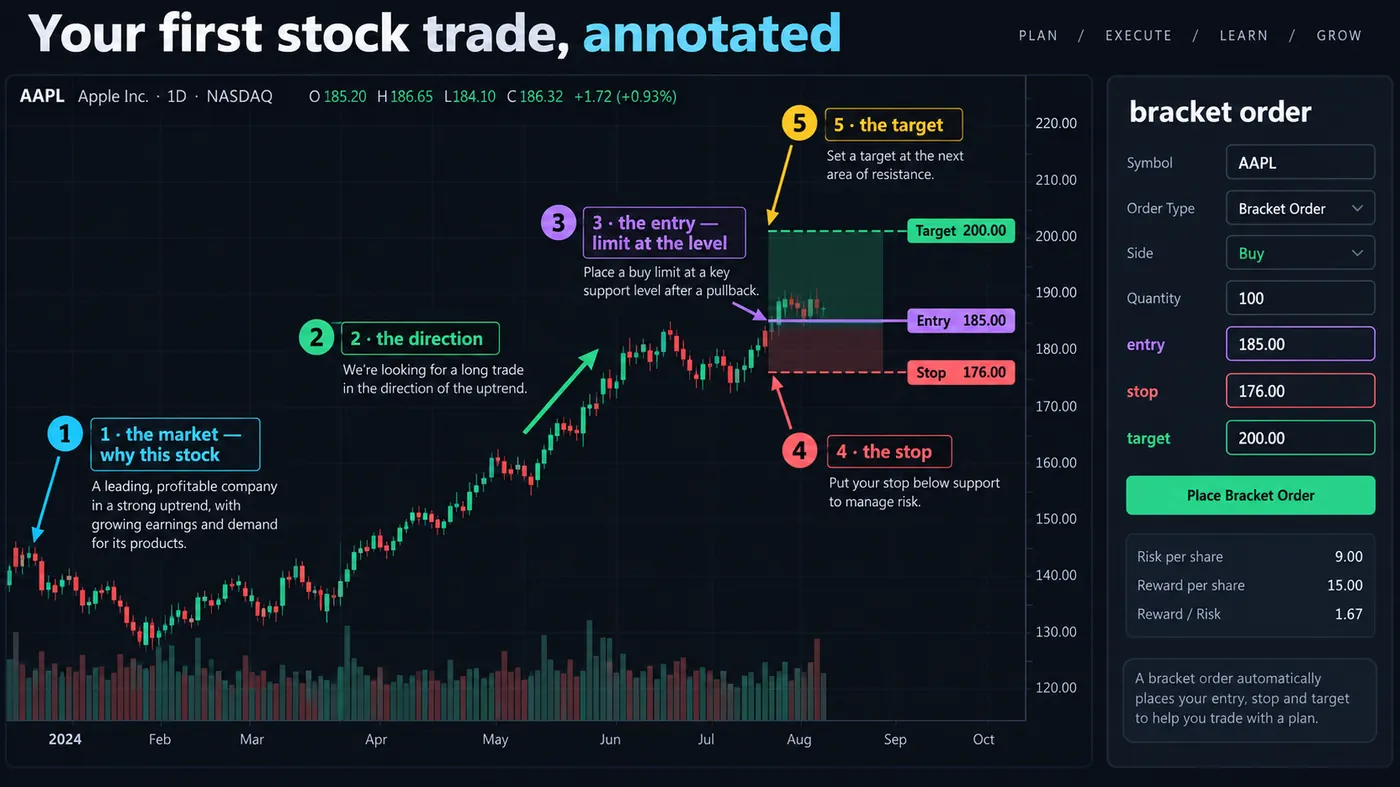
- The market — why this stock. A liquid name with a catalyst or a clear trend; you can explain why it is on the chart in one sentence.
- The direction. Long, because the structure shows higher highs and higher lows and price has pulled back to a level that held before.
- The entry — a limit at the level. Not a market order in the first minute; a limit order at the retest of support, placed and left.
- The stop. Below the level that would prove the idea wrong, sized so the loss is 1% of the account.
- The target. The prior high — the next place sellers are known to be.
The order ticket beside the chart is a bracket: entry, stop and target in one order, so the exits exist before you can change your mind. Our order types guide explains every field.
The stock trading week
The timeline illustration in this guide is one trading day: pre-market 4:00 am ET (thin), the open at 9:30 with the volume spike, the lunch lull, the 3:00 pm push, the close at 4:00, after-hours to 8:00 (thin again). The shaded zones are where a beginner should and should not be trading: not the first five minutes (the spread and the chaos), not pre-market or after-hours (limit orders only, and no need), yes the 9:45–11:00 window and the 3:00–3:50 window, when volume is real and structure has formed.
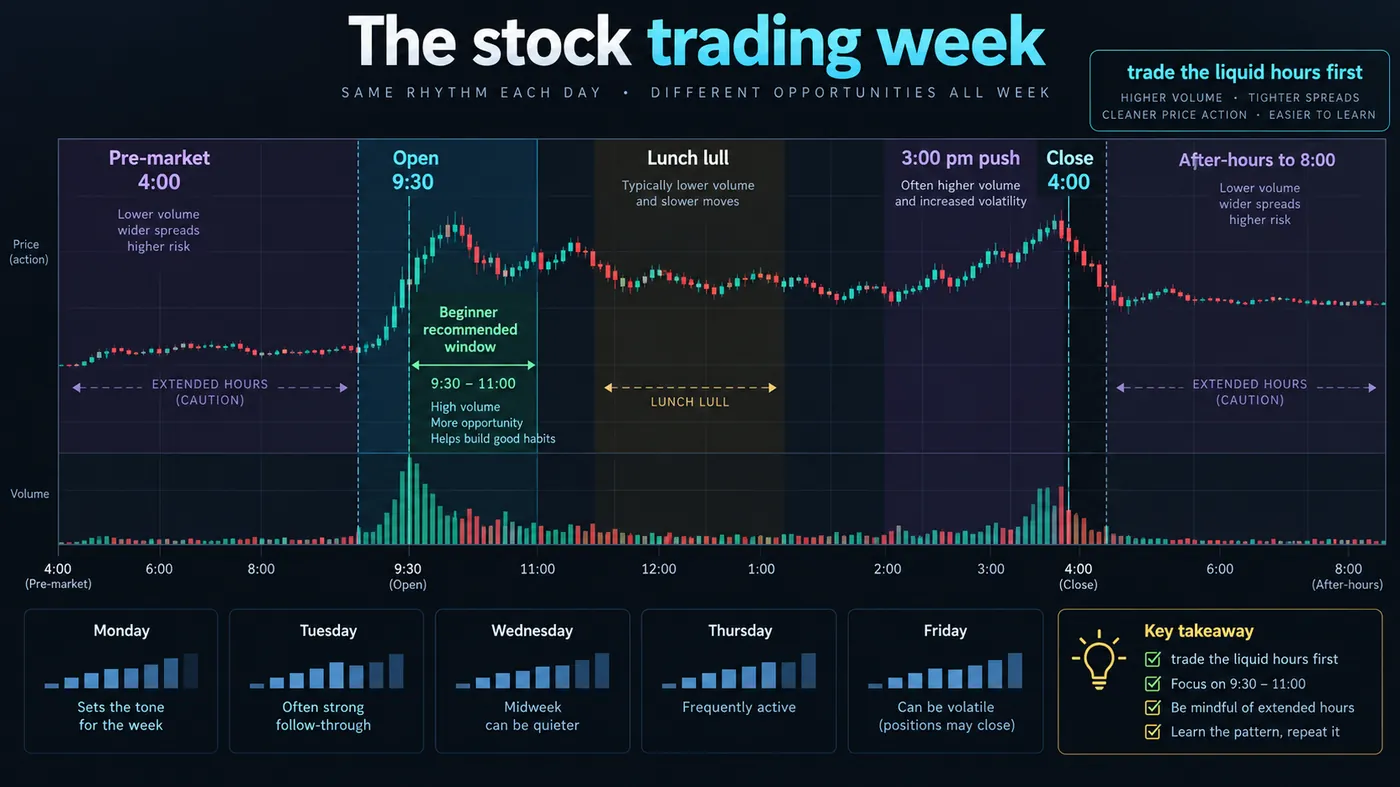
Across the week: Monday morning carries the weekend's news, Wednesday and Thursday are the cleanest sessions, Friday afternoon fades, and the third Friday of the month is options expiry, when large names pin. Earnings seasons — the four to six weeks after each quarter ends — are when individual stocks gap; a beginner should not hold a position through its own earnings.

Automate your trades. Let Quantum Algo trade for you.
Every signal executed on your own account — on your account, with the plan you define.
Order types you will use in the first month
- Limit order for every entry — at the level, placed and left; if it does not fill, there was no trade.
- Stop-market for every stop-loss — never stop-limit, which a gap can skip.
- Limit for the target.
- Bracket / OCO to send all three at once; most brokers offer it under "bracket", "attached orders" or "TP/SL".
- Day time-in-force for intraday orders, GTC for a resting entry at a level that may take days.
- Not yet: market orders (except to flatten), trailing stops (after the first month), extended-hours orders.
Our order-types guide has the full list and the stop-market-versus-stop-limit gap that decides it.
Reading a stock chart: what to look at first
The daily chart for the trend and the levels — prior highs and lows, the last consolidation before a strong move (the order block), gaps left unfilled. The 15-minute chart for the entry — the pullback to the level, the candle that rejects it. Volume for confirmation: a level that holds on rising volume is defended; one that breaks on rising volume is gone. Earnings dates on the chart. That is enough to trade the beginner's pullback setup; the free indicators mark the structure so you are not drawing it by hand, and the Academy's candlestick lesson covers what a single bar is telling you.
Stock versus other markets, for a beginner deciding
| Stocks | Forex | Futures | Crypto | |
|---|---|---|---|---|
| Hours | 9:30–4:00 ET plus thin extended hours | 24/5 | ~23/5 | 24/7 |
| Leverage | 2:1 overnight (margin) | up to 1:30 (regulated) | exchange margin, high | a slider, up to 100× |
| Day-trade rule | PDT under $25k (margin) | none | none | none |
| Beginner size | fractional shares | micro lots | micro contracts | small coin sizes |
| Regulation of venue | strong (SEC/FINRA, SIPC) | strong if regulated entity | strong (CFTC/NFA) | varies |
| Best for a beginner because | least leverage, most protection, clearest hours | tightest spreads, clearest sessions | tick-precise, no PDT | always open |
Stocks are the least leveraged, most protected market a beginner can start in, with the fewest ways to blow up an account by accident. The cost is the shortest trading day and, for day traders, the $25,000 rule — which is why the general roadmap does not pick a market for you and this page does.
Rules a stock beginner learns the hard way
- Settlement. Sell today, the cash is usable tomorrow. Plan the day's trades around it in a cash account.
- The PDT rule. In a margin account under $25,000, four day trades in five business days restricts you. Count them.
- Earnings. Know the date for every stock you hold; the overnight gap can be 10–20%.
- Halts. Volatility halts freeze small caps mid-move; large caps rarely halt.
- Extended hours. Limit orders only, thin books, and the open reprices everything.
- Dividends and ex-dates. The stock drops by the dividend on the ex-date; not a signal.
- Taxes. Short-term gains are ordinary income in most jurisdictions; the wash-sale rule disallows a loss if you rebuy within 30 days in the US. Keep records from day one.
A 90-day plan, stock edition
- Days 1–30: open a cash account with paper trading, learn the five decisions and one setup (a pullback to support in an uptrend on a liquid large-cap is the beginner's), write the rules, and learn to read the chart with the free indicators marking structure.
- Days 31–60: fifty logged paper trades on the same platform, respecting settlement as if it were real, through at least one earnings season.
- Days 61–90: live in fractional shares or single shares at 1% risk, with a bracket order every time; compare the live log to the paper log; size up only when they match.
How to start trading stocks with little money
Fractional shares make a $500 account sizeable: 1% risk is $5, a $100 stock with a 2% stop allows $250 of position, which is two and a half shares. It is tuition, not income, and it is the right way to learn: real fills, real settlement, real emotions at a size that cannot hurt. The mistake is opening a margin account instead to "do more" — leverage is not the answer to a small account; time is.
Cash account first, one liquid large-cap setup, fifty paper trades respecting settlement, then fractional shares with a bracket order at 1% risk. Know the four rules that end beginners — settlement, the PDT rule, earnings gaps, halts — and trade the two windows of the day when volume is real. Stocks are the least leveraged, most protected market to start in; the cost is the shortest trading day.
◆ Interactive check
Do you know the stock rules?
Questions beginners ask about starting with stocks
Nothing for the paper-trading phase; $500–1,000 for a live cash account with fractional shares; $25,000 only if you intend to day trade in a margin account under the pattern day trader rule.
Cash. No PDT rule, no leverage, no possibility of owing more than you deposited. Switch to margin when you need to short or have $25,000 and a day-trading plan.
Yes, with fractional shares at a broker that offers them, sized at 1% risk ($1 a trade). The point at that size is the process, not the profit.
A regulated broker with fractional shares, a paper account on the live platform, bracket orders and TradingView integration. Our platforms pillar has the criteria and the types.
Liquid large-caps — the stocks in the S&P 100 — where spreads are a cent, halts are rare and structure is clean. Small caps and penny stocks come never, or much later.
Zeno Stocks and the free indicators mark structure on any US stock on TradingView — the levels, sweeps and order blocks behind the pullback setup this page teaches.
One setup — a pullback to support in an uptrend on a liquid large-cap — paper traded fifty times on the platform you will use, with the five decisions written down, then live in fractional shares. Our roadmap is the general version; this page is the stock edition.
Only to day trade more than three times in five business days in a margin account. Swing trading and cash-account trading have no such requirement.
Investing holds for years on value; trading holds for hours to weeks on price behaviour with a defined stop. Our fundamental-vs-technical guide covers the split; beginners should know which one they are doing before the first order.
Yes, through a broker regulated where you live (FCA, ASIC, ESMA-regulated) that offers US and local equities; CFDs on stocks are common outside the US and carry different rules. The PDT rule is US-specific.
References & Related Guides
Read next
- How to Start Trading: 90-Day Roadmap
- Pattern Day Trader Rule
- What Is Margin Trading?
- Order Types Explained
- How to Find Stocks for Day Trading
- Best Trading Platforms
- Best Indicator for Stocks
- Fundamental vs Technical Analysis
Authoritative sources
- SEC Investor.gov: how stock markets work
- FINRA: cash vs margin accounts
- FINRA: day trading and the pattern day trader rule
- SEC: T+1 settlement
- SIPC: what SIPC protects
- IRS Publication 550: wash sales and capital gains