Day Trading Strategies: The Complete Guide to Profitable Intraday Trading
| Signal type | Trading style |
| Directional bias | Both directions |
| Best context | Liquid sessions (London/NY) with clear intraday structure |
| Confirmation | Setup-specific: structure break, VWAP reclaim, or range extreme rejection |
| Invalidation | Daily loss limit hit or setup criteria break down |
1. What Is Day Trading?
Day trading is a trading style where positions are opened and closed within the same trading session — typically held for minutes to a few hours, with all positions flat by the end of the day. Day traders aim to capture intraday price movements driven by news, order flow imbalances, technical setups, and short-term momentum shifts.
Unlike swing trading (positions held days to weeks) or position trading (weeks to months), day trading concentrates returns and risk into compressed time windows.
Day trading has been a legitimate professional activity since the rise of electronic markets in the 1990s. Modern day trading spans every liquid market — equities (especially during the US session 9:30 AM–4:00 PM ET), forex (24/5 with peak liquidity during London-NY overlap), futures (CME index and energy contracts), and cryptocurrency (24/7 with concentrated volume during US and European hours).
Each market has distinct microstructure, but the fundamental discipline — entering and exiting within a single session — is the same.
The appeal of day trading is misunderstood. Many newcomers see it as a path to quick wealth or a way to avoid the complexity of fundamental analysis. The reality is that successful day trading requires more skill, discipline, and capital management than longer-term approaches. Industry studies consistently find that 70–85% of day traders are unprofitable over their first three years, and only 5–10% become consistently profitable long-term.
The traders who succeed do so because they treat day trading as a professional discipline — with defined strategies, strict risk management, journaling, and continuous improvement.
This guide focuses on the five strategies that consistently produce edge across markets and timeframes, plus the risk framework and execution discipline that transform strategies from theory to consistent profit. Each strategy includes the specific setup criteria, entry trigger, stop placement, and target methodology. For broader context on risk and methodology, see our Risk Management Trading Guide and Backtesting Strategy Guide.
2. The 4 Foundations Every Day Trader Needs
Strategies fail without foundation. Before any specific setup or technique, day traders need four foundational elements in place. Skipping any of these is why most beginners fail regardless of what strategy they try.
Foundation 1: Adequate Capital. Day trading requires more capital than most beginners realize. US equity day traders face the Pattern Day Trader (PDT) rule — requiring a minimum $25,000 account balance to execute four or more day trades within five business days. Forex and futures have no PDT rule, but practical minimums apply: $5,000–$10,000 for forex, $5,000–$15,000 for index futures.
Below these levels, risk-per-trade math forces position sizes so small that even profitable strategies cannot overcome commissions and slippage. Undercapitalized traders fail not because their strategies are wrong but because the math doesn\'t work.
Foundation 2: Validated Edge. An "edge" is a tested setup with positive expectancy — a combination of win rate, average win size, and average loss size that produces net profit over many trades. The minimum threshold: 55% win rate at 2:1 risk-reward, or 40% win rate at 3:1 risk-reward. Below these levels, the math doesn\'t support long-term profitability after commissions and slippage.
Edge cannot be assumed — it must be proven through backtesting on at least 100 trades and forward-tested in real markets with small size before scaling up.
Foundation 3: Risk Control Discipline. The single most important foundation. Risk no more than 1% of account equity on any single trade. Cap total daily loss at 3% — if you hit this level, stop trading for the day regardless of "opportunities." Use hard stop-losses on every trade — never trade without a defined exit point. The discipline to enforce these rules under live pressure is what separates profitable traders from the 75% who lose.
Risk control failures account for nearly every blow-up in trading history.
Foundation 4: Trading Psychology. The mental dimension matters as much as technical skill. Common psychological failures: revenge trading after losses, oversizing winning streaks, exiting winners too early out of fear, holding losers too long out of hope, and trading outside the plan when bored. The professional response is a daily journaling practice — recording every trade with entry rationale, emotional state, and post-trade analysis.
Patterns emerge over months that reveal personal psychological weaknesses to address systematically.
The compound effect: All four foundations work multiplicatively. Strong strategy with weak risk control = blow-up. Weak strategy with strong risk control = slow decline. Strong on three but weak on one = inevitable failure. All four = the rare combination that produces long-term success. Most traders focus exclusively on Foundation 2 (strategy) and neglect the others — which is why the failure rate is so high.
3. What Are the Best Day Trading Strategies? Five Core Approaches
The following five strategies have produced consistent edge across markets for decades. Each works in specific market conditions — understanding when each applies is as important as the mechanics.
Strategy 1: Opening Range Breakout (ORB)
The classic day trading strategy. Define the "opening range" as the high and low formed in the first 15 or 30 minutes of the trading session (15M and 30M ORB are the two standard variants). When price breaks decisively above the range high on elevated volume, enter long. When it breaks decisively below the range low, enter short. Stop at the opposite side of the range.
Target = 2x the range width projected from the breakout level.
Best markets: US equities and futures during the 9:30 AM ET open, when overnight orders compress into the first 30 minutes. Forex equivalent: London session open at 3:00 AM ET. Works best on volatile sessions following news catalysts — earnings, economic releases, central bank decisions.
Expected metrics: Win rate 55–60% in trending markets. R:R 2:1 to 3:1. Win rate drops to 40–45% in ranging markets — combine with a volatility filter (skip if previous day\'s ATR is below 50% of 20-day average).
Strategy 2: VWAP Mean Reversion
The Volume Weighted Average Price (VWAP) is the average price weighted by volume — institutional traders use VWAP as a benchmark for execution quality. Price typically oscillates around VWAP during ranging sessions. The strategy: in ranging markets (confirmed by ADX below 20), short when price stretches 2+ standard deviations above VWAP; long when price stretches 2+ standard deviations below. Stop beyond the next standard deviation. Target = VWAP.
Best markets: Large-cap stocks during quiet news days; index futures in the middle of the trading session (avoid the first and last hour where directional moves dominate). Avoid in strong trending sessions — VWAP becomes a trend line rather than a mean.
Expected metrics: Win rate 60–70% in confirmed ranges. R:R 1.5:1 to 2:1. Tighter R:R than breakouts but higher win rate compensates. Best combined with rejection candles at the standard deviation bands.
Strategy 3: Liquidity Sweep Continuation
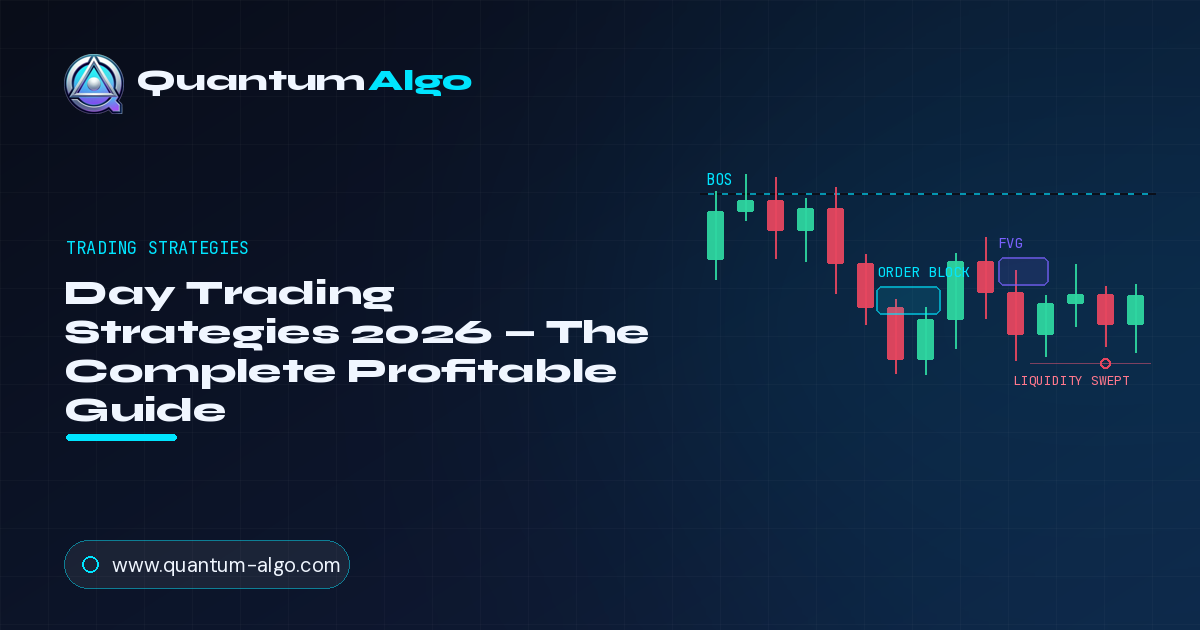
An advanced Smart Money Concepts strategy. Identify a prominent intraday swing high (where stops are clustered above) or swing low (stops below). When price aggressively sweeps the level — taking out the stops with a quick wick — but immediately reverses, enter in the OPPOSITE direction of the sweep. The sweep cleared retail stops and created institutional fill liquidity; the subsequent reversal is the institutional position taking control.
Best markets: Forex (especially during London-NY overlap), index futures, large-cap crypto. Works on every liquid market where retail stop clusters are predictable.
Expected metrics: Win rate 65–75% on properly identified sweeps with confirmation. R:R 3:1 to 5:1. Among the highest-edge day trading setups available — but requires patience for proper setups. See our Liquidity Sweep Guide for full mechanics.
Strategy 4: Momentum Breakout
The trend-following day trading approach. Scan for stocks (or assets) showing exceptional pre-market volume and gap activity. When the asset breaks decisively above its pre-market high on the regular session open with continued elevated volume, enter long. Stop below the breakout level or the most recent swing low. Trail stop with a moving average (typically 9 or 20 EMA). Exit when the trailing stop is hit or the trend visibly breaks.
Best markets: Small-to-mid cap stocks on news catalysts (earnings beats, FDA approvals, contract wins). Crypto on major announcements. Works less reliably in forex and large-cap indices where momentum extremes are rarer.
Expected metrics: Win rate 45–55% (lower than other strategies) but exceptional R:R (often 5:1 to 10:1 on winners). The winners pay for many losers. Requires strict discipline to take stops on the failures.
Strategy 5: Smart Money Setup (Highest-Edge)
The composite institutional strategy. Combines order block identification (where institutions positioned on higher timeframes) with intraday confirmation (rejection candle, FVG fill, or breaker structure). Enter when price returns to a higher-timeframe bullish order block during the intraday session with a clear rejection signal. Stop just beyond the order block. Target = next opposing structural level (typically 3:1 to 5:1 R:R).
Best markets: Works universally — forex, futures, crypto, large-cap equities. Requires understanding of Smart Money Concepts as the underlying framework. The most consistent setup across market conditions.
Expected metrics: Win rate 65–75% on properly identified setups. R:R 3:1 to 5:1. The cleanest edge in day trading when executed with discipline. See our Smart Money Concepts Guide and Order Block Trading Guide.

Automate your trades. Let Quantum Algo trade for you.
Every signal executed on your own account — 24/7, hands-off.
4. The Risk Management Framework
Strategy edge is necessary but not sufficient for profitable day trading. The risk framework determines whether edge translates to compounding equity or accelerated drawdown. The five rules below are non-negotiable for any serious day trader.
Rule 1: Maximum 1% risk per trade. Calculate position size such that the distance from entry to stop equals exactly 1% of account equity. If your account is $50,000 and your stop is $0.50 away on a stock, your maximum position size is 1,000 shares ($500 risk = 1% of $50,000). Never override this rule for "high conviction" setups — high conviction is exactly when traders blow up because they sized up.
Rule 2: Maximum 3% daily loss cap. If your cumulative losses for the day reach 3% of account equity, stop trading immediately. Close any open positions, walk away from the screen, journal what happened. The 3% cap exists because trading at three consecutive losing positions reveals that today\'s conditions don\'t match your edge. Forcing more trades to recover the loss is how 3% becomes 6%, becomes 10%, becomes a margin call.
Rule 3: Hard stops on every position. Set a stop-loss order at the moment of entry — not "mental stops" that you plan to execute when price hits the level. Mental stops fail under emotional pressure. Live markets routinely produce price action that overrides mental stops, turning small planned losses into large unplanned ones. Hard stops execute mechanically and remove the most common point of failure.
Rule 4: Asymmetric risk-reward. Never take trades with worse than 1.5:1 risk-reward (potential profit at least 1.5x the risk). Below this threshold, even high-win-rate strategies struggle to overcome commissions and the small inevitable losses. Most professional day traders target 2:1 minimum, with 3:1 to 5:1 ideal. Position sizing is determined by stop distance; targets are set by structural levels and measured projections.
Rule 5: Scale into winners, scale out at targets. Start with the full planned position size (sized to risk 1%). When the trade moves favorably to the first scale-out target (typically 1:1 R:R), close 50% of position and move stop to breakeven on the remainder. Let the remaining 50% run to the full target with a trailing stop.
This approach captures the math advantage — your largest position size is on the closest, most certain targets; your smallest position runs for the home runs.
5. The Daily Execution Routine
Strategy edge plus risk framework still fails without consistent execution. The daily routine that separates profitable traders from gamblers is structured and repeatable.
Pre-Market Preparation (60-90 minutes before open): Review overnight news and economic calendar. Identify the day\'s catalysts (Fed announcements, earnings, geopolitical events). Mark key levels on your watchlist — yesterday\'s high/low, weekly highs/lows, premium/discount zones. Note any open higher-timeframe order blocks or FVGs that price might revisit. Set price alerts at structural levels. Plan the day\'s setups based on which catalysts and levels align.
The First 30 Minutes: Avoid most trades during the opening 30 minutes unless your strategy specifically targets this window (Opening Range Breakout). Volatility is highest, spreads are widest, and false moves are common. Watch how the opening range develops. Note which assets are leading the market and which are weak.
The Trading Window: Execute setups as they form during your highest-probability hours — typically 10:00-11:30 AM ET and 1:30-3:30 PM ET for US equities; London-NY overlap (8:00 AM-12:00 PM ET) for forex. Avoid the "lunch lull" (typically 12:00-1:30 PM ET) when liquidity drops and noise dominates. Take only setups that match your defined strategies — pass on everything else regardless of how attractive it appears.
End-of-Day Review: 15 minutes after close, review every trade taken. Record in journal: entry rationale, emotional state, execution quality (was the stop where it should have been? Did you size correctly?), and post-trade analysis (was the loss avoidable? Did you take the winner to target?). Note patterns over weeks — recurring mistakes become opportunities for systematic improvement.
Weekly Review: Every Friday, aggregate the week\'s trades into a performance summary — total trades, win rate, average R:R, net P&L, drawdown. Compare to the strategy\'s expected metrics. Significant deviation in either direction warrants investigation — either market conditions have shifted, or execution has drifted.
6. Common Day Trading Mistakes
Mistake 1: Undercapitalization. Trying to day trade with $1,000-$3,000 accounts forces position sizes so small that profitable strategies still produce net losses after commissions. The math doesn\'t work below practical minimums ($25k for US equities, $5-10k for forex/futures). Better to swing trade until capital reaches viable day-trading levels.
Mistake 2: Overtrading. Taking 20+ trades per day is not "more opportunity" — it\'s death by a thousand cuts via commissions and slippage. Professional day traders typically take 3-8 high-quality setups per session. Quality over quantity is not a cliché — it\'s the math.
Mistake 3: Revenge trading after losses. The single most destructive psychological failure. After a loss, the temptation to "make it back" leads to trading outside the plan, oversizing, and chasing setups that don\'t match strategy criteria. The 3% daily loss cap exists specifically to prevent this. Discipline enforcement is non-negotiable.
Mistake 4: Moving stops to avoid losses. The classic amateur mistake. Trade goes against you, you move the stop further away "to give it room to work." Sometimes price reverses and the trade works out — reinforcing the behavior. Eventually the stop gets moved so far that a single bad trade wipes out weeks of gains. Hard stops set at entry, never moved further away (only closer for profit protection).
Mistake 5: No defined edge. Trading without a tested strategy is gambling, not investing. Many beginners trade on intuition, news headlines, or chart patterns they "feel" should work. Without statistical validation through backtesting, you have no way to distinguish edge from luck. Define the strategy, test it on at least 100 historical setups, then forward-test with small size.
Mistake 6: Trading outside personal optimal hours. Performance varies dramatically by time of day. Most traders perform best during specific 2-3 hour windows when their cognitive state, market conditions, and personal life align. Trading 8+ hours daily produces diminishing returns and increased losses in the final hours. Identify your optimal window through journaling and trade only that window.
7. Test Your Knowledge
Seven questions on day trading strategies and discipline.
8. Day Trading with Smart Money Concepts
The Smart Money Setup — combining higher-timeframe order blocks with intraday confirmation — produces the most consistent edge in day trading. Identifying these setups manually across multiple assets requires hours of analysis. Algorithmic detection transforms the strategy from theory to practical application.
• Order block detection across multiple timeframes — institutional zones identified automatically
• FVG identification — gap-fill setups during the trading session
• Liquidity sweep alerts — sweep continuation setups as they form
• Multi-timeframe context — HTF structure aligned with LTF entries
• Smart alerts — notified the moment confluence setups appear
Frequently Asked Questions
Day trading strategies are systematic approaches for opening and closing positions within a single trading session to capture short-term price movements. The five most effective: Opening Range Breakout, VWAP Mean Reversion, Liquidity Sweep Continuation, Momentum Breakout, and Smart Money Setup. Each works in specific market conditions.
US equity day trading requires $25,000+ minimum due to the Pattern Day Trader (PDT) rule. Forex day trading: $5,000-$10,000 practical minimum. Index futures: $5,000-$15,000. Below these levels, position sizes are too small to overcome commissions and slippage after risk management is applied.
Opening Range Breakout (ORB) is the simplest mechanically — define the first 15-30 minute range, trade breakouts on volume. Master one strategy through 100+ trades before adding others. Avoid trying to learn multiple strategies simultaneously.
Industry studies consistently find that 70-85% of day traders are unprofitable over their first three years. Only 5-10% become consistently profitable long-term. Success requires capital, validated edge, strict risk management, and psychological discipline working together.
Maximum 1% of account equity per trade is the standard professional rule. Calculate position size based on the distance from entry to stop. Combined with a 3% daily loss cap and 1.5:1 minimum R:R, this risk framework protects capital while allowing for compounding returns.
For US equities: 9:30-11:30 AM ET (open + first hour of regular session) and 1:30-3:30 PM ET (final two hours). For forex: London-NY overlap (8:00 AM-12:00 PM ET). Avoid the "lunch lull" (12:00-1:30 PM ET) when liquidity drops. Identify your personal optimal window through journaling.
Day trading is profitable for the 5-10% of traders who combine validated edge, strict risk management, and psychological discipline. The remaining 90%+ are unprofitable. The math of edge + risk management produces compounding returns; failures come from one or more of these foundations being weak.
Yes. Crypto markets trade 24/7 with concentrated volume during US and European hours. All five core strategies work in crypto, with momentum breakouts particularly effective on news catalysts. Crypto\'s higher volatility produces wider intraday ranges, requiring slightly larger stops and adjusted position sizing.
More guides
References & Related Guides
More in this topic
- Intraday vs End-of-Day Trading: Which Is Better, and Which Fits Your Life
- Backtesting Trading Strategies 2026 — Complete Guide
- What Are the Best Indicators for Day Trading? (2026)
- What Are the Best Indicators for Scalping? (2026)
- What Are the Best Indicators for Swing Trading? (2026)
- Best TradingView Strategy 2026 — The Definitive Guide
- Breakout Probability: Complete Trading Guide (2026)
- Breakout Trading Strategy: Complete Guide (2026)
- Gap Trading Strategy: Complete Guide (2026)
- Grid Trading Strategy: The Complete Guide (2026)
- Institutional Trading Strategy 2026: Trade Like Banks
- Position Sizing: The Complete Guide (2026)
- Prop Firm Trading Strategy 2026 — Pass Any Challenge Guide
- Trading Psychology Guide 2026
Core reading
- BOS & CHoCH: Complete Market Structure Guide 2026
- Order Blocks Trading: Complete 2026 Guide
- Best TradingView Indicators 2026 — Complete Guide
- Risk Management in Trading 2026 — Complete Guide
- Candlestick Patterns Guide 2026 — Engulfing, Pinbar & More
- All Premium Guides
- Quantum Algo on TradingView
- Public Verified Track Record
For the next decision, continue with a daily trade-count rule and keep the execution rule separate from the context.