Change of Character
A change of character is the earliest signal of a potential trend reversal. It occurs when price closes beyond a swing point against the current trend, such as below the last higher low in an uptrend. It is a warning, not confirmation. Traders wait for a liquidity sweep, then enter at the order block or FVG that produced the CHoCH.
◆Full guide: Break of Structure & CHoCH: The Complete Guide to Market Structure Shifts
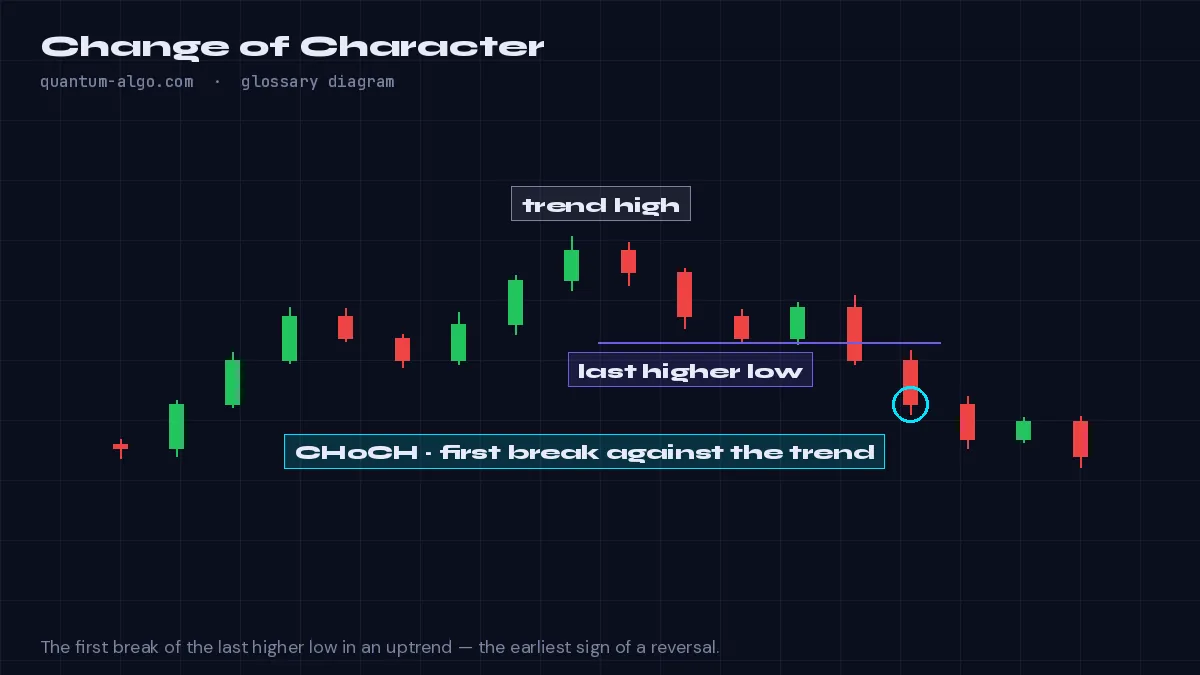
What it means
A Change of Character (CHoCH) is the first warning sign that an existing trend may be reversing. It occurs when price breaks a swing point in the direction opposite to the prevailing trend. In a bullish trend, CHoCH happens when price breaks below the most recent swing low. In a bearish trend, CHoCH occurs when price breaks above the most recent swing high.
CHoCH is not a reversal confirmation by itself. It is a warning that institutional flow may be shifting. After a CHoCH, the next event determines whether a true reversal is underway: another CHoCH in the same direction (now becoming a BOS in the new trend) confirms reversal; a return to the original direction with a fresh BOS rejects the CHoCH as a false signal.
Practically, CHoCH is the trigger event most discretionary SMC traders use to time entries on the lower timeframe. The standard workflow: wait for a higher-timeframe liquidity sweep, then drop to a lower timeframe and wait for a CHoCH that confirms the institutional reversal. Enter at the order block or FVG that produced the CHoCH, with a stop-loss beyond the swept liquidity.
Distinguishing CHoCH from a minor pullback is the most common practical challenge. Real CHoCH events typically include a displacement candle that breaks structure decisively. Pullbacks lack displacement and produce only marginal breaks of minor swing points.
How to identify it on a chart
- In an uptrend, mark the most recent higher low that produced the last higher high.
- A body close below it is the CHoCH — the trend structure has changed character.
- Confirm with displacement; then look for entries on the first pullback in the new direction.
Worked example
After a series of higher highs, price fails to make a new high and closes below the last higher low at 2,315. That close is the CHoCH; the bearish order block formed on the way down is the short entry on retest.
See it on the chart, read it in depth
Frequently asked questions
How is CHoCH different from a normal pullback?
A real CHoCH breaks a defined swing point with a candle body close, ideally with displacement. A pullback typically only retraces to a Fibonacci level or order block without breaking structure. If structure is not broken, it is a pullback, not a CHoCH.
Does every CHoCH lead to a reversal?
No. CHoCH is a warning, not a guarantee. Roughly 55–65% of CHoCH events lead to confirmed reversals; the rest are false signals where the original trend resumes. Confirmation requires a second structure event in the new direction (the CHoCH-to-BOS sequence).
Should I trade on the CHoCH itself or wait for confirmation?
More aggressive traders enter on the CHoCH itself at the order block or FVG that produced it. Conservative traders wait for the next BOS in the new direction to confirm the reversal before taking entries on subsequent pullbacks.
Related terms
See Change of Character on your TradingView chart
Zeno reads Smart Money structure across timeframes and prints the entry, stop and targets — with a public record of every posted trade. The free indicators draw the concepts this page defines.