Break of Structure
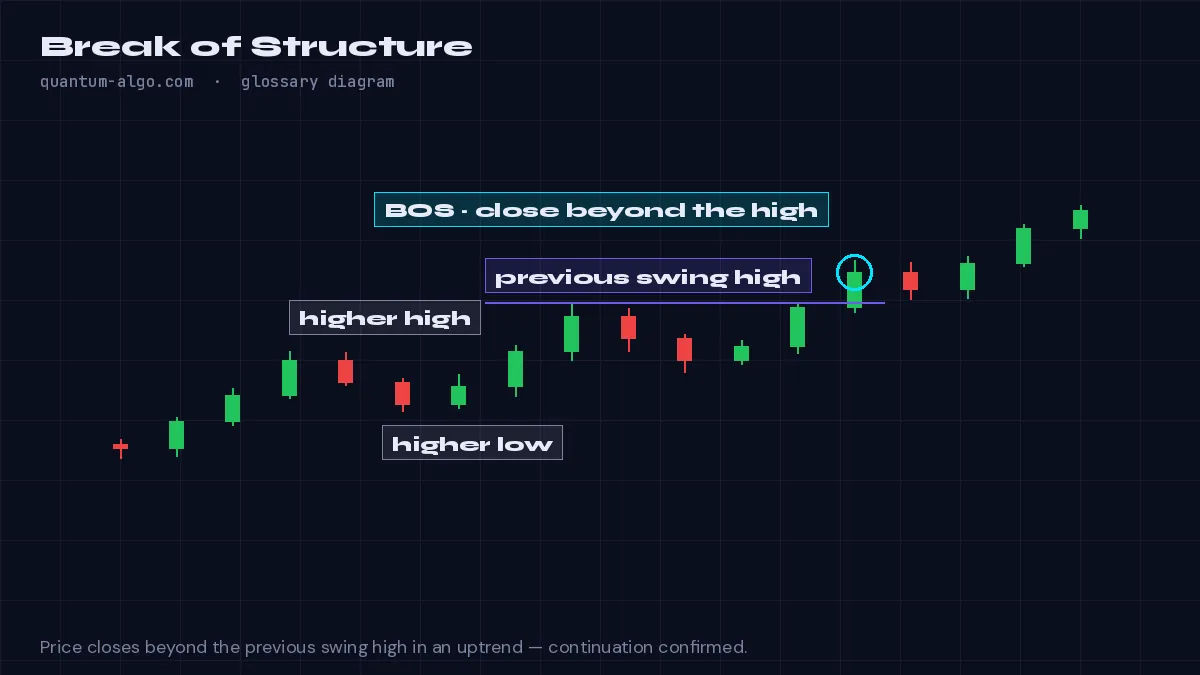
A break of structure is when price closes beyond the most recent swing point in the direction of the existing trend, confirming continuation. The strict rule requires a candle body close; a wick-only break is a liquidity grab, not a BOS. Traders take continuation entries on the pullback into the order block that produced the break.
◆Full guide: Break of Structure & CHoCH: The Complete Guide to Market Structure Shifts
What it means
A Break of Structure (BOS) is the trend-confirming event in Smart Money Concepts methodology. In a bullish trend, BOS occurs when price breaks above the most recent swing high. In a bearish trend, BOS occurs when price breaks below the most recent swing low. BOS confirms that the existing trend is continuing and that institutional flow remains aligned with the direction.
The strict definition requires a candle body close beyond the swing point — a wick-only break is not a confirmed BOS, only a liquidity grab. Many SMC traders also wait for the BOS candle to close fully before treating the level as confirmed, because intracandle prints can revert.
BOS is the most important structural concept for trend identification. Until you can correctly identify whether the most recent break of structure was a BOS (continuation) or a CHoCH (reversal warning), no other SMC concept will work reliably. Order blocks, FVGs, and liquidity sweeps all depend on knowing the higher-timeframe trend, and BOS is what defines that trend at every checkpoint.
The opposite of BOS is Change of Character (CHoCH), which is the first sign of a potential trend reversal. A BOS confirms continuation; a CHoCH signals possible reversal. The two events together form the structural backbone of every SMC trading system.
How to identify it on a chart
- Mark the most recent confirmed swing high (uptrend) or swing low (downtrend).
- Wait for a candle body close beyond that level — a wick alone is a sweep, not a break.
- The pullback after the break is where continuation entries are taken.
Worked example
In an uptrend on the 4-hour, price forms a swing high at 3,420, pulls back, then closes at 3,441. The body close above 3,420 is the BOS; the retrace into the order block that produced the break is the entry.
See it on the chart, read it in depth
Frequently asked questions
Does a wick break count as a Break of Structure?
Strictly, no. A confirmed BOS requires a candle body close beyond the swing point. Wick-only breaks are usually liquidity grabs or stop hunts, not real structural shifts. Many traders only treat BOS as confirmed after the candle closes.
What is the difference between BOS and CHoCH?
BOS breaks structure in the direction of the existing trend, confirming continuation. CHoCH (Change of Character) breaks structure in the opposite direction of the existing trend, signaling a potential reversal. BOS is bullish-after-bullish or bearish-after-bearish; CHoCH is the first crack in either direction.
How do I trade a Break of Structure?
Wait for the BOS to confirm on the candle close. Mark the order block or FVG that produced the BOS — that becomes your point of interest for entry on a pullback. Stop-loss goes beyond the far edge of the OB or FVG. Take-profit at the next major liquidity pool in the direction of the new BOS.
Related terms
See Break of Structure on your TradingView chart
Zeno reads Smart Money structure across timeframes and prints the entry, stop and targets — with a public record of every posted trade. The free indicators draw the concepts this page defines.