Premium and Discount Zones: Buy Cheap, Sell Expensive, With the Bias
| Concept type | Smart Money range framework (ICT) |
| Premium | Upper half of a range — where smart money sells |
| Discount | Lower half of a range — where smart money buys |
| Equilibrium | The 50% midpoint — fair value |
| Anchored to | The last confirmed swing high and swing low |
| Best used with | Structure bias, order blocks, liquidity |
1. What Are Premium and Discount Zones?
Premium and discount zones answer a question every trader faces but few answer with any discipline: is this a good price to buy or sell, or just a good direction? You can be completely right about the trend and still lose, simply because you entered at a terrible price. Premium and discount is the framework Smart Money traders use to make sure they buy cheap and sell expensive — relative to a clearly defined range.
The logic is borrowed straight from how institutions think. A large desk accumulating a long position does not want to pay top dollar; it wants to buy in the discount — the lower half of the current range, below fair value. A desk distributing into strength wants to sell in the premium — the upper half, above fair value. Retail traders do the opposite: they buy breakouts at premium prices and panic-sell at discount prices, handing the good fills to everyone else.
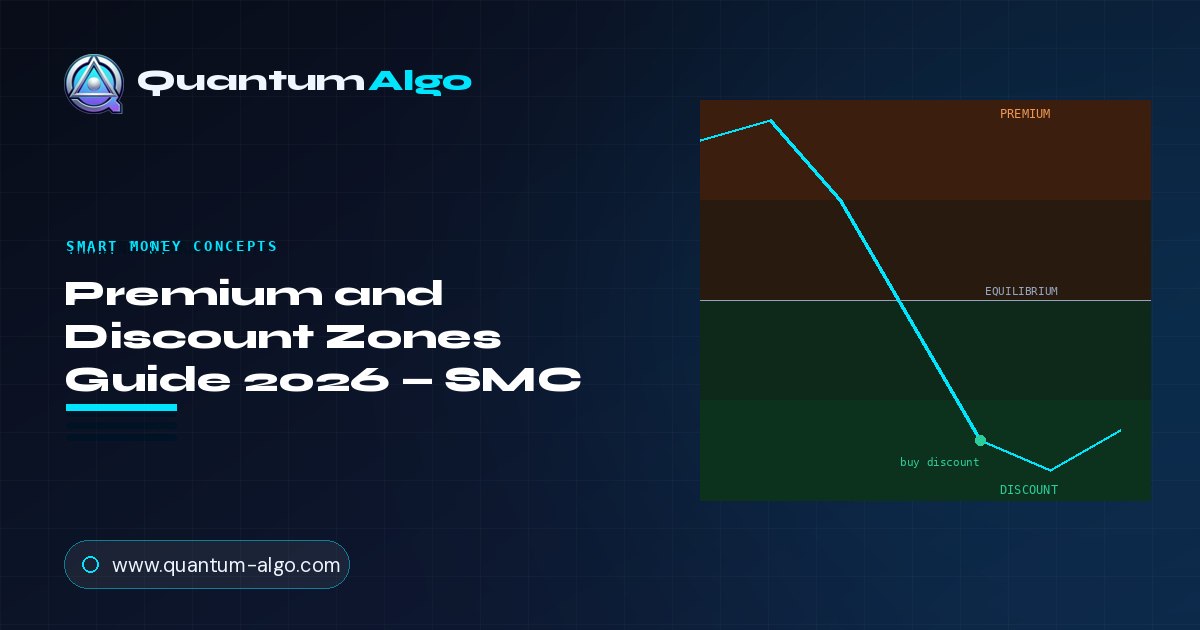
The construction is simple. Take the range between the last confirmed swing high and swing low. The midpoint (50%) is equilibrium — fair value. Everything above it is premium; everything below it is discount. That single line reframes every decision: in a bullish market you are looking to buy pullbacks into discount, not chase them in premium; in a bearish market you are looking to sell rallies into premium, not short them once they are already in discount.
Premium and discount split a range at its 50% equilibrium: buy in the discount half, sell in the premium half. It stops you paying premium prices for a trade the trend already justified.
2. Equilibrium: The Line That Reframes Everything
Equilibrium is the 50% level of the range, and it is the most important line in this framework because it converts a vague sense of "cheap" or "expensive" into a hard, mechanical boundary. Above it, you are paying up. Below it, you are getting a discount. There is no in-between opinion to argue about — price is either in premium or in discount, and that fact alone should change how aggressively you act.
The power of equilibrium is that it filters your own worst instincts. The moments that feel best to buy — price ripping upward, green candles everywhere — are usually premium moments, exactly where a disciplined trader is looking to sell or at least stop buying. The moments that feel worst to buy — price bleeding lower into a demand zone — are often discount moments, where the best long fills live. Equilibrium gives you a rule that overrides the feeling: below it, buying is a discount; above it, buying is a premium you need a very good reason to pay.
Deep premium (75–100%)
The extreme upper quartile. In a bearish market this is the prime zone to look for shorts — price is expensive and near the top of the range. Longs taken here are chasing.
Equilibrium (50%)
Fair value. Price at equilibrium is neither cheap nor expensive. Many traders treat a break back through equilibrium as confirmation that the range is resolving in that direction.
Deep discount (0–25%)
The extreme lower quartile. In a bullish market this is the prime zone to look for longs — price is cheap and near the bottom of the range. Shorts taken here are chasing.
Bias decides the side
Premium and discount is not a signal on its own. Your structural bias decides which half you act from: bullish bias, buy discount; bearish bias, sell premium. Trading against the bias needs strong justification.
3. Drawing the Range Correctly
Like every range tool, premium and discount is only as good as the swing points it is anchored to. Anchor to the wrong high and low and the equilibrium sits at the wrong price, which flips your read of the entire market. The rules are the same discipline that governs Fibonacci and OTE — because they are the same skill.
Use confirmed swings
Anchor to the last confirmed swing high and swing low — pivots that have completed, not the live bar. An unconfirmed high that price is still making is not a valid anchor and will shift the whole range under you.
Match the timeframe to the decision
The range you use should match the decision you are making. A swing trader anchors to higher-timeframe swings; a scalper uses the internal range. Mixing them — a scalp entry judged against a weekly range — produces nonsense.
Redraw when structure shifts
When price breaks structure and forms a new swing, the range that matters changes with it. A premium/discount map from an old, invalidated range is describing a market that no longer exists.
Let the extremes carry weight
The deep quartiles (0–25% and 75–100%) are where the framework is most decisive. Price in the middle band is closer to fair value, and the edge from premium/discount alone is thinner there.
This is exactly the kind of mechanical, error-prone measurement that automation handles better than a tired discretionary eye. A tool that anchors the range to the last confirmed swing high and low, redraws it the moment structure shifts, and reports the live position as a percentage of the range is doing — consistently, on every bar — what a disciplined trader does by hand.
Premium and discount is meaningless without the right range. Anchor to confirmed swings, match the timeframe to your decision, and redraw when structure shifts. A discount is only a discount relative to the correct range.
4. Premium/Discount as Confluence, Not a Signal
The single biggest mistake with this framework is treating "price is in discount" as a buy signal. It is not. It is a filter — one condition among several that, when stacked with others, produces a high-quality setup. On its own, a discount tells you the price is favourable; it says nothing about whether the trend supports a long or whether there is a reason for price to turn there.
The framework earns its keep when it agrees with the rest of your read. The highest-quality long is not simply "price in discount" — it is a bullish structure, a liquidity sweep to the downside that grabbed stops, price trading in the discount half, and a fresh demand order block sitting right there. Now four independent conditions point the same way, and the discount is the price context that makes the entry cheap. That is the difference between a location and a trade.
| Condition | What it adds |
|---|---|
| Structure bias | Tells you which half to trade from — buy discount when bullish, sell premium when bearish |
| Premium / discount position | The price context — cheap or expensive relative to the range |
| Liquidity sweep | Evidence stops were run before the turn — the move was engineered |
| Fresh order block or FVG | A specific level inside the zone where price is likely to react |
This is precisely how a well-built Smart Money engine treats it: premium/discount positioning is not the whole answer, it is a weighted component of a larger confluence read. Get the structure, the sweep, the zone and the discount all agreeing, and the setup grades high. Get only the discount, and you have a cheap price with no reason to act.
Premium or discount?
Four price positions within the same range. You are bullish. Click the position that gives the highest-quality long — deep in discount, near the bottom of the range.
Notice what the game rewards: not the level that looks like it is "breaking out" (that is premium, the expensive chase), but the uncomfortable one deep in discount. That discomfort is the point. The whole framework exists to make you act against the retail instinct to buy high and sell low.

Automate your trades. Let Quantum Algo trade for you.
Every signal executed on your own account — 24/7, hands-off.
5. Common Mistakes and How to Avoid Them
Premium and discount is simple to understand and surprisingly easy to misuse. A handful of errors account for most of the damage.
Trading it as a standalone signal
"Price is in discount" is not "buy." Without a supporting bias and a reason to turn, a discount can get much deeper. The framework is a filter, not a trigger.
Ignoring the bias
Buying discount in a clearly bearish market is catching a falling knife. Premium and discount tells you the price; structure tells you the direction. You need both.
Using a stale range
Anchoring to a swing high and low that structure has already invalidated puts equilibrium at the wrong price, flipping premium and discount. Redraw when structure shifts.
Forcing a fill in the middle
The framework is decisive at the extremes and thin near equilibrium. Taking a "discount" long at 48% of the range is barely a discount at all — wait for the deep quartile.
6. Premium and Discount in the Smart Money Concepts Engine
Mapping a range by hand, redrawing it every time structure shifts, and honestly assessing whether the current price is a real discount is exactly the kind of repetitive, judgement-heavy work that a tool does more consistently than a discretionary trader. Our free, open-source Smart Money Concepts Engine on TradingView builds the premium/discount map automatically and — crucially — folds it into a larger read rather than leaving it as an isolated line.
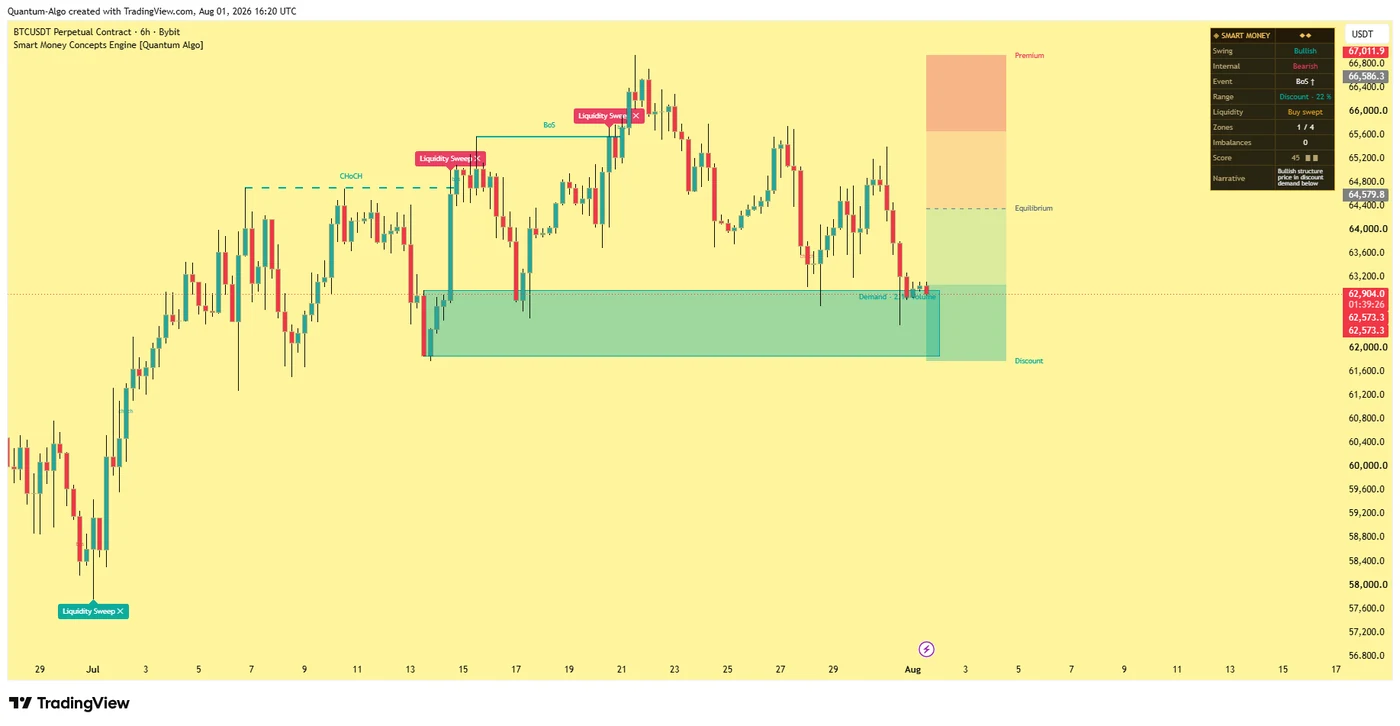
What makes this more than a drawing tool is how it weighs premium/discount. The engine scores the confluence of everything on the chart into a transparent 0–100 Confluence Score, and correct premium or discount positioning for the bias is worth a full 25 of those points — the same weight as structure alignment. In other words, the tool treats "am I buying in discount?" as one of the two most important questions on the chart, exactly as this guide argues you should.
Automatic range mapping
The range between the last confirmed swing high and low is mapped into premium, equilibrium and discount, with deeper tinting in the extreme quartiles — the decisive zones highlighted for you.
Live range position
The dashboard reports exactly where price sits as a percentage of the range — "Discount − 22%" — so there is no guessing whether you are in the cheap half or the expensive one.
Weighted into the score
Correct premium/discount positioning contributes 25 of the 100 Confluence Score points — a transparent, explainable weight, never a black box.
The plain-language narrative
The engine writes the read as a sentence — "bullish structure, price in discount, demand below" — so the premium/discount context is stated, not just drawn.
The engine also tracks structure (BoS and CHoCH on two tiers), volume-graded order blocks, fair value gaps with inversions, and liquidity sweeps — so the premium/discount map never stands alone. In keeping with our approach — don't trust us, verify us — the script is fully open-source, so you can read exactly how the 25-point premium/discount weight is computed.
Smart Money Concepts Engine [Quantum Algo] on TradingView — automatic premium/discount mapping, live range position, structure, order blocks, FVGs and liquidity unified into a transparent 0–100 Confluence Score with a plain-language narrative. Free to use, open-source to verify.
7. Test Your Knowledge
Seven questions on premium, discount, equilibrium and how to use them.
8. Premium/Discount Within a Full SMC Framework
Premium and discount is the price-context layer of Smart Money trading, and it interlocks with every other concept. It tells you where in the range you are; the rest of the framework tells you whether that location is worth acting on.
The connections are direct. A break of structure sets the bias that decides which half you trade from. A liquidity sweep into discount is the engineered turn that often marks the bottom of the range. An order block sitting in the discount half is the specific level where a cheap price and a reaction point coincide. And the Optimal Trade Entry is premium/discount made precise — the 61.8–79% retracement is a discount in an uptrend.
• Buy/sell signals with built-in SL and TP — structural entries that respect premium/discount context
• Break of structure mapping — the bias that decides which half to trade from
• Order block and FVG detection — the levels inside a discount where price reacts
• Multi-timeframe confluence scoring — so a discount that aligns across timeframes scores higher
• ATR-based risk management — position sizing anchored to the range, not guesswork
The habit to build: let structure set the bias, let premium/discount decide whether the price is worth paying, and let order blocks and sweeps pinpoint the exact level. Buy cheap, sell expensive — but only in the direction the market has already shown you.
Frequently Asked Questions
Premium and discount zones split a price range into halves at its 50% midpoint, called equilibrium. The upper half is the premium — where price is expensive and smart money looks to sell. The lower half is the discount — where price is cheap and smart money looks to buy. The framework, drawn from ICT Smart Money Concepts, helps traders buy low and sell high relative to a defined range rather than chasing price at unfavourable levels.
Take the range between the last confirmed swing high and swing low. The 50% midpoint is equilibrium. Everything above it is premium; everything below it is discount. The extreme quartiles - 0-25% (deep discount) and 75-100% (deep premium) - are where the framework is most decisive. Anchor only to confirmed swings and redraw the range whenever structure shifts and a new swing forms.
Equilibrium is the 50% level of a range - fair value, the boundary between premium and discount. Above equilibrium, price is expensive relative to the range; below it, price is cheap. It reframes every decision: buying below equilibrium is a discount, buying above it is a premium you need a good reason to pay. Many traders also treat a decisive break back through equilibrium as a sign the range is resolving in that direction.
As a default discipline in a trending market, yes - but only in the direction of your structural bias. In a bullish market you look to buy pullbacks into discount; in a bearish market you look to sell rallies into premium. Premium and discount is a price filter, not a standalone signal: it tells you whether the price is favourable, while structure tells you the direction. Buying a deep discount in a confirmed downtrend, with no bias support, is catching a falling knife.
They are closely related. Equilibrium is the 50% Fibonacci level of the range, and the Optimal Trade Entry zone (61.8-79%) sits inside the discount half of an up-move. Premium and discount is the simpler, structural version - just three bands split at 50% - while Fibonacci adds finer levels within those bands. Many Smart Money traders use both together: premium/discount for the big-picture price context, Fibonacci and OTE for the precise entry within the discount.
Match the range to the decision. A swing trader anchors the range to higher-timeframe swing highs and lows; an intraday trader uses the internal range on lower timeframes. The mistake is mixing them - judging a scalp entry against a weekly range, or a swing entry against a five-minute range. Whatever timeframe you trade, anchor the range to confirmed swings on that same timeframe.
In the Quantum Algo Smart Money Concepts Engine, correct premium or discount positioning for the current bias contributes 25 of the 100 Confluence Score points - the same weight as structure alignment. That makes it one of the two most heavily weighted conditions in the score, reflecting how important price context is: buying in discount when bullish, or selling in premium when bearish, is treated as a core requirement of a high-quality setup, not an optional extra.
More guides
References & Related Guides
More in this topic
- Smart Money Concepts (SMC): Ultimate Trading Guide 2026
- Optimal Trade Entry (OTE): Complete Guide 2026
- Fibonacci Retracement 2026 - Complete Trading Guide
- Order Block Trading: Complete Guide 2026
- Fair Value Gaps (FVG): Complete Trading Guide 2026
- Liquidity Sweep Trading: Stop Hunts Explained (2026)
- BOS & CHoCH: Complete Market Structure Guide 2026
- ICT Trading Strategy: Complete Interactive Guide 2026
- What Is a Market Structure Shift (MSS)? 2026
- Inducement Trading 2026 - Trap Liquidity Explained
- Support & Resistance: Complete Trading Guide (2026)
- Wyckoff Method 2026 - Complete Institutional Trading Guide
- Premium, Discount & Equilibrium in SMC
Core reading
- Smart Money Concepts (SMC): Ultimate Trading Guide 2026
- Optimal Trade Entry (OTE): Complete Guide 2026
- ICT Trading Strategy: Complete Interactive Guide 2026
- Liquidity Sweep Trading: Stop Hunts Explained (2026)
- Fibonacci Retracement 2026 - Complete Trading Guide
- All Premium Guides
- Quantum Algo on TradingView
- Public Verified Track Record