Inducement Trading: The Trap Liquidity Before the Real Move
| What it is | Bait liquidity that lures traders before the real move |
| Also called | IDM, inducement liquidity, the trap |
| Purpose | Fuels the move to the real order block or zone |
| Where it sits | Between price and the true point of interest |
| Tell | An obvious high/low that looks too good |
| Best used with | Structure, order blocks, liquidity sweeps |
1. What Is Inducement in Trading?
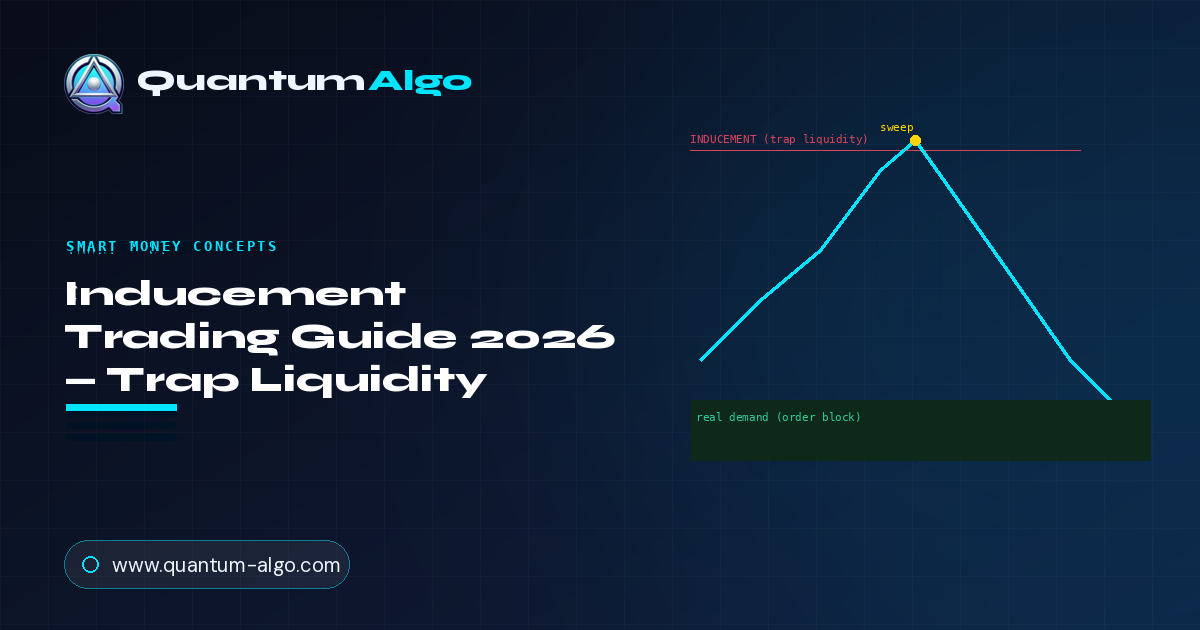
Inducement — often shortened to IDM — is bait. It is a pocket of obvious liquidity that smart money deliberately leaves in plain sight to lure traders into a position, so that their stop orders can be used as fuel for the real move. If a liquidity sweep is the crime, inducement is the setup: the trap laid before the sweep, engineered to make you feel clever right up until the moment it turns.
The idea only makes sense once you accept that markets move toward liquidity, not away from it. Large players need other people's orders to fill their size — they cannot buy a big position without a matching crowd of sellers, and vice versa. Inducement manufactures that crowd. By creating an inviting-looking high or low, a level that screams "obvious entry," it draws in breakout traders and early counter-trend traders whose stops then pile up in a predictable pocket. That pocket is the liquidity the real move is aiming for.
Here is the crucial distinction that separates traders who understand inducement from those who keep getting trapped: the inducement level is not the destination. It is the bait on the way to the destination. The real point of interest — a genuine order block, a fair value gap, a higher-timeframe zone — sits beyond the inducement. Price uses the inducement's liquidity as fuel to reach that real zone, and only there does the actual reversal begin. Trade the bait and you are the fuel; wait for the destination and you trade alongside the move.
Inducement is bait liquidity — an obvious high or low left in plain sight to lure traders in, so their stops fuel the real move to a deeper order block. The bait is the trap before the sweep, never the destination.
2. Why Inducement Works: The Psychology of the Trap
Inducement is effective because it weaponises exactly the things retail traders are taught to do. Every beginner learns to buy the obvious support, sell the obvious resistance, enter on the clean breakout, and place a tight stop just beyond the level. Inducement takes that entire rulebook and turns it into a targeting system: the more "textbook" a level looks, the more orders and stops cluster around it, and the more attractive it becomes as liquidity to be harvested.
Think about where stops actually sit. A crowd of traders who bought an obvious low will place their stops just below it. A crowd that sold an obvious high parks stops just above. Those clustered stops are resting sell orders (below) and buy orders (above) — precisely the counterparty liquidity a large player needs. The inducement's job is to make that level look so appealing that the crowd rushes in and stacks its stops into a tidy, harvestable pocket.
There is a second, quieter layer to the psychology worth naming. Inducement does not only trap the traders who take the obvious entry — it also traps the ones who correctly identify the real zone but cannot bear to watch price approach it without them. Those traders talk themselves into the early entry at the bait, reasoning that "close enough" is good enough. Inducement is engineered precisely for that moment of weakness. The level is built to be tempting to the informed trader too, not just the beginner, which is why even experienced traders get caught: knowing where the real zone is does not protect you if you cannot wait for price to actually get there.
It looks too clean
An inducement level is often suspiciously obvious — a picture-perfect double bottom or an equal high that any beginner would trade. That obviousness is the point; clean levels attract the most orders.
It sits before the real zone
Inducement is always positioned between current price and the genuine point of interest. If you can identify the real higher-timeframe order block, the obvious level in front of it is the likely bait.
It harvests stops
The crowd's stops cluster just beyond the inducement. Sweeping them provides the resting orders a large player needs to fill size — the reason price is drawn there at all.
It exploits impatience
Inducement preys on the fear of missing out. Traders who cannot wait for the real zone take the obvious early entry — and become the liquidity for those who did wait.
3. How to Spot Inducement
Spotting inducement is a skill of working backwards. Instead of asking "where is the obvious entry?", you ask "where is the real zone, and what obvious level sits in front of it that the crowd will take instead?" The obvious level is your inducement candidate. This reversal of the usual thought process is the whole discipline.
Find the real zone first
Start on a higher timeframe and locate the genuine point of interest — an unmitigated order block, a strong FVG, a major swing. Everything else is judged relative to it.
Look for the obvious level in front
Between price and that real zone, find the level a beginner would trade — an equal high or low, a clean minor swing, a textbook double top. That is the likely inducement.
Watch for the sweep
Inducement is confirmed when price sweeps that obvious level — grabbing the stops — and then continues toward the real zone rather than reversing at the bait. The sweep is the tell.
Wait for the real reaction
The genuine entry comes when price reaches the real order block after taking the inducement. That is where structure and confluence line up — not at the bait you were tempted by.
The mechanical, repetitive part of this — scanning for unmitigated order blocks, flagging the obvious minor swings in front of them, and watching for the sweep-then-continue pattern — is exactly the kind of pattern recognition a well-built Smart Money tool performs consistently on every bar, without the impatience and fear of missing out that lead a human to grab the bait. The concept is simple; the discipline to wait for the destination instead of the bait is what a systematic approach protects.
Find the genuine higher-timeframe order block first, then identify the obvious level in front of it — that is the inducement. The confirmation is a sweep of the bait followed by continuation to the real zone, where the true entry lives.
4. Inducement vs Liquidity Sweep vs Order Block
Inducement is easy to confuse with the concepts around it, so it is worth pinning down the differences precisely. These three ideas describe different moments in the same sequence, and understanding how they fit together is what turns a collection of terms into a usable read.
| Concept | What it is | When in the sequence |
|---|---|---|
| Inducement | The bait — an obvious level that lures traders in | First: laid before the move |
| Liquidity sweep | The action — price runs the stops beyond the bait | Second: the trap springs |
| Order block | The destination — the real zone where price reacts | Third: the true reversal point |
Read that as a single story. Smart money lays the inducement to attract a crowd and build a pocket of stops. Price then performs the liquidity sweep, running through that pocket to harvest the orders. And it comes to rest — and reverses — at the real order block beyond. The inducement is the "why," the sweep is the "how," and the order block is the "where." Miss the inducement and the sweep looks like a random stop hunt; understand it, and the whole move reads as a deliberate sequence.
The most important practical consequence is this: the inducement level is a place to avoid entering, and the order block beyond it is the place to look for an entry. New traders do the opposite — they enter at the bait and get stopped out precisely as price sweeps on to the real zone. The entire edge of understanding inducement is redirecting your attention from the obvious level to the one hiding behind it.
Spot the inducement
Four levels marked on the way down to a real demand zone. You are looking for the inducement — the obvious bait level that traps early buyers before the real move. Click it.
Notice the trap the game sets: the most "obvious" support — the clean, equal low that looks like the textbook buy — is the bait, not the entry. The real demand sits below it, unmitigated and less obvious. Retraining your eye to distrust the obvious level and look for the real zone behind it is the entire skill of trading inducement.

Automate your trades. Let Quantum Algo trade for you.
Every signal executed on your own account — 24/7, hands-off.
5. Trading With Inducement in Mind
Once inducement is part of your read, it changes two concrete things: where you enter and where you place your stop. Both changes push you away from the crowd and toward the side that harvests it.
Enter at the real zone, not the bait
Skip the obvious level entirely. Wait for price to sweep the inducement and reach the genuine order block beyond, then look for your entry there with structure confirming.
Place stops beyond the sweep
A stop resting just past the inducement is in the harvest pocket — the exact place price is designed to reach. Place stops beyond the real zone or the sweep's extreme instead, out of the obvious cluster.
Let the sweep be your trigger
The sweep of the inducement, followed by a reaction at the real zone, is a far higher-quality trigger than the obvious level breaking. Patience for the sweep is the edge.
Respect the higher timeframe
Inducement is cleanest when the real zone is a higher-timeframe point of interest. A lower-timeframe inducement into a daily order block is a classic, high-conviction sequence.
6. Common Inducement Mistakes
Inducement is a concept that traders often half-learn, and the half-knowledge causes its own errors. A few mistakes account for most of the frustration.
Seeing inducement everywhere
Not every minor swing is a deliberate trap. If there is no genuine higher-timeframe zone beyond it, an "inducement" is probably just an ordinary level. Anchor the read to a real destination.
Entering at the bait anyway
Recognising the inducement and still taking the obvious entry — out of impatience — defeats the entire purpose. The discipline is to wait for the real zone, every time.
Ignoring the trend
Inducement works with the higher-timeframe bias, not against it. Using it to justify a counter-trend trade into a strong move is fighting the current with a clever-sounding excuse.
No confirmation at the real zone
Reaching the order block is not the entry — the reaction there is. Buying blindly because "price hit the zone" skips the confirmation that separates a setup from a hope.
The through-line of every one of these mistakes is impatience. Inducement is fundamentally a test of whether you can wait for the real move instead of grabbing the obvious one. That is a discipline problem as much as an analysis problem, which is why a systematic framework — one that only flags the setup when the sweep-then-continue sequence actually completes — protects you from your own worst instinct to jump early.
Every inducement mistake traces back to acting too early — seeing traps that aren't there, or taking the bait you correctly identified. Anchor to a real higher-timeframe zone, wait for the sweep, and demand a reaction before you enter.
7. Test Your Knowledge
Seven questions on inducement, the trap, and how to trade around it.
8. Inducement Within a Full SMC Framework
Inducement is one link in the Smart Money chain, and it only makes sense alongside the concepts on either side of it. It is the reason liquidity sweeps happen where they do, and the thing that makes an order block worth waiting for.
The connections are direct. Inducement is the bait that leads to a liquidity sweep; the sweep carries price to a genuine order block or fair value gap; and the whole sequence is validated by a break of structure as price reverses out of the real zone. The real order block usually sits in the discount or premium half of the range, and the entry there is often a textbook Optimal Trade Entry.
• Buy/sell signals with built-in SL and TP — triggered at the real zone, not the bait
• Liquidity sweep detection — the moment the inducement is taken
• Order block and FVG detection — the genuine destination beyond the bait
• Multi-timeframe confluence scoring — so a sweep into a higher-timeframe zone scores higher
• ATR-based risk management — stops placed beyond the sweep, out of the harvest pocket
The habit to build: never trade the obvious level. Find the real zone, treat the obvious level in front of it as bait, wait for the sweep, and take your entry at the destination with structure confirming. Let the impatient crowd be the fuel — you trade the move their stops paid for.
Frequently Asked Questions
Inducement, often shortened to IDM, is bait liquidity - an obvious high or low that smart money deliberately leaves in plain sight to lure traders into a position, so their stop orders can be used as fuel for the real move. It is the trap laid before a liquidity sweep. Crucially, the inducement level is not the destination; it sits between current price and the genuine order block or zone, and price uses the crowd's stops as fuel to reach that real zone, where the actual reversal begins.
They are two moments in the same sequence. Inducement is the bait - the obvious level that lures traders in and builds a pocket of stops. The liquidity sweep is the action - price running through that pocket to harvest the orders. Inducement is the "why" (the trap is set), the sweep is the "how" (the trap springs), and a real order block beyond is the "where" (price reverses). Inducement comes first; the sweep is what happens to it.
Work backwards. Instead of asking where the obvious entry is, find the genuine higher-timeframe zone first - an unmitigated order block, a strong fair value gap, a major swing. Then look for the obvious level sitting between current price and that zone: an equal high or low, a clean minor swing, a textbook double top. That obvious level is the likely inducement. Confirmation comes when price sweeps it, grabbing the stops, and continues toward the real zone rather than reversing at the bait.
Inducement weaponises what retail traders are taught to do - buy obvious support, sell obvious resistance, enter clean breakouts, place tight stops just beyond the level. The more textbook a level looks, the more orders and stops cluster around it, making it attractive liquidity to harvest. Those clustered stops are exactly the counterparty orders a large player needs to fill size. Inducement makes a level look so appealing that the crowd rushes in and stacks its stops into a tidy, harvestable pocket.
Not at the inducement level - entering there makes you the liquidity. Wait for price to sweep the inducement, harvesting the crowd's stops, and reach the real order block or zone beyond. Look for your entry there, with structure confirming the reversal. Place your stop beyond the real zone or the sweep's extreme, not just past the inducement where the harvest pocket sits. The entire edge is redirecting your attention from the obvious level to the real one hiding behind it.
They are closely related but not identical. A stop hunt is the general act of price running through a cluster of stop orders. Inducement is the more specific concept of deliberately creating an obvious level beforehand to build that cluster in a chosen spot, as bait toward a real zone. In other words, inducement is the setup that makes a stop hunt targeted and predictable rather than incidental. The sweep of an inducement is a stop hunt with a clear purpose: fuelling the move to the genuine point of interest.
Yes, but it is cleanest when the real zone is a higher-timeframe point of interest and the inducement is on a lower timeframe. A classic, high-conviction sequence is a lower-timeframe inducement being swept into a daily or 4-hour order block. On very low timeframes in isolation, inducement reads can become noisy and subjective, with too many minor swings that look like traps. Anchoring the read to a genuine higher-timeframe destination keeps it reliable across timeframes.
More guides
References & Related Guides
More in this topic
- Liquidity Sweeps — Free Liquidity Sweep Indicator for TradingView (Buy-Side and Sell-Side Liquidity, Stop Hunts)
- Liquidity Sweep Trading: Stop Hunts Explained (2026)
- Order Block Trading: Complete Guide 2026
- Smart Money Concepts (SMC): Ultimate Trading Guide 2026
- Premium and Discount Zones: Complete Guide 2026
- Optimal Trade Entry (OTE): Complete Guide 2026
- Liquidity Trading Guide 2026 - Raids & Kill Zones
- Fair Value Gaps (FVG): Complete Trading Guide 2026
- BOS & CHoCH: Complete Market Structure Guide 2026
- ICT Trading Strategy: Complete Interactive Guide 2026
- What Is a Market Structure Shift (MSS)? 2026
- Wyckoff Method 2026 - Complete Institutional Trading Guide
- Supply and Demand Trading: Complete Guide 2026
Core reading
- Liquidity Sweep Trading: Stop Hunts Explained (2026)
- Order Block Trading: Complete Guide 2026
- Smart Money Concepts (SMC): Ultimate Trading Guide 2026
- Premium and Discount Zones: Complete Guide 2026
- ICT Trading Strategy: Complete Interactive Guide 2026
- All Premium Guides
- Quantum Algo on TradingView
- Public Verified Track Record