Inducement
Inducement is a minor liquidity pool that lures retail traders into premature entries before the real institutional move occurs in the opposite direction. Every major sweep is usually preceded by 1–3 minor inducement sweeps. Traders defend against it by waiting for price to reach the higher-timeframe order block or FVG before entering.
◆Full guide: Inducement Trading: The Trap Liquidity Before the Real Move
What it means
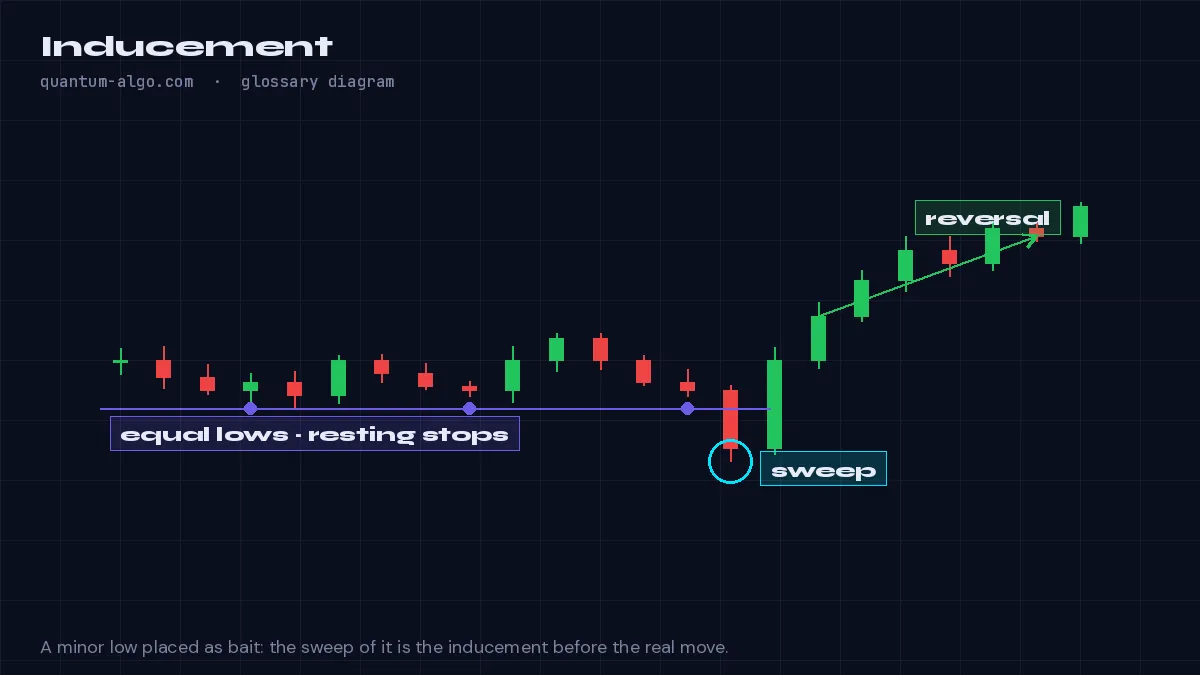
An inducement is a minor liquidity pool deliberately created (or naturally occurring) to lure retail traders into entering positions before the real institutional move occurs in the opposite direction. The classic inducement pattern: price creates a small swing high, retracts, then breaks above that swing high, triggering breakout buyers and short-stops, before reversing sharply downward to the actual institutional sell zone.
Inducements are particularly common around major liquidity levels. The pattern is fractal — every major sweep is usually preceded by 1–3 minor inducement sweeps that drain retail conviction and trigger early entries before the genuine institutional move. Recognizing inducement requires understanding that not every BOS or sweep is the 'real' one.
The defense against inducement is patience and multi-timeframe alignment. If your higher-timeframe bias is clear and you are waiting for a specific HTF point of interest (an HTF order block or FVG), minor LTF moves that look like setups but don't reach the HTF POI are usually inducements. Wait for price to actually reach the HTF zone before considering entries.
Inducement is closely related to the ICT concept of the Judas Swing — the deliberate fake move at the start of the London or New York session designed to trap traders before reversing in the real direction. Both are institutional mechanics for harvesting retail liquidity before committing capital to the actual trend.
How to identify it on a chart
- Find a minor swing point between price and the real point of interest.
- Retail enters or places stops at that minor level.
- Price runs it (the inducement), then reaches the true order block or FVG and reverses.
Worked example
A small pullback low sits at 1,842 above a 4-hour order block at 1,830. Price breaks 1,842, triggering early longs' stops, taps 1,832 and reverses — the minor low was the inducement.
See it on the chart, read it in depth
Frequently asked questions
How do I know if a sweep is inducement or the real move?
Inducement sweeps target minor liquidity (small swing points, single-touch levels). Real institutional sweeps target major liquidity (equal highs/lows, multi-touch levels, session highs/lows). If the sweep level is not visible from a higher timeframe, it is probably inducement.
Can I trade inducements directly?
Yes, but it requires lower-timeframe execution and tighter risk management. Most discretionary SMC traders avoid trading inducements and focus only on the major sweeps. Systematic traders may include inducement detection as part of their setup library.
What is the relationship between inducement and the Judas Swing?
The Judas Swing is a specific type of inducement that occurs at session opens (typically London Open). It is the same institutional mechanic — fake move, sweep retail liquidity, reverse to the real direction — applied at a predictable time window.
Related terms
See Inducement on your TradingView chart
Zeno reads Smart Money structure across timeframes and prints the entry, stop and targets — with a public record of every posted trade. The free indicators draw the concepts this page defines.