Displacement
Displacement is a strong, full-bodied candle showing aggressive institutional intent, typically 1.5 times the 14-period ATR or more, with the body closing near its extreme. It creates fair value gaps and confirms breaks of structure. Traders use it as the main quality filter: an order block whose impulse lacked displacement is low probability.
◆Full guide: Displacement Trading: The Footprint of Institutional Conviction
What it means
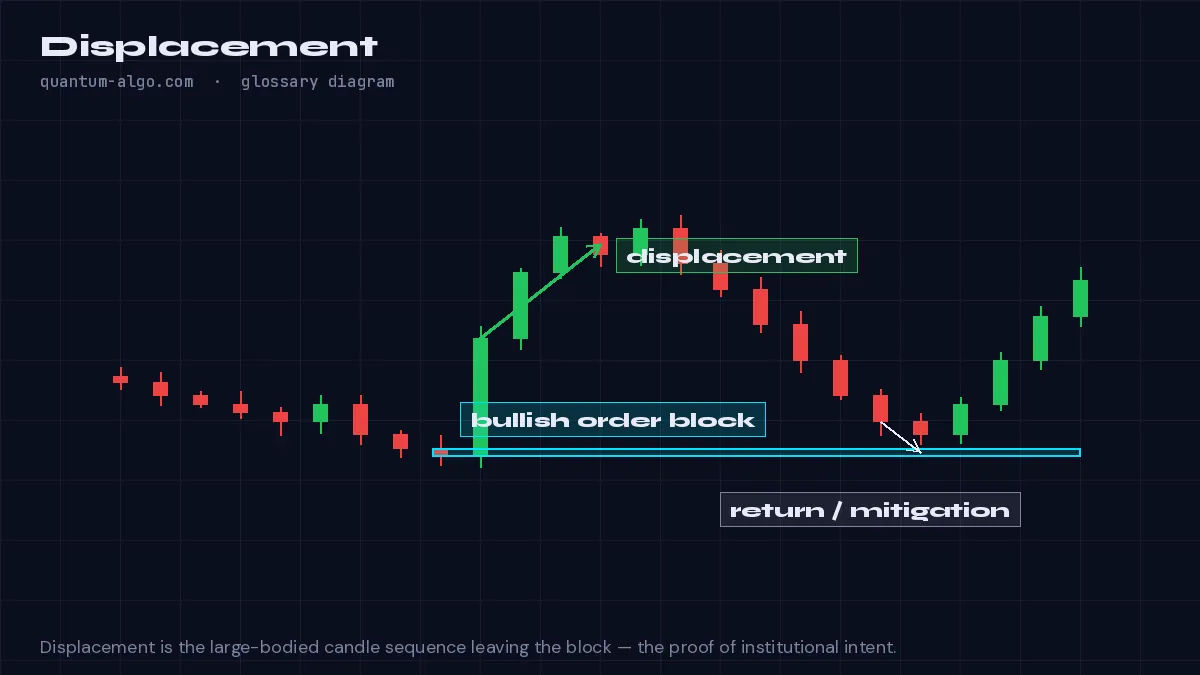
Displacement is the SMC term for a strong, aggressive price move that signals clear institutional intent. A displacement candle has a large body relative to its wicks, closes near its extreme (high for bullish displacement, low for bearish), and is typically at least 1.5 times the average true range (ATR) of the prior 14 candles. Displacement is what creates Fair Value Gaps and confirms the breaking of structure.
The institutional logic is straightforward: when a desk decides to commit to a position, the execution algorithms stop trying to be sneaky and start crossing the spread aggressively. The result is a candle that runs through resting limit orders, leaves a price imbalance behind (the FVG), and breaks structure with a decisive body close. Without displacement, an apparent break of structure is usually noise that reverts.
Quality displacement is the single most important filter for any SMC setup. An order block that produced strong displacement on its impulse leg is high probability; an OB whose impulse was a weak, drifting move is much lower probability. Quantum Algo measures displacement strength as part of its order block grading and only flags A-grade OBs with 1.5+ ATR displacement.
Displacement is also what distinguishes a Wyckoff Sign of Strength bar from ordinary price action — and the connection is exact: every Sign of Strength bar is a displacement candle in SMC terminology. The two frameworks are reading the same chart event with different vocabularies.
How to identify it on a chart
- Look for one or more candles with bodies well above average range (1.5× ATR or more).
- The move should leave a fair value gap behind — inefficiency is the fingerprint of displacement.
- The candle immediately before it is the order block; the move usually breaks structure.
Worked example
Gold ranges with 4-dollar candles, then prints a 13-dollar bullish candle that leaves a gap and closes above the range high. That candle is the displacement; the last bearish candle before it is the order block to trade.
See it on the chart, read it in depth
Frequently asked questions
How do I measure displacement objectively?
Compare the body of the candle in question to the 14-period ATR. A body of 1.5×ATR or larger qualifies as displacement. Body close in the upper 25% of the range (for bullish) or lower 25% (for bearish) confirms strength. Multiple displacement candles in sequence indicate a strong impulse leg.
Can a small candle still be displacement?
On lower timeframes (1m, 5m), small absolute moves can still be displacement if they are 1.5+ ATR for that timeframe. Displacement is relative to recent volatility, not an absolute number of pips or dollars.
Why does displacement matter for trading FVGs?
An FVG created without displacement is usually mid-range noise that does not represent a real institutional event. Filtering for displacement strength is what separates A-grade FVGs (60%+ win rate) from C-grade FVGs (sub-50% win rate). Quantum Algo applies this filter automatically.
Related terms
See Displacement on your TradingView chart
Zeno reads Smart Money structure across timeframes and prints the entry, stop and targets — with a public record of every posted trade. The free indicators draw the concepts this page defines.