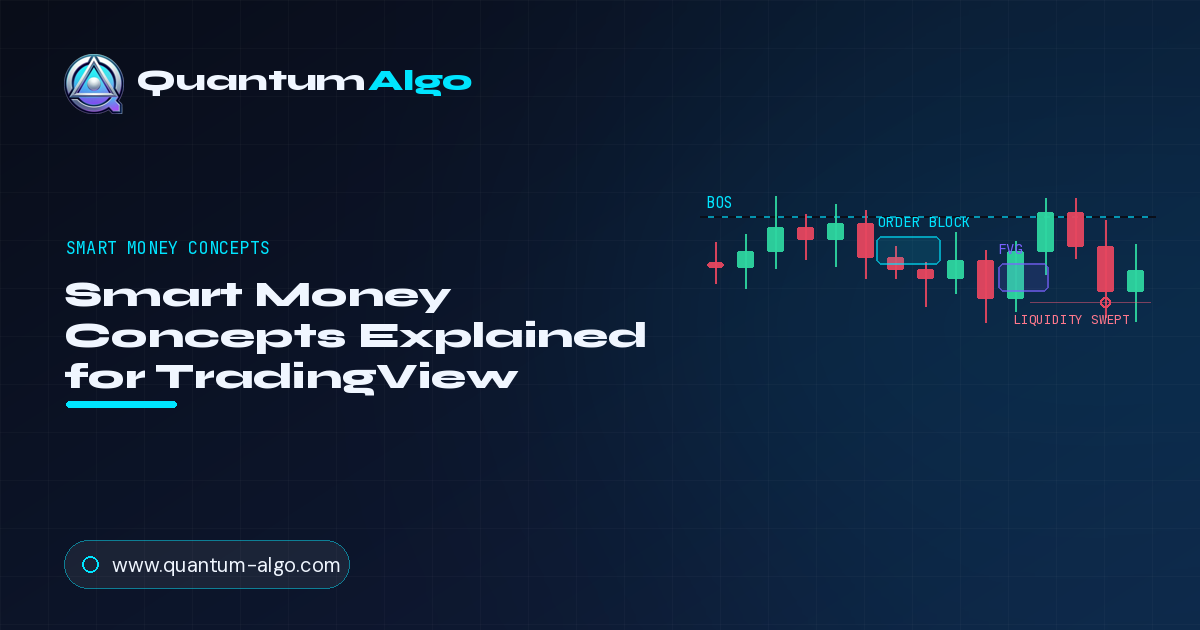
Smart Money Concepts (SMC) explained simply: it is a price action trading framework that reads the footprints of institutional traders — banks, hedge funds, and market makers — on the chart. The core idea is that these large players create predictable patterns when entering and exiting positions, including order blocks, Fair Value Gaps, liquidity grabs, and structural shifts. By identifying these patterns, retail traders can trade in the same direction as institutional money rather than being used as exit liquidity.
Last verified: April 15, 2026 · Beginner-friendly guide to Smart Money Concepts methodology.
Smart Money Concepts (SMC) is a trading methodology that reverse-engineers how institutional players — banks, hedge funds, and market makers — accumulate and distribute positions. Instead of using lagging retail indicators, SMC traders read the footprint that large orders leave on the chart.
The Core Principles of SMC
At its foundation, SMC rests on one key insight: retail traders lose money because they're unknowingly providing liquidity to institutions. Every stop loss you set, every breakout you chase — these are precisely the price levels where smart money fills their orders.
The four pillars of SMC are: Market Structure (identifying trend direction through higher highs and higher lows), Order Blocks (institutional supply and demand zones), Fair Value Gaps (price imbalances where institutional orders displaced price), and Liquidity (pools of stop losses that institutions target before reversing price).
Market Structure: The Foundation
Before identifying any setup, you need to know the current market structure. A bullish structure shows price making consistently higher highs (HH) and higher lows (HL). A bearish structure shows the opposite — lower highs (LH) and lower lows (LL). The critical moment is the Break of Structure (BOS) — when price violates a key swing point, confirming a continuation or reversal.
A Change of Character (CHoCH) occurs when the first swing point in the opposite direction is broken. This is the earliest sign that smart money may be shifting their bias. For example, in a downtrend, a CHoCH happens when price breaks above the most recent lower high — signaling potential accumulation by institutions.
Order Blocks: Where Institutions Enter
An order block is the last opposing candle before a strong impulsive move. When price drops sharply, the last bullish candle before that drop becomes a bearish order block — this is where institutions placed their sell orders. These zones act as high-probability reversal areas when price returns to them.
Fair Value Gaps: Price Imbalances
A Fair Value Gap (FVG) forms during a three-candle sequence where the wick of candle one and the wick of candle three don't overlap. The gap between them represents an area where institutional orders moved price so aggressively that no two-way auction occurred. Price has a statistical tendency to return to these zones before continuing in the original direction.
FVGs are most powerful when they form during impulsive moves — sharp, one-directional candles driven by institutional volume. Low-volume FVGs in ranging markets are far less reliable and should typically be filtered out.
Liquidity: The Fuel for Moves
Liquidity in SMC refers to clusters of pending orders — primarily stop losses — that sit above swing highs and below swing lows. Institutions need this liquidity to fill large orders without excessive slippage. Before a major reversal, you'll often see price sweep through these levels (a liquidity sweep), triggering retail stop losses and collecting the order flow they need.
There are two main types: Buy-side liquidity (BSL) above equal highs or swing highs, and Sell-side liquidity (SSL) below equal lows or swing lows. When you see price aggressively take out one of these pools and immediately reverse, that's often the signature of an institutional position being loaded.
Putting It All Together: The SMC Entry Model
The textbook SMC entry combines all four concepts: (1) Identify the HTF bias using market structure, (2) Wait for a liquidity sweep at a key level, (3) Look for a FVG or order block as your entry zone, (4) Enter with a stop below the liquidity sweep and target the opposing liquidity pool. This framework gives you a clear, rules-based system with defined risk.
How Quantum Algo Automates SMC
Manually identifying order blocks, FVGs, and liquidity levels across multiple timeframes is extremely time-consuming. Quantum Algo automates this entire process on TradingView — it identifies every valid structure break, grades order blocks by quality, marks FVGs with mitigation tracking, and highlights liquidity pools in real time. You focus on execution while the algorithm handles the analysis.
The Evolution of SMC in Retail Trading
Smart Money Concepts did not emerge in a vacuum. They evolved from a lineage of institutional trading methodologies that were traditionally the domain of proprietary trading desks and hedge funds. Richard Wyckoff's work on accumulation and distribution in the early 20th century laid the groundwork for understanding institutional behavior. The Inner Circle Trader (ICT) methodology later popularized many of these concepts on YouTube, making institutional analysis accessible to retail traders for the first time. Modern SMC synthesizes these influences into a practical, rule-based framework.
What makes SMC particularly powerful in the 2026 trading landscape is the proliferation of algorithmic market makers. These algorithms execute the same type of institutional behavior that Wyckoff observed a century ago — accumulation, markup, distribution, markdown — but at higher speed and with greater precision. The structural footprints they leave (order blocks, FVGs, liquidity sweeps) are more consistent and more predictable than ever because the algorithms follow deterministic rules. This is why SMC has become increasingly effective: the institutional behavior it detects is now executed by machines that repeat the same patterns with mechanical consistency.
Common Beginner Misconceptions About SMC
New SMC traders frequently make the mistake of treating every candle pattern as an order block. A genuine order block requires specific context: it must precede a strong displacement that breaks structure, it should sit in a premium or discount zone, and it should align with the higher-timeframe directional bias. A random bearish candle followed by a minor bounce is not an order block — it is just a candle. Applying the label too loosely dilutes the methodology's effectiveness and leads to overtrading on low-quality setups.
Another misconception is that SMC provides certainty. No methodology provides certainty. SMC provides a probabilistic edge — a statistical tendency for price to react at specific levels based on identifiable institutional behavior. Over a sample of 100 trades using properly filtered SMC setups, you might win 55–65% with an average 1:2 R:R. That is an exceptional edge. But it also means that 35–45% of your trades will lose, and you will experience streaks of 5–8 consecutive losses that test your conviction. Understanding this probabilistic nature from the outset prevents the emotional devastation that comes from expecting every trade to be a winner.
Building Your SMC Skill Progression
The most effective learning path for SMC follows a structured progression. Month 1–2: Focus exclusively on market structure. Learn to identify trends, BOS, and CHoCH on every timeframe. Do not trade live during this phase — just mark up charts daily and verify your analysis as price develops. Month 3–4: Add order blocks and FVGs to your analysis. Learn to identify high-quality zones and track their hit rate on historical charts. Begin paper trading with a small number of setups per week. Month 5–6: Incorporate liquidity analysis and multi-timeframe confluence. Transition to live trading with minimal position sizes.
This six-month progression may feel painfully slow, but it builds competence from the ground up. Traders who skip ahead — trying to trade complex multi-timeframe liquidity sweeps in their first month — inevitably develop bad habits and inconsistent results. The fundamentals of market structure recognition are the foundation. Every advanced SMC concept builds on top of structural analysis. If your structural reads are wrong, no amount of order block or FVG analysis will save the trade. Master the foundation first, then add complexity gradually.
SMC in the Age of Algorithmic Trading
A common concern is whether SMC concepts remain valid as markets become increasingly dominated by algorithmic trading. The answer is that algorithmic dominance actually strengthens SMC's effectiveness rather than weakening it. The algorithms that execute institutional orders follow systematic rules for accumulation, distribution, and liquidity targeting. These rules produce the same structural patterns (order blocks, FVGs, liquidity sweeps) with even greater consistency than human-driven institutional activity. As long as large orders need to be filled in a market with finite liquidity, the structural footprints that SMC identifies will persist.
The one area where algorithms have changed the game is speed of execution. Institutional algorithms can sweep liquidity and fill order blocks in milliseconds, making some setups develop and resolve faster than they did in the pre-algorithmic era. For retail traders, this means that the higher timeframes (4-hour, daily) have become more reliable than the lower timeframes (1-minute, 5-minute) because the higher timeframes smooth out the algorithm-driven noise and reveal the genuine institutional structural patterns. Focus your SMC analysis on the 15-minute chart and above for the most reliable signals in the current algorithmic market environment.
Resources for Continued Learning
The SMC learning journey never truly ends, but having reliable resources accelerates your development. The Quantum Algo Academy provides 80 structured lessons covering every aspect of Smart Money Concepts from beginner foundations to advanced institutional strategies. For supplementary learning, YouTube channels focused on ICT and SMC concepts offer free educational content — though the quality varies widely, so focus on educators who show real-time analysis rather than hindsight markup. TradingView's community script library contains numerous free SMC-based indicators and studies that help you visualize the concepts on live charts.
The most underrated learning resource is your own trading journal. After six months of consistent journaling, you will have a personalized textbook of your own market observations, successful patterns, common mistakes, and evolving understanding. No external resource can match the learning value of systematically reviewing your own experience. Combine structured education (academy lessons), community learning (forums and educational channels), and self-directed learning (journal review and chart markup practice) for the fastest progression from beginner to consistently profitable SMC trader.
Key Takeaways
Understanding Smart Money Concepts fundamentals provides a meaningful addition to your trading toolkit, but the real value emerges only when you integrate these concepts with a structured methodology like Smart Money Concepts. No single indicator, pattern, or analytical concept produces consistent profitability in isolation. The concepts covered in this guide become powerful when they serve as one layer in a multi-confirmation system that includes higher-timeframe directional bias, institutional zone identification, and disciplined risk management.
The most important practical step is to backtest before you trade live. Take the concepts from this guide and apply them to historical price data using TradingView's bar replay feature. Walk through at least 50 setups, recording the entry, stop, target, and outcome for each. This backtesting exercise accomplishes two things: it builds your pattern recognition for the specific setup types discussed in this article, and it gives you empirical data on the setup's actual performance — win rate, average R:R, and maximum drawdown — that you can use to make informed decisions about incorporating it into your live trading plan.
Your Next Steps
Now that you have a solid understanding of building your SMC knowledge from foundational principles, the next step is implementation. This week, dedicate 30 minutes per day to chart markup practice focused specifically on the concepts covered in this guide. Use the daily and 4-hour charts of your primary trading assets. Mark every relevant setup you can find, then track how price interacts with those levels over the next few sessions. This deliberate practice builds the visual pattern recognition that eventually becomes automatic during live trading.
After two weeks of chart markup practice, begin incorporating these setups into your demo trading or your live trading with minimal position sizes. Start with your single highest-conviction setup type and trade only that setup for 30 consecutive trades. After 30 trades, review your journal data: which setups produced the best R:R? Which sessions were most productive? Which assets showed the cleanest patterns? Use this data to refine your approach, eliminate underperforming variants, and concentrate on the specific combinations that your data shows work best for your trading style and market.
Finally, remember that mastery is a journey measured in months and years, not days and weeks. The traders who achieve lasting success are the ones who commit to continuous improvement through consistent practice, honest self-assessment, and evidence-based refinement. Every session of chart markup, every journaled trade, and every weekly review compounds your skill and brings you closer to the level of unconscious competence where profitable trading becomes second nature. Stay patient, stay disciplined, and trust the process.