The ICT 2022 Model: Liquidity Sweep, Displacement & FVG Entry, Step by Step
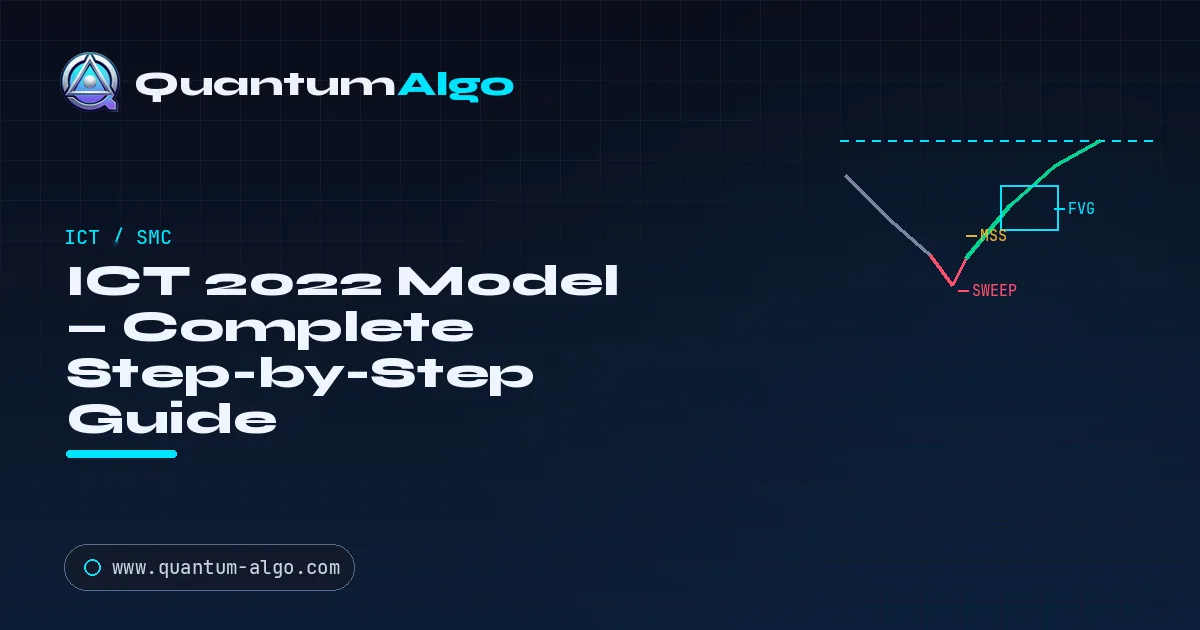
The ICT 2022 Model is the Inner Circle Trader's five-step sequence: price sweeps liquidity beyond a swing high or low, shifts market structure on strong displacement, and leaves a fair value gap. Enter as price retraces into that gap, stop just beyond the sweep wick, target the opposite liquidity pool, ideally in a kill zone. Never enter before the sweep.
The ICT 2022 Model is the single most-taught price-action framework to come out of Michael J. Huddleston's (the Inner Circle Trader's) 2022 mentorship series. It compresses years of institutional-order-flow theory into one repeatable sequence: sweep the liquidity resting beyond an obvious high or low, break market structure with a violent displacement candle, and re-enter on the fair value gap that displacement leaves behind. Done correctly, it produces high reward-to-risk entries at the exact moment "smart money" commits to a direction.
This guide walks the model end to end — every component, the exact sequence, the kill-zone timing that makes it work, the entry and stop rules, and the mistakes that turn a textbook setup into a losing trade. It is written for a trader who already knows the vocabulary of Smart Money Concepts and wants a mechanical, rules-based way to trade it.

Automate your trades. Let Quantum Algo trade for you.
Every signal executed on your own account — 24/7, hands-off.
The five components of the model
The 2022 Model is not a single indicator or candle pattern. It is a sequence of five things that must happen in order. Skip one, and the setup is invalid. Understanding each piece in isolation is what separates traders who can run the model live from those who only recognise it in hindsight.
▲ 1 · Liquidity pool
A cluster of stop orders resting above a swing high (buy-side liquidity) or below a swing low (sell-side liquidity). This is the fuel — the market moves toward it to fill institutional orders. Equal highs/lows and session highs/lows are the cleanest pools.
▲ 2 · Liquidity sweep
Price spikes past that high or low, triggering the resting stops, then rejects. This is the stop hunt. The wick beyond the level is the signature — a close beyond it usually invalidates the setup.
▲ 3 · Market structure shift
After the sweep, price breaks the most recent opposing short-term structure point with intent. This MSS is the first evidence the sweep was a reversal, not a continuation.
▲ 4 · Displacement
The move that causes the MSS must be a strong, one-directional displacement — large-bodied candles that leave an inefficiency behind. Weak, overlapping candles do not count.
▲ 5 · Fair value gap
The displacement leaves a fair value gap (a three-candle imbalance). This gap is your entry zone — price is expected to retrace into it before continuing toward the opposite liquidity.
◆ Result · The entry
You enter as price retraces into the FVG, stop just beyond the sweep wick, target the opposite liquidity pool. Because the stop is tight and the target is far, the reward-to-risk is naturally asymmetric.
What does the model's sequence look like on a chart?
Reading the five components as a list is one thing; seeing them fire in order is another. The diagram below traces a textbook bullish 2022 Model — a sell-side liquidity raid below a swing low, followed by displacement up, an MSS, and an FVG entry targeting buy-side liquidity above.
Bullish ICT 2022 Model — the full sequence
Notice the rhythm: the market needs the sweep to generate the orders that fuel the displacement. The stops triggered below the low become the counterparty for institutional buying. That is why entering before the sweep — anticipating the reversal — is the most common way traders lose with this model. You wait for the raid, then you react.
Why do kill zones matter for the model?
The 2022 Model is not a "trade it whenever you see it" setup. Huddleston teaches it inside specific windows — the kill zones — when institutional volume is concentrated and the liquidity runs are most reliable. Outside these windows, the same visual pattern fires far more false signals.
| Kill zone | Time (EST) | Why it works |
|---|---|---|
| London Open | 02:00 – 05:00 | London liquidity enters; often sweeps the Asian range before the real daily move |
| New York AM | 07:00 – 10:00 | Highest-volume US session open; the classic window for the model on indices and FX |
| London Close | 10:00 – 12:00 | Afternoon reversals as London desks close positions |
| New York PM | 13:30 – 16:00 | Secondary US window; useful for continuation setups |
The practical rule: identify the liquidity pool before the kill zone opens, then let the sweep and displacement develop inside it. If the model completes outside a kill zone, treat it as lower probability and reduce size or skip it entirely.
What are the model's entry, stop and target rules?
The model's edge comes from mechanical execution. Here is the exact rule set for a bullish setup (mirror everything for shorts):
▸ Entry
Place a limit order at the fair value gap. Conservative traders use the FVG's upper edge (consequent encroachment is the 50% midpoint); aggressive traders use the far edge for a better price at the cost of a lower fill rate.
▸ Stop loss
Just below the low of the sweep wick — the point that, if broken, proves the reversal failed. This is typically a tight stop, which is what creates the model's high reward-to-risk.
▸ Target
The opposite liquidity pool — the buy-side liquidity above the most recent swing high (or a clean draw on liquidity like an old high, session high, or premium array).
How do bullish and bearish setups of the model differ?
The model is fully symmetric. The only thing that changes is which liquidity gets swept first and which direction displacement travels.
Which mistakes break the model?
✕ Entering before the sweep
Anticipating the raid instead of waiting for it. The sweep is the trigger — no sweep, no trade.
✕ Accepting weak displacement
Overlapping, small-bodied candles are not displacement. Without a clean, large-range move you have no valid FVG and no institutional conviction.
✕ Ignoring HTF bias
Taking bullish setups in a clear higher-timeframe downtrend. The model works best with the higher-timeframe draw on liquidity.
✕ Trading outside kill zones
The same pattern at 3pm on a quiet Friday is not the same trade as the New York AM open. Respect the windows.
✕ No clean target
If there is no obvious opposite liquidity pool to draw toward, the reward side of the trade is a guess. Skip it.
✕ Moving the stop
Widening the stop past the sweep wick to "give it room" destroys the entire risk premise of the model.
How does the model fit the wider ICT framework?
The 2022 Model is the entry engine, but it lives inside a bigger picture. Use it alongside the Power of Three (accumulation-manipulation-distribution) to understand why the sweep happens where it does, and premium/discount zones to confirm you are buying discount and selling premium. Traders coming from a pure Smart Money Concepts background will find the 2022 Model is essentially SMC's break-of-structure entry with strict sweep-and-displacement filters bolted on.
It also pairs naturally with an automated, non-repainting confirmation tool. If you would rather have the sweep, displacement, and FVG detected for you rather than drawing them by hand, that is exactly the kind of institutional-order-flow logic the QuantumAlgo indicator is built to surface on your TradingView chart.
• Liquidity sweep alerts — the raid that triggers the model, flagged automatically on your chart
• Displacement detection — strong one-directional moves that validate the market structure shift
• FVG identification — the fair value gap entry zone marked the moment displacement prints
• Order block context — institutional zones that reinforce your 2022 model entries
• Multi-timeframe bias — HTF draw on liquidity aligned with your LTF model entries
◆ Trade the model without drawing every box by hand
QuantumAlgo flags liquidity sweeps, displacement, and fair value gaps automatically on TradingView — the exact components of the 2022 Model — with a verified public track record.
See the indicator → Verify the track recordFrequently Asked Questions
The ICT 2022 model is a price-action trading framework taught by Michael J. Huddleston (the Inner Circle Trader) in his 2022 mentorship. It sequences five components — a liquidity pool, a liquidity sweep, a market structure shift, displacement, and a fair value gap entry — into a repeatable setup that aims to enter at the moment institutional order flow commits to a direction, targeting opposite liquidity for high reward-to-risk.
Five, in order: (1) a liquidity pool of resting stops above a high or below a low, (2) a liquidity sweep that raids those stops and rejects, (3) a market structure shift that breaks opposing structure, (4) displacement — a strong one-directional move — that causes the shift, and (5) a fair value gap left by that displacement, which becomes the entry zone.
After the sweep and market structure shift, place a limit order in the fair value gap left by the displacement. Conservative entries use the FVG midpoint (consequent encroachment); aggressive entries use the far edge for a better price at a lower fill rate. The stop sits just beyond the sweep wick and the target is the opposite liquidity pool.
The model is most commonly executed on lower timeframes (1-minute to 15-minute) for entries, with higher-timeframe bias set on the 1-hour or 4-hour chart. The key is aligning the entry with the higher-timeframe draw on liquidity rather than trading the pattern in isolation.
Inside the ICT kill zones — London Open (02:00–05:00 EST), New York AM (07:00–10:00 EST), London Close (10:00–12:00 EST), and New York PM (13:30–16:00 EST). These windows concentrate institutional volume and produce the most reliable liquidity runs. The same pattern outside these windows is lower probability.
Displacement is a strong, one-directional price move made of large-bodied candles that breaks structure and leaves an inefficiency (a fair value gap) behind. It signals institutional conviction. Weak, overlapping, small-bodied candles are not displacement and invalidate the setup because they leave no clean FVG to enter.
The 2022 model is essentially the break-of-structure entry from Smart Money Concepts with strict filters added: a mandatory liquidity sweep before the entry and a displacement requirement to validate the structure shift. SMC is the broader vocabulary; the 2022 model is one specific, mechanical way to trade it.
Because the stop sits at the sweep wick and the target sits at distant opposite liquidity, textbook setups routinely offer 3:1 to 5:1. Actual results depend on fill quality — if price only taps the fair value gap edge before running, aggressive far-edge entries can miss, so traders should track their personal fill rate before trusting the headline ratio.
Yes. The model is market-agnostic because it is based on liquidity and order flow, which exist in any market with participants and stop orders. It is widely applied to forex majors, index futures, and major crypto pairs. The kill-zone timing is anchored to the forex/US-session clock, so crypto traders often adapt the windows to the sessions that move their pair.
Just beyond the sweep wick — below the low for a bullish setup, above the high for a bearish setup. That point is the price level that, if broken, proves the sweep was not a reversal. Widening the stop past the sweep to 'give it room' destroys the tight-risk premise that makes the model's reward-to-risk attractive.
A liquidity sweep (or stop hunt) is when price spikes past an obvious swing high or low to trigger the stop orders resting there, then rejects and reverses. It is the trigger for the whole model — the raided stops become the counterparty for the institutional position, fuelling the displacement that follows. No sweep means no valid setup.
The individual components — liquidity levels, sweeps, displacement, and fair value gaps — can each be detected algorithmically, and tools like the QuantumAlgo indicator surface them automatically on TradingView. Full end-to-end automation of the entry decision is harder because it requires judgement on higher-timeframe bias and clean target selection, which most traders still confirm manually.
References & Related Guides
More in this topic
- Who Is ICT (Michael J. Huddleston)? The Trader Behind Killzones, FVGs and the 2022 Model
- ADX Indicator: Complete Trading Guide
- AlphaTrend Indicator: Complete Trading Guide
- ATR (Average True Range): Complete Trading Guide
- Awesome Oscillator: Complete Indicator Guide
- What Are the Best Volume Indicators?
- Bollinger Bands — Complete Trading Indicator Guide
- CCI Indicator: Complete Guide
- Chandelier Exit: Complete Trading Guide
- Donchian Channels: Complete Indicator Guide
- Fibonacci Bollinger Bands: Complete Trading Guide
- Fibonacci Retracement — Complete Trading Guide
- Hull Moving Average (HMA): Complete Trading Guide
Core reading
- BOS & CHoCH: Complete Market Structure Guide
- Order Blocks Trading: Complete Guide
- Best TradingView Indicators — Complete Guide
- Risk Management in Trading — Complete Guide
- Candlestick Patterns Guide — Engulfing, Pinbar & More
- All Premium Guides
- Quantum Algo on TradingView
- Public Track Record