Inversion Fair Value Gap (IFVG)
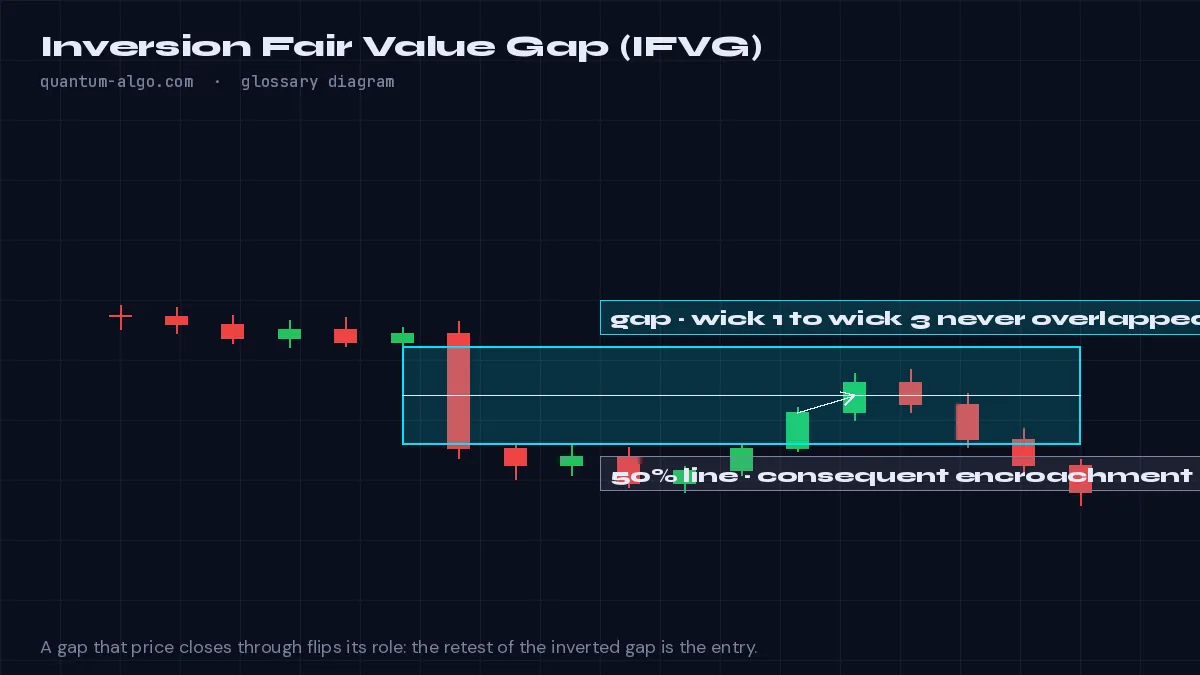
An inversion fair value gap is a fair value gap that price has closed through: a bullish gap that fails becomes resistance, a bearish gap that fails becomes support, and the retest of the inverted gap is the entry.
What it means
A fair value gap is expected to hold — price returns to fill some of it and continues. When instead a candle closes through the entire gap, the gap has failed and inverts. The inversion fair value gap (IFVG) is that flipped zone: former support is now resistance, former resistance now support. The first retest after the inversion is where the trade sits.
The inversion is meaningful because the participants who defended the original gap have been run over, and the close through it usually comes with displacement — a fresh injection of order flow. IFVGs form the core of the ICT 2022 model's entry logic and are graded on their own by the Fair Value Gaps + Inversion indicator.
Not every close through a gap is a clean inversion. A wick through with a close back inside is a sweep of the gap, not an inversion; a close through on a low-range candle without follow-through is weak. The best IFVGs come from a decisive body close with structure breaking in the same direction.
How to identify it on a chart
- Mark a fair value gap on your timeframe.
- Wait for a candle body to close completely beyond the far side of the gap.
- The gap is now inverted; enter on the first retest with the stop beyond the gap's far edge.
Worked example
A bullish FVG at 1.0840–1.0855 holds twice, then a 15-minute candle closes at 1.0831 below the whole gap. Price rallies back to 1.0850 and rejects — the inverted gap is now resistance and the short targets the session low.
See it on the chart, read it in depth
Frequently asked questions
What is the difference between an FVG and an IFVG?
An FVG is expected to act as support (bullish) or resistance (bearish); an IFVG is a gap that failed and now acts as the opposite. Same zone, opposite role.
Does the whole gap have to be closed through?
Yes for a clean inversion — a body close beyond the far edge. A close inside the gap is a partial fill, not an inversion.
How many retests does an IFVG hold?
Usually one clean reaction; treat the second retest with caution and discard it after a close back through.
Which timeframe is best for IFVG trading?
Any, but the ICT 2022 model uses 1–5 minute inversions inside a 15-minute or hourly bias.
Related terms
See Inversion Fair Value Gap (IFVG) on your TradingView chart
Zeno reads Smart Money structure across timeframes and prints the entry, stop and targets — with a public record of every posted trade. The free indicators draw the concepts this page defines.