ICT Macros: The Time Windows When the Algorithm Seeks Liquidity
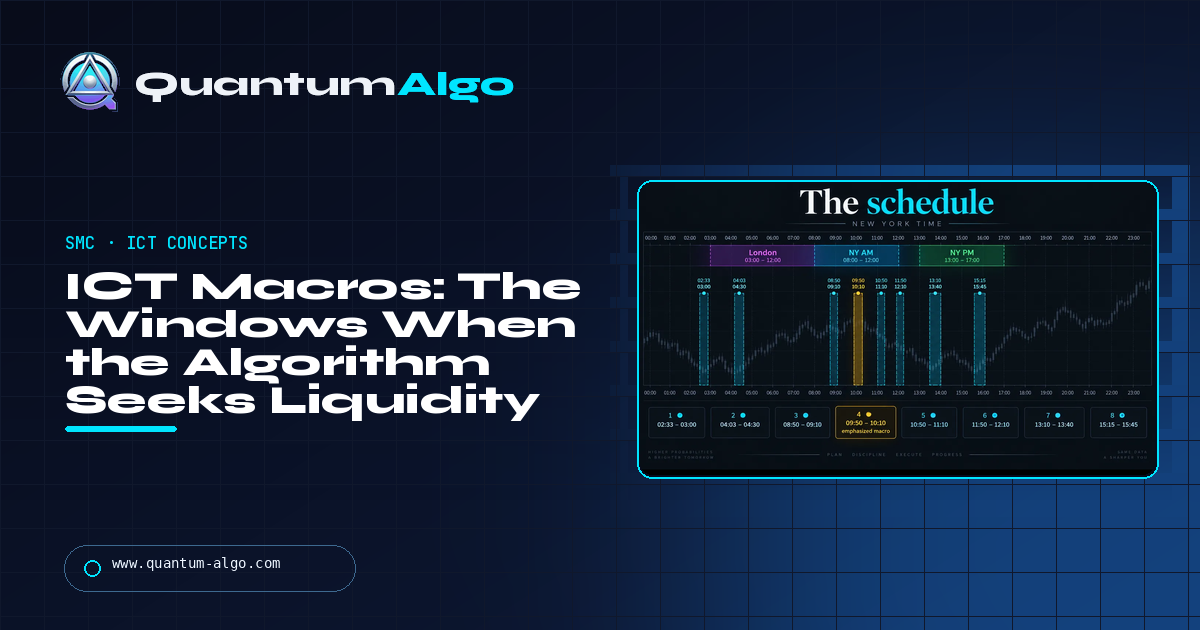
An ICT macro is a twenty-to-thirty-minute window at a fixed New York time — 02:33–03:00, 04:03–04:30, 08:50–09:10, 09:50–10:10, 10:50–11:10, 11:50–12:10, 13:10–13:40 and 15:15–15:45 — during which price is expected to run a pool of liquidity or reprice into a fair value gap. The window tells you when to watch; the trade is the failed run or the touch of the gap, confirmed on the 1- or 5-minute chart, with the target at the opposite pool. It is not a signal on its own.
I keep the macro times on a sticky note next to the screen, which sounds like superstition until you log a few hundred sessions and see where the runs cluster. This page is the schedule in New York, London and UTC, what happens inside a window and what does not, how to trade one step by step, a NAS100 morning worked through minute by minute, the relationship to killzones and the Silver Bullet, and the five conditions under which the windows do nothing. The clock tool converts everything to your timezone and counts down to the next one.
Indicators that prove themselves in public.
One engine, four precision tools — the Gold (XAU) Scalper, the institutional Gravity Zone, the Zeno momentum Oscillator, and Zeno Stocks for equities.
What is an ICT macro?
An ICT macro is a short, fixed time window — twenty to thirty minutes — during which, in Michael Huddleston's framework, the delivery algorithm that prices the market goes looking for something: a pool of resting stops above or below the recent range, or an unfilled fair value gap. Inside the window price tends to do one of two things: run a level and reverse, or reprice into an imbalance and continue. Outside the window it is more likely to drift.
"Macro" here has nothing to do with macroeconomics. ICT borrowed the word from programming, where a macro is a small routine that runs on a schedule. The claim is that the algorithm has such routines and that they run at set clock times in New York. Whether you accept the mechanism or not, the observable part is testable: the 09:50–10:10 window on NAS100 and ES contains a disproportionate share of the morning's liquidity runs, and has done for as long as intraday data has been easy to check.
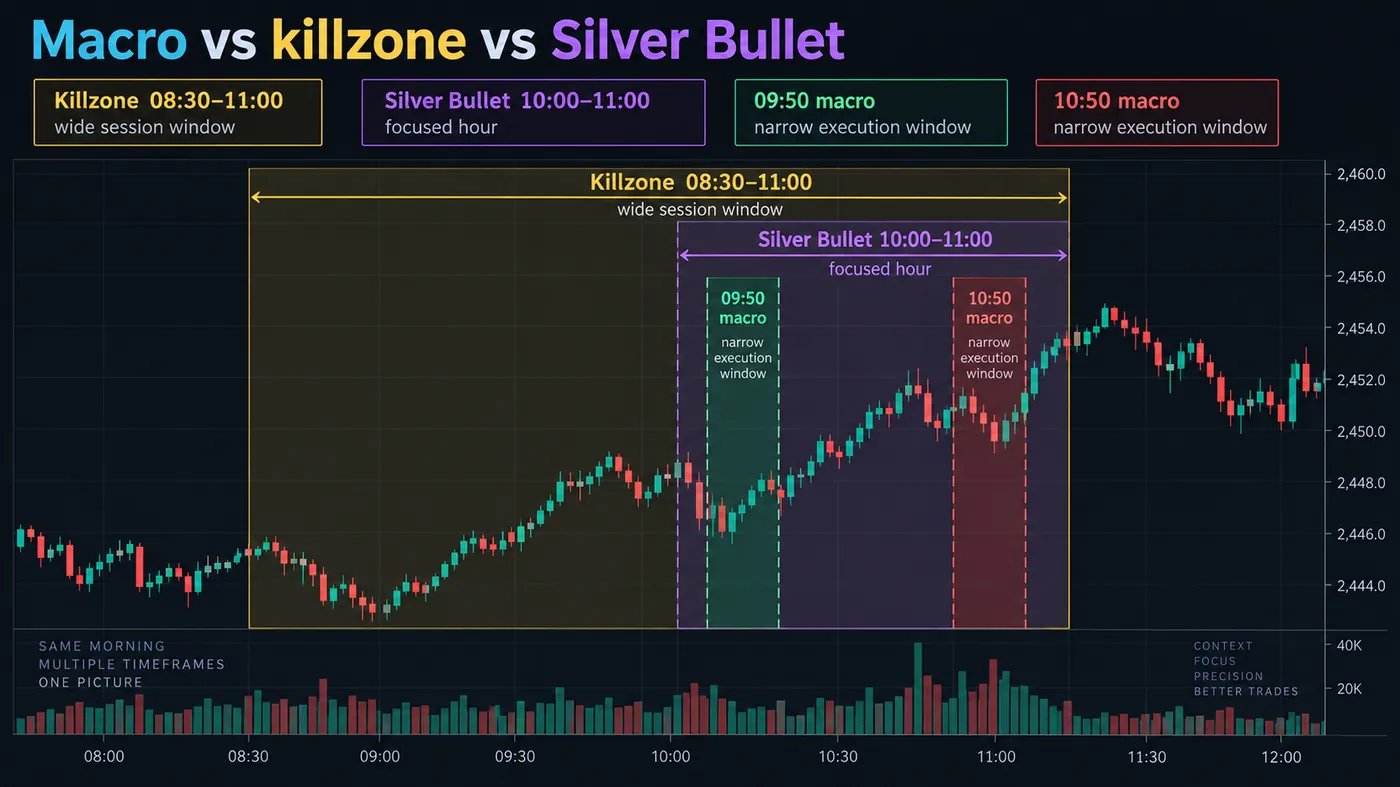
The macro is not a killzone. The killzone is a two-to-three-hour session window where volume is high; the macro is a twenty-minute slice inside or near it where a specific behaviour is expected. It is not the Silver Bullet either, although the 10:00–11:00 Silver Bullet hour contains the 09:50 and 10:50 macros and most Silver Bullet entries happen inside one of them. And it is not a signal. A macro with no liquidity pool nearby and no gap to reprice into does nothing you can trade.
The macro schedule
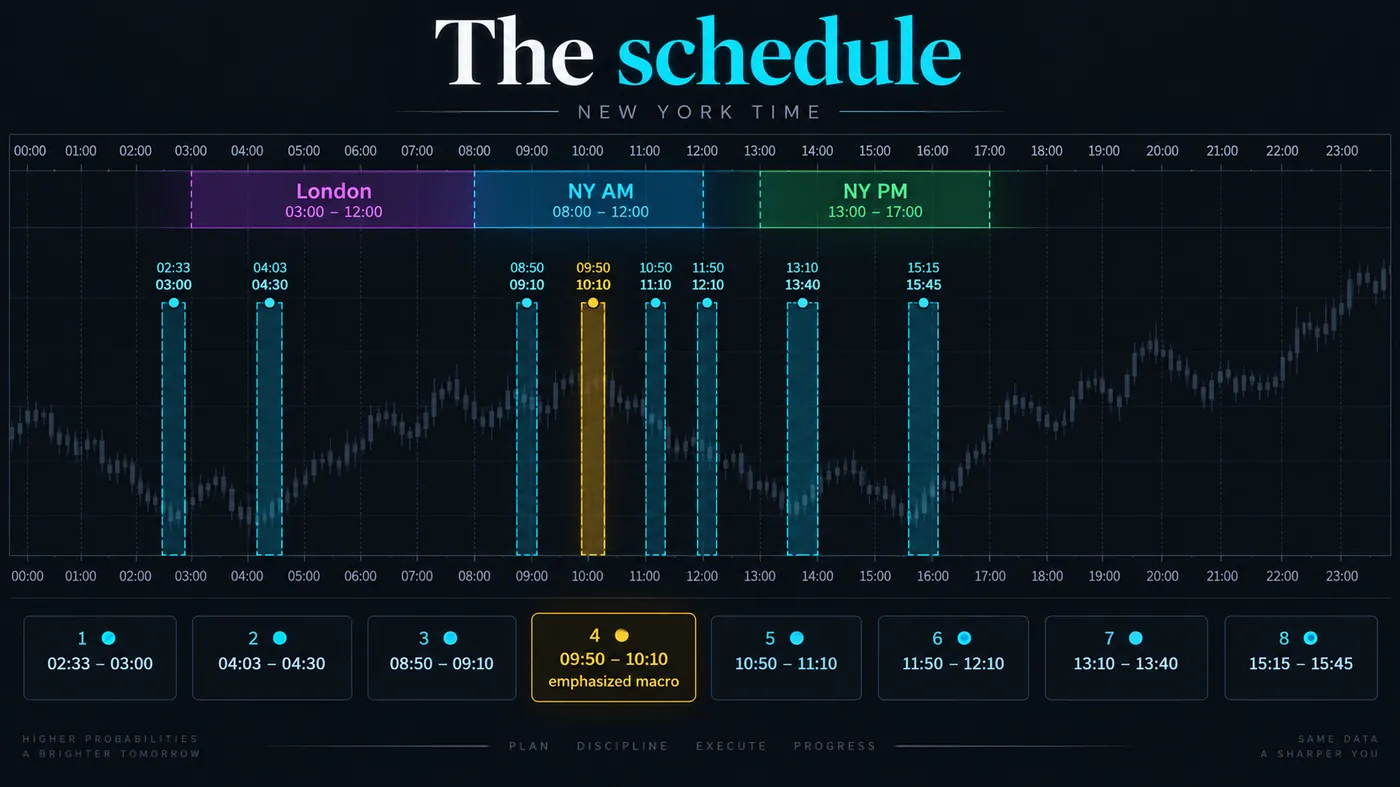
All times are New York local time and shift with US daylight saving; the London pair also shifts with British Summer Time, so the two do not always line up the same way in UTC. The clock tool further down converts them for wherever you are.
| Macro | New York time | London (while both on summer time) | UTC (US summer) | What it usually does |
|---|---|---|---|---|
| London 1 | 02:33 – 03:00 | 07:33 – 08:00 | 06:33 – 07:00 | First run on the Asian range high or low after the London open |
| London 2 | 04:03 – 04:30 | 09:03 – 09:30 | 08:03 – 08:30 | Second London push; often the London high or low of the day |
| NY AM 1 | 08:50 – 09:10 | 13:50 – 14:10 | 12:50 – 13:10 | Pre-open run on the overnight high or low, ahead of the 09:30 cash open |
| NY AM 2 | 09:50 – 10:10 | 14:50 – 15:10 | 13:50 – 14:10 | The one everybody watches: run on the opening-range high/low, reprice to the 5M gap |
| NY AM 3 | 10:50 – 11:10 | 15:50 – 16:10 | 14:50 – 15:10 | Second AM run; often the high or low of the morning |
| Lunch | 11:50 – 12:10 | 16:50 – 17:10 | 15:50 – 16:10 | Low-volume run; frequently a false move into the lunch range |
| NY PM 1 | 13:10 – 13:40 | 18:10 – 18:40 | 17:10 – 17:40 | Start of the afternoon delivery; runs the lunch range |
| NY PM 2 | 15:15 – 15:45 | 20:15 – 20:45 | 19:15 – 19:45 | Last-hour positioning into the 16:00 cash close |
Two things to notice. The windows are not evenly spaced and they do not sit on round numbers, which is deliberate: 09:50, not 10:00, so that the run happens before the round-number crowd expects it. And the two London windows begin at odd minutes — 02:33, 04:03 — for the same reason. Treat the minutes as approximate by two or three either side; the algorithm, if it is one, does not read your chart's clock.
What happens inside a macro
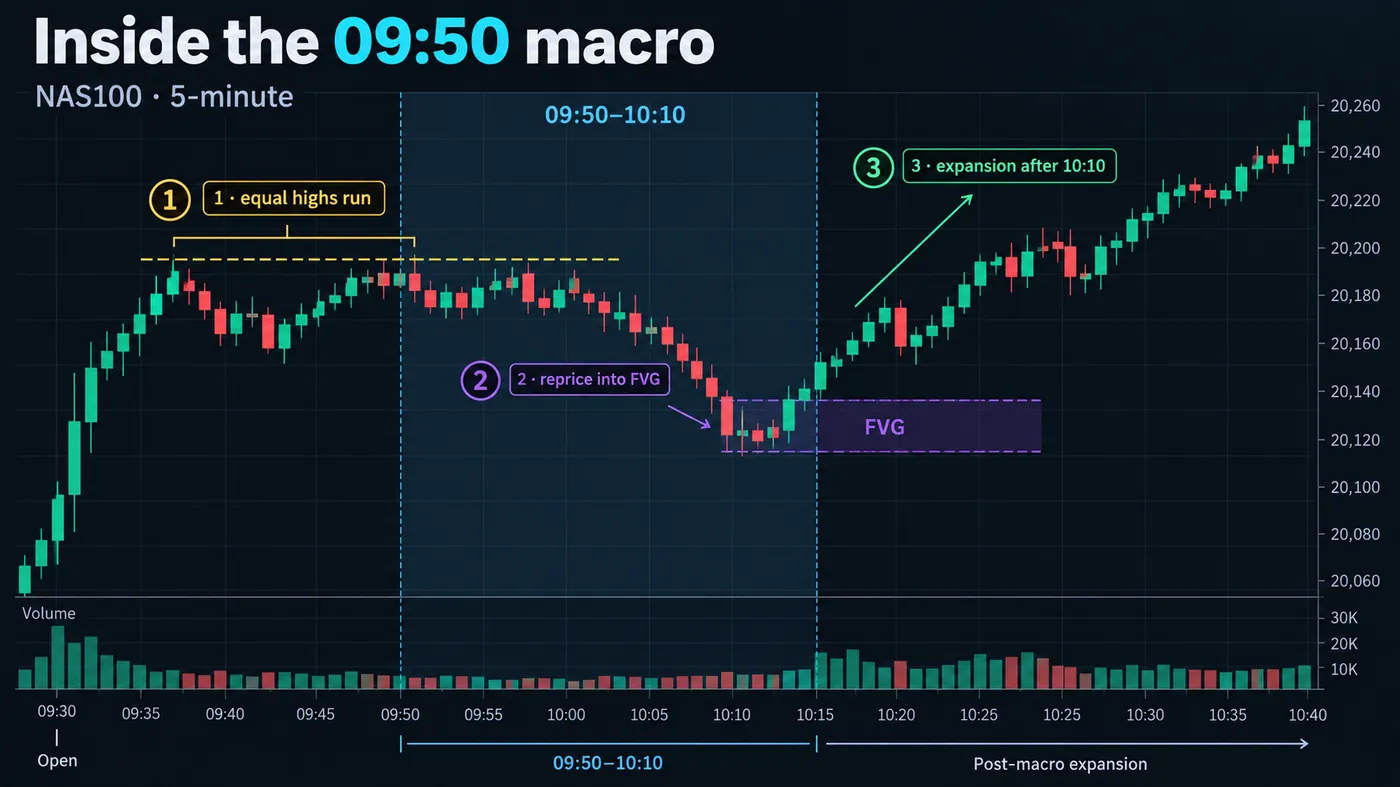
Three behaviours cover almost everything I have logged in these windows.
The run to liquidity. Price accelerates into a pool — equal highs from the open, the overnight high, the London low — trades through it by a few ticks or points, and reverses. This is the liquidity sweep on a schedule. The tell is speed: a 5-minute candle that covers more range than the previous six, straight into a level everyone can see.
The reprice to the gap. Price returns to a 5-minute or 15-minute fair value gap left earlier in the session, fills it partway — often to the consequent encroachment, the midpoint — and resumes. This is the continuation version. It is quieter than the run and easier to miss, because nothing dramatic happens; price simply comes back to where it should and leaves.
The expansion. Sometimes the run and the reprice both happen in the first ten minutes of the window and the second ten minutes are the expansion away from them. The expansion is the profit, and it is not tradable on its own — by the time it is obvious, you are late. Either you were in from the run or the reprice, or you wait for the next window.
What does not happen in a macro is the thing beginners expect: a clean reversal candle at exactly 09:50 that you can buy. The window opens; the run happens somewhere inside it; the entry is the failure of the run, or the touch of the gap, confirmed on the 1-minute or 5-minute chart. The clock tells you when to pay attention. It never tells you which way.

Automate your trades. Let Quantum Algo trade for you.
Every signal executed on your own account — on your account, with the plan you define.
How to trade a macro
- Before the window: mark the targets. Ten minutes before, draw the pools — equal highs and lows, the session high and low, the overnight range — and the unfilled 5-minute and 15-minute gaps. A macro needs a draw. If there is nothing within reach, there is nothing to trade.
- Decide the bias from the higher timeframe. The 15-minute and 1-hour structure say which side is likely to be run. In a morning that opened with displacement up, the 09:50 macro usually runs the sell-side under the opening range and continues up; the pool on the other side is the target, not the trade.
- Wait for the run into the pool. Inside the window, wait for price to reach the level. Do not enter early on the approach; the algorithm runs levels, it does not respect them.
- Enter on the failure, or the gap. For a reversal: the 1-minute or 5-minute close back through the level after the sweep, or the market structure shift that follows. For a continuation: the touch of the gap's consequent encroachment with a rejection candle. Stop beyond the sweep wick or beyond the gap.
- Target the opposite pool. The draw on the other side of the range, or the next gap. Macro trades are fast — thirty to ninety minutes — and the first target is usually reached before the next window opens.
- If nothing happens by the close of the window, stand down. A window with no run and no reprice is a window the algorithm skipped. Do not manufacture a trade because the clock said so.
Live macro clock
The tool converts the eight windows to your timezone, respects both daylight-saving changes (New York and London are handled separately), shows which window is open and counts down to the next. It reads the clock in your browser, so it is correct anywhere.
| Macro | Window | Status |
|---|
Macro versus killzone versus Silver Bullet
| Concept | Duration | Typical windows (NY time) | What it tells you | Where it sits |
|---|---|---|---|---|
| Killzone | 2–3 hours | London 02:00–05:00 · NY AM 08:30–11:00 · NY PM 13:30–16:00 | When volume and range are highest | The session container |
| Macro | 20–30 minutes | Eight windows, 02:33 to 15:45 | When a run or a reprice is expected | Inside or beside a killzone |
| Silver Bullet | 1 hour | 03:00–04:00 · 10:00–11:00 · 14:00–15:00 | A specific entry: the FVG after a sweep, inside the hour | Contains the 09:50 and 10:50 macros (10:00 hour) |
| Opening range | 15–30 minutes | 09:30–09:45 or 09:30–10:00 | The range the 09:50 macro usually runs | Immediately before the 09:50 window |
The practical relationship: the killzone says the session is live, the opening range gives the 09:50 macro its target, the macro gives the Silver Bullet its sweep, and the Silver Bullet gives you the gap to enter. They nest. You do not need all four names to take the trade, but you do need to know that they describe one sequence, not four separate signals.
Reference data
| Item | Value |
|---|---|
| Number of macros | 8 (2 London, 3 NY AM, 1 lunch, 2 NY PM) |
| Window length | 20 minutes (AM) to 30 minutes (London 1, PM) |
| Clock | New York local time; shifts with US daylight saving |
| Most-watched window | 09:50 – 10:10 (NY AM 2), inside the 10:00–11:00 Silver Bullet hour |
| Expected behaviours | Run to liquidity and reverse · reprice into a fair value gap and continue · expansion |
| Entry confirmation | 1M/5M close back through the swept level, or rejection at the gap's consequent encroachment |
| Stop | Beyond the sweep wick, or beyond the far side of the gap |
| Markets | NAS100 and ES futures, then SPX/NQ CFDs, major forex pairs (EURUSD, GBPUSD), gold; crypto only during US hours |
| Origin | Michael J. Huddleston (ICT), 2022 mentorship and later streams |
| Weekends and US holidays | No macros; on half-days the PM windows are unreliable |
Worked example: NAS100, the 09:50 macro
A Tuesday in New York. NAS100 opened at 09:30 with a 42-point up candle, then spent 09:35 to 09:45 making two highs within three points of each other at 18,644 and 18,646 — equal highs, a pool. The 15-minute chart had a bullish structure from the overnight session and a fair value gap between 18,598 and 18,611 left by the opening candle. That is the pre-window map: pool above, gap below, bias up.
At 09:52 price broke the equal highs and printed 18,653, seven points through. The 09:55 1-minute candle closed at 18,639, back below both highs — the run and the failure. But the bias was up, so the reversal was not the trade. At 10:04 price traded down into the gap, touched 18,604 — one point above the consequent encroachment at 18,604.5 — and the 10:05 5-minute candle closed at 18,619 with a lower wick the length of its body. Long at 18,619, stop at 18,594 under the gap, twenty-five points of risk.
The window closed at 10:10 with price at 18,631. The expansion came in the next twenty minutes: 18,668 by 10:31, through the swept highs, and 18,702 at 10:49 — one minute before the next macro opened, which is as neat as it gets. Target was the overnight high at 18,690; filled at 10:44 for seventy-one points, 2.8R. The 10:50 macro then ran the 18,702 high and reversed, which was the next trade, not this one.
The point of the example is the sequence, not the numbers. Map first, wait for the run, do not trade the run against the bias, enter at the reprice, and be flat before the next window if the target has been hit.
Where macros fail
No target. A window with no pool within reach and no gap to reprice into produces a drift. This is the majority of London 2 and lunch macros, and most of the PM ones on quiet days. The schedule is only half the model; the map is the other half.
News inside the window. 08:30 data releases spill into the 08:50 macro; a 10:00 ISM or consumer-sentiment print lands in the middle of the 09:50 window. A run driven by a headline does not owe you a reversal. On data days, wait for the second candle after the release before believing anything the window does.
Trend days. When the market opens with displacement and never looks back, the macros run the pools in the trend direction and never reprice. The reversal trader is stopped four times by 11:10. Read the daily candle first; on a day that is already at its high by 09:50, the macro is a continuation tool.
The wrong clock. Most losses attributed to "the macro didn't work" are a chart set to exchange time, UTC, or a timezone that did not shift with daylight saving. Set the chart to America/New_York and confirm the 09:30 candle is the cash open before trusting any window.
Low-volume instruments. Macros are a New York cash-session phenomenon. They are clear on NQ, ES, SPX and the majors, faint on gold outside the AM session, and largely absent on altcoins, where the exchange day resets at 00:00 UTC and the New York clock is one input among many.
Mistakes traders make with macros
- Trading the clock instead of the level. The window is a time to look, not a reason to click. Without a pool or a gap there is no trade.
- Buying the first reversal candle at 09:50. Runs take a few minutes; the failure comes after the sweep, not at the bell.
- Ignoring bias. A macro runs one side and continues in the direction of the higher-timeframe structure. Fading it against a trend morning is the fastest way to give back a week.
- Holding through the next window. Each macro can undo the previous one. If the target has not been hit by the next window, reduce.
- Using the London times in New York hours or vice versa. Two clocks, two daylight-saving rules; check both twice a year.
- Treating the minutes as exact. 09:50 means "about ten to ten". The run can start at 09:47 and finish at 10:13.
Macros and the free indicators
Sessionscope draws the killzones and the session ranges so the pools that the macros run — the Asian high and low, the London range, the opening range — are on the chart before the window opens. Pair it with the Fair Value Gaps + Inversion script for the reprice targets and the Liquidity Sweeps script for the run itself. The premium engine, Zeno, prints its signals with a stop and targets regardless of the clock; a signal that prints in the 09:50 or 10:50 window on NAS100 is one I weight more, for the reasons above.
Eight windows on the New York clock, twenty to thirty minutes each. Inside them price runs a pool or reprices into a gap; outside them it drifts. Map the pools and gaps before the window, take the bias from the 15-minute chart, enter the failed run or the gap touch, target the opposite pool, and be flat before the next window if you have been paid. No target, no trade — the clock only says when to look.
◆ Interactive check
Do you know the windows?
Questions traders ask about ICT macros
In New York local time: 02:33–03:00, 04:03–04:30 (London), 08:50–09:10, 09:50–10:10, 10:50–11:10 (New York AM), 11:50–12:10 (lunch), 13:10–13:40 and 15:15–15:45 (New York PM). They shift with US daylight saving; the London pair also shifts with British Summer Time.
A short scheduled routine — the word comes from programming, not economics. ICT's claim is that the pricing algorithm runs such routines at set times, seeking liquidity above or below the range or repricing into an imbalance. The observable version is that runs and reprices cluster inside those windows.
The 09:50–10:10 window on NAS100 and ES, because it sits after the opening range has formed (so it has a pool to run) and inside the 10:00–11:00 Silver Bullet hour (so it has the gap to enter). The 10:50–11:10 window is second. The lunch and PM windows are less reliable.
On EURUSD and GBPUSD the London macros (02:33 and 04:03) are the useful ones, running the Asian range; the New York AM macros still show up because the majors trade the US session. On crosses and exotics the effect is faint.
During US hours on Bitcoin and Ethereum, weakly. Crypto's exchange day resets at 00:00 UTC and its largest scheduled flows are funding settlements every eight hours, so the New York clock is one input among several. Trade the 00:00 UTC candle logic first and use macros only when the NY session is clearly driving.
The Silver Bullet is a one-hour window (03:00–04:00, 10:00–11:00, 14:00–15:00) with a specific entry — the fair value gap after a liquidity sweep. A macro is a twenty-minute window in which the sweep is expected to happen. The 10:00 Silver Bullet hour contains the 09:50 and 10:50 macros; the macro supplies the sweep, the Silver Bullet supplies the entry.
Map on the 15-minute and 1-hour charts before the window; execute on the 1-minute or 5-minute chart inside it. The window is twenty minutes long, so anything above 5 minutes has too few candles to confirm a failure.
In ICT's telling, because round-number times are where the crowd expects something, and the algorithm runs the level before the crowd is ready. Treat the minutes as approximate by two or three either side.
Beyond the wick of the run for a reversal, or beyond the far edge of the gap for a continuation. On NAS100 that is typically 15–30 points; if the structure needs more than that, the window was not the right one.
Sessionscope draws the killzones and session ranges that the macros run; the Liquidity Sweeps and Fair Value Gaps + Inversion scripts mark the run and the reprice. There is no separate macro-window script — the clock tool on this page does that job.
References & Related Guides
Read next
- ICT Silver Bullet Strategy
- Killzone — glossary
- Liquidity Sweep Trading
- Fair Value Gaps: Complete Guide
- What Is ORB (Opening Range Breakout)?
- Forex Market Hours
- Candle Range Theory (CRT)
- Power of Three (AMD)
- Who Is ICT? Michael J. Huddleston
- Sessionscope (free indicator)
- Session-based trading — Academy
- Zeno — the premium engine